SMASH SLBM Testing - Nov 2025

I have a theory on the CEP numbers. I suspect that the GNSS is only used until slightly after apogee due to reentry reasons and jamming reasons. Otherwise I would expect a smaller CEP. You're right, 10m is huge for hitting a ship. Might be difficult to get an IR seeker to work at those high Machs. I'm sure there's room for improvement on the radar seeker.
10m is very good for hitting ships.
Because ships are the second biggest targets to hit after airfield.
 
Doesn’t it also have lateral thrusters?
It does! More reason I doubt it is a control authority/bandwidth issue.

10m is very good for hitting ships.
Because ships are the second biggest targets to hit after airfield.
So CEP is the RADIUS of the circle in which 50% of the rounds will hit. So this is a circle of diameter 20m. IN's biggest non carrier ship has beam of 17.4 m. I'm not sure if this is a good CEP. If I am generous one in every two SMASH fired at INS Visakhapatnam will miss. Not great.
 
Masoomana Sawal, do we have infrastructure and resources to mass produce such missiles?


It's a good question, but even more relevant one is: can we mass produce it, without consuming dollars?

Because the issue of mass production would not exist if you dont have built local expertise.

Is there any example of this in the world? Yes, North Korea.

so, if we fix availability of local expertise and $ shortage, then, mass production, is only a matter of time
 
It does! More reason I doubt it is a control authority/bandwidth issue.
For control surfaces but with thrusters shouldn’t it be able to maneuver/orient fast enough?
 
For control surfaces but with thrusters shouldn’t it be able to maneuver/orient fast enough?
I have a rant on the roohani azmatain of thrusters on the forum as well lol.

More the reason I think this is a seeker issue - I'm sure its not easy to design a seeker small enough to detect a target so far away (you're going at Mach 3). I know nothing about RF and seekers so I don't know the specific challenges.

If you detect too late, no amount of super maneuverability will correct your path fast enough.
 
found it
A related rant:
When you want to change direction using fins, you move the fine, this causes angle-of-attack, this causes pitch-rate, this causes the pitch angle to change, this causes the missile to move off path. This is a slow process but it can provide relatively large movements.
On the other hand, if you have a thruster, you fire it and your missile moves off its path. It is VERY rapid but is limited in terms of magnitude of movements.
This basically has to do with F = ma and how quickly you can generate a. With fins it is a long process and with thrusters it is immediate.
 
It does! More reason I doubt it is a control authority/bandwidth issue.


So CEP is the RADIUS of the circle in which 50% of the rounds will hit. So this is a circle of diameter 20m. IN's biggest non carrier ship has beam of 17.4 m. I'm not sure if this is a good CEP. If I am generous one in every two SMASH fired at INS Visakhapatnam will miss. Not great.
Talwar class is 15 meter beam.
If we draw a circle of 10m radius on a 15 m wide square.
37% of the circle area will be outside of the square.
That is a 63 % chance of hitting i guess.
Not great in a top down attack. But 63% chance of hitting is good enough if two missiles are fired per target.
 
10m is very good for hitting ships.
Because ships are the second biggest targets to hit after airfield.

Ships can take evasive actions, so having terminal guidance beit radar, or IIR ( or both to circumvent jamming) is very important to ensure a hit, aswell as end state manoeuvrability.
 
Like @JamD pointed out the CEP is likely the land attack CEP without using the radar seeker. I expect the accuracy to be better using the radar seeker against a stationary target (like we saw tested). But in real world against a moving target and jamming, they are bound to be complications.
 
To me, from what I see, the focus seems to be more on exports orders(and therefore on MTCR compliant platforms) than raw capability for the armed forces?
Maybe, but then how much demand would there be for a very Pakistani specific weapon system in terms of requirements? If it was a conventional AShM, maybe supersonic, it would have broader appeal, but as it stands this seems to be a shoehorn for the lack of being able to develop a more potent AShM. If this isn't the P282 and that ends up being something more akin to a supersonic sea skimming AShM we may see that equip the newer vessels like the Jinnah class, but it's interesting that for the time being the SMASH is solely deployed on the F22Ps, and we haven't seen the configuration in terms of launch canisters and how they are arranged on the vessel.
 
Talwar class is 15 meter beam.
If we draw a circle of 10m radius on a 15 m wide square.
37% of the circle area will be outside of the square.
That is a 63 % chance of hitting i guess.
Not great in a top down attack. But 63% chance of hitting is good enough if two missiles are fired per target.
My brother. Unfortunately, probability math isn't as straightforward as that. That 63% number is wrong. And that 63% number is misleading. It does not mean 63% of missiles are hitting.

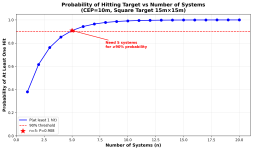
Let's say we want the probability of at least one hit in n shots to be 90%.

Single shot success probability 0.38 - your number is quite wrong - you need to model the 2D normal distribution, use its density function, integrate it over the square. This will give you the actual probability of hitting the square. What you did was assumed a uniform distribution (I think). Yes I used AI for it - I don't have the time to do the math but the math seems fine to me.

Probability all miss = 0.62^n
Probability at least 1 hit = 1 - 0.62^n
try this until you cross 0.9
You get n = 5.
So these CEP numbers suggest you need 5 SMASHs to hit Talwar ONCE with 90% probability.
Better to see plot (again AI generated) and decide how many you want to launch at a single talwar and what success probability you want:
Untitled.png
 
Maybe, but then how much demand would there be for a very Pakistani specific weapon system in terms of requirements? If it was a conventional AShM, maybe supersonic, it would have broader appeal, but as it stands this seems to be a shoehorn for the lack of being able to develop a more potent AShM. If this isn't the P282 and that ends up being something more akin to a supersonic sea skimming AShM we may see that equip the newer vessels like the Jinnah class, but it's interesting that for the time being the SMASH is solely deployed on the F22Ps, and we haven't seen the configuration in terms of launch canisters and how they are arranged on the vessel.
SMASH, F1/F2, etc., are all being made available for export so that NESCOM can secure funding for improvements and scaling up production. In fact, I've never seen NESCOM be so aggressive with exports until the last 2 years, so I guess the armed forces have told NESCOM (and other SOEs) that it'd be difficult to fund overhead expansion solely through public tax income. We'll give the designs and ToT to those who'll pay so that we can expand our output, iterate real improvements more rapidly, and develop new stuff.

In fact, I recall the @Quwa guys on their podcast discussing offshoring production to countries like Poland and Brazil. It's really starting to seem like NESCOM, HIT, POF, etc., are moving in that direction in a sense. Basically, get overseas customers to pay for added R&D in return for full ToT to them, and we get funding to boost our capacity as well as potentially buy from the customer if we need to up-scale even more rapidly.
 
SMASH, F1/F2, etc., are all being made available for export so that NESCOM can secure funding for improvements and scaling up production. In fact, I've never seen NESCOM be so aggressive with exports until the last 2 years, so I guess the armed forces have told NESCOM (and other SOEs) that it'd be difficult to fund overhead expansion solely through public tax income. We'll give the designs and ToT to those who'll pay so that we can expand our output, iterate real improvements more rapidly, and develop new stuff.

In fact, I recall the @Quwa guys on their podcast discussing offshoring production to countries like Poland and Brazil. It's really starting to seem like NESCOM, HIT, POF, etc., are moving in that direction in a sense. Basically, get overseas customers to pay for added R&D in return for full ToT to them, and we get funding to boost our capacity as well as potentially buy from the customer if we need to up-scale even more rapidly.
I find the idea of Pakistan exporting ToT for scaling productions somewhat ironic given that it mostly imports ToT from elsewhere, like the JF17, it would be far easier and cheaper to scale production in Pakistan given the abundance of human capital at a fraction of the cost of other places. Secondly, while it may be relatively easy to export products like F1/F2 that have wider appeal amongst foreign militaries, it may not be so easy in the case of SMASH, which seems like a throwaway idea by the Pak navy and military, it's like they were brainstorming one afternoon in a board meeting and someone said "I know, let's stick F2 on a ship!" lol probably because they couldn't come up with a more appropriate design and this was far easier and cheaper solution.
 
abundance of human capital at a fraction of the cost of other places
but human capital is never the biggest expense when setting up these sorts of facilities
 

Users who are viewing this thread

Pakistan Defence Latest

Back
Top