Syrian Civil War and The future of Syria after liberation

Assad family's net worth

BBC

A 2022 US State Department report to Congress said the extended Assad family's net worth was between $1bn (£790m) and $2bn (£1.6bn) - though it noted that it was difficult to estimate because their assets are "believed to be spread out and concealed in numerous accounts, real estate portfolios, corporations, and offshore tax havens".

According to the report, Bashar and Asma maintained "close patronage relationships with Syria's largest economic players, using their companies to launder money from illicit activities and funnel funds to the regime".

It also said that Asma had "influence over the economic committee that manages Syria's ongoing economic crisis" - and had made key decisions on Syria's "food and fuel subsidies, trade and currency issues".

She also exerted influence over the Syria Trust for Development, through which most foreign aid for reconstruction in regime-held areas was channelled.

In 2020, then-Secretary of State Mike Pompeo alleged that Asma had "become one of Syria's most notorious war profiteers" with the help of her husband and her family.

Another senior Trump administration official described her as the "business head of the family" and an "oligarch" who had been competing with Bashar's cousin Rami Makhlouf.

He is one of Syria's richest men and the family rift became public knowledge after he posted videos on social media complaining about his treatment.
 
Unfortunately the US will not leave the region as long as Israel (their main beloved ally in the world) exists and as long as the Jews in the US have such a big influence on US politics, economics, media etc.

Biden wants to leave the ME, because he believes that the renewable energy is superior to the fossil fuel, and he doesn't want China to fully control the renewable energy.

Trump also wants to leave, because he cannot live in a day without thinking China.

Israel will eventually learn how to deal everything by themselves.
 

Could Assad face prosecution?​

BBC​


Following the fall of the Assad dynasty, Amnesty International's secretary general Agnès Callamard said Syrians had been subjected to what she called "a horrifying catalogue of human rights violations that caused untold human suffering on a vast scale".

This includes "attacks with chemical weapons, barrel bombs, and other war crimes, as well as murder, torture, enforced disappearance and extermination that amount to crimes against humanity".

She called on the international community to ensure that people suspected of breaking international law and other serious human rights violations must be investigated and prosecuted for their crimes.

On Tuesday, the Islamist rebel leader in Syria said any of the ousted regime's senior officials found to have been involved in torturing political prisoners would be named.

Abu Mohammed al-Jolani also said his so-called Syrian Salvation Government would seek to repatriate officials it identified who fled to another country.

In France, investigative judges have sought an arrest warrant for Assad for alleged complicity in crimes against humanity and war crimes, in connection with a deadly chemical attack in Syria in 2013 under the legal concept of universal jurisdiction.

Russia does not extradite its own nationals - a legal process whereby someone is returned to another country or state to face trial for a suspected crime.

Assad is unlikely to leave Russia to go to a country where he could be extradited back to Syria or any other that might charge him with a crime.
 
To get out of the current downturn, Iran should do rapprochement with HTS and supply it with money and weapons to start the Jihad against Israel and remove focus on Baghdad. Many Al-Qaeda leaders reside in Iran so it should be easy to influence them. A Shia-Sunni unity should be worked out against the common enemy. In the meanwhile, Hezbollah should restart the front in Lebanon. Attack is the best defense. If the Shias and the Sunnis unite, no power on Earth can fight them. All the fighters from across the World will pour into Syria to fight Israel. As I have said earlier, Syria is already destroyed and will prove to be the killing ground for the destruction of the Israeli Army. By adopting this strategy, victory will be snatched from the jaws of defeat. Anyway, according to Prophetic predictions, fighting will continue in this region for a long time. The Iranian people were waiting for the Mehdi to come to better the situation in Iran during Shah's time but Khomeini told them to prepare the ground for the coming of Mehdi by removing the Shah first. In the same way, both the Sunnis and the Shias should prepare the ground for the coming of Mehdi by uniting and fighting against Israel. Temporary downturn is a part of War. Under the Holy Prophet's leadership, the Muslims faced a downturn during the battle of Uhad when the Kuffars led by Khalid bin Walid RA attacked them from behind. Khalid Bin Walid RA later became a Muslim and proved to be the best and victorious General against the enemies of Islam. So enemies of today may become the best comrades in a short while.
 
Unfortunately, international politics is full of dissonance and inconsistencies. I can remember quite a few:

1. Oldest one: He may be a son of a bitch, but he's our son of a bitch.
2. "One man's terrorist is another man's freedom fighter"
3. We should not trade with Cuba because they are communists, but we can trade with PRC
4. Antisemitism is bad, but Anti-Roma (Gypsy) discrimination may be swept under the carpet.
So are you a Roma? lol kinda specific that last one
 
Biden wants to leave the ME, because he believes that the renewable energy is superior to the fossil fuel, and he doesn't want China to fully control the renewable energy.

Trump also wants to leave, because he cannot live in a day without thinking China.

Israel will eventually learn how to deal everything by themselves.
My friend, I have heard this story of the US and West leaving the Arab world and West Asia for almost 2 decades now. This has never occurred. Likely it will never occur even if their most beloved ally Israel did not exist in the first place. You know why? Due to simple geography. We share the biggest border (Mediterranean Sea) with Europe next door. There has been close relations/rivalries/contacts since recorded history began. Will only increase given the future demographics. Not to mention the strategic importance of the area, the natural riches etc.

I don't believe that it will ever occur. If it does it will mean that the US/West dominance has come to an end and their successor (s) would want to replace them and their role in the region. At least for the foreseeable future.

As for US-China relations, unlike the US, I don't think (history shows this as does the Chinese psyche) that China wants to replace the US in terms of political and military influence/interference across the world. Mostly China cares about economics and safeguarding its own country and spheres of influence.

Outside of Taiwan I don't see any reason for the US and China to be enemies. You are also each other's main trade partners.

A China-USA conflict would impact the entire world and likely start WW3. It is bad news for everyone involved.

And unlike Russia, China is much, much more a direct equal than Russia is, nukes excluded.
 
  • Like
Reactions: FHN

I don't regret blocking UK action against Assad - Miliband​


Kate Whannel
BBC Politics reporter

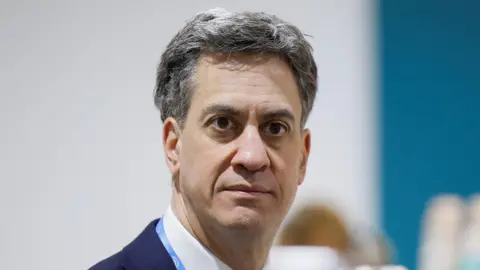
Reuters Ed Miliband


Reuters

Energy Secretary Ed Miliband has said he does not regret voting to block UK military action against then Syrian President Bashar al-Assad in 2013.

Prime Minister at the time David Cameron wanted to attack Syria, after reports Assad had used chemical weapons on his own citizens.

However, Miliband, who was then leading Labour, directed his MPs to vote against the proposal, preventing the UK from taking part in any action.

He was forced to respond after cabinet colleague Health Secretary Wes Streeting questioned that decision.

However, Streeting later denied criticising Miliband.

Appearing on the BBC's Question Time on Thursday, the health secretary, who was not an MP at the time, said: "With hindsight, I think we can say looking back on the events of 2013 the hesitation of this country and the US created a vacuum that Russia moved into and kept Assad in power for much longer."

He added: "What we can not say is that the back of Assad is going to lead to a better Syria."

In a post on X on Friday, Streeting insisted his comments were not directed at the former Labour leader.

"On the contrary, I pointed out the challenges of hindsight, Libya and the uncertainty we face about post-Assad Syria today.

"It is frustrating, to put it mildly, to see a nuanced answer to a complicated issue presented as criticism of a good colleague," he said.
 
He's Indian aka Roma lol jk
The history of Romas shows that Indians aren't compatible with Western civilization even if they live there a thousand years. Even after a thousand years the Romas are an outcast population is most European countries. Yet, the Jews are importing millions of Indians into the West.
 

'Relief but also stress': Syrians in London on Assad's downfall​


Simran Sohal
BBC News

Reuters Two women hugging at a demonstration in Trafalgar Square. One has the flag of Syria draped on her back. There are surrounded by other people who also have the Syrian flag around their backs while some are holding flags.


Reuters

Londoners embrace Assad's downfall

After President Bashar al-Assad's regime collapsed in Syria following a lightning-fast rebel offensive, displaced Syrians living in London share their thoughts on what this means for their country and their future.

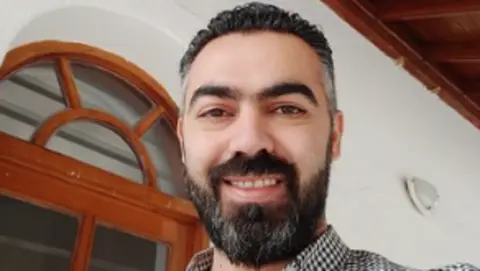
"I feel like I'm in a dream and I don't want to wake up," says Amr Shayah, a Syrian refugee living in Greenwich, south-east London.

He calls me with a croaky voice after spending the past few days celebrating the end of Assad's brutal regime with family and friends.

"The last time I was there, I left twice because I was threatened to be killed or arrested and tortured to death," he said.

Amr Shayah An image of Amr, who has a black beard is smiling. He is wearing a black and white checked shirt and is standing in front of a white wall with an arched wooden frame.


Amr Shayah

Mr Shayah says witnessing the downfall of Assad was "something I never expected"
For more than 50 years, the Assad family ruled with an iron fist.

But now the Islamist militant group Hayat Tahrir al-Sham (HTS) and allied rebel factions have overthrown the government, leaving Assad to flee to Russia where he has been granted asylum.

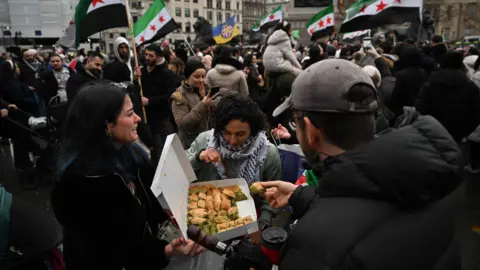
Following this, the Syrian diaspora gathered in Trafalgar Square to share sweets, dance and sing in the streets.


Getty Images An image of the demonstration at Trafalgar Square where people hold Syrian flags in the background. A woman hands out baklava and another woman and man reach in to take a bite.


Families gather in Trafalgar Square and share sweets
 

Can Syria’s Islamist rebels govern the country? Their rule in Idlib offers clues​

By Mostafa Salem, CNN
Fri December 13, 2024


(File photo) yrian President Bashar Assad is seen during a visit to Moscow on January 25, 2005.


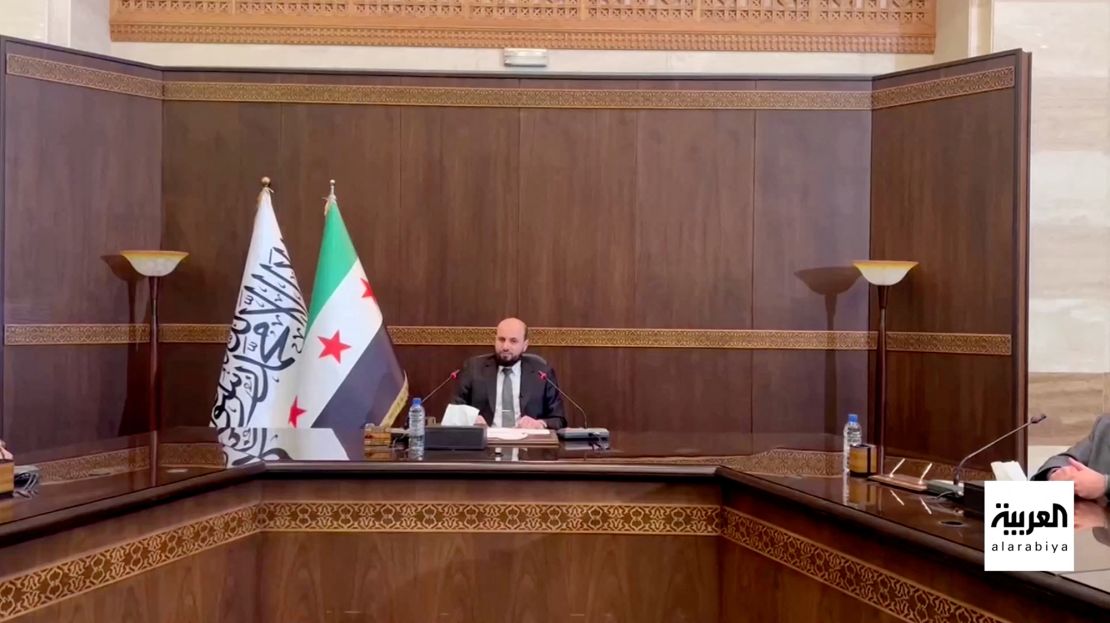
When Syria’s rebel-appointed prime minister sat down with officials from the ousted Assad regime for the first time on Tuesday, the backdrop included the flag of the Syrian revolution alongside another bearing the Islamic declaration of faith that is often displayed by jihadists.

The choice of optics for the rebels’ first publicized cabinet meeting to discuss the transition of power since the fall of Bashar al-Assad’s regime sparked controversy, with sceptics taking to social media to criticize the move.

The rebels may have taken note. In a later televised interview with Al Jazeera, caretaker Prime Minister Mohammad Al Bashir, who until this week ruled the small, conservative province of Idlib on the rebels’ behalf, appeared only with the new Syrian flag.

20241206-gngngng.jpg


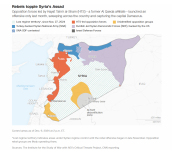
How the rebels governed Idlib, in northwest Syria, offers insight into how they might rule the country. Experts and residents of Idlib describe their governance as pragmatic and influenced by both internal and external pressure, with efforts to distance themselves from a jihadist past and gain international acceptance. However, their rule was far from democratic or liberal. Governing a large, diverse nation like Syria, they warn, will be an entirely different challenge.

Abu Mohammad al-Jolani, the leader of Hayat Tahrir Al Sham (HTS), the Islamist group that led the rebel offensive to topple the Assad regime and is proscribed as a terrorist organization by the United States, has opted to rule from the shadows. Jolani, who now uses his real name Ahmad al-Sharaa, picked a technocrat – Bashir – to lead Syria in the interim. He has said his officials gained valuable experience while governing Idlib but acknowledged that may not be enough.
 
“They (rebels) started from nothing, Idlib is small and without resources but thank God we were able to do really good things in the past… their experience is not zero and there are (areas) they were successful in,” Jolani told Mohammed Jalali, Assad’s prime minister, in a meeting on Monday to discuss the transfer of power. “However, we cannot do without the old (guard) and we have to benefit from them.”

Syrian caretaker Prime Minister Mohamed al-Bashir attends a meeting with the transitional cabinet after Syrian rebels ousted President Bashar al-Assad, in Damascus, Syria, on Tuesday.

Syrian caretaker Prime Minister Mohamed al-Bashir attends a meeting with the transitional cabinet after Syrian rebels ousted President Bashar al-Assad, in Damascus, Syria, on Tuesday.
AL ARABIYA TV/Reuters
In just 13 days, Jolani’s ministers went from ruling the small province of Idlib to aspiring to govern Syria following its first regime change in six decades. Experts and residents who lived under the rebel-led Syrian Salvation Government (SSG) say the inexperienced cabinet will need to significantly adapt if they are to lead the transitional period effectively.
 

Taking control​

CNN

When Jolani expanded his influence in Idlib in 2017, he eliminated rival Islamist groups and backed a new project to install a civilian government made up of local technocrats and academics, breaking from other jihadist methods that saw religious coercion under the rule of the sword in territories they captured.

“Before the Salvation Government you had many different factions that had their own courts of justice, prisons and social services,” Jerome Drevon, a senior analyst who has researched HTS for the Brussels-based International Crisis Group think tank, told CNN. “It imposed itself on other factions and took out their governing responsibilities.”

Displaced Syrians arrive from Lebanon to Idlib on October 10. In the center of the picture, the minister of interior in the Syrian Salvation Government, affiliated with Hayat Tahrir al-Sham, Muhammad Abd al-Rahman, appears as he inspects the registration procedures for displaced Syrians fleeing Lebanon.


Displaced Syrians arrive from Lebanon to Idlib on October 10. In the center of the picture, the minister of interior in the Syrian Salvation Government, affiliated with Hayat Tahrir al-Sham, Muhammad Abd al-Rahman, appears as he inspects the registration procedures for displaced Syrians fleeing Lebanon.

Upon its establishment in 2017, the SSG issued a communique outlining four principles, one of which was that Islamic Sharia law is the “sole source of legislation,” emphasizing the need to “maintain the people’s Syrian and Islamic identity,” Al Jazeera reported.

The SSG operated as a functional government, holding publicized cabinet meetings with suited officials, issuing press statements and overseeing eleven ministries, including justice, sports, and education. It collected taxes, managed Idlib’s limited resources to govern 4 million people, and coordinated with international humanitarian groups to deliver aid to the 3 million displaced people in the region.

But the government wasn’t democratically elected, with ministers appointed through the approval of the shura, or consultative council, made up of prominent local figures, some of whom were selected by Jolani’s HTS. No women served in SSG leadership positions during its seven years of rule.

“It’s an Islamic governance in a technocratic way. What they wanted to do is control how religion is understood and how it’s implemented,” said Drevon.

A United Nations report from 2022 painted a grim picture of what life under HTS’ leadership was like.
 
1734129612532.png


“People were detained following comments made in private conversations pertaining to the cost of living or religious matters,” the UN Human Rights Council report on Syria said. “These comments were qualified as slander and blasphemy, with the latter leading to a sentence of one year of imprisonment.” Authorities “continued to arrest women for being ‘inappropriately’ dressed, and for non-compliance with entertainment-related bans.”

Tamer, who said he negotiated with HTS and SSG officials over medical matters, said that over the years, Jolani took a back seat in the daily affairs of the government and gave it more agency, only intervening on larger issues that endangered his group’s influence.
 

Users who are viewing this thread

Back
Top