Syrian opposition factions supported by Türkiye are exploiting regional transformations to control Aleppo
November 2024:
In a surprise move that takes advantage of the changing geopolitical dynamics in the region, Syrian opposition factions loyal to Turkey enter Aleppo, Syria's second-largest city, after launching a rapid offensive earlier this week.
This unexpected advance into Aleppo – a city of enormous strategic and symbolic importance – marked a major escalation in the ongoing conflict and highlighted the vulnerabilities of Assad's forces amid shifting alliances in the region.
The surprise offensive, which began on Wednesday, saw opposition forces take control of “half of Aleppo” as government forces withdrew, according to the Syrian Observatory for Human Rights. The timing of the attack coincided with the imposition of a fragile ceasefire in neighboring Lebanon between Israel and Hezbollah, which is backed by Iran.
Initially, violent clashes were reported, with the Britain-based Observatory estimating that 277 people were killed, including 28 civilians, many of whom died as a result of Russian airstrikes. By Friday, opposition factions and their allies had captured more than 50 towns and villages in northern Syria and advanced toward western Aleppo, a city of two million people that served as Syria's industrial center before the civil war.
Opposition forces, many of which are closely linked to Turkey, were able to quickly take control of large parts of Aleppo without facing significant resistance. “There were no battles, and no shooting was fired during the retreat of the regime forces,” Rami Abdel Rahman, director of the observatory, told AFP early Saturday morning.
“This operation aims to silence the sources of enemy fire along the front lines,” Muhammad Bashir, leader of the Hay’at Tahrir al-Sham group, which was at the forefront of the attack launched by opposition forces, said in a press conference on Saturday.
The Syrian government and Russian air force responded to the advance by launching intense air attacks on the opposition-controlled enclave around Idlib, a stronghold for several factions. According to the Syrian Observatory for Human Rights, 23 air strikes have been carried out since the start of the attack. Russian military officials confirmed the targeting of what they called “extremist forces.”
A Russian Defense Ministry spokesman told official news agencies: “The Russian Air Force is carrying out missile and bomb strikes on command centers, storage facilities and artillery sites belonging to terrorists.”
Türkiye responded by calling for a halt to the bombing. The Turkish Foreign Ministry said: “The recent clashes led to an unwanted escalation of tension in the region,” stressing Ankara’s role in calling for stability.
Since 2020, a ceasefire brokered by Türkiye and Russia in the Idlib region has held, despite being repeatedly violated. Kremlin spokesman Dmitry Peskov described the situation in Aleppo as a “violation of Syria’s sovereignty” and expressed support for “the rapid restoration of order by the Syrian government in the region.”
Iran also made its contribution to the development of the situation. Iranian Foreign Minister Abbas Araqchi pledged to continue supporting the Syrian government, during a phone call with his Syrian counterpart, Bassam Al-Sabbagh, stressing: “We will continue to support the Syrian government, its people, and its army.”
In recent days,
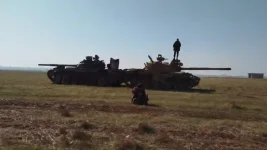
AFP reporters have documented the advance of opposition forces on tanks amid heavy exchanges of fire just seven kilometers from Aleppo. Abandoned Syrian Army tanks and military vehicles could be seen scattered throughout the area, while opposition forces advanced, supported by the Turkish command.
Pro-Turkish forces appear to have taken advantage of Russia's weak position, distracted by the protracted and bloody war in Ukraine and the ongoing confrontation between Israel and Iran that has exhausted military assets in Syria. Without direct support from Russian and Iranian forces, Assad's weak army appears unable to confront the well-equipped opposition factions that Ankara has consistently supported in pursuit of its regional interests.
The fall of half of Aleppo into the hands of pro-Turkish forces not only underscores the increasing fragmentation of power in Syria, it also illustrates the shifting sands of international influence in the region. With the Assad regime in conflict and its allies exhausted, the path forward in Syria remains fraught with uncertainty, with new alliances and conflicts emerging in a region already marked by volatility and turmoil.


Reports from the Midwest: