Syrian Civil War and The future of Syria after liberation

There are lot of fake pro-Palestinian accounts out there. No principle whatsoever.

People think that its b/c they are Pro Palestinain. The reality is that a lot of those accounts are grifters for an audience and Palestine is popular, for obvious reasons. They are social media engagement farmers.

The other half are Shia/Iran bots not as much as being Pro Palestinian, but trying to bring Pro Palestinian crowds to their cause/agenda.
 
Columns of Russian army and Rosgvardia units continue to converge on the Khmeimim airbase and the Tartus base in Syria. It is too early to talk about the future of Russian military bases in Syria; negotiations are currently underway with the new Syrian leadership. Earlier, the Syrian opposition gave their own security guarantees not only to Russian military bases, but also to all Russian diplomatic institutions in Syria. The second part of the video shows the operation of an airfield near the city of Qamishli, in northeastern Syria, where units of the 154th regiment of the Russian group of troops are stationed. The base is still operating, but judging by the flags, the military equipment is being prepared for movement. There are currently two key Russian bases in Syria — in Tartus and Khmeimim. Tartus is the only Russian naval base in the Mediterranean.

To view this content we will need your consent to set third party cookies.
For more detailed information, see our cookies page.

What's Rosgvardia even doing in Syria?!
 
Will the SDF in the northeast be able to hold all the territory they control now, where they are not the overwhelming majority population?

The Turkish foreign minister is half Turkish himself, and he said the add has no future in Syria’s future, viewing them as just PKK, according to the following video, and supported by western volunteers and the Kurdish diaspora openly, and foreign powers, perhaps until Trump is back in office in 5-6 weeks.

To view this content we will need your consent to set third party cookies.
For more detailed information, see our cookies page.
 
Columns of Russian army and Rosgvardia units continue to converge on the Khmeimim airbase and the Tartus base in Syria. It is too early to talk about the future of Russian military bases in Syria; negotiations are currently underway with the new Syrian leadership. Earlier, the Syrian opposition gave their own security guarantees not only to Russian military bases, but also to all Russian diplomatic institutions in Syria. The second part of the video shows the operation of an airfield near the city of Qamishli, in northeastern Syria, where units of the 154th regiment of the Russian group of troops are stationed. The base is still operating, but judging by the flags, the military equipment is being prepared for movement. There are currently two key Russian bases in Syria — in Tartus and Khmeimim. Tartus is the only Russian naval base in the Mediterranean.

To view this content we will need your consent to set third party cookies.
For more detailed information, see our cookies page.


If the Russians leave those bases, Israel will destory them outright as it has done with all other bases. Regardless of the longterm view Syria has of Russia, it would do well to protect those bases as it will need them and to find a formula that allows those bases to be protected? Maybe a joint Turkish presence ? Maybe a light "Russian presence" ? Something has to be done - they cannot be left naked ?
 
Now one thing is clear, Syria will never be allowed to have a real conventional military force ever again. Israel is going to attack and destroy any attempt to rebuild Syrian army. With no airforce, navy or heavy equipment, Syria will turn into a bigger version of Lebanon. A nuisance at best, but never a strategic threat to Israel.

This is why the decision by both HTS, Turkey and the Syrian High Command/Airforce makes so little sense to allow all this infrastructure to be destroyed. They can never rebuild unless Turkey, or Russia step in and say we will defend Syrian airspace until the rebuilding is complete.
 
Unless there is a "deal' to turn Syria into another Jordan, then no rebuilding and economic recovery will be "allowed" by Zio-US.

That looks impossible as Syria cannot have a puppet toy king like Jordan put in and even if this did happen Syria could turn at any time in the future with a revolution.

Syria will be kept split into multiple factions and kept in a state of chaos on purpose. Basic economic activities will be allowed for subsistence levels of economic production.

At least some Turkish posters were honest as they said they just want to weaken PKK but they do not understand that their master(Zio-US) has other plans for the Kurds which will be harmful to Turkish interests.

Syria is probably finished now as a unified country for years and maybe decades to come.
if waited for Iran so long, we can wait now also, perpetual war when you are inferior in military means is not sustainable. You should give them some tIme as the one geopolitical military setup interested in Palestina liberation, crumbled into ashes and next one is emerging.
 
Now one thing is clear, Syria will never be allowed to have a real conventional military force ever again. Israel is going to attack and destroy any attempt to rebuild Syrian army. With no airforce, navy or heavy equipment, Syria will turn into a bigger version of Lebanon. A nuisance at best, but never a strategic threat to Israel.
they will be first arab army equiped and trained by NATO standards. It is bless in disguise that they got ridden of all outdated armament, equipment and soviet military doctrine.
 
This is why the decision by both HTS, Turkey and the Syrian High Command/Airforce makes so little sense to allow all this infrastructure to be destroyed. They can never rebuild unless Turkey, or Russia step in and say we will defend Syrian airspace until the rebuilding is complete.


Only way to protect these bases is to allow Russia to remain in control of them.

Turkey is not an independent and strong sovereign nation like Russia and so they do not come into the picture here.
 
His "job" was never to fire a single bullet at the entity as he was in no position to go to war with it.

Allowing supply to Hezbollah was more than any other Arab state was doing.

I have no idea why people do not think at any more than a surface level when it comes to what Assad could realistically do.
Now you are beginning to be rude and ill intended towards syrian people like they do not deserve basic state and liberty with agency to them self or they should endure for eternity assad criminal and idiotic regime for the sake of weapons smuggling.
Hezbollah already capitulated before rebels launched their offensive, so importance of that route is more or less irrelevant now.
 

'I felt like a breathing corpse': Stories from people freed from Syria torture prison​


Alice Cuddy
Reporting from Damascus

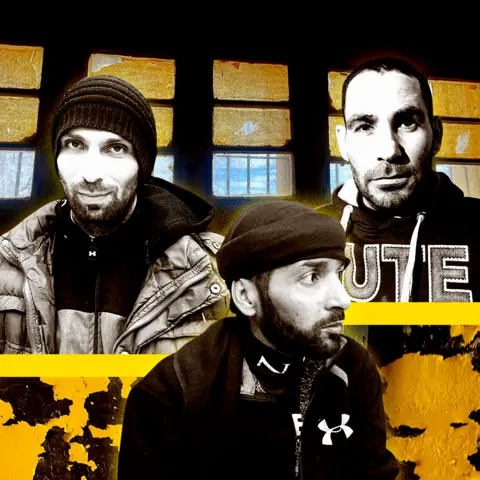
BBC A composite image of the prisoners


BBC

It was a defining moment of the fall of the Syrian regime - rebels freeing inmates from the country's most notorious prison. A week on, four men speak to the BBC about the elation of their release, and the years of horror that preceded it.

Warning: This article contains descriptions of torture


The prisoners fell silent when they heard the shouting outside their cell door.

A man's voice called: "Is there anyone in there?" But they were too afraid to answer.

Over years, they had learnt that the door opening meant beatings, rapes and other punishments. But on this day, it meant freedom.

At the shout of "Allahu Akbar", the men inside the cell peered through a small opening in the centre of the heavy metal door.

They saw rebels in the prison's corridor instead of guards.

"We said 'We are here. Free us,'" one of the inmates, 30-year-old Qasem Sobhi Al-Qabalani, recalls.

As the door was shot open, Qasem says he "ran out with bare feet".

Like other inmates, he kept running and didn't look back.

"When they came to start liberating us and shouting 'all go out, all go out', I ran out of the prison but I was so terrified to look behind me because I thought they'd put me back," says 31-year-old Adnan Ahmed Ghnem.

They did not yet know that Syria's President Bashar al-Assad had fled the country and that his government had fallen. But the news soon reached them.

"It was the best day of my life. An unexplainable feeling. Like someone who had just escaped death," Adnan remembers.
 
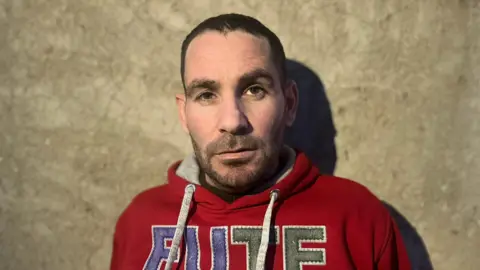
Adnan Ahmed Ghnem wearing a red hoodie looks  at the camera


Adnan Ahmed Ghnem was released this week from the "slaughterhouse" that was Saydnaya

Qasem and Adnan are among four prisoners the BBC has spoken to who were released this week from Saydnaya prison - a facility for political prisoners nicknamed the "human slaughterhouse".

All gave similar accounts of years of mistreatment and torture at the hands of guards, executions of fellow inmates, corruption by prison officials, and forced confessions.

We were also shown inside the prison by a former inmate who had a similar account, and heard from families of missing people held at Saydnaya who are desperately looking for answers.

We have seen bodies found by rebel fighters in the mortuary of a military hospital, believed to be Saydnaya detainees, that medics say bear signs of torture.

Rights group Amnesty International, whose 2017 report on the prison accuses authorities of murder and torture there, has called for "justice and reparations for crimes under international law in Syria", including its treatment of political prisoners.
Saydnaya prison, a sprawling complex located atop a hill of barren land and surrounded by barbed wire, was established in the early 1980s and for decades has been used to hold opponents of the Assad family regime.

It has been described as the country's main political prison since the 2011 uprising, when the Turkey-based Association of Detainees and The Missing in Saydnaya Prison says it effectively became a "death camp".

The prisoners we spoke to say they were sent to Saydnaya because of real or perceived links with the rebel Free Syrian Army, their opposition to Assad, or simply because they lived in an area known to oppose him.

Some had been accused of kidnapping and killing regime soldiers and convicted of terrorism.

All said they had given confessions under "pressure" and "torture".

They were given lengthy sentences or sentenced to death. One man said he had been detained at the prison for four years but had not yet been to court.

The men were held in the prison's main Red Building, for opponents of the regime.

Qasem says he was arrested while passing through a road block in 2016, accused of terrorism with the Free Syrian Army, and sent for short stints at several detention facilities before being transferred to Saydnaya.

"After that door, you are a dead person," he says softly in an interview at his family home in a town south of Damascus, as relatives gather around sipping coffee and nodding in grim captivation.

"This is where the torture began."
 

Users who are viewing this thread

Back
Top