In this section you’ll find charts and graphs laying out the most important numbers in American philanthropy. They document how much we give, how that has changed over time, what Read more...

www.philanthropyroundtable.org
Statistics on U.S. Generosity
Real Rise in U.S. Giving
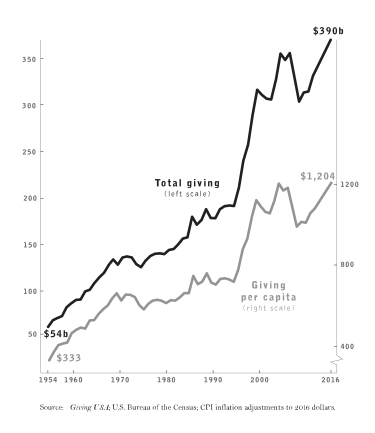
After adjusting for inflation, charitable giving by Americans was close to seven times as big in 2016 as it was 62 years earlier.
Of course, one reason total giving went up is because the U.S. population almost doubled. But if we recalculate inflation-adjusted charitable giving on a
per capita basis, we see that has also soared: by 3½ times. Charitable causes are very lucky to have a remarkably expansive American economy behind them, and a standard of living that refuses to stagnate.
Graph 1: charitable donations after adjustment for inflation
Generosity of Cities
A pattern similar to what the previous graph showed for states is also clearly visible in this data on giving levels in America’s 50 biggest cities. It is residents of our Mormon and southern Bible Belt metro areas who are our most generous citizens. Meanwhile, many of our very wealthiest urban areas—like San Francisco and Boston—rank low on generosity.
Graph 17: giving as percent of adjusted gross income
Note here the interesting divergence between Dallas and Austin. Those two cities, just 180 miles apart, share the same economic climate, exact same levels of state taxation, same basic cost of living. Where they differ rather sharply is in culture. The fact that Dallasites give almost 40 percent more to charity than Austinites underlines the powerful influence on charitable behavior exerted by factors like religious practice and political ideology.
Private Donations for Overseas Aid
Americans are much more willing than other peoples to voluntarily donate money to help the poor and stricken in foreign lands. The figures here depict private charitable giving in various forms.
Graph 25
Of course there are other ways that a nation can give to less developed countries in addition to private philanthropy—official government aid, remittances to families back home by immigrants, private business investment, etc. See Graph 26 and its text for more on this subject. When you add up all of these sources of aid, the U.S. comes out far ahead of any other nation, sending $365 billion overseas annually to developing countries.
Giving Levels, by Country
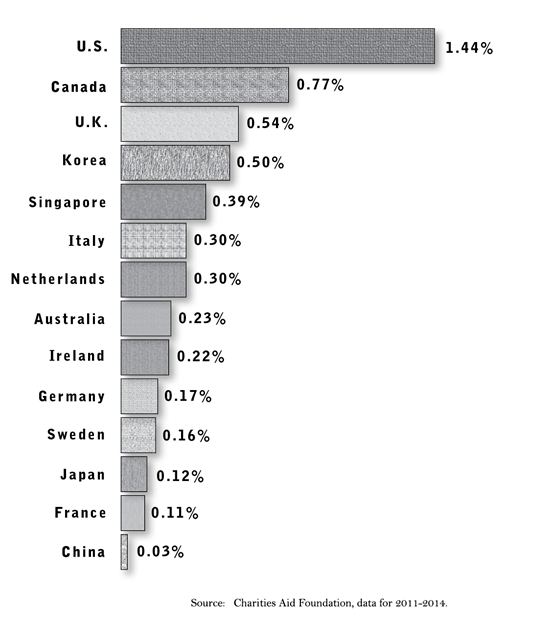
A number of studies have been undertaken to compare the charitable giving of various countries in fair ways—adjusting for differences in standards of living, population, and so forth. All end up showing about the same relationship that is charted here: Americans are about twice as generous in their private giving as our kissing cousins the Canadians, and 3-15
times as charitable as the residents of other developed nations. Americans also volunteer more than almost any other wealthy people.
Graph 27: annual private philanthropy as a percentage of GDP