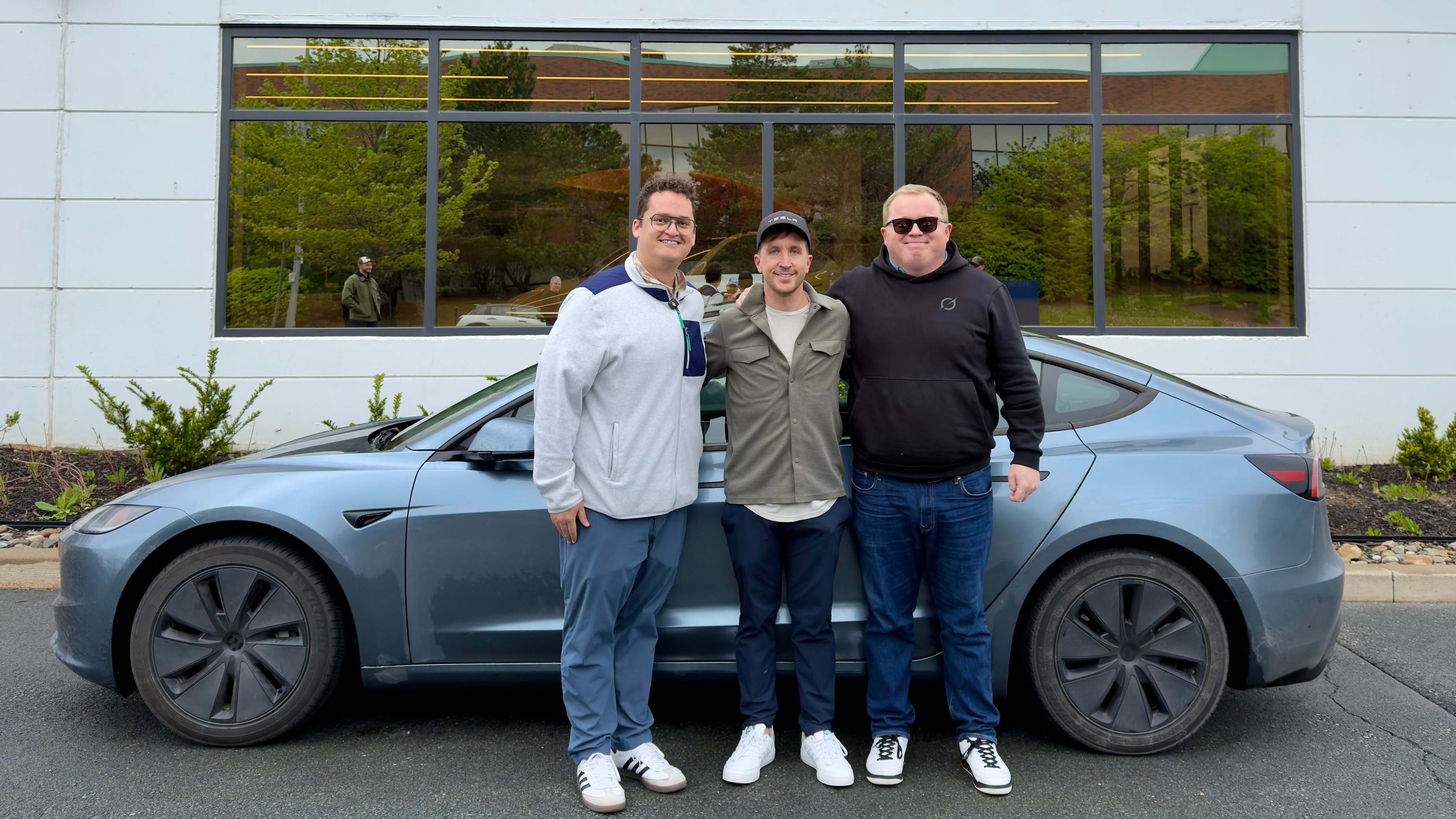
A three-man team has driven a Tesla Model 3 across Canada from coast to coast on the company's Full Self-Driving (Supervised) software without a single intervention, the group said Friday, in what it billed as a world first.

eletric-vehicles.com
Tesla Model 3 Crosses Canada on FSD With Zero Interventions After 3,760 Miles
A three-man team has
driven a
Tesla Model 3 across Canada from coast to coast on the company’s Full Self-Driving (Supervised) software without a single intervention, the group said Friday, in what it billed as a world first.
David Moss, Devin Olsen and Spencer ended the crossing at
Tesla‘s store in Dartmouth, in metropolitan Halifax, Nova Scotia.
The run began at the Horseshoe Bay terminal in Vancouver, British Columbia and it covered 3,760 miles (6,051 kilometres) over four days and 21 hours.
Moss called it “the world’s first Canada coast to coast fully autonomous drive” in a post on X.
The vehicle ran
Tesla FSD version 14.3.3 throughout, and the team reported zero disengagements of any kind, including for parking and at
Tesla Superchargers.
A public tracker that logged the trip in real time supported the claim, recording 3,760 self-driving miles, zero manual miles, and a 100% self-driving rate when the car parked.
The Team Behind the Drive
Moss led the trip alongside Devin Olsen and Spencer. Olsen livestreamed parts of the drive on his YouTube channel as the car worked east.
Moss, a Model 3 owner from Tacoma, Washington, has become one of the most visible advocates for
Tesla‘s camera-only approach to autonomy.
The advocacy carries an irony, since Moss sells LiDAR for a living as a 3D solutions manager at Stonex USA — the sensing technology
Tesla has rejected in favor of cameras alone.
The drive was backed by sponsors including EVject and TesCam Studio, with the team selling commemorative merchandise online.
The Final Stretch
The team posted frequent updates through the last day as the finish neared.
Moss checked in from Lincoln, New Brunswick, with fewer than 500 miles to go, identifying the car as a 2025 Model 3 Long Range Rear-Wheel Drive Premium.
By the final evening, only two Supercharger stops remained.
The team charged at a
Tesla Supercharger in Aulac, New Brunswick, then at another in Enfield, Nova Scotia, before stopping overnight in Enfield.
They set out the next morning for the short final leg into the Halifax area, completing the crossing on Friday.
The Route and the Car
The route ran across the breadth of the country.
It crossed British Columbia, Alberta, Saskatchewan, Manitoba, Ontario, Quebec and New Brunswick before finishing in Nova Scotia.
The car was Moss’s 2025 Model 3, a Long Range Rear-Wheel Drive Premium running
Tesla‘s AI4 hardware.
The live tracker was built on the FSD database maintained by
Tesla owner and content creator Omar Qazi, who posts as @WholeMars.
A Sequel to the US Record
The Canada run follows the drive that made Moss a fixture in the
Tesla community.
On the last day of 2025, he claimed the first zero-intervention coast-to-coast drive across the US.
That trip covered 2,732 miles from the
Tesla Diner in Los Angeles to Myrtle Beach, South Carolina, in two days and 20 hours on FSD version 14.2.
The announcement reached about 16 million people on X and drew recognition from
Tesla‘s leadership.
Ashok Elluswamy,
Tesla‘s VP of AI software, called it the “World’s first fully autonomous coast-to-coast drive, done with Tesla self-driving v14.”
Chief Executive Elon Musk reposted it with the caption “cool,” and former
Tesla AI director Andrej Karpathy described it as the first fully autonomous coast-to-coast drive on FSD V14.2.
The US crossing was part of a longer streak of 12,961 intervention-free miles across 30 states, which ended in January on snow-covered roads in rural Wisconsin.
Tesla later featured the trip as an official customer story in March.
What Canada Adds
At 3,760 miles, the route in Canada ran more than 1,000 miles longer than the US crossing.
The drive has also pushed FSD across a wider range of conditions and a newer software build, version 14.3.3, against the 14.2 release that handled the December drive.
With the crossing done, Moss has already turned to the next target, asking followers where the team should attempt to drive next.
Tesla Exec
Max Zeger,
Tesla‘s director of charging for North America, shared the announcement on X.
“Trans-Canada Supercharger route opened in 2019 and now driven coast-to-coast autonomously with FSD,” Zeger wrote, congratulating the team.
The drive leaned on that Supercharger network, which
Tesla opened across Canada in 2019 to link the country from coast to coast.