The Commonwealth of Pakistan (1947–1956) Clash of Civilizations theory

ST1976

Trusted Member
Joined
Jul 25, 2006
Messages
3,461
Reaction score
482
Reputation
246.7
Country of Origin
Country of Residence
The intersection of Samuel Huntington’s "Clash of Civilizations" theory, Hindu-Muslim riots, and the Dominion (Commonwealth) of Pakistan provides a comprehensive lens through which to look at the history, division, and political geography of South Asia. :coffee:

1. The Clash of Civilizations Framework in South Asia
Samuel Huntington's theory argues that post-Cold War conflicts are primarily driven by cultural and religious identities. In South Asia, this manifests as a fault line between two massive, distinct cultures: [1]
    • The Hindu Civilization: Concentrated chiefly in India and Nepal.
    • The Islamic Civilization: Embraced by Pakistan, Bangladesh, and Afghanistan. [1]
Critics note that Huntington's macro-theory overlooks centuries of cultural assimilation, syncretic traditions (like Sufism and Bhakti movements), and shared socio-economic realities in the subcontinent. However, right-wing and Islamist political entities on both sides frequently exploit this "clash" narrative to mobilize populations along communal lines.

2. The Legacy of Hindu-Muslim Riots

Communal violence between Hindus and Muslims serves as the primary flashpoint of this civilizational friction, structurally altering South Asia's demographics over the last century. [1, 2] ☕
    • Pre-Partition Mobilization: Large-scale mass strikes and the breakdown of political consensus led to the 1946 Great Calcutta Killings, setting off a chain reaction of retaliatory violence across Punjab and Bengal. [1] :)
    • The Partition Genocide (1947): The division of British India resulted in an estimated one million deaths 👎and the forced migration of over 14 million people, transforming local neighborhoods into hostile zones. [1, 2] :coffee:
    • Post-Partition Reciprocity: Riots became transnational. Incidents in India often sparked retaliatory violence against minority Hindus in Pakistan (such as the 1950 and 1964 East Pakistan Riots or the backlash following the 1992 Babri Masjid demolition). ☕
3. The Commonwealth of Pakistan (1947–1956)👎

What is historically referred to as the "Commonwealth of Pakistan" is the Dominion of Pakistan. :)
  • Political Structure: Established on August 14, 1947, through the Indian Independence Act, Pakistan operated as a constitutional monarchy within the British Commonwealth of Nations, sharing King George VI (and later Queen Elizabeth II) as its sovereign.👎 [1, 2]
  • The Governor-General: Local authority was held by a Governor-General—initially Muhammad Ali Jinnah. Unlike India, which retained Lord Mountbatten as its first Governor-General, Pakistan's rejection of Mountbatten signaled an immediate desire to sever structural ties with the old colonial center. [1, 2] ☕
  • The Transition to a Republic: This status ceased on March 23, 1956, when Pakistan adopted its first constitution, shedding its dominion status to become the world’s first official Islamic Republic while retaining its voluntary political membership within the 'wider' Commonwealth.👎
If you are looking into a specific angle, let me know if you would like me to focus on:
 

.​

Monarchy of Pakistan​

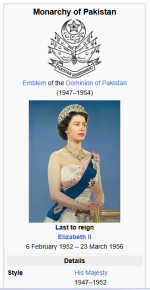
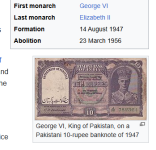
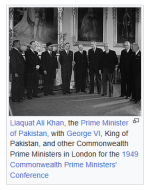
From 1947 to 1956, the Dominion of Pakistan was an independent, federal dominion within the British Commonwealth of Nations that shared a monarch with the United Kingdom and the other Dominions of the Commonwealth. The monarch's constitutional roles in Pakistan were mostly delegated to a vice-regal representative, the governor-general of Pakistan.
1788279884773.png
1788279930826.png
1788279949710.png
The dominion was created by the Indian Independence Act 1947, which divided British India into two independent sovereign states of India and Pakistan. The monarchy was abolished on 23 March 1956, when Pakistan became "a republic within the Commonwealth" with a president as its head of state.

.
 
Reign of Elizabeth II (1952–1956)

Following George VI's death on 6 February 1952, his elder daughter Princess Elizabeth became the new monarch of Pakistan.[3][13] She was proclaimed Queen throughout her realms, including in Pakistan, where she was honoured with a 21-gun salute on 8 February.[14][11][15][9]

Andrew Michie wrote in 1952 that "Elizabeth II embodies in her own person many monarchies", as she was Queen of the United Kingdom, but was also equally Queen of Pakistan. 👎 He added that it was "now possible for Elizabeth II to be, in practice as well as theory, equally Queen in all her realms".[16]

1788280227923.png
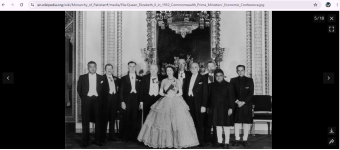
Queen Elizabeth II with the Commonwealth prime ministers during their conference in December 1952. Pakistani Prime Minister Sir Khawaja Nazimuddin is second from the right. ☕

During her coronation in 1953, Elizabeth II was crowned as Queen of Pakistan and other independent Commonwealth realms.[17] In her coronation oath, the Queen promised "to govern the Peoples of … Pakistan … according to their respective laws and customs".[18]:) The Queen's coronation gown was embroidered with the floral emblems of each Commonwealth nation, and it featured the three emblems of Pakistan: wheat, in oat-shaped diamante and fronds of golden crystal; cotton, made in silver with leaves of green silk; and jute, embroidered in green silk and golden thread.[19][20]

The Standard of Pakistan at the Coronation was borne by Mirza Abol Hassan Ispahani.[21] Major-General Mohd. Yusuf Khan served as the head of Pakistan's Coronation Contingent.[22] Pakistani naval vessels HMPS Zulfiqar and HMPS Jhelum took part in the Coronation Review of the fleet at Spithead on 15 June 1953,[23][24][25] which cost approximately 81,000 rupees.[26]

Eighty seats were reserved for Pakistanis in the Abbey for the Coronation.[22] Prime Minister Mohammad Ali Bogra, also attended the Coronation on 2 June, along with his wife and two sons,[27] after which he attended the Commonwealth Prime Ministers' Conference from 3 June to 9 June 1953, in London.[28] ☕


Indian nationalism and the British response, 1885–1920​

Origins of the nationalist movement​

The Indian National Congress (Congress Party) held its first meeting in December 1885 in Bombay city while British Indian troops were still fighting in Upper Burma.:coffee: Thus, just as the British Indian empire approached its outermost limits of expansion, the institutional seed of the largest of its national successors was sown. Provincial roots of Indian nationalism, however, may be traced to the beginning of the era of crown rule in Bombay, Bengal, and Madras.👍

Nationalism emerged in 19th-century British India both in emulation of and as a reaction against the consolidation of British rule and the spread of Western civilization.👎
There were, moreover, two turbulent national mainstreams flowing beneath the deceptively placid official surface of British administration: the larger, headed by the Indian National Congress, which led eventually to the birth of India, and the smaller Muslim one, which acquired its organizational skeleton with the founding of the Muslim League in 1906 and led to the creation of Pakistan in 1947. 👎

Many English-educated young Indians of the post-mutiny period emulated their British mentors by seeking employment in the ICS, the legal services, journalism, and education. The universities of Bombay, Bengal, and Madras had been founded in 1857 as the capstone of the East India Company’s modest policy of selectively fostering the introduction of English education in India. At the beginning of crown rule, the first graduates of those universities, reared on the works and ideas of Jeremy Bentham, John Stuart Mill, and Thomas Macaulay, sought positions that would help them improve themselves and society at the same time.

They were convinced that, with the education they had received and the proper apprenticeship of hard work, they would eventually inherit the machinery of British Indian government. Few Indians, however, were admitted to the ICS, and, among the first handful who were, one of the brightest, Surendranath Banerjea (1848–1925), was dismissed dishonorably at the earliest pretext and turned from loyal participation within the government to active nationalist agitation against it.

Banerjea became a Calcutta college teacher and then editor of The Bengalee and founder of the Indian Association in Calcutta. In 1883 he convened the first Indian National Conference in Bengal, anticipating by two years the birth of the Congress Party on the opposite side of India.

After the first partition of Bengal in 1905, Banerjea attained nationwide fame as a leader of the Swadeshi Movement (swadeshi meaning “of one’s own country”), which promoted Indian-made goods and boycotted British manufactured goods. (y)
☕
🇷🇺🇮🇳
 

Users who are viewing this thread

Back
Top