ST1976
Trusted Member

The intersection of Samuel Huntington’s "Clash of Civilizations" theory, Hindu-Muslim riots, and the Dominion (Commonwealth) of Pakistan provides a comprehensive lens through which to look at the history, division, and political geography of South Asia. 
1. The Clash of Civilizations Framework in South Asia
Samuel Huntington's theory argues that post-Cold War conflicts are primarily driven by cultural and religious identities. In South Asia, this manifests as a fault line between two massive, distinct cultures: [1]
2. The Legacy of Hindu-Muslim Riots
Communal violence between Hindus and Muslims serves as the primary flashpoint of this civilizational friction, structurally altering South Asia's demographics over the last century. [1, 2]

What is historically referred to as the "Commonwealth of Pakistan" is the Dominion of Pakistan.
1. The Clash of Civilizations Framework in South Asia
Samuel Huntington's theory argues that post-Cold War conflicts are primarily driven by cultural and religious identities. In South Asia, this manifests as a fault line between two massive, distinct cultures: [1]
- The Hindu Civilization: Concentrated chiefly in India and Nepal.
- The Islamic Civilization: Embraced by Pakistan, Bangladesh, and Afghanistan. [1]
2. The Legacy of Hindu-Muslim Riots
Communal violence between Hindus and Muslims serves as the primary flashpoint of this civilizational friction, structurally altering South Asia's demographics over the last century. [1, 2]
- Pre-Partition Mobilization: Large-scale mass strikes and the breakdown of political consensus led to the 1946 Great Calcutta Killings, setting off a chain reaction of retaliatory violence across Punjab and Bengal. [1]
- The Partition Genocide (1947): The division of British India resulted in an estimated one million deaths and the forced migration of over 14 million people, transforming local neighborhoods into hostile zones. [1, 2]
- Post-Partition Reciprocity: Riots became transnational. Incidents in India often sparked retaliatory violence against minority Hindus in Pakistan (such as the 1950 and 1964 East Pakistan Riots or the backlash following the 1992 Babri Masjid demolition).
- Pre-Partition Mobilization: Large-scale mass strikes and the breakdown of political consensus led to the 1946 Great Calcutta Killings, setting off a chain reaction of retaliatory violence across Punjab and Bengal. [1]
What is historically referred to as the "Commonwealth of Pakistan" is the Dominion of Pakistan.
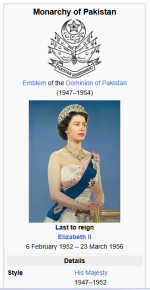
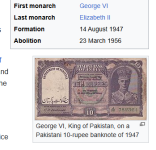
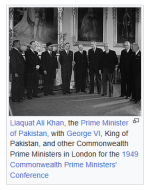
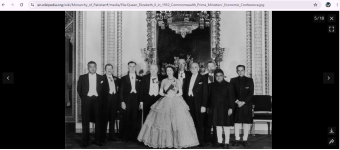
- Political Structure: Established on August 14, 1947, through the Indian Independence Act, Pakistan operated as a constitutional monarchy within the British Commonwealth of Nations, sharing King George VI (and later Queen Elizabeth II) as its sovereign. [1, 2]
- The Governor-General: Local authority was held by a Governor-General—initially Muhammad Ali Jinnah. Unlike India, which retained Lord Mountbatten as its first Governor-General, Pakistan's rejection of Mountbatten signaled an immediate desire to sever structural ties with the old colonial center. [1, 2]
- The Transition to a Republic: This status ceased on March 23, 1956, when Pakistan adopted its first constitution, shedding its dominion status to become the world’s first official Islamic Republic while retaining its voluntary political membership within the 'wider' Commonwealth.
- The Two-Nation Theory that drove the partition.
- A deeper historical breakdown of the 1950 or 1964 communal riots.
- How Pakistan's relationship with the modern Commonwealth evolved post-1956.
- The Two-Nation Theory that drove the partition.