

Douglas Murray: The Death Penalty Is Cruel. Hamas Terrorists Deserve It.
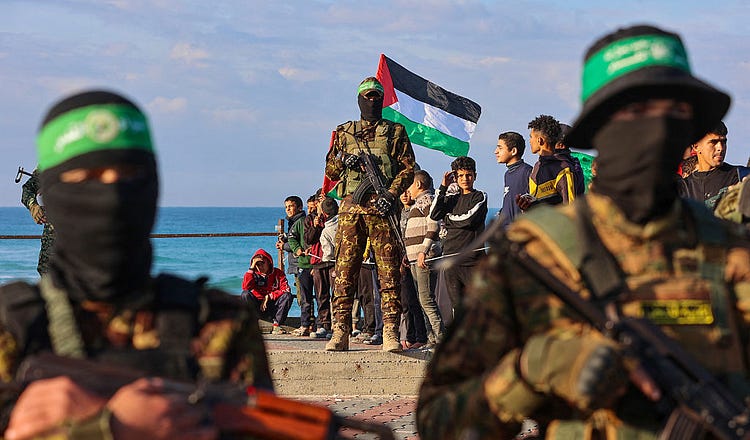
The Israeli justice system must determine whether capital punishment will go forward, and exactly who it will be allowed to ensnare. (Omar Al-Qattaa/AFP via Getty Images)
Israel’s security minister is degrading the debate over whether to execute terrorist captives. But there are urgent reasons not to spare the October 7 perpetrators.
By Douglas Murray
08.25.26 —Israel
The death penalty is an issue that should be discussed with awe. More than perhaps any other subject it demands to be treated so, because it is an issue which even its advocates recognize to be solemn and severe.
It is one reason why the provocations and trollings by Itamar Ben-Gvir on the matter provoke such revulsion. To date, the Israeli minister of national security has advocated mass executions of terrorists in Israeli jails by such means as wearing a golden noose lapel pin and celebrating his 50th birthday with execution-themed birthday cakes with nooses in the center. Last week he took his voluble enthusiasm for executions to another level, posting a video online in which he gloated about building a gallows for public executions, complete with viewing rooms for the families of victims.
Not for the first time Ben-Gvir is a man who harms any cause to which he fixes himself. Yet aside from his stunts, Israelis must soon make serious decisions about the issue. Though Israel prohibits the death penalty for most offenses, the Knesset voted unanimously in May to allow it for terrorists who participated in the October 7, 2023, attacks. Now the Israeli justice system must determine whether capital punishment will go forward, and exactly who it will be allowed to ensnare.
Since this is a question of conscience, perhaps it is worth outlining my own moral views from the outset. I have always been deeply opposed to the death penalty. Rather than explain every reason I have for opposing it, I’ll just say that I agree with the argument Albert Camus makes in his 1957 essay “Reflections on the Guillotine.” The problem is not only the possibility of wrongful convictions, and not just the taking of a life, but something perhaps even more cruel: putting a human mind in the position of knowing the place and time of its ending. A change comes upon a society when it permits this ultimate sanction.
Yet despite my deep, instinctive opposition to the practice, I still believe that there are times when it may be legitimate. Few people would deny that the Allies had the right after World War II not just to try and convict but also to hang the Nazi war criminals at Nuremberg. The world needed to demonstrate this ultimate expression of revulsion for the crimes of the Nazi high command. And the new world that was to follow, which was being built by Allied victors and Holocaust survivors, could not afford to remain haunted by living Nazi leaders, who would have sustained a glimmer of faith in their movement despite living in captivity.
The same justification may rightly stand in the case of the only hanging to have taken place in the State of Israel since its reestablishment. That is the hanging in 1962—after capture, trial, and judgment—of the architect of the Shoah, Adolf Eichmann.
The same principle may well be applied to the several hundred terrorists belonging to Hamas’s most gruesome fighting unit, the Nukhba Force, who were captured alive after breaking into Israel on the morning of October 7, 2023. Each of these men invaded Israel in order to murder, rape, torture, and kidnap. They represent a special type of evil.
But there is an additional justification for the execution of these terrorists which too few people outside of Israel appreciate. It is the fact that Israel will someday face the temptation to use the several hundred terrorists currently held in its maximum-security prisons as bargaining chips.
The architect of October 7, Yahya Sinwar, was himself a terrorist detained in Israeli prisons. He was released early from his sentence and returned to Gaza in 2011, along with more than 1,000 other terrorists, in exchange for a single Israeli soldier who had been captured by Hamas and held in Gaza. Sinwar himself once said that the best news that a Palestinian prisoner could receive in jail was the news that an Israeli had been kidnapped. That is because the prisoners then knew that a thousand-to-one prisoner swap might be in the offing, and they had a good chance of being spared even from a life sentence.
Despite my deep, instinctive opposition to the practice, I still believe that there are times when it may be legitimate.
In recent decades, including the years since October 7, thousands of terrorists who should have spent the rest of their lives in prison have been released in exchange for Israeli hostages. It is the best leverage that Hamas and other Palestinian terrorist groups have. This has led to some of the most painful scenes imaginable in which, for instance, people convicted of murdering Israelis have been released from prison after serving just a few years and receive a hero’s welcome from enraptured crowds in Gaza. It is a wretched, appalling system, which Hamas and others exploit well.
For as long as they are alive and in Israeli prisons, the October 7 terrorists will be available for such swaps. It may seem inconceivable today that they would be traded away, with the memories of their crimes so fresh in the minds of the public. But in the not-so-distant future if another atrocity were to occur, or even a single Israeli soldier was kidnapped and held up for such an exchange, the same unbearable calculus could yet again swing into action.
It is for this reason, above all others, that the execution of the October 7 terrorists should be treated seriously, in an exception to the normal moral order. I have been to the prisons where these terrorists are held, seen the spartan conditions in which they are kept, and seen the fervor with which these prisoners, even in that state, wish to harm any guard or other Israeli who they can lay hands on, using any tool they can reach.
Never again should terrorist mass murderers retain the hope of being released. The incentive for kidnapping Israelis must be broken. And if that requires the hanging of several hundred terrorists, then it seems possible to justify such a course of action. The Nukhba terrorists carried out their brave acts of terror against unarmed women and children, and unarmed partygoers, and thus may be treated as heinous criminals rather than combatants.
Still there are reasons to oppose it. Israel’s international reputation, already worn down by so much of the world’s hostile scrutiny, would almost certainly be diminished further if it became the site of mass hangings—an unnecessarily vivid mode of execution. Human rights groups and governments that remain silent on the mass executions of innocent protesters in Iran would leap at the chance to draw an equivalence between the Khomeinists and Israel, and then find Israel to be more odious. But on balance, the move would improve Israel’s strategic situation by decisively ending the incentive to kidnap its citizens.
These are deep and difficult waters. And they are made infinitely harder to navigate thanks to the antics of the shrill and taunting Ben-Gvir. The promise of hangings is just such an antic.
It seems unlikely that calls for basic decency will prompt the Israeli security minister to hesitate or rein in his provocations. But perhaps he and others around him might notice the seriousness with which those who believed the Holocaust cried out for justice went about their task. Nobody who observed the pathetic last moments of Eichmann or Julius Streicher gloated at the proceedings. They argued their case and saw the sentence through not with cakes and taunting but with silence and solemnity. That is the appropriate attitude with which to address the most evil necessity any society can allow.
Appropriate attitudes can still be taken up, and explained, by Israel and its supporters. Even if one of its brashest politicians remains a stranger to such decency.

Douglas Murray is a columnist at The Free Press. He also writes a column at The Spectator and is the best-selling author of eight books. His work as a reporter has taken him to Iraq, North Korea, northern Nigeria, and Ukraine. Born in London, he now lives in New York.
The Israeli justice system must determine whether capital punishment will go forward, and exactly who it will be allowed to ensnare. (Omar Al-Qattaa/AFP via Getty Images)
Israel’s security minister is degrading the debate over whether to execute terrorist captives. But there are urgent reasons not to spare the October 7 perpetrators.
By Douglas Murray
08.25.26 —Israel
The death penalty is an issue that should be discussed with awe. More than perhaps any other subject it demands to be treated so, because it is an issue which even its advocates recognize to be solemn and severe.
It is one reason why the provocations and trollings by Itamar Ben-Gvir on the matter provoke such revulsion. To date, the Israeli minister of national security has advocated mass executions of terrorists in Israeli jails by such means as wearing a golden noose lapel pin and celebrating his 50th birthday with execution-themed birthday cakes with nooses in the center. Last week he took his voluble enthusiasm for executions to another level, posting a video online in which he gloated about building a gallows for public executions, complete with viewing rooms for the families of victims.
Not for the first time Ben-Gvir is a man who harms any cause to which he fixes himself. Yet aside from his stunts, Israelis must soon make serious decisions about the issue. Though Israel prohibits the death penalty for most offenses, the Knesset voted unanimously in May to allow it for terrorists who participated in the October 7, 2023, attacks. Now the Israeli justice system must determine whether capital punishment will go forward, and exactly who it will be allowed to ensnare.
Since this is a question of conscience, perhaps it is worth outlining my own moral views from the outset. I have always been deeply opposed to the death penalty. Rather than explain every reason I have for opposing it, I’ll just say that I agree with the argument Albert Camus makes in his 1957 essay “Reflections on the Guillotine.” The problem is not only the possibility of wrongful convictions, and not just the taking of a life, but something perhaps even more cruel: putting a human mind in the position of knowing the place and time of its ending. A change comes upon a society when it permits this ultimate sanction.
Yet despite my deep, instinctive opposition to the practice, I still believe that there are times when it may be legitimate. Few people would deny that the Allies had the right after World War II not just to try and convict but also to hang the Nazi war criminals at Nuremberg. The world needed to demonstrate this ultimate expression of revulsion for the crimes of the Nazi high command. And the new world that was to follow, which was being built by Allied victors and Holocaust survivors, could not afford to remain haunted by living Nazi leaders, who would have sustained a glimmer of faith in their movement despite living in captivity.
The same justification may rightly stand in the case of the only hanging to have taken place in the State of Israel since its reestablishment. That is the hanging in 1962—after capture, trial, and judgment—of the architect of the Shoah, Adolf Eichmann.
The same principle may well be applied to the several hundred terrorists belonging to Hamas’s most gruesome fighting unit, the Nukhba Force, who were captured alive after breaking into Israel on the morning of October 7, 2023. Each of these men invaded Israel in order to murder, rape, torture, and kidnap. They represent a special type of evil.
But there is an additional justification for the execution of these terrorists which too few people outside of Israel appreciate. It is the fact that Israel will someday face the temptation to use the several hundred terrorists currently held in its maximum-security prisons as bargaining chips.
The architect of October 7, Yahya Sinwar, was himself a terrorist detained in Israeli prisons. He was released early from his sentence and returned to Gaza in 2011, along with more than 1,000 other terrorists, in exchange for a single Israeli soldier who had been captured by Hamas and held in Gaza. Sinwar himself once said that the best news that a Palestinian prisoner could receive in jail was the news that an Israeli had been kidnapped. That is because the prisoners then knew that a thousand-to-one prisoner swap might be in the offing, and they had a good chance of being spared even from a life sentence.
Despite my deep, instinctive opposition to the practice, I still believe that there are times when it may be legitimate.
In recent decades, including the years since October 7, thousands of terrorists who should have spent the rest of their lives in prison have been released in exchange for Israeli hostages. It is the best leverage that Hamas and other Palestinian terrorist groups have. This has led to some of the most painful scenes imaginable in which, for instance, people convicted of murdering Israelis have been released from prison after serving just a few years and receive a hero’s welcome from enraptured crowds in Gaza. It is a wretched, appalling system, which Hamas and others exploit well.
For as long as they are alive and in Israeli prisons, the October 7 terrorists will be available for such swaps. It may seem inconceivable today that they would be traded away, with the memories of their crimes so fresh in the minds of the public. But in the not-so-distant future if another atrocity were to occur, or even a single Israeli soldier was kidnapped and held up for such an exchange, the same unbearable calculus could yet again swing into action.
It is for this reason, above all others, that the execution of the October 7 terrorists should be treated seriously, in an exception to the normal moral order. I have been to the prisons where these terrorists are held, seen the spartan conditions in which they are kept, and seen the fervor with which these prisoners, even in that state, wish to harm any guard or other Israeli who they can lay hands on, using any tool they can reach.
Never again should terrorist mass murderers retain the hope of being released. The incentive for kidnapping Israelis must be broken. And if that requires the hanging of several hundred terrorists, then it seems possible to justify such a course of action. The Nukhba terrorists carried out their brave acts of terror against unarmed women and children, and unarmed partygoers, and thus may be treated as heinous criminals rather than combatants.
Still there are reasons to oppose it. Israel’s international reputation, already worn down by so much of the world’s hostile scrutiny, would almost certainly be diminished further if it became the site of mass hangings—an unnecessarily vivid mode of execution. Human rights groups and governments that remain silent on the mass executions of innocent protesters in Iran would leap at the chance to draw an equivalence between the Khomeinists and Israel, and then find Israel to be more odious. But on balance, the move would improve Israel’s strategic situation by decisively ending the incentive to kidnap its citizens.
These are deep and difficult waters. And they are made infinitely harder to navigate thanks to the antics of the shrill and taunting Ben-Gvir. The promise of hangings is just such an antic.
It seems unlikely that calls for basic decency will prompt the Israeli security minister to hesitate or rein in his provocations. But perhaps he and others around him might notice the seriousness with which those who believed the Holocaust cried out for justice went about their task. Nobody who observed the pathetic last moments of Eichmann or Julius Streicher gloated at the proceedings. They argued their case and saw the sentence through not with cakes and taunting but with silence and solemnity. That is the appropriate attitude with which to address the most evil necessity any society can allow.
Appropriate attitudes can still be taken up, and explained, by Israel and its supporters. Even if one of its brashest politicians remains a stranger to such decency.

Douglas Murray is a columnist at The Free Press. He also writes a column at The Spectator and is the best-selling author of eight books. His work as a reporter has taken him to Iraq, North Korea, northern Nigeria, and Ukraine. Born in London, he now lives in New York.


