
Navigation
Install the app
How to install the app on iOS
Follow along with the video below to see how to install our site as a web app on your home screen.
Note: This feature may not be available in some browsers.
More options
Style variation
You are using an out of date browser. It may not display this or other websites correctly.
You should upgrade or use an alternative browser.
You should upgrade or use an alternative browser.
Theft of reserved seats from PTI allocated to other political parties by Supreme Court
- Thread starter AZADPAKISTAN2009
- Start date
More options
Who Replied?


El Sidd
Elite Member

Absolutely...I support neutering all Patwaris so we can put an end to low IQ cousin marrying retards that support vote for PML. Castrate them all...
Do you think PTI when is back in power, they would skim through voter list and target such individuals? What would be the eligibility criteria apart from IQ and occupation(village officers)?

AZADPAKISTAN2009
Elite Member


- Thread starter
- #48
Pakistan must return back to Spirit of Democracy as experienced between 1980-2021
1- Ensure Elections are secured , and observed by Independent Observers
2- The vote people of Pakistan cast is protected like "Gold" bricks
3- It is right of People of Pakistan to choose a Political Leader with strong policy for Government
Elections have always been held in Pakistan in 90's , 00' , 10' ,15'
PPP or PML took turns . Imran Khan did had 1-2 seats start of his term but he did not act harshly , he worked 25 years to build a following
Imran Khan waited for his legitimate turn to lead after winning elections
When he won 1 seat (24 years ago ) he still patiently waited for his turn in National Assembly and developed a political following
[Fact]
Panama Leaks as we know was a data leak from foreign None Profit Organization, which got Nawaz Sharif family in hot waters
All Pakistanis Lived thru Governance of PML in 1990's , PPP in 1990's and same group in 2000's and 2010's
If People elect a new Party or Leader , it just means the party who did not win on Form-45 should work harder with ground level people to win back their trust
1- Ensure Elections are secured , and observed by Independent Observers
2- The vote people of Pakistan cast is protected like "Gold" bricks
3- It is right of People of Pakistan to choose a Political Leader with strong policy for Government
Elections have always been held in Pakistan in 90's , 00' , 10' ,15'
PPP or PML took turns . Imran Khan did had 1-2 seats start of his term but he did not act harshly , he worked 25 years to build a following
Imran Khan waited for his legitimate turn to lead after winning elections
When he won 1 seat (24 years ago ) he still patiently waited for his turn in National Assembly and developed a political following
- It is will of Pakistani People to elect a Leader this will should be respected
[Fact]
Panama Leaks as we know was a data leak from foreign None Profit Organization, which got Nawaz Sharif family in hot waters
- Imran Khan don't have a direct link to Panama Leaks None Profit org
All Pakistanis Lived thru Governance of PML in 1990's , PPP in 1990's and same group in 2000's and 2010's
- PML And PPP should focus on better national policy to attract people to their campaign in future
- There is no point to cling on to power
- Winning seat with Courts , and making mockery of Constitution is not ideal
If People elect a new Party or Leader , it just means the party who did not win on Form-45 should work harder with ground level people to win back their trust
Last edited:

imadul
Elite Member
We cant predict the futute...Who will invest in country and work for its growth and development when it's own courts especially the highest ones in the land don't uphold the rule of law and openly violates its constitution. Pakistan is a lost cause.
We mist keep hope that pakistan will come out of army's nth grand salam of political system.
I just cant figure out how did they manufacture their complete hold over every instituition of pakistan.

SaadH
Elite Member

Its quite easy if you are the paid thugs of the colonial powers and carry all the guns and the public refuses to challenge their tormentors.We cant predict the futute...
We mist keep hope that pakistan will come out of army's nth grand salam of political system.
I just cant figure out how did they manufacture their complete hold over every instituition of pakistan.

Pakistani Dragon
Elite Member

Good luck. Better send another love letter to the Yahoodi US Congress and see how that goes.... ANyways as far as I am concerned Pakistan is finished unless a bloody revolution is launched directed at Patwaris and Genaerals........
By the way, has the Jail Baro Tehrik been cancelled? If not, why don't the Shaikh Chillis join Cartoon-e-Azam Imran Khan instead of shouting and screaming all the way from Canada and the US?

ACE OF HEARTS
Registered Member
Create new small provinces, no more than 30 million population each, so that the fight over the most populous and rich province stops and new regional leaders emerge, at the national level, diluting the authority of two or three or four ruling families / dynasties.

Fatman17
THINK TANK: CONSULTANT
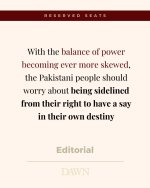
Editorial: The Constitutional Bench’s most recent decision is an attempt to provide legal closure, but it may just engender another crisis. On Friday, the bench overturned the Supreme Court’s earlier judgement in the reserved seats case, effectively foreclosing the possibility of correcting the imbalance created by the ECP’s controversial decisions during the conduct of the last general election.
Read the full editorial here: https://www.dawn.com/news/1920907
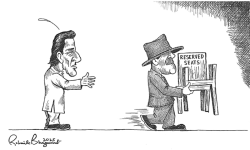

ghazi52
THINK TANK: CONSULTANT
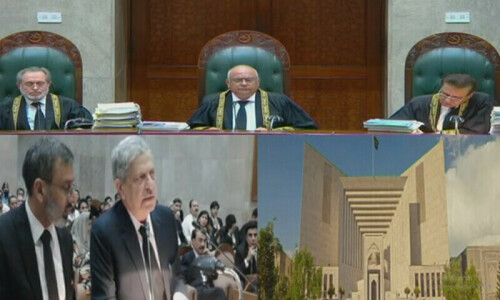
Editorial:
Constitutional Bench’s decision on reserved seats may just engender another crisis
With the balance of power becoming ever more skewed, the Pakistani people should worry about being sidelined.Reserved seats
EditorialJune 29, 2025
THE Constitutional Bench’s most recent decision is an attempt to provide legal closure, but it may just engender another crisis. On Friday, the bench overturned the Supreme Court’s earlier judgement in the reserved seats case, effectively foreclosing the possibility of correcting the imbalance created by the ECP’s controversial decisions during the conduct of the last general election.
Holding the Sunni Ittehad Council ineligible for reserved seats, the bench has paved the way for these to be divided among other parties. Consequently, the ruling coalition will control more than two-thirds of the National Assembly, solidifying its grip on power. An unfortunate precedent has been set, however.
The efforts of a high-powered Supreme Court bench to restore political rights, which were denied as a consequence of the ‘bat symbol’ judgement, have been undone by a fresh set of judges. Many will criticise the ruling for focusing too narrowly on technicalities while overlooking the broader constitutional and political context.
There is much that continues to be unpacked about why and how the reserved seats became an issue, and the judiciary’s role in precipitating the electoral crisis that led to this point will long be debated.
Still, in their judgement in the original case, even the Supreme Court judges who had disagreed with the majority verdict had conceded that the ECP acted illegally when it blocked a major political party from contesting the elections as a single entity and forced its candidates to run as independents.
But even though the illegality of this action was well established, the Commission circumvented the law once again by refusing to execute the restorative measures ordered.
One would have expected the ECP to be chastised for its conduct, but instead, the Constitutional Bench — whose formation and constitution are perceived as having been enabled by stakeholders who directly benefited from the ECP’s wrongful actions — has now granted legal cover to this misconduct. Questions will be raised.
With the government now having enough lawmakers on its benches to do as it pleases, the elected representatives can breathe easy. Those not aligned to the ruling coalition no longer need to worry about harassment, threats and abductions whenever the Constitution needs to be rewritten, as was seen in the passage of the 26th Amendment.
It also seems worth recalling some of the warnings from that time, which, in retrospect, seem to have been justified. The Constitutional Bench, one of the amendment’s most visible by-products, has, since its inception, endorsed military trials for civilians, executive interference in judicial appointments, and, most recently, the perversion of the electoral process. With the balance of power becoming ever more skewed, the Pakistani people should worry about being sidelined from their right to have a say in their own destiny.
Published in Dawn, June 29th, 2025
Desprado123
Registered Member
Written by Reema Omar?
Editorial:
Constitutional Bench’s decision on reserved seats may just engender another crisis
With the balance of power becoming ever more skewed, the Pakistani people should worry about being sidelined.
Reserved seats
Editorial
June 29, 2025
THE Constitutional Bench’s most recent decision is an attempt to provide legal closure, but it may just engender another crisis. On Friday, the bench overturned the Supreme Court’s earlier judgement in the reserved seats case, effectively foreclosing the possibility of correcting the imbalance created by the ECP’s controversial decisions during the conduct of the last general election.
Holding the Sunni Ittehad Council ineligible for reserved seats, the bench has paved the way for these to be divided among other parties. Consequently, the ruling coalition will control more than two-thirds of the National Assembly, solidifying its grip on power. An unfortunate precedent has been set, however.
The efforts of a high-powered Supreme Court bench to restore political rights, which were denied as a consequence of the ‘bat symbol’ judgement, have been undone by a fresh set of judges. Many will criticise the ruling for focusing too narrowly on technicalities while overlooking the broader constitutional and political context.
There is much that continues to be unpacked about why and how the reserved seats became an issue, and the judiciary’s role in precipitating the electoral crisis that led to this point will long be debated.
Still, in their judgement in the original case, even the Supreme Court judges who had disagreed with the majority verdict had conceded that the ECP acted illegally when it blocked a major political party from contesting the elections as a single entity and forced its candidates to run as independents.
But even though the illegality of this action was well established, the Commission circumvented the law once again by refusing to execute the restorative measures ordered.
One would have expected the ECP to be chastised for its conduct, but instead, the Constitutional Bench — whose formation and constitution are perceived as having been enabled by stakeholders who directly benefited from the ECP’s wrongful actions — has now granted legal cover to this misconduct. Questions will be raised.
With the government now having enough lawmakers on its benches to do as it pleases, the elected representatives can breathe easy. Those not aligned to the ruling coalition no longer need to worry about harassment, threats and abductions whenever the Constitution needs to be rewritten, as was seen in the passage of the 26th Amendment.
It also seems worth recalling some of the warnings from that time, which, in retrospect, seem to have been justified. The Constitutional Bench, one of the amendment’s most visible by-products, has, since its inception, endorsed military trials for civilians, executive interference in judicial appointments, and, most recently, the perversion of the electoral process. With the balance of power becoming ever more skewed, the Pakistani people should worry about being sidelined from their right to have a say in their own destiny.
Published in Dawn, June 29th, 2025

MasterChief
Registered Member

K2 was the name of a cigarette brand. There used to be a cigarette ad when we were kids that ended with the saying "K2 ka Pakistan!" Meaning K2's Pakistan.Now, it's "officially" the government by, of, and for the Pak Deep State....
Extraordinary war times, extraordinary war measures. And, this war will continue for decades to come....
It's over all politicians in Pakistan. They're all now peons and janitors. At the least IK is a prisoner inside a jail....
Now instead of "Pakistan's Army" people can say "Army ka Pakistan!"
Jango007
Registered Member
Good luck. Better send another love letter to the Yahoodi US Congress and see how that goes.
By the way, has the Jail Baro Tehrik been cancelled? If not, why don't the Shaikh Chillis join Cartoon-e-Azam Imran Khan instead of shouting and screaming all the way from Canada and the US?
Evil knows no limits....
Mian saanp and Field chaprasi have played an outstanding game....make people so poor, things so expensive and torture/rape so common that people will get stuck in feeding their kids few rotis with lack of job and work who is going to come out to get arrested and raped?
Yes jail bharo will not happen....why would IK want poor people to suffer for him?
Unlike your fat bastard of a leader IK has not ran away to London after making a deal...only Mian saanp family knows that skill.
As for the congress and letter was it not Mian saanp begging for his life from Musharraf to Clinton? Did mian saanp not make a deal with Clinton to stab Pakistan army in the back?
Did Mian saanp not appeal to UN?
Wait wasnt field martial giving BJ to Trump just few days back?
If his support was only in the USA and CANADA then why was his election symbol banned? party denied election space and massive win? why was this constitutional court needed stacked with hand picked clowns to steal reserve seats? IK in prison on absolutely comical charges? why fear PTI so much?
Oh wait the last elections lets look at the number of votes......
Donkey party/ PTI/ PPP
read and enlighten yourself what so cal unconstitutional court is doing :
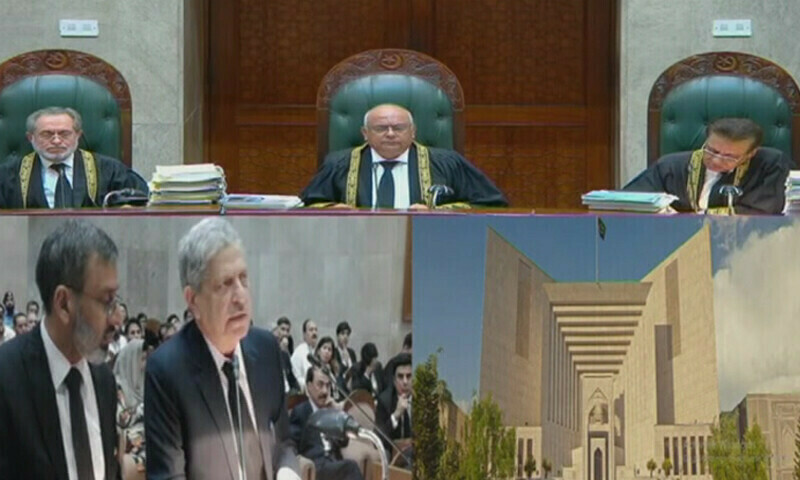
Reserved seats
With the balance of power becoming ever more skewed, the Pakistani people should worry about being sidelined.
www.dawn.com
Fatman17
THINK TANK: CONSULTANT


How the SC Constitutional Bench handed two-thirds majority to an unelected ‘unity’ regime
After this latest verdict, the Constitutional Bench has served that Constitution on a platter to the rejected parties: they can now reshape our legal order all by themselves.Asad Rahim Khan Published June 30, 2025 Updated about 5 hours ago
1x1.2x1.5x
This past week, the Supreme Court’s ‘Constitutional Bench’ — itself still under constitutional challenge — decided to strip the Pakistan Tehreek-i-Insaf (PTI), the single-largest party in Parliament, of its reserved seats.
It also went one further: it thought to hand those seats to the ruling coalition. Thus, for the first time in our history, nearly two dozen seats were gifted to the same parties that had lost at the polls.
To break this down further: the public’s votes were doled out to those they had voted against. The result is an unelected ‘unity’ regime being handed a two-thirds majority, the very haul it needs to mangle the Constitution in earnest.
We know this to be true because of the disaster that has been the 26th Amendment — around last fall, the coalition parties were smarting from their lack of numbers. It was only after months of cajoling or coercing opposition lawmakers that the amendment could be passed — that too as a watered-down version of an even more atrocious bill.
But after this latest verdict, the Constitutional Bench has served that Constitution on a platter to the rejected parties: they can now reshape our legal order all by themselves.
This is because the PTI’s reserved seats are what tipped the scale: to meet the magic number of 224 seats (in a 336-strong assembly), the regime, at roughly 213 altogether, needed another 11 to get over the line.
They now have those and more: up for grabs were the PTI’s 22 reserved seats, and the coalition got all of them; 14 to PML-N, 5 to PPP, and 3 to fence-sitter JUI-F.

In sum, amendments can pass easily now, regardless of whether their authors were voted in or not. If the Constitution Bench’s view is anything to go by, democracy is besides the point.
Reserved seats have a long and storied past in Pakistan — they were one of founding father Muhammad Ali Jinnah’s core demands, put to British rulers as well as the Hindu majority.
And with reason: to ensure historically underrepresented groups get a say in Parliament. That’s why, of the total 70 reserved seats in the National Assembly at present, 60 have been earmarked for women; 10 for religious minorities.
Given that equal opportunity doesn’t always mean equal participation, these candidates have been shielded from the rough and tumble of a direct election. They are instead allotted seats from pre-existing party lists after the election is over, in proportion to how many general seats their party has won.
It follows that the more general seats a party wins, the more the reserves that fall in its share.
That is, until the Constitutional Bench’s ruling: having turned that formula on its head, the Court has shown it’s better to lose with the system than win against it.
Take, for example, the absurd outcomes trickling out of Khyber Pakhtunkhwa: in a province the PTI swept last year, the PML-N, PPP, and JUI-F are now eyeing more seats in reserve than what they’d won in the general election. The PPP, for example, hopes to bag two reserves — despite securing just one seat in the actual polls.
Apart from women and minorities, the Constitutional Bench seems to have created a third category: losers that serve democracy’s latest derailment.
It begins, as so much of this judicial surrender does, with former Chief Justice of Pakistan Qazi Faez Isa. More specifically, with Isa’s infamous bat symbol verdict, yanking away the PTI’s electoral symbol right before the polls. Punishment, per the Isa Court, for not holding intra-party elections.
Enough ink has been spilt over how gross that verdict was (far more, it must be said, than when a similar decision stripped the PML-N of its lion symbol before the Senate races, at the height of Justice Saqib Nisar).
So we push ahead: the logical result of the bat symbol ruling should have been that PTI candidates would have to contest the polls under a symbol other than the bat, or, worst-case scenario, individual symbols.
Which would have been penalty enough: in a land where, in the eyes of the voting public, the symbol is the party, the PTI bore a clear handicap. But the election commission, cartoonishly hostile to whichever party is out of the deep state’s favour, went one further: it ruled that no candidate could contest from the PTI platform whatsoever.
In essence, the PTI hadn’t so much as lost its symbol as it had been dissolved overnight. Not only would its members have to contest with baingans, bottles, and bajas as its symbols, they would now have to do so as independents — as if the party didn’t exist.
As we now know, a historic number of PTI-backed independents made it to Parliament anyway. But even there, the election commission met them with trap after trap — whittling down their numbers as much as possible.
For starters, the PTI’s broken bat fell foul of Rule 94 of the Election Rules — that parties are entitled to reserved seats only if they are allotted a symbol.
Looking for a way out, the 80 PTI indies first thought to join sectional party Majlis Wahdat-e-Muslimeen, which had both symbol and seat. It was hoped the boost in MWM’s numbers would help PTI claim all the reserves it was entitled to.
But for reasons still hazy — rumour has it that PTI conservatives were ill at ease with their new ally’s brand — Imran Khan’s partisans opted out of MWM. Instead, they veered into Sunni Ittehad Council, another sectional party — one that hadn’t contested the election, let alone won a seat.
This blunder opened up a second trap: the law mandates that reserved seats be allotted to parties that actually contest the polls. And since Sunni Ittehad hadn’t contested, the election commission smirked, it was ineligible for reserves.
Not that this was what the commission used to think: it had tossed the Balochistan Awami Party a reserved seat in 2019 after elections were held in the ex-tribal areas, without the party ever having contested them. When confronted, the commission shrugged: if it was wrong then, it was correct now.
And it was also correct, it ruled, to have handed PTI’s reserved seats to the parties that had lost them.
Though Sunni Ittehad would appeal the commission’s ruling, a full bench of the Peshawar High Court upheld it: they were entitled to no reserves.
Try as it might, the independents had run out of options. So they returned to the Isa Court, which had created the crisis in the first place.
Thus began a month of Sunni Ittehad Council vs Election Commission of Pakistan. After eight anguished hearings, the Isa Court announced its decision on July 12, 2024.
On the question of how many reserved seats were bound for PTI, the Court split four ways: 8-2-2-1.
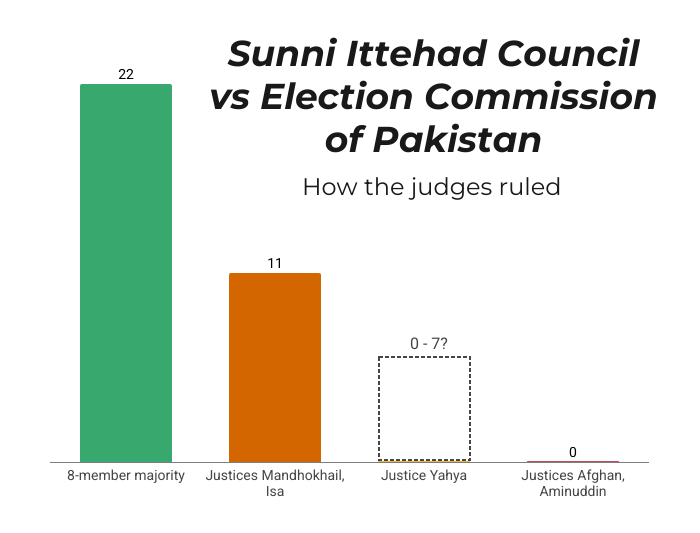
Co-signed by Justice Isa — the closest he ever came to recognising the havoc wreaked by his bat verdict — Justice Mandokhail’s dissent repaired only a fraction of the harm.
It did so by cutting the 80 PTI independents in two: the 39 that had declared themselves PTI in their election forms, and the 41 that hadn’t. “We do not agree with … the ECP declaring PTI’s 39 affiliated returned candidates as independents,” the dissent held. “The electorate voted for them in their such [sic] capacity.”
The judges directed that reserved seats be allotted to PTI in proportion to those 39. The remaining 41 stood knocked out, based on the technicality that their forms didn’t say PTI (even as they claimed the party, and the party claimed them).
All said, the dissent halved PTI’s rightful share, and handed the loser parties reserved seats well above their proportion. Per the Isa Court’s formula, the ruling regime would still walk away with a two-thirds majority it never won.
The lowest score came from Justices Aminuddin Khan and Naeem Akhter Afghan, dismissing the petitions.
In their 25-page opinion (of which nearly 17 were consumed by facts and background), the dissenters held that Sunni Ittehad was before the Court, not PTI.
And since Sunni Ittehad hadn’t contested the polls, it deserved no reserved seats. Nor did PTI, which hadn’t asked the court for relief anyway.
The dissent proved extraordinary for two reasons: it didn’t cite a single precedent, and it was the first minority opinion to urge that its own majority be disobeyed.
Like Justices Aminuddin and Afghan, Justice Yahya also dismissed Sunni Ittehad’s petitions outright.
As for the 80 PTI claimants, he directed the election commission to revisit the notifications of a handful of the 39 that had declared themselves PTI in their election forms; specifically, the lucky few that had also provided party certificates.
But unlike Justice Mandokhail’s dissent — which had at least handed over reserved seats to PTI in proportion to those 39 — Justice Yahya kept it narrow: he held that the Court itself could not order any such allocation. To do so “would not be legally appropriate”.
Though he found its behaviour “deeply concerning”, the same election commission was left to decide the future of the assembly.
Authored by Justice Syed Mansoor Ali Shah, the majority went furthest in restoring the people’s will. It held the election commission had been wrong to pretend as if the PTI stood dissolved, even if it had lost its symbol.
It also acknowledged the chaos caused by Justice Isa’s bat verdict: issuing it on the same day that party tickets were to be submitted had “contributed in causing confusion and prejudice to PTI, its candidates, and the electorate”.
Nor could such candidates have been forced to run as independents, or been deprived of their reserved seats.
Since the electorate couldn’t be made to suffer for the commission’s unlawful acts, the Court ordered that the 22 reserved seats be returned to PTI “as an obligation of justice”. The Constitution was a covenant, Justice Shah held; one that affirmed “the supreme role of the people in shaping their destiny”.
As to Justices Isa, Mandokhail, and Yahya excluding at least 41 independents, the majority replied: “We are completely at a loss to understand the logic, other than the constraint of the circumstances, as to why a candidate of a national-level political party … would become an independent candidate by his own free will.”
To quote the majority’s Justice Munib Akhtar, a “cascading series of errors” by the commission had forced the party into such a predicament. Whether or not the judge meant it as a reference, that exact expression was first used in relation to a gory plane crash from 1985 — a metaphor for systems breaking down.
And they would break down again: the state would never implement the verdict.
With no small encouragement from Qazi Faez Isa, the election commission refused to budge. Even the 26th amendment was passed — and the judiciary wrecked along with it — without the PTI being returned its reserved seats.
Hence, also, the amendment’s brand-new ‘Constitutional Bench’. Having achieved much of what it was created for — allowing military trials of civilians, as well as executive interference in the appointments of Islamabad High Court judges — the bench was set for a third act: reviewing Sunni Ittehad.
If while going against all principles of review: though the Supreme Court rules mandate that a review bench must be the same as the original, five of the eight majority judges — including its author, Justice Shah — were dropped without explanation.
They were replaced by seven newcomers, most brought in by the unity regime’s court-packing plan, which had inflated the Supreme Court’s 17-judge strength to 34. For context, India has 33 judges, despite a population five times the size.
Then again, policy concerns were hardly on the executive’s mind. “Observers will ask why the authorities are suddenly worried about how many judges there are in the Supreme Court,” a Dawn editorial wondered when the packing was underway. “Does it have something to do with how the bench ruled in the reserved seats case?” Well, yes.
As it turns out, when said court-packing was alleged before the bench, one new judge did recuse himself from the proceedings — but the bench was never reconstituted. For the first time ever, a smaller bench (12 members) would review the decision of a larger bench (13 members).
And in yet another first, that bench itself was headed by its most fervent dissenter: in what seemed to be pure happenstance, the executive had already decided on Justice Aminuddin as head of the Constitutional Bench. (The only judge on the judicial commission to have voted for Justice Aminuddin had been Justice Aminuddin.)
All of which brings us to the end scene: if not obvious already, Sunni Ittehad has been reversed in review. The PTI’s haul of reserved seats has dropped from 22 back to 0; its seats again dished out to the losers. Designed for the underrepresented, they are now tools for overrepresentation.
Not only has Justice Aminuddin’s view prevailed, even the original majority’s judges have swapped sides: Justices Mazhar and Rizvi have decided against Justices Mazhar and Rizvi from last summer, and accepted a review of their own decision. The final tally stands at 10-2.
If there’s a silver lining, it comes from said two: Justices Ayesha and Abbasi, who threw out the review petitions upon arrival. Even amid the judiciary’s continuing debasement, Justice Ayesha has given cause for hope: prior to standing up for the reserved seats verdict, she struck down military trials of civilians and rejected each tier of the bogus Practice and Procedure Act.
And more hope will be required: per Sunni Ittehad’s counsel, “The journey from stealing the general election to stealing the reserved seats is complete”.
Which means more corrosion ahead: the 27th amendment is now on the horizon, its contents still in the dark. Until it is exposed, and it must be, Pakistanis wonder: what rough beast, its hour come round at last, slouches towards Bethlehem to be born?
The author is a lawyer and columnist.
Reserved seats
‘Charge sheet against ECP’: Legal experts hail SC’s detailed verdict on reserved seats
High-stakes reserved seats
Users who are viewing this thread
Total: 1 (members: 0, guests: 1)
Pakistan Defence Latest
-

-
 PTI Murad Saeed in Afghanistan, was 'controlling KP govt' from there: Rana Sanaullah (1 Viewer)
- Latest: prothought
-

-
Federal cabinet gives nod to imposition of emergency in KP; summary sent to president (5 Viewers)
- Latest: prothought
-
Country Watch Latest


Latest Posts
-

-

-
-
Israel declares all Arab states as Illegitimate Official government declaration (8 Viewers)
- Latest: Feroze
-