MNZGamerX
Registered Member

The Cockroach Janata Party is leading a youth-heavy protest movement that embodies the public anger with the BJP.
By Tarushi Aswani
July 21, 2026
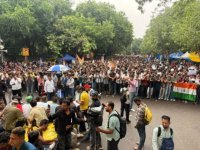
“Modi, your dictatorship, won’t last, won’t last,” yelled Abhijeet Dipke as he motioned at the crowd to repeat the slogan.
Dipke, the founding president of the Cockroach Janata Party, meets thousands of faces every day. At first glance, the party’s name sounds like a joke. In many ways, that is precisely the point.
On May 15, during a hearing in India’s Supreme Court, Chief Justice Surya Kant said that unemployed young people in India move toward activism and attack the system like “cockroaches.” Kant also said that it was the “unemployed” who questioned the government like cockroaches. So Dipke came up with the name “Cockroach Janata Party” – combining Kant’s epithet with the name of the ruling Bharatiya Janata Party (BJP) – and invited people to join the parody political brand, with the cockroach embraced as a proud political metaphor.
What began as a viral digital movement quickly evolved into something more revealing. After garnering more than 20 million Instagram followers through memes and satire, Cockroach Janata Party (CJP) began raising questions about unemployment, governance, accountability, and political representation. It is creating an alternative form of political participation and digital dissent that is thriving largely outside traditional party structures.
A Conflict With Cockroaches
Since June 6, the road near New Delhi’s Jantar Mantar, a popular protest site, has echoed with the anger, frustration and damage that the 12-year-old government of the BJP has caused.
Under New Delhi’s blazing hot skies, Indians from all sections of society, all religious lines, and all walks of life, have been protesting with one primary demand: the resignation of Education Minister Dharmendra Pradhan.
Since its inception, the CJP has demanded that Pradhan be held accountable for what it describes as systemic failures in India’s examination system. The CJP argues that repeated controversies – including paper leaks, the cancellation and rescheduling of key entrance examinations, and alleged irregularities in On-Screen Marking valuation process – have severely undermined the credibility of high-stakes government-run exams that determine the futures of millions of Indian students.
It is this lack of accountability that is drawing masses to the protest. Indrija Singh, a retired philosophy professor from north India’s Uttar Pradesh, took an overnight train from her home in Allahabad, some 700 kilometers from Delhi, to reach Jantar Mantar.
Singh, 65, explained that as a professor – someone who has invested decades in empowering young minds – the BJP’s actions felt like fraud. “This is unethical at all levels. The government’s actions in the last decade have eroded our trust in the way they deal with the citizenry. Students are the future of any country and the BJP is pushing this future to ruin. It must accept its failures,” Singh told The Diplomat.
Singh is one of the many common citizens who are traveling to Delhi and making the protest site their home, proudly calling themselves cockroaches.
Ashutosh Ranka, national spokesperson for the CJP, is outraged at the way the government has dealt with the education cams and even those protesting against them. “This is the most ridiculous government, they don’t believe in dialogue, they only believe in harassing, jailing and robbing the rights of citizens,” Ranka told The Diplomat. “Millions of futures are at stake, but for them [the BJP], students, their stagnant lives, and painful suicides don’t seem to matter.”
As day turns to night, and night brings another day, more and more cockroaches join the movement in what they call a “peaceful strike” for their demands to be heard.
United in Uncertainty
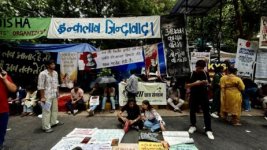
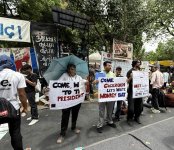
Since the cockroaches arrived at Jantar Mantar, the protest site doesn’t sleep. Volunteers serve food donated by supporters. Protesters camp at the site, sleeping in New Delhi’s extreme humid and hot weather. Those who want to support the movement in their own ways bring to the site home-cooked meals, chilled sherbets and lemonade, India’s tricolor flag, India’s constitution, and unique posters that serve the Modi government some Gen-Z sarcasm.
“We have come here to let Modi know, we understand his politics and we won’t be fooled anymore,” said Prerna, who traveled from Maharashtra, 1200 km from Delhi, to protest against the injustice unfolding in the education sector.
Prerna is a member of the Rashtriya Yuva Sangathan, a national youth organization based on Gandhian ideology. Though the protest began to highlight the ecosystem of evasions in the education sector at the hands of the BJP, today, she views the movement as larger that those primary demands.
Cooling herself with a hand fan, Prerna said that protesters here have shown utmost commitment to the ideas that the Constitution of India embodies. “We won’t leave till Pradhan resigns. This site has become our home, fellow protestors our family. Their tactics cannot break our resolve,” she said.
But the man in question, Pradhan, has refused to resign and even dismissed the movement and its protesters as the “B team of terrorists.” Modi, who has not held a news conference in more than 12 years but is active on social media, has not reacted to the protests yet.
Anjali, a member of All India Students’ Association (AISA), the student wing of the Communist Party of India (Marxist-Leninist), has been at the protest site for weeks now. “This is what bugs them: our unity, our oneness. We represent an India which is secular, which does not fight on caste-lines, religious lines, standing against the same regime which is scared of people coming together and posing questions at it,” Anjali said.
Anjali pointed out how BJP National President Nitin Nabin recently launched an attack on the CJP. Nabin referred to the satirical political outfit as a “virus and cockroach-like gang” that aims to “make the country hollow” and “divide the country.”
India’s police force is actively monitoring the protest site. As one enters the road, the police first makes sure that entrants get their bags checked; they paste stickers on each OK checked bag. From there on, the entrant must pass through two metal detector checks and a physical frisk by officers. The road is heavily guarded by the police; every few steps the police are visibly taking note of every protestor and every poster that lands there. The protest is also digitally monitored, with a dozen CCTV cameras and policemen also filming protestors.
Entering the venue, one sees scores of different organizations’ banners and a sea of tens of thousands of people who want to be heard.
At the site, one particular board has the photos of more than 20 students who committed suicide in the aftermath of the National Eligibility Entrance Test (NEET) 2026 paper leak. “The government shows zero accountability. Even parents of these students made sure to mark their anguish by supporting our protest. They brought their children’s ashes to us,” Vijeta Dahiya, the CJP spokesperson, told The Diplomat.
“We began with education, but look around, India is here. Those who are battling unemployment, exam scams, paper leaks, corruption, and [are] desperately tired of the Modi government are all here. We are peacefully protesting because we want the government to listen, they must wake up,” he said.
Cordon, Kidnap, and Crack Down
In the early hours of July 18, plain-clothed Delhi Police officers marched into Jantar Mantar and forcibly removed activist Sonam Wangchuk from the protest site.
Wangchuk, a 59-year-old climate activist and educator who began a hunger strike to support the cockroaches on June 28, was forcibly taken away from the protest site. When CJP members, students, and protesters at the site tried to stop the police, they were threatened and beaten.
Wangchuk’s indefinite hunger strike was joined by three doctoral students, Neha Bora, Aameen and Manish, all members of AISA. The three ended their hunger strike on July 20, at the request of several opposition leaders amid the government’s silence, apathy, and Delhi’s heat affecting their health.
The police made sure that Dipke, the founder of the CJP, was not around when they removed Wangchuk. Dipke has now demanded Modi’s resignation and announced a march to parliament on July 20, the first day of its monsoon session.
While Wangchuk was supposed to lead this march, he was taken to a government hospital without his family members’ knowledge and consent, where he was being made to break his hunger strike.
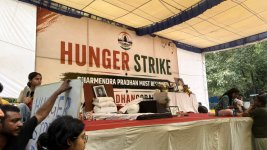
After this forceful removal, several Indian public and political figures visited the protest site, showing previously absent support for the movement.
On July 20, the CJP led a march with more than 100,000 citizens protesting against the government. The protest, which saw a heavy police and security forces presence, made its way to India’s Parliament. The protesters were tear gassed, beaten, and dragged across the roads of India’s capital, but they reached the parliament of one of the world’s largest democracies. Modi swiftly left the parliament building in his cavalcade.
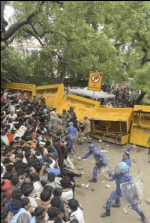
In the aftermath, two events unfolded. A CJP delegation was invited to submit its memorandum to Union Health Minister, J.P. Nadda and in the same breath, the Delhi Police and Rapid Action Force appeared hellbent on tearing down the protest. Several protesters told The Diplomat that they were heavily beaten with thick batons, and they were pulled, pushed, and hurt by the forces.
“They lobbed tear gas shots and dragged us so hard that it left blood spots on the road, we had abrasions. Even a 12-year-old child was hurt,” Suraj said.
Two months after the movement to seek accountability began, the cockroach has become larger than a symbol of irreverence. The cockroach now stands for a movement asking tough questions in an era where the Modi government’s fiascos are doubling by the day.
Over the last week, several cities across India, such as Nagpur, Bhubaneshwar, and Bangalore also saw protests aligned with the CJP, demanding answers over the hollowing of the education sector, the deaths of students, the lack of accountability at the part of the government, and Pradhan’s resignation.
In Modi’s third term as the prime minister of India, cockroaches have managed to move him away from the parliament and closer to answering the very questions on which he has maintained rigid silence for the last 12 years.
By Tarushi Aswani
July 21, 2026
“Modi, your dictatorship, won’t last, won’t last,” yelled Abhijeet Dipke as he motioned at the crowd to repeat the slogan.
Dipke, the founding president of the Cockroach Janata Party, meets thousands of faces every day. At first glance, the party’s name sounds like a joke. In many ways, that is precisely the point.
On May 15, during a hearing in India’s Supreme Court, Chief Justice Surya Kant said that unemployed young people in India move toward activism and attack the system like “cockroaches.” Kant also said that it was the “unemployed” who questioned the government like cockroaches. So Dipke came up with the name “Cockroach Janata Party” – combining Kant’s epithet with the name of the ruling Bharatiya Janata Party (BJP) – and invited people to join the parody political brand, with the cockroach embraced as a proud political metaphor.
What began as a viral digital movement quickly evolved into something more revealing. After garnering more than 20 million Instagram followers through memes and satire, Cockroach Janata Party (CJP) began raising questions about unemployment, governance, accountability, and political representation. It is creating an alternative form of political participation and digital dissent that is thriving largely outside traditional party structures.
A Conflict With Cockroaches
Since June 6, the road near New Delhi’s Jantar Mantar, a popular protest site, has echoed with the anger, frustration and damage that the 12-year-old government of the BJP has caused.
Under New Delhi’s blazing hot skies, Indians from all sections of society, all religious lines, and all walks of life, have been protesting with one primary demand: the resignation of Education Minister Dharmendra Pradhan.
Since its inception, the CJP has demanded that Pradhan be held accountable for what it describes as systemic failures in India’s examination system. The CJP argues that repeated controversies – including paper leaks, the cancellation and rescheduling of key entrance examinations, and alleged irregularities in On-Screen Marking valuation process – have severely undermined the credibility of high-stakes government-run exams that determine the futures of millions of Indian students.
It is this lack of accountability that is drawing masses to the protest. Indrija Singh, a retired philosophy professor from north India’s Uttar Pradesh, took an overnight train from her home in Allahabad, some 700 kilometers from Delhi, to reach Jantar Mantar.
Singh, 65, explained that as a professor – someone who has invested decades in empowering young minds – the BJP’s actions felt like fraud. “This is unethical at all levels. The government’s actions in the last decade have eroded our trust in the way they deal with the citizenry. Students are the future of any country and the BJP is pushing this future to ruin. It must accept its failures,” Singh told The Diplomat.
Singh is one of the many common citizens who are traveling to Delhi and making the protest site their home, proudly calling themselves cockroaches.
Ashutosh Ranka, national spokesperson for the CJP, is outraged at the way the government has dealt with the education cams and even those protesting against them. “This is the most ridiculous government, they don’t believe in dialogue, they only believe in harassing, jailing and robbing the rights of citizens,” Ranka told The Diplomat. “Millions of futures are at stake, but for them [the BJP], students, their stagnant lives, and painful suicides don’t seem to matter.”
As day turns to night, and night brings another day, more and more cockroaches join the movement in what they call a “peaceful strike” for their demands to be heard.
United in Uncertainty
Since the cockroaches arrived at Jantar Mantar, the protest site doesn’t sleep. Volunteers serve food donated by supporters. Protesters camp at the site, sleeping in New Delhi’s extreme humid and hot weather. Those who want to support the movement in their own ways bring to the site home-cooked meals, chilled sherbets and lemonade, India’s tricolor flag, India’s constitution, and unique posters that serve the Modi government some Gen-Z sarcasm.
“We have come here to let Modi know, we understand his politics and we won’t be fooled anymore,” said Prerna, who traveled from Maharashtra, 1200 km from Delhi, to protest against the injustice unfolding in the education sector.
Prerna is a member of the Rashtriya Yuva Sangathan, a national youth organization based on Gandhian ideology. Though the protest began to highlight the ecosystem of evasions in the education sector at the hands of the BJP, today, she views the movement as larger that those primary demands.
Cooling herself with a hand fan, Prerna said that protesters here have shown utmost commitment to the ideas that the Constitution of India embodies. “We won’t leave till Pradhan resigns. This site has become our home, fellow protestors our family. Their tactics cannot break our resolve,” she said.
But the man in question, Pradhan, has refused to resign and even dismissed the movement and its protesters as the “B team of terrorists.” Modi, who has not held a news conference in more than 12 years but is active on social media, has not reacted to the protests yet.
Anjali, a member of All India Students’ Association (AISA), the student wing of the Communist Party of India (Marxist-Leninist), has been at the protest site for weeks now. “This is what bugs them: our unity, our oneness. We represent an India which is secular, which does not fight on caste-lines, religious lines, standing against the same regime which is scared of people coming together and posing questions at it,” Anjali said.
Anjali pointed out how BJP National President Nitin Nabin recently launched an attack on the CJP. Nabin referred to the satirical political outfit as a “virus and cockroach-like gang” that aims to “make the country hollow” and “divide the country.”
India’s police force is actively monitoring the protest site. As one enters the road, the police first makes sure that entrants get their bags checked; they paste stickers on each OK checked bag. From there on, the entrant must pass through two metal detector checks and a physical frisk by officers. The road is heavily guarded by the police; every few steps the police are visibly taking note of every protestor and every poster that lands there. The protest is also digitally monitored, with a dozen CCTV cameras and policemen also filming protestors.
Entering the venue, one sees scores of different organizations’ banners and a sea of tens of thousands of people who want to be heard.
At the site, one particular board has the photos of more than 20 students who committed suicide in the aftermath of the National Eligibility Entrance Test (NEET) 2026 paper leak. “The government shows zero accountability. Even parents of these students made sure to mark their anguish by supporting our protest. They brought their children’s ashes to us,” Vijeta Dahiya, the CJP spokesperson, told The Diplomat.
“We began with education, but look around, India is here. Those who are battling unemployment, exam scams, paper leaks, corruption, and [are] desperately tired of the Modi government are all here. We are peacefully protesting because we want the government to listen, they must wake up,” he said.
Cordon, Kidnap, and Crack Down
In the early hours of July 18, plain-clothed Delhi Police officers marched into Jantar Mantar and forcibly removed activist Sonam Wangchuk from the protest site.
Wangchuk, a 59-year-old climate activist and educator who began a hunger strike to support the cockroaches on June 28, was forcibly taken away from the protest site. When CJP members, students, and protesters at the site tried to stop the police, they were threatened and beaten.
Wangchuk’s indefinite hunger strike was joined by three doctoral students, Neha Bora, Aameen and Manish, all members of AISA. The three ended their hunger strike on July 20, at the request of several opposition leaders amid the government’s silence, apathy, and Delhi’s heat affecting their health.
The police made sure that Dipke, the founder of the CJP, was not around when they removed Wangchuk. Dipke has now demanded Modi’s resignation and announced a march to parliament on July 20, the first day of its monsoon session.
While Wangchuk was supposed to lead this march, he was taken to a government hospital without his family members’ knowledge and consent, where he was being made to break his hunger strike.
After this forceful removal, several Indian public and political figures visited the protest site, showing previously absent support for the movement.
On July 20, the CJP led a march with more than 100,000 citizens protesting against the government. The protest, which saw a heavy police and security forces presence, made its way to India’s Parliament. The protesters were tear gassed, beaten, and dragged across the roads of India’s capital, but they reached the parliament of one of the world’s largest democracies. Modi swiftly left the parliament building in his cavalcade.
In the aftermath, two events unfolded. A CJP delegation was invited to submit its memorandum to Union Health Minister, J.P. Nadda and in the same breath, the Delhi Police and Rapid Action Force appeared hellbent on tearing down the protest. Several protesters told The Diplomat that they were heavily beaten with thick batons, and they were pulled, pushed, and hurt by the forces.
“They lobbed tear gas shots and dragged us so hard that it left blood spots on the road, we had abrasions. Even a 12-year-old child was hurt,” Suraj said.
Two months after the movement to seek accountability began, the cockroach has become larger than a symbol of irreverence. The cockroach now stands for a movement asking tough questions in an era where the Modi government’s fiascos are doubling by the day.
Over the last week, several cities across India, such as Nagpur, Bhubaneshwar, and Bangalore also saw protests aligned with the CJP, demanding answers over the hollowing of the education sector, the deaths of students, the lack of accountability at the part of the government, and Pradhan’s resignation.
In Modi’s third term as the prime minister of India, cockroaches have managed to move him away from the parliament and closer to answering the very questions on which he has maintained rigid silence for the last 12 years.