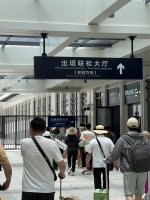
Trips of China-Laos High Speed Railway surpass 38 millions

The railway is going to speed up the economic development of Laos a lot, Vietnam is jealousy for sure.
Some Indian and American PDFers claimed that few if any would ride this remote bullet train in the tropical jungles when it opened over 3 years ago.
 
Jealousy too.
Lol, sure, when China builds public infrastructure in China, they say they are money losing projects which are not sustainable and are bound to fail. When China builds infras overseas, they say those are China's debt traps designed to destroy those countries. China is evil all the way.
 
For a country like Lao with a GDP of 15 billion, they have spent $ 6 billion on this project. but the funny part is $3.6 billion of it is a loan from a chinese bank by Lao. Another $480 million is contributed by the Laon government, which in turn again took a loan from Chinese Bank. net, Lao took $4 billion loan for a single project, which is 27% of its GDP..

with a rate of return on investment of 4.65% on the total investment for the project vs interest payment for the loan + Operations cost of the projects, only God, XI and our friend @Beijingwalker would know how good is the project for the Laon people..

:))
 
Last edited:
For a country like Lao with a GDP of 15 billion, they have spent $ 6 billion on this project. but the funny part is $3.6 billion of it is a loan from a chinese bank by Lao. Another $480 million is contributed by the Laon government, which in turn again took a loan from Chinese Bank. net, Lao took $4 billion loan for a single project, which is 27% of its GDP..

with a rate of return on investment of 4.65% on the total investment for the project vs interest payment for the loan + Operations cost of the projects, only God, XI and our friend @Beijingwalker would know how good is the project for the Laon people..

:))
You Indians always do your math which doesn't not add up in real life, lol
Only you idiot think public transport have to make profit all by themselves and fail to see the big picture of the great boost for the overall local economy.

How China's high-speed rail promote local economy: New evidence from county-level panel data

 
Last edited:
China’s HSR network has exceeded its predictions–both technically and financially–and is solidly profitable today.

Where do the profits come from and how are profits diverted to pay off construction loans? The answers are: they come from almost everywhere and, since every aspect of the network is cooperatively owned, it’s easy to skim off enough pay the interest and retire the bonds when they fall due. ‘Everywhere’ is a little vague, so here’s a list of the cost savings and some revenue streams:

  • Increased forecasting accuracy. The more they have built, the more accurate their predictions have become. Accurate predictions lead to accurate financial models which lead to accurate bond pricing.
  • Low construction cost. The program benefits from scale. From mass-produced, unballasted rail sections to bridges (ordered by the meter) to engines and carriages. Production and demand are tightly integrated, eliminating stop-and-go and costly downtime. Current construction and manufacturing costs are now 30%-40% cheaper than anywhere on earth. Here’s an example of how automated the process is: the SLJ900/32 Bridge Girder Erector Machine lays a pre-fabbed tranche of track in 50 minutes, much faster than if done by 20 workers. High-Speed Railways in China: A Look at Construction Costs
  • Economic stimulus from the initial investment. A surprising percentage of the $650 billion invested (so far) came back within twelve months in the form of income and sales taxes that ripple out in all directions from the factories and construction sites. HSR construction creates jobs and lifts demand for construction, steel and cement industries during the economic downturn. Work on the Beijing–Shanghai HSR mobilized 110,000 workers.
  • Land development. This is the system’s ace card: Those shopping complexes at the stations? A share of the rents goes to pay off the bonds. Land sales around the stations? A share of the sales price goes to pay off the bonds. The increased commercial activity around stations? A share of the increased taxes help pay off the bonds. Those ‘stations in the middle of nowhere’? When new towns are built around them, land sales and development and the increased tax base will help pay off the bonds.
  • Increased productivity from passenger time savings. Improves economic productivity and competitiveness over the long term by increasing the transport capacity of railways and linking labor markets. The World Bank’s survey found that high-speed passengers' average income is 35-50% higher than that of passengers on conventional trains. This year (2017), if 1.8 billion riders each saves an average of four hours compared to automobile, plane or regular train and the average urban wage in 2017 is US $1,000/mo, then HSR will save the average rider $24 of productive time, for a total of $43 billion. that will, eventually, boost economic activity and, of course, tax revenues.
  • Ticket revenues. Since the first line opened, ticket prices have stayed almost flat while the average wage has doubled. Today, twice as many people can afford HSR as could afford it in 2007.
  • Enhanced freight revenues. Intercity high speed package delivery is a large and growing revenue source. Today someone who lives in Shanghai can order products from Alibaba in the morning and get them in the evening thanks to the HSR network, another reason why China's e-commerce is flourishing. Improved productivity and competitiveness generate increased taxes. Moving passengers to high-speed lines frees up older railways to carry more freight, which is more profitable for railways than passengers.
  • Advertising revenues. Billions of ‘impressions’ to passengers whose average income is 30–50% higher than the national average.
  • Concession revenues (food and drink). Those snack carts, station concessions, drink dispensers? They’re paying off the bonds, too.
  • Environmental benefits. HSR reduces noise, high-atmosphere pollution and CO2 dramatically. These are direct contributions to quality of life and indirect contributions to reducing atmospheric pollution, thus raising the value of surrounding land.
  • Tourism revenues. ‘The results indicate that at the national level, a trend of convergence emerges during the three-year period of analysis in both China and Korea. At the HSR passing area level, HSR contributes to accelerate regional economic convergence and reduce the regional income disparities in China’. HSR is responsible for 59% of the increase in market potential for the secondary cities connected by bullet trains. (Economic geographers call market potential "a geographic area's access to markets for inputs and outputs"). A 10% increase in a secondary city's market potential is expected to be associated with a 4.5% increase in its average real estate price. HSR promotes the growth of second-tier cities by making them more livable/desirable–and, of course, collects taxes on the increased revenues that go to pay….you know the rest.
  • National cohesion and a national market. People, products and services move quickly, allowing people to live in one place and work in another. HSR helps rural areas profit from their natural resources by bringing business opportunities and tourists–while reducing rural people’s isolation (think Tibet!).
  • Intellectual property exports. China is a leading source of high-speed rail technology. Chinese train-makers have absorbed imported technologies quickly, localized production processes and began competing in the export market. Six years after receiving Kawasaki's license to produce Shinkansen E2, CSC Sifang produced the CRH2A without Japanese input (Kawasaki ended cooperation with Sifang and has been sulking ever since).
  • Energy savings. Electric trains use less energy to transport people and goods on a per unit basis and can draw power from more diverse sources of energy–including renewables–than automobile and aircraft, which are more reliant on imported petroleum. This cuts billions from China’s energy import bills.
  • Scale savings: more profitable lines subsidize less profitable lines that serve thinly populated areas (think Tibet again).
 
You Indians always do your math which doesn't not add up in real life, lol
Only you idiot think public transport have to make profit all by themselves and fail to see the big picture of the great boost for the overall local economy.

How China's high-speed rail promote local economy: New evidence from county-level panel data

I looked at the authors of your pathfinding article—Yao Wang and Weijia Dong—and spared myself the pain of going through some CCP propaganda. Come up with something more authentic next time.. :LOL: :LOL:
 
I looked at the authors of your pathfinding article—Yao Wang and Weijia Dong—and spared myself the pain of going through some CCP propaganda. Come up with something more authentic next time.. :LOL: :LOL:
You Indian progaganda is the best, we are no match for it.
 
China-Laos Railway marks new milestone on Thursday, transporting 50 million tons of goods since its launch

By Global Times
Published: Jan 02, 2025 01:54 PM

A freight train loaded with fresh fruits and vegetables set off from the Wangjiaying West Station in Kunming, Southwest China's Yunnan Province, bound for Laos on Thursday. The train run marks a new milestone for the China-Laos Railway, which has transported over 50 million tons of cargo since its launch in 2021, China State Railway Group Co (China Railway) said.

From the start in 2021, the number of daily cross-border freight trains has grown from two to 18 now, with each train loads on average increasing from 2,000 tons to 2,500 tons. The railway has transported a total of 11.58 million tons of cross-border cargo to date.

Leveraging the railway's connectivity, China Railway have introduced innovative services like the "Lancang-Mekong Express," having operated over 1,670 trains so far, according to media reports. International freight routes such as the "Beijing-Yunnan-Lancang-Mekong" and the "Shanghai-Kunming-Lancang-Mekong" have effectively accelerated China-ASEAN transport capabilities.

Innovative freight models, combining the China-Laos Railway with China-Europe freight train services, have reduced delivery time to Europe from Laos and Thailand to as short as 15 days. According to a statement from China Railway, the network spans 31 Chinese provinces and integrates 19 countries, facilitating the transport of over 3,000 types of goods.

The China-Laos Railway transported 19.6 million tons of goods in 2024, with the daily average hitting 50,000 tons. Cross-border freight accounted for 4.78 million tons, with imports to China far exceeding exports.

Authorities have enhanced the railway's efficiency with measures like pre-declaration for imports and fast clearance, attracting 71 businesses and securing 700 million yuan ($96.3 million) in credit through multimodal transport and financing reforms.

The Mohan railway port in Southwest China's Yunnan Province has deployed advanced technologies like 5G, BeiDou Navigation Satellite System, and AI, to develop a smarter network of freight train runs.

And, collaboration among railway, customs, and border check agencies in China and Laos has significantly improved the management at the Mohan railway port, reducing clearance time for goods import and export by 60 percent and 90 percent, respectively.

China has boosted international freight transportation capacity with initiatives such as the Chongqing-Vientiane cross-border rail and road freight service, focused on auto and motorcycle logistics, which helps deepen trade and economic links with the ASEAN nations. Also, the New International Land-Sea Trade Corridor connects a broad network of ports, underscoring China's commitment to advancing global trade integration, analysts said.

 
I looked at the authors of your pathfinding article—Yao Wang and Weijia Dong—and spared myself the pain of going through some CCP propaganda. Come up with something more authentic next time.. :LOL: :LOL:
what does IN make from the dropping of cows over the rail tracks, billions?
 

Users who are viewing this thread

Pakistan Defence Latest

Back
Top