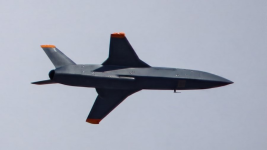
I also have this fantasy of transforming ANKA-3 into a air refueling aircraft by scaling it up. As flying wings design is not so hard to scale. It would end our dependence on foreign suppliers.
Asked this to AI, it come up with the answer below.
Why is a flying wing potentially well suited for a tanker?
In a conventional tanker, the fuselage, wings and tail are separate structures. In a flying wing, much more of the aircraft becomes usable structural volume.
That could provide some major advantages for a tanker:
- Very large internal volume
- Fuel tanks can be distributed through the center body and wings
- Potential structural-weight advantages
- Large wing area makes carrying a high fuel load more practical
- No conventional tail, potentially reducing drag
- Good potential for efficient, long-endurance cruise
- And most importantly, long endurance is exactly what you want from a tanker
But there is an important point:
Scaling ANKA-3 ≠ simply making ANKA-3 bigger
The basic scaling principle works reasonably well at the conceptual level. If you double the linear dimensions:
- Wing area ≈ 4×
- Internal volume ≈ 8×
- Geometric mass scaling would also be roughly 8×
So a 6.5-ton aircraft could theoretically move into something around the
50-ton class with a 2× linear scale.
Of course, real aircraft don't scale this cleanly. Structural loads, aeroelasticity, engines, landing gear, fuel fraction and aerodynamic optimization all become major factors.
Now the really interesting part: the tanker
Instead of thinking of it as a larger MQ-25, imagine something like:
ANKA-3 → 6.5 tons
↓
Larger flying-wing derivative → 30–50 tons
↓
15–25 tons of internal fuel
↓
Unmanned tanker for KAAN, HÜRJET, KIZILELMA and ANKA-3
An unmanned tanker wouldn't need to carry a pilot or life-support systems. That could mean longer endurance, lower operating costs, and potentially the ability to accept more risk in contested environments.
And then there is the stealth tanker idea
This is probably the most interesting part.
A conventional tanker such as the KC-46 has a large radar signature and generally has to remain well behind the forward edge of the battlespace.
A
low-observable flying-wing tanker, however, could potentially operate much closer to contested airspace and refuel fighters further forward.
Instead of:
"I need to refuel before entering the enemy's air-defense envelope."
it could become:
"The tanker is already operating with me closer to the battlespace."
For an aircraft like KAAN, this could potentially have a significant effect on effective combat radius and mission endurance.
The biggest engineering problem?
Aerial refueling.
A flying wing doesn't have the conventional tail section where you would normally place a boom. A boom system could be challenging, while
wing-mounted hose-and-drogue pods might be a more natural solution, although the airflow around a flying wing would make this far from simple.
And I don't think you necessarily need to directly scale ANKA-3 itself. You could develop a
family of larger flying-wing aircraft based on the same technology:
ANKA-3 → 6.5 t
KIZILELMA → ~9 t class
Large flying-wing tanker → 30–50 t
Strategic flying wing → 100+ t
They could potentially share technologies such as flight-control systems, low-observability techniques, composites, avionics, mission computers and autonomous systems.
So, while "just scale up ANKA-3" is obviously an oversimplification, I don't think the basic idea of a
30–50 ton-class unmanned flying-wing tanker is crazy at all.