Dalit
Elite Member


As cash-strapped Pakistan tried to mediate an end to the US-Israeli war on Iran, the United Arab Emirates made a shock request of its longtime ally — repay $3.5bn immediately.
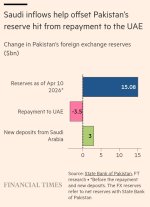
Abu Dhabi’s request this month threatened to drain a fifth of Pakistan’s central bank reserves and imperilled a $7bn IMF bailout programme agreed in 2024. Saudi Arabia, which signed a mutual defence pact with Islamabad last year, swung to the rescue. It lent $3bn to Pakistan to bolster its central bank reserves and extended an existing $5bn loan for more than a year.
Abu Dhabi’s decision reflects its growing frustration with Islamabad, partly because of its deepening ties with Riyadh, but also what it considers Pakistan’s meek response to Iranian attacks on the Gulf after the US and Israel launched their war, analysts say.
Neil Quilliam, an associate fellow at Chatham House, said Pakistan’s role as mediator in the US’s war against Iran also annoyed the Gulf state as it “sees things in kind of black and white at the moment”.
“There’s no neutrality in this [from the UAE perspective], there’s no middle ground and if you’re mediating then you are in the middle ground,” he said.
Underlying this is simmering tensions between Saudi Arabia, which signed a defence pact with Islamabad in September, and the UAE. A rift between the Gulf’s powerhouses burst into the open over disputes in the civil war in Yemen, where they back rival factions, in December and January.
The US-Israeli war with Iran papered over those cracks as the Islamic republic has responded by attacking both Gulf states. But analysts say the Saudi-UAE tensions continue to fester, with Riyadh more closely aligned with Pakistan, Turkey and Egypt than its Gulf neighbour.
“The rift is still there, and Pakistan is one area it can play out, and the UAE is much more invested in India anyway,” Quilliam said. “They [UAE] see this growing alliance between the Saudis and the Pakistanis, and for the UAE that constitutes a conflict of interests for Abu Dhabi.”
Three Pakistani advisers said the UAE had signalled to Islamabad that it wanted it to take a harder line against Iran. The UAE’s foreign ministry did not respond to a request for comment.
There is frustration [in Abu Dhabi],” said Abdulkhaleq Abdulla, an Emirati academic and commentator. “They [Islamabad] sought to position themselves as a mediator which didn’t go down well.”
“However, being upset is one thing, but rethinking the relationship after all this is said and done is something else.”
Pakistan’s foreign ministry has described the decision to return the money to the UAE as simply a “routine financial transaction” and denied that it is connected to the war in the Gulf or that there is “any gap” between Islamabad and Abu Dhabi.
But privately, officials in Islamabad voiced frustration, the advisers said, albeit with relief at being less beholden to Abu Dhabi, which has forged closer ties with Pakistan’s arch-rival India. “The Saudis obliged our request, which they usually do,” an adviser said. “We could see it coming after their [Riyadh’s] rift with the UAE.”
The UAE’s ties with Islamabad date to Abu Dhabi’s independence from the UK in 1971. The first five chiefs of staff of the Emirati air force were Pakistani citizens, while Pakistan’s flag carrier Pakistan International Airlines provided aircraft and training to Emirates Airlines. The UAE in turn provided billions of dollars of financial support to Pakistan and hosts some 1.5mn Pakistani expatriates.
Relations became strained in 2015 when Islamabad bowed to public pressure and declined to join the Saudi-led coalition against Iranian-backed Houthi rebels in Yemen. The UAE was the Saudis’ main partner in that conflict. A top Emirati diplomat publicly complained at the time that despite “inevitable” economic and financial support from the UAE, “Tehran seems to be more important to Islamabad . . . than the Gulf countries”.
Since late last year, Pakistan had been seeking to secure an agreement to roll over at least $2bn of the Emirati loans for two years, but Abu Dhabi rattled Islamabad by moving to monthly extensions in January, according to two people familiar with the matter.
The UAE’s decision to seek immediate repayment this month surprised the finance ministry in Islamabad, as well as the IMF, according to people familiar with the matter. Abu Dhabi had promised the fund that it would not seek repayment until the end of Pakistan’s programme in 2027, a precondition for approving the bailout.
Mahir Binici, the IMF’s representative in Islamabad, said in a statement that Pakistan had sought to fill the financing shortfall “in co-operation with their bilateral partners and through market access” to meet their “reserve level commitments under the programme”. Pakistan’s finance ministry did not respond to a request for comment.
The move also spelled the end of an ambitious Pakistani proposal that Islamabad’s foreign minister said was agreed with Abu Dhabi in December to convert $1bn of debt into investments in a military-linked conglomerate, the Fauji Foundation. Two people familiar with the plan now say it has been axed, and the money earmarked for it has been repaid to the UAE.
Some observers, however, warn of the risk of over-reliance on financing from Saudi Arabia, which is now equivalent to roughly half of Pakistan’s central bank reserves of $16bn.
The mutual defence pact had raised hopes of more Saudi investment and financial support in exchange for Pakistan’s military might.
But two of the Pakistani advisers said Riyadh, which is facing tightening liquidity and a widening deficit while managing vast domestic financial commitments, had so far shown limited appetite in translating the accord into investments.
After the US and Iran agreed a ceasefire, Pakistan this month positioned fighter and support aircraft in Saudi Arabia as part of their agreement, Riyadh said. But the existence of the pact had failed to deter Iranian missile and drone attacks against the Gulf kingdom.
“The Saudis never had any illusions about Pakistani help and were simply hoping Iran would think twice before attacking them. This proved wrong,” said Bernard Haykel, professor of near eastern studies at Princeton University, who is writing a book about the Crown Prince Mohammed bin Salman. “Saudi cannot afford to bail out Pakistan,” said Haykel.
Abu Dhabi’s request this month threatened to drain a fifth of Pakistan’s central bank reserves and imperilled a $7bn IMF bailout programme agreed in 2024. Saudi Arabia, which signed a mutual defence pact with Islamabad last year, swung to the rescue. It lent $3bn to Pakistan to bolster its central bank reserves and extended an existing $5bn loan for more than a year.
Abu Dhabi’s decision reflects its growing frustration with Islamabad, partly because of its deepening ties with Riyadh, but also what it considers Pakistan’s meek response to Iranian attacks on the Gulf after the US and Israel launched their war, analysts say.
Neil Quilliam, an associate fellow at Chatham House, said Pakistan’s role as mediator in the US’s war against Iran also annoyed the Gulf state as it “sees things in kind of black and white at the moment”.
“There’s no neutrality in this [from the UAE perspective], there’s no middle ground and if you’re mediating then you are in the middle ground,” he said.
Underlying this is simmering tensions between Saudi Arabia, which signed a defence pact with Islamabad in September, and the UAE. A rift between the Gulf’s powerhouses burst into the open over disputes in the civil war in Yemen, where they back rival factions, in December and January.
The US-Israeli war with Iran papered over those cracks as the Islamic republic has responded by attacking both Gulf states. But analysts say the Saudi-UAE tensions continue to fester, with Riyadh more closely aligned with Pakistan, Turkey and Egypt than its Gulf neighbour.
“The rift is still there, and Pakistan is one area it can play out, and the UAE is much more invested in India anyway,” Quilliam said. “They [UAE] see this growing alliance between the Saudis and the Pakistanis, and for the UAE that constitutes a conflict of interests for Abu Dhabi.”
Three Pakistani advisers said the UAE had signalled to Islamabad that it wanted it to take a harder line against Iran. The UAE’s foreign ministry did not respond to a request for comment.
There is frustration [in Abu Dhabi],” said Abdulkhaleq Abdulla, an Emirati academic and commentator. “They [Islamabad] sought to position themselves as a mediator which didn’t go down well.”
“However, being upset is one thing, but rethinking the relationship after all this is said and done is something else.”
Pakistan’s foreign ministry has described the decision to return the money to the UAE as simply a “routine financial transaction” and denied that it is connected to the war in the Gulf or that there is “any gap” between Islamabad and Abu Dhabi.
But privately, officials in Islamabad voiced frustration, the advisers said, albeit with relief at being less beholden to Abu Dhabi, which has forged closer ties with Pakistan’s arch-rival India. “The Saudis obliged our request, which they usually do,” an adviser said. “We could see it coming after their [Riyadh’s] rift with the UAE.”
The UAE’s ties with Islamabad date to Abu Dhabi’s independence from the UK in 1971. The first five chiefs of staff of the Emirati air force were Pakistani citizens, while Pakistan’s flag carrier Pakistan International Airlines provided aircraft and training to Emirates Airlines. The UAE in turn provided billions of dollars of financial support to Pakistan and hosts some 1.5mn Pakistani expatriates.
Relations became strained in 2015 when Islamabad bowed to public pressure and declined to join the Saudi-led coalition against Iranian-backed Houthi rebels in Yemen. The UAE was the Saudis’ main partner in that conflict. A top Emirati diplomat publicly complained at the time that despite “inevitable” economic and financial support from the UAE, “Tehran seems to be more important to Islamabad . . . than the Gulf countries”.
Since late last year, Pakistan had been seeking to secure an agreement to roll over at least $2bn of the Emirati loans for two years, but Abu Dhabi rattled Islamabad by moving to monthly extensions in January, according to two people familiar with the matter.
The UAE’s decision to seek immediate repayment this month surprised the finance ministry in Islamabad, as well as the IMF, according to people familiar with the matter. Abu Dhabi had promised the fund that it would not seek repayment until the end of Pakistan’s programme in 2027, a precondition for approving the bailout.
Mahir Binici, the IMF’s representative in Islamabad, said in a statement that Pakistan had sought to fill the financing shortfall “in co-operation with their bilateral partners and through market access” to meet their “reserve level commitments under the programme”. Pakistan’s finance ministry did not respond to a request for comment.
The move also spelled the end of an ambitious Pakistani proposal that Islamabad’s foreign minister said was agreed with Abu Dhabi in December to convert $1bn of debt into investments in a military-linked conglomerate, the Fauji Foundation. Two people familiar with the plan now say it has been axed, and the money earmarked for it has been repaid to the UAE.
Some observers, however, warn of the risk of over-reliance on financing from Saudi Arabia, which is now equivalent to roughly half of Pakistan’s central bank reserves of $16bn.
The mutual defence pact had raised hopes of more Saudi investment and financial support in exchange for Pakistan’s military might.
But two of the Pakistani advisers said Riyadh, which is facing tightening liquidity and a widening deficit while managing vast domestic financial commitments, had so far shown limited appetite in translating the accord into investments.
After the US and Iran agreed a ceasefire, Pakistan this month positioned fighter and support aircraft in Saudi Arabia as part of their agreement, Riyadh said. But the existence of the pact had failed to deter Iranian missile and drone attacks against the Gulf kingdom.
“The Saudis never had any illusions about Pakistani help and were simply hoping Iran would think twice before attacking them. This proved wrong,” said Bernard Haykel, professor of near eastern studies at Princeton University, who is writing a book about the Crown Prince Mohammed bin Salman. “Saudi cannot afford to bail out Pakistan,” said Haykel.
Attachments
Last edited: