US close to striking massive deal for Venezuelan oil fields

The Trump administration is in talks with Venezuela's interim government about taking an ownership stake in the South American country's enormous oil resources, two U.S. officials tell Axios.

Why it matters: The historic deal would more than double U.S. oil reserves by drawing from a country that has the world's largest proven reserves.

  • "Calling this deal huge would be an understatement," one of the officials said. "It is massive."
  • Adding pressure to get the deal signed: the wars in Iran and Ukraine, which have disrupted global oil supplies and raised prices.
  • The U.S. Strategic Petroleum Reserve is now at a 40-year low.
Zoom in: Details are still being hammered out, but the discussions involve more than a dozen productive oil fields — not all of Venezuela's 300 billion barrels of proven reserves.

  • The fields in question, which have 90 billion barrels of proven reserves, used to be controlled by former Venezuelan insiders — including some who've been indicted — as well as interests once controlled by China, the official said.
  • In return for giving the U.S. an ownership stake, Venezuela's government would benefit from private companies, including American firms, developing the fields and returning more oil revenue to that country.
Zoom out: The Venezuelan oil deal would be a legacy-defining moment for President Trump, who has made U.S. energy security and dominance in the Western Hemisphere pillars of his so-called "Donroe Doctrine."

  • "President Trump is close to securing America's energy future for generations to come, not just in the U.S. but in the hemisphere," a second official said.
  • Trump began privately discussing ways to have an ownership stake in Venezuelan oil fields even before he authorized the Jan. 3 capture of Venezuelan strongman Nicolas Maduro, who faces narco-terrorism charges in New York.
  • Venezuela's oil sector fell into a relative state of disrepair because of the legacy of socialist mismanagement by Maduro and his predecessor, Hugo Chavez, after he took over in 1999.

Behind the scenes: The talks have been spearheaded by U.S. Secretary of State Marco Rubio and Venezuela's acting president, Delcy Rodriguez.

  • Last month, top officials from the State and Defense departments met with their counterparts in Caracas to discuss more of the specifics.
  • Deputy White House Chief of Staff Stephen Miller is also playing a major role.
  • The administration is sensitive to accusations that Rodriguez would be giving away Venezuela's natural resources to the U.S., one official said, so "we're going out of our way to show how this will benefit the people of Venezuela, because it will."
What's next: The exact timing for finalizing the deal is unclear, but Energy Secretary Chris Wright has been discussing plans to go to Venezuela next week as his department discusses ways to increase oil production by U.S. firms.


Now imagine if some other country did the same with USA. As Texas also produces oil.
 
US strategic capture of Venezuela turning into a major W for the Trump administration

So if China takes back Taiwan by force, will it be invasion or a strategic capture ?

Let's say it takes taiwan by and than ask for 50% shares in TSMC. ??
 

Chevron, Other U.S. Firms Near Deal to Invest Billions in Venezuelan Oil Fields​


Chevron CVX 0.03%increase; green up pointing triangle and other U.S. energy companies are nearing deals to invest billions of dollars in Venezuela’s oil fields, positioning President Trump for a win after months of slow negotiations.

Chevron is close to a deal to expand its longstanding operations in the Latin American country, potentially adding two new heavy-oil fields to its portfolio in Venezuela, according to people familiar with the matter. It currently has three joint ventures with PdVSA and is the only big U.S. company active in the country.

Halliburton HAL 1.10%increase; green up pointing triangle, one of the largest U.S. oil-field-services firms, is also in talks to bring its suite of equipment to oil producers in Venezuela, some of the people said.


Chevron, Other U.S. Firms Near Deal to Invest Billions in Venezuelan Oil Fields​


Chevron CVX 0.03%increase; green up pointing triangle and other U.S. energy companies are nearing deals to invest billions of dollars in Venezuela’s oil fields, positioning President Trump for a win after months of slow negotiations.

Chevron is close to a deal to expand its longstanding operations in the Latin American country, potentially adding two new heavy-oil fields to its portfolio in Venezuela, according to people familiar with the matter. It currently has three joint ventures with PdVSA and is the only big U.S. company active in the country.

Halliburton HAL 1.10%increase; green up pointing triangle, one of the largest U.S. oil-field-services firms, is also in talks to bring its suite of equipment to oil producers in Venezuela, some of the people said.

Gulf states oil income is verily screwed in coming years.... oil will be trading at below 50 $ a barrel.
 
Can Venezuela refuse this most generous American offer ?
 
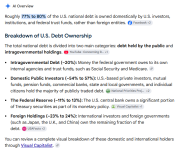
Just for perspective .... Japanese national debt to GDP 240 % .... Chinese national debt to GDP 300 % ..... US national debt to GDP is less than 130 % ...some people enjoy singing the blues.
Those countries own their own debt its internal. Its completely incomparable.
 
Just for perspective .... Japanese national debt to GDP 240 % .... Chinese national debt to GDP 300 % ..... US national debt to GDP is less than 130 % ...some people enjoy singing the blues.
China's government debt is 86% of GDP, and it is domestic debt, not external debt.
 

Forget U.S. debt, China’s total borrowing is in ‘a league of its own’—much worse and deteriorating faster, analyst says​

As President Donald Trump gets set to meet Chinese counterpart Xi Jinping this week, China’s technological prowess will be on display. But its state-led growth model has been slowing—and a rapidly expanding mountain of debt is a warning sign.

In fact, while the recent explosion in U.S. federal debt has raised numerous red flags, a broader measure of indebtedness across the public and private sectors shows borrowing as a share of GDP is actually down since 2010.

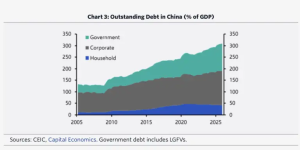
By contrast, China’s total debt-to-GDP ratio, excluding the financial sector, doubled in that span and has now topped 300%, according to Mark Williams, chief Asia economist at Capital Economics.

In a note late last month, he pointed out China’s debt surge has come despite weaker borrowing from households, which have been battered by the real estate market’s collapse.

But borrowing by companies as well as the central and local governments has continued to far outpace GDP growth, which has slowed in recent years, pushing the overall debt ratio higher.

Nearly 40% of outstanding debt is now owed by the public sector, including so-called local government financing vehicles, Williams calculated.


The result is total debt that surpasses the U.S., eurozone, the U.K., and other emerging markets. Aside from some smaller economies, only Japan has more debt.

“China’s current level of indebtedness puts it in a league of its own,” Williams said.

1787932867719.png

Little reality slap for certain folk in here.
 

Forget U.S. debt, China’s total borrowing is in ‘a league of its own’—much worse and deteriorating faster, analyst says​

As President Donald Trump gets set to meet Chinese counterpart Xi Jinping this week, China’s technological prowess will be on display. But its state-led growth model has been slowing—and a rapidly expanding mountain of debt is a warning sign.

In fact, while the recent explosion in U.S. federal debt has raised numerous red flags, a broader measure of indebtedness across the public and private sectors shows borrowing as a share of GDP is actually down since 2010.

By contrast, China’s total debt-to-GDP ratio, excluding the financial sector, doubled in that span and has now topped 300%, according to Mark Williams, chief Asia economist at Capital Economics.

In a note late last month, he pointed out China’s debt surge has come despite weaker borrowing from households, which have been battered by the real estate market’s collapse.

But borrowing by companies as well as the central and local governments has continued to far outpace GDP growth, which has slowed in recent years, pushing the overall debt ratio higher.

Nearly 40% of outstanding debt is now owed by the public sector, including so-called local government financing vehicles, Williams calculated.


The result is total debt that surpasses the U.S., eurozone, the U.K., and other emerging markets. Aside from some smaller economies, only Japan has more debt.

“China’s current level of indebtedness puts it in a league of its own,” Williams said.

View attachment 212976

Little reality slap for certain folk in here.
This article title is very misleading.

If you look at total debt of both US and China financial and non financial by gdp, its more or less equal for both countries around 330% gdp.

Both countries have different issues. China has lots of local government borrowing and bad investments like the property market, the US despite low unemployment and growing economy fiscally is getting worse with government debt every year.

US has the reserve currency so can issue debt easier but that's becoming more and more expensive.

China has a massive $3+ trn forex reserve which it could tap into for liquidity as well.

So all in all China and US are in the same debt league.
 
So if China takes back Taiwan by force, will it be invasion or a strategic capture ?

Let's say it takes taiwan by and than ask for 50% shares in TSMC. ??
Speaking of TSMC, I counted no less than 30 cranes in the air yesterday at the new campus in north Phoenix. Taiwan is indeed serious about duplicating all of its Taiwan-based capacity in the US.
 
South americans love a good revolution, I see history repeating itself nationalisation and control back by Venezuelan government not in bed with taco trump.
 
South americans love a good revolution, I see history repeating itself nationalisation and control back by Venezuelan government not in bed with taco trump.
Venezuela had a revolution and it got them Chavez who turned out, and his successor, to be nothing but incompetent hypocrite thieves which is why you don't see the masses in Venezuela protesting and rioting about US running the show. In their minds anything (for now) is better than what they had for the past decades. The people now have access to toilet paper unlike before where it got really sketchy back then.
 
I wonder how much investment will need to be made to bring the infrastructure back up to par. There has been years of neglect.
 
This article title is very misleading.

If you look at total debt of both US and China financial and non financial by gdp, its more or less equal for both countries around 330% gdp.

Both countries have different issues. China has lots of local government borrowing and bad investments like the property market, the US despite low unemployment and growing economy fiscally is getting worse with government debt every year.

US has the reserve currency so can issue debt easier but that's becoming more and more expensive.

China has a massive $3+ trn forex reserve which it could tap into for liquidity as well.

So all in all China and US are in the same debt league.
Based on the latest available data, the United States paid significantly more in debt interest than China in 2025. The exact comparison is as follows:

  • China (2025): Paid approximately $189 billion in interest on government debt, as reported by the Ministry of Finance.
  • United States (FY2025): The federal government paid almost $971 billion in net interest, according to the Congressional Budget Office (CBO).

📊 Understanding the Figures​

  • Differences in Data Scope: The US figures often represent "net interest," which accounts for interest payments on public debt minus certain interest income the government receives. The Chinese figure cited is the specific government budget expenditure line for debt interest payments. This can lead to slightly different numbers being reported for the US depending on the source, with total interest payments on public debt sometimes exceeding $1 trillion.
  • Overall Scale: Even with these accounting differences, the US interest bill remains several times larger than China's. The US spent over $970 billion on net interest in FY2025, making it one of the largest federal expenses, roughly $100 billion more than defense spending.
 

Users who are viewing this thread

Pakistan Defence Latest

Back
Top