Two articles were from the Unz Review and were on topic. Another (wish it did not get deleted, was an excellent article on how the closing of the Persian Gulf will affect the economy in China).
Choke Point: The Global Economic Consequences of the Persian Gulf Shutdown
How the disruption of oil, liquefied natural gas, and urea exports will cascade through the world economy
How the disruption of oil, liquefied natural gas, and urea exports will cascade through the world economy

www.unz.com
Snippets:
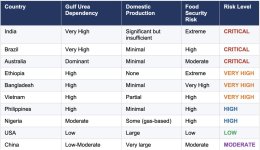
United States. The US has achieved near-energy-independence through its shale oil and gas revolution. It is a net oil exporter and the world’s largest LNG exporter. It produces large quantities of domestic urea. A Gulf shutdown would raise global prices and affect US consumers, but the supply shock would not directly threaten US energy security. The US is best placed of all major economies.
And
Conclusion
The Persian Gulf is not merely an important trade route — it is a structural dependency baked into the global economy over seven decades. The simultaneous disruption of oil, LNG, and urea flows from the region constitute a polycrisis of exceptional severity: an energy shock, an industrial shock, and a food security crisis arriving together, reinforcing one another, and challenging the capacity of governments, international institutions, and markets to respond.
Decades of optimisation around cost efficiency — concentrating energy production, fertiliser manufacture, and shipping in the most economical locations — has created a system that is efficient in stable conditions but catastrophically fragile under stress. If Iran is able to sustain the closure of the Strait of Hormuz for a month or more, it will enjoy significant leverage in negotiations to end the blockade.
~
Watch the urea exports, and the countries most exposed:
Crop yield decline. Without adequate nitrogen fertiliser, yields of staple crops — wheat, rice, maize, soy — would fall dramatically within one to two growing seasons. The effect would not be uniform: wealthy agricultural nations with domestic fertiliser capacity or large stockpiles (the United States, Canada, parts of Europe) would be more insulated. The developing world, particularly sub-Saharan Africa and South and Southeast Asia, would face acute shortages.
Food price inflation. Global food prices, already elevated by conflict-related supply disruptions in recent years, would surge further. The Food and Agriculture Organisation’s food price index would likely break historical records. Bread, rice, and staple grain prices would become unaffordable for hundreds of millions of people.
Urea Exposure: Country Risk Summary
View attachment 186221
My (and others) assessment:
The longer this war drags on, the greater risk of global famine.