U.S. Navy completes final deliveries of 300 Harpoon missiles
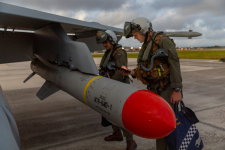
The U.S. Navy has completed delivery of the 300th and final Harpoon missile under its Lot 91 multi-year production agreement with Boeing, closing out a significant chapter in one of the Western world’s most widely fielded anti-ship weapon programs.
The milestone caps a production run primarily oriented toward Foreign Military Sales, extending the Harpoon’s global reach to a growing list of allied nations.
The missiles delivered under the Lot 91 agreement are the Harpoon Block II variant, the most capable iteration of the system currently in production. Block II incorporates GPS-assisted inertial navigation — a crucial upgrade that expands the weapon’s mission envelope well beyond its original anti-ship role. That dual-mode guidance architecture allows the Harpoon to prosecute both surface targets at sea and fixed targets on land, making it a more versatile strike asset for partner nations operating in complex, multi-domain threat environments.
According to the Precision Strike Weapons program office (PMA-201), the milestone reflects the coordinated effort of professionals spanning program management, engineering, logistics, and contracting disciplines. The international program lead credited that cross-functional teamwork as central to executing the delivery on schedule, underscoring the complexity of sustaining a multi-year production line that serves a wide roster of foreign buyers alongside domestic requirements.
The Lot 91 contract was structured specifically to support Foreign Military Sales, meaning the bulk of those 300 rounds are headed to allied and partner militaries rather than U.S. fleet inventories. That arrangement is consistent with the Navy’s broader strategy of leveraging FMS agreements to keep production lines active and costs manageable while simultaneously bolstering the maritime strike capacity of allied partners — many of whom operate aging or limited inventories of precision anti-ship weapons.
The Harpoon Block II’s GPS/inertial navigation combination addresses one of the original system’s key limitations. Earlier Harpoon variants relied on active radar homing for terminal guidance, which worked well against surface ships but constrained the weapon to purely maritime targets. The Block II’s GPS integration enables the missile to fly pre-programmed routes to fixed coordinates, allowing operators to engage land targets — coastal defense installations, port infrastructure, or beachhead positions — with the same round used for anti-ship strikes. That flexibility has made Block II the preferred export variant for navies and air forces seeking a single solution for both sea-control and land-attack missions.
The Harpoon itself traces its operational lineage back nearly five decades. PMA-201 has delivered close to 6,000 Harpoon missiles in total since 1977, spanning air-launched, surface-launched, submarine-launched, and exercise configurations. Those deliveries have gone to 30 FMS partner nations worldwide, a testament to the system’s reputation for reliability and the long-standing international demand for capable, proven anti-ship weaponry.
That scale of proliferation also speaks to the broader challenge facing U.S. partners: aging or insufficient stocks of precision maritime strike weapons at a time when naval competition is intensifying across multiple theaters. Demand for systems like Harpoon — affordable, combat-proven, and compatible with a wide range of launch platforms — has remained steady even as navies worldwide evaluate next-generation alternatives.
Boeing has been the program’s prime contractor throughout, and the Lot 91 production run represents one of the more recent sustained tranches of Harpoon manufacturing. While the Navy continues to assess longer-term successors to Harpoon in its own fleet, the FMS pipeline has kept the production base warm and ensured that allied partners can continue receiving new-build rounds rather than drawing down aging inventories.