US Economy - News, Updates and Discussion

US holds interest rates as Iran war triggers oil shock​


Natalie Sherman
Business reporter

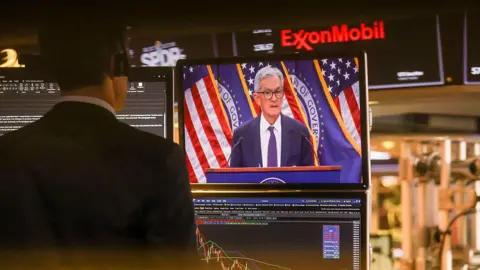
Bloomberg via Getty Images A livestream shows Jerome Powell, chairman of the US Federal Reserve, speaking after a Federal Open Market Committee (FOMC) meeting on the floor of the New York Stock Exchange (NYSE) in New York, US, on Wednesday, Jan. 28, 2026.


Bloomberg via Getty Images A livestream shows Jerome Powell, chairman of the US Federal Reserve, speaking after a Federal Open Market Committee (FOMC) meeting on the floor of the New York Stock Exchange (NYSE) in New York, US, on Wednesday, Jan. 28, 2026. Bloomberg via Getty Images

The US central bank has voted to hold interest rates steady again, as a spike in oil prices since the US-Israel war with Iran began raises economic uncertainty and threatens to drive up inflation.

The decision, which was widely expected, left the Federal Reserve's key interest rate in the range of 3.5%-3.75%, where it has stood since December.

Despite pressure from US President Donald Trump to slash borrowing costs, policymakers have been moving cautiously, as they face a tricky combination of rising prices and mixed signals from the job market.

Analysts say the war has made them even less likely to cut, pushing back expectations for a rate cut until the end of this year.

The Fed typically lowers borrowing costs when it sees unemployment rising and wants to boost the economy. It raises them when it is worried about inflation, hoping higher borrowing costs will ease spending and slow down price rises.

But an economic picture muddied in part by abrupt policy changes, such as tariffs, has made it difficult for policymakers to agree on which problem to prioritise.

The war in Iran is the latest, triggering a spike in oil prices that has already driven up gas prices in the US to the highest since 2024.

While that is likely to drive up prices more widely, at least temporarily, it also risks slowing the economy, as households have less money to spend on other things.

"The implications of developments in the Middle East for the US economy are uncertain," the Fed said in the statement announcing its rates decision.
 
Forecasts from policymakers show on average they now expect inflation of 2.7% this year, up from the 2.4% they were predicting in December.

The average forecasts for economic growth are 2.4%, up slightly from 2.3% in December. The unemployment rate is expected to hold steady at 4.4%, as previously predicted.

A majority of Fed board members still expect to cut interest rates at least once this year, with five now expecting rates could fall below 3%.
 
To view this content we will need your consent to set third party cookies.
For more detailed information, see our cookies page.
 
To view this content we will need your consent to set third party cookies.
For more detailed information, see our cookies page.
 
To view this content we will need your consent to set third party cookies.
For more detailed information, see our cookies page.
 
To view this content we will need your consent to set third party cookies.
For more detailed information, see our cookies page.

It was 5 months to the day before our home sold. Local market experts predicted a further decline through the late spring and so far, that has been the case.
 
For an economy that is supposedly in shambles, why is it I still receive several solicitations a week for various contract positions?

Have received 4 so far this week alone.
 
To view this content we will need your consent to set third party cookies.
For more detailed information, see our cookies page.
 
Forecasts from policymakers show on average they now expect inflation of 2.7% this year, up from the 2.4% they were predicting in December.

The average forecasts for economic growth are 2.4%, up slightly from 2.3% in December. The unemployment rate is expected to hold steady at 4.4%, as previously predicted.

A majority of Fed board members still expect to cut interest rates at least once this year, with five now expecting rates could fall below 3%.
The way doomsayers make predictions regarding inflation is as if it's going to reach 50% in the US.
 

US stocks skid as Middle East turmoil fans inflation fear

Reuters
March 21, 2026

Wall Street ended sharply lower on Friday, with the S&P 500 closing at its lowest in six months, as the US-Israeli war against Iran entered its fourth week, deepening worries about inflation and the potential for higher interest rates.

The conflict in the Middle East showed no signs of easing. The US military was deploying an amphibious assault ship with thousands of additional Marines and sailors to the Middle East, while Iran’s new supreme leader hailed Iran’s “unity” and “resistance”.

“The market is finally settling into the idea that this may go on longer than initially expected, and I think that’s why markets are selling off. This conflict may go on not for just a few weeks, but maybe beyond several months,” said Jake Dollarhide, CEO of Longbow Asset Management in Tulsa, Oklahoma.
 
Magnificent 7 companies fall
Wall Street’s most valuable companies dropped, with Nvidia and Tesla losing over 3pc each. Alphabet, Meta Platforms and Microsoft were all down about 2pc.

US Treasuries fell for a third session, in step with a broader selloff in UK and European government bonds, as the Middle East conflict kept oil prices elevated and reinforced inflation worries.

US rate futures show the Fed is more likely to raise interest rates than cut them by the end of 2026, according to CME’s FedWatch tool.

“We just have a classic environment that is pushing rates up and it’s driven by higher inflation expectations, which relate back to the oil price. And the fact that we’re heading into the fourth week of the war suggests that that stress is not going away anytime soon,” said Padhraic Garvey, head of global rates and debt strategy at ING in New York.

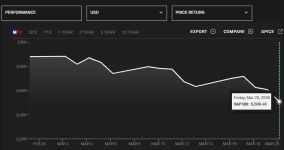
The S&P 500 declined 1.51pc to end the session at 6,506.48 points, its lowest since September.

1774184991325.png

Screengrab from S&P Global’s website.

The Nasdaq slumped 2.01pc to 21,647.61 points, leaving it down almost 10pc from its record high close on October 29.

The Dow Jones Industrial Average declined 0.96pc to 45,577.47 points.

The Russell 2000 index of smaller companies dropped 2.26pc, leaving it down 10pc from its record high close on January 22.
 
Nine of the 11 S&P 500 sector indexes declined, led lower by utilities, down 4.11pc, followed by a 3.15pc loss in real estate.

The S&P 500 energy sector index was near flat for the day, but it logged its 13th straight weekly gain. That week-over-week rally was its longest since at least the late 1980s, according to LSEG data, as geopolitical events in Venezuela and the Middle East dominated much of the first quarter.

Friday marked the once-in-a-quarter simultaneous expiry of derivatives contracts tied to stocks, index options and futures, also known as “triple witching”, and volume on US exchanges was heavy, with 27.5 billion shares traded, compared to an average of 20.1bn shares over the previous 20 sessions.


For the week, the S&P 500 lost 1.9pc, while the Nasdaq and Dow lost just over 2pc.

Since the war in Iran began on February 28, the S&P 500 has lost 5.4pc, the Nasdaq has declined 4.5pc and the Dow is down nearly 7pc.

All three major indexes are below their 200-day moving averages, underscoring the recent deterioration of sentiment on Wall Street.

Super Micro Computer tumbled 33pc after three people associated with the artificial intelligence server maker were charged with smuggling at least $2.5 billion of AI technology to China. Rival Dell advanced.

FedEx, often seen as a barometer of business activity, issued upbeat forecasts and said global demand was holding steady despite geopolitical tensions, sending its shares up almost 1pc.

Declining stocks outnumbered rising ones within the S&P 500 by a 3.4-to-one ratio.

The S&P 500 posted 11 new highs and 36 new lows; the Nasdaq recorded 43 new highs and 274 new lows.
 

The Treasury just declared the U.S. insolvent. The media missed it​


March 23, 2026

Steve Hanke is a professor of applied economics at The Johns Hopkins University and a member of the Board of Directors at the Federal Fiscal Sustainability Foundation. He is the co-editor, with Barry W. Poulson and John Merrifield, of Public Debt Sustainability: International Perspectives (Lexington Books, 2022). David M. Walker is the former Comptroller General of the United States and the Chairman of the Board of Directors at the Federal Fiscal Sustainability Foundation.
 
To view this content we will need your consent to set third party cookies.
For more detailed information, see our cookies page.
 

Users who are viewing this thread

Country Watch Latest

Back
Top