Beijingwalker
VIP Member

U.S. lawmaker proposes building most Navy ships in South Korea
By Asia Today and translated by UPI,July 17 (Asia Today) -- A senior U.S. lawmaker proposed building as much as 80% of some American naval vessels in South Korea while reserving sensitive technology and final assembly for the United States.
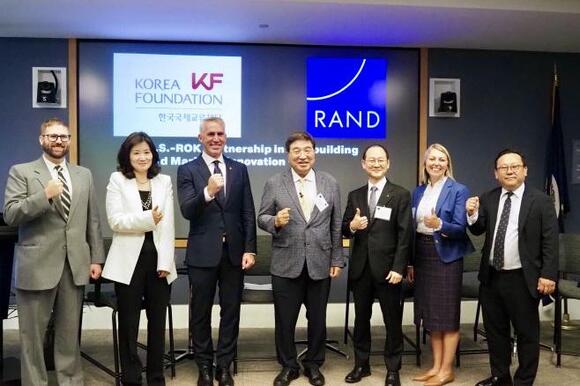
Korea Foundation and shipbuilding industry representatives attend a South Korea-U.S. shipbuilding and maritime innovation forum Thursday at RAND in Arlington, Va. Photo by Asia Today
Rep. Ami Bera of California, the top Democrat on the House Foreign Affairs subcommittee overseeing East Asia and the Pacific, said Thursday that relying exclusively on domestic shipyards was unrealistic because the United States lacks sufficient workers and production capacity.
Bera spoke at a South Korea-U.S. shipbuilding and maritime innovation forum hosted by the Korea Foundation and the RAND research organization in Arlington, Va.
"To say we are going to build everything in the United States is wrong," Bera said, urging Washington to make greater use of allied manufacturing capacity.
He suggested that South Korean shipyards could produce hulls and other components accounting for 75% to 80% of a vessel, while highly sensitive systems could be manufactured and installed in the United States.
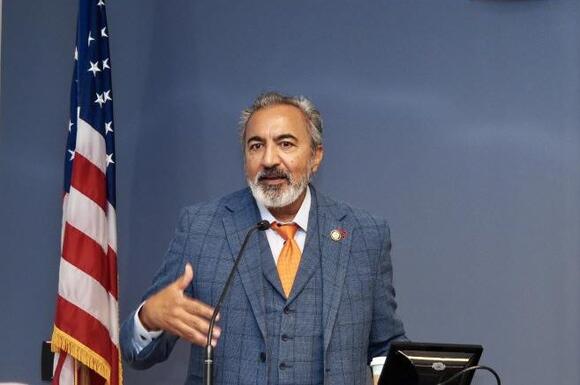
Rep. Ami Bera, D-Calif., speaks Thursday at a South Korea-U.S. shipbuilding and maritime innovation forum at RAND in Arlington, Va. Photo by Asia Today
Bera also proposed a distributed construction model under which components would be produced at different locations before being brought to the United States for final assembly.
"If we do not have the workers or construction capacity in the United States, we have to build where ships can be built," he said.
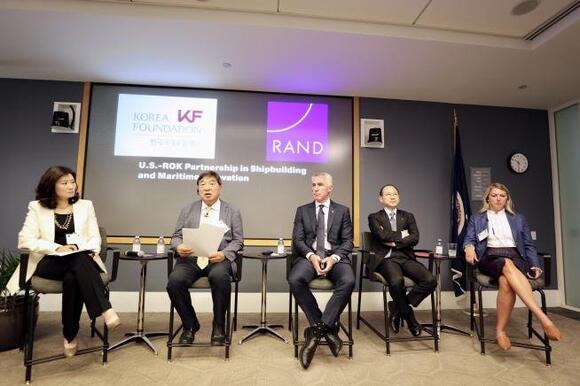
Shipbuilding executives and experts discuss South Korea-U.S. maritime cooperation Thursday at RAND in Arlington, Va. Photo by Asia Today
Bera said combining the capabilities of the United States and its allies would strengthen deterrence and help prevent a military conflict with China.
Technology controls and visas remain obstacles
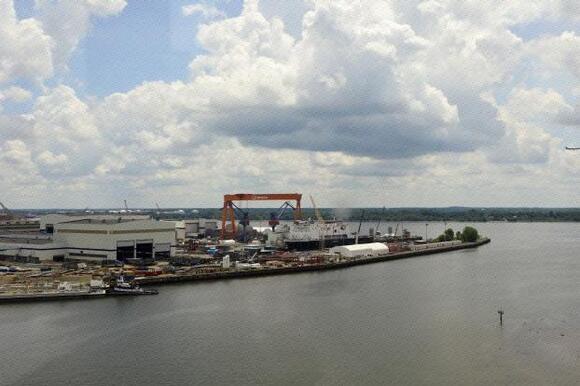
Hanwha Philly Shipyard in Philadelphia could support expanded South Korea-U.S. shipbuilding cooperation. Photo by Asia Today
Bera said President Donald Trump had discussed nuclear-powered submarine construction with South Korea.
Such cooperation would require the two countries to address technology sharing and export control restrictions, he said.
Bera cited the security partnership among the United States, Britain and Australia as a possible model for resolving issues related to joint naval construction.
The partnership, commonly known as AUKUS, includes plans for Australia to acquire nuclear-powered submarines with American and British assistance.
Bera also called on the United States to facilitate the entry of South Korean engineers and technicians needed to support investments by Korean shipbuilding companies.
He described the detention of more than 300 South Korean workers in Georgia in September as an "embarrassing fiasco" and said the visa problem must be resolved.
The United States has encouraged South Korean companies to invest in American manufacturing while immigration restrictions have complicated the deployment of specialized Korean personnel to construction sites and shipyards.
Expert says U.S. rebuilding could take decades
Shin Jong-gye, a professor emeritus of naval architecture and ocean engineering at Seoul National University, said China's overall shipbuilding capacity by gross tonnage was more than 230 times that of the United States.
He said China had more than 50 dry docks large enough to accommodate aircraft carriers.
Newport News Shipbuilding in Virginia is the only U.S. shipyard capable of designing and building nuclear-powered aircraft carriers.
Shin said the United States must expand both its physical shipyard capacity and its ability to build vessels quickly and efficiently.
South Korea, Japan and China benefit from building commercial and naval vessels within the same industrial ecosystems, allowing them to share technology, workers and supply chains, he said.
The United States lacks a comparable commercial shipbuilding base and therefore cannot obtain the same economies of scale, Shin said.
South Korea, Japan and China together account for more than 95% of global commercial shipbuilding.
Shin said rebuilding an industry requires accumulated experience, technology and repeated construction cycles.
He estimated that rebuilding the U.S. shipbuilding sector independently could take 20 to 30 years, while cooperation with South Korea could significantly shorten the process.
Shin proposed initially building complete ships in South Korea while developing supply chains in the United States. American production could then be expanded gradually.
He said protecting South Korean intellectual property, providing appropriate compensation and resolving visa restrictions for Korean specialists would be essential.
Hanwha, HD Hyundai respond to Navy request
Michael Coulter, president and chief executive officer of Hanwha Defense USA, said protectionism was one of the largest obstacles to industrial cooperation.
He said South Korea and the United States often viewed each other primarily as export markets rather than partners sharing a common industrial base.
Coulter said the U.S. Navy had issued a request for information after consulting the South Korean government and Korean shipbuilders.
The request examined the possible use of a vessel construction manager who would help finalize a ship's design before construction begins.
South Korean shipyards generally complete designs before starting construction, while U.S. Navy projects often undergo design changes after work has begun, increasing costs and delaying delivery, Coulter said.
The U.S. government has asked Hanwha about options ranging from building combat vessels and supplying motors to constructing hulls in South Korea before installing American technology, he said.
Coulter said, however, that the administration and Congress had not reached a unified position.
He called on the two countries to integrate portions of their industrial bases rather than treat each investment or contract as a conventional export transaction.
Hong Suk-hwan, president and chief executive officer of HD Hyundai USA, proposed a two-track strategy involving investment in U.S. shipyards and partnerships with existing American companies.
Hong said HD Hyundai had built about 5,000 vessels during the past 50 years and could apply its skilled workforce, manufacturing experience and supply network to the United States.
He also proposed a "bridge strategy" in which American workers would train at South Korean shipyards for about three years while ships were being constructed there.
The trained workers could then return to the United States as supervisors and production managers at American shipyards.
U.S. law limits overseas warship construction
Brittany Clayton, a senior operations researcher at RAND, said complicated U.S. defense procurement procedures, unpredictable orders and design changes during construction remained major barriers to cooperation.
The Navy, Defense Department and Congress all play roles in funding and policy decisions, making rapid action difficult, she said.
Clayton said companies needed consistent and predictable demand from the U.S. government before making long-term investments.
She also cited proposed legislation restricting the overseas construction of American combat vessels.
Rep. Jared Golden of Maine, whose district includes the Bath Iron Works shipyard, introduced an amendment to the fiscal 2027 defense authorization bill that would restrict foreign construction of combat ships.
Clayton said distributed construction could provide an alternative, with components built at multiple locations before being integrated and tested in the United States.
She also suggested beginning cooperation with strategic sealift vessels, which contain fewer sensitive military technologies than combat ships.
The Senate Armed Services Committee included language in its fiscal 2027 defense authorization legislation that would permit the acquisition of up to two noncombat vessels from allied shipyards, including bulk fuel carriers and strategic sealift ships.
Trump said Wednesday that his administration was examining shipbuilders in South Korea and other countries and could purchase some vessels built outside the United States.
Kristin Gunness of San Diego State University said the university had signed an agreement with Samsung Heavy Industries to establish a marine engineering and shipbuilding center.
She said the university was also developing exchange programs with Seoul National University and other South Korean institutions.
Shin proposed short-term educational programs involving retired South Korean professors and American universities to train ship designers and production managers.