Built quietly by Raytheon’s Advanced Technology division, the AIM-424 Long Range Air-to-Air Missile (LRAAM) is capable of hitting targets over 250 nautical miles (463 kilometers) away by leveraging its 13.5″ diameter and aerodynamic profile — outranging “any threat” according to Raytheon’s president Phil Jasper.
The U.S. Navy’s newest air-to-air missile, the AIM-424 Malice, was developed for both Air Force and Navy current- and next-generation fighters as the Pentagon looks to press additional capabilities into service for a high-end war in the Pacific, drawing from program efforts dating to the mid-2010s that sought long-range air-to-air missiles for competition with China.
Aviation Week was first to report on the missile’s existence when it was unveiled at the Tailhook Convention in Reno, Nevada — an event focused on naval aviation.
Built by Raytheon, the AIM-424 is capable of hitting targets over 250 nautical miles (463 kilometers) away, leveraging a 13.5″ diameter and aerodynamic profile that appears to have been built for range. That range would exceed estimates of all currently known Chinese air-to-air missiles that have widely been recognized as major threats to U.S. airpower in the Pacific.
“LRAAM sustains the Department’s first look, first shot, first kill advantage by providing our aviators greater reach, greater survivability, and greater tactical flexibility in the air-to-air fight. Built for 4th, 5th, and 6th generation platforms, LRAAM is designed for the air wing of today and the future,” the Navy said
in its recently updated weapons portfolio overview.
Its range — and speed — exceed that of the currently fielded AIM-174B, a U.S. official familiar with the program confirmed to
Naval News. Specialized aerodynamic fins and strakes also enable the missile to retain significant amounts of maneuverability even with its larger size compared to the long-fielded Raytheon-built AIM-120 AMRAAM and in-development Lockheed Martin-built AIM-260 JATM, according to the official. The retained maneuverability may allow the missile to engage fighter-sized targets even with its larger size.
Specialized cyber development teams have worked on building the missile’s infrastructure for a broad range of aircraft and joint systems shared between the U.S. Air Force and U.S. Navy, according to two U.S. officials familiar with elements of the program’s development. Their work began in January and included work on a specialized datalink designed for Malice’s longer range, of which little details are known.
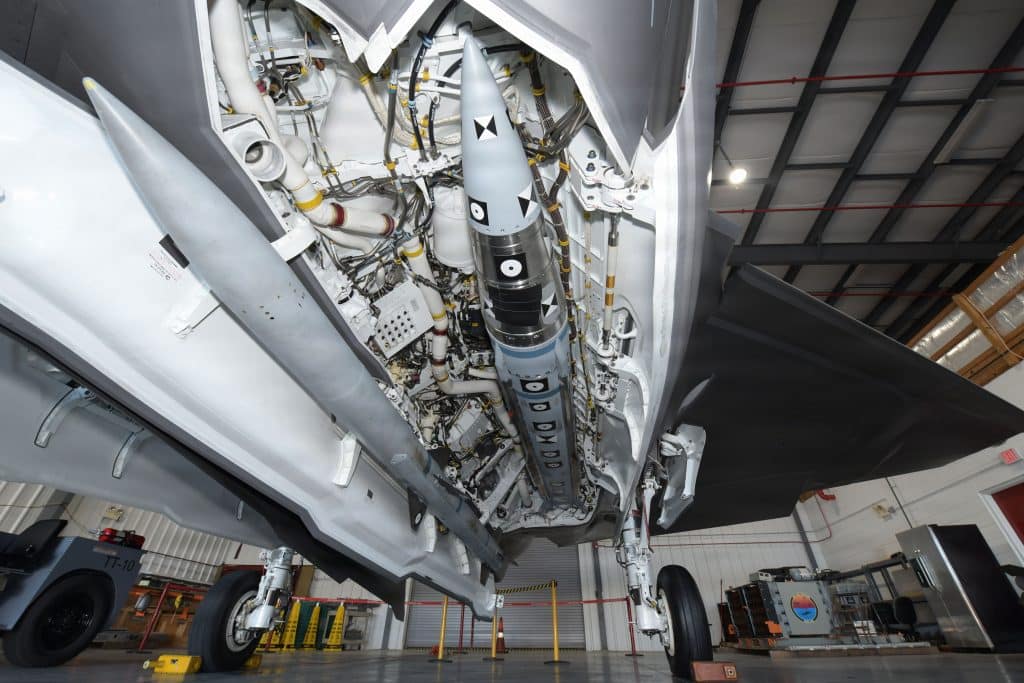
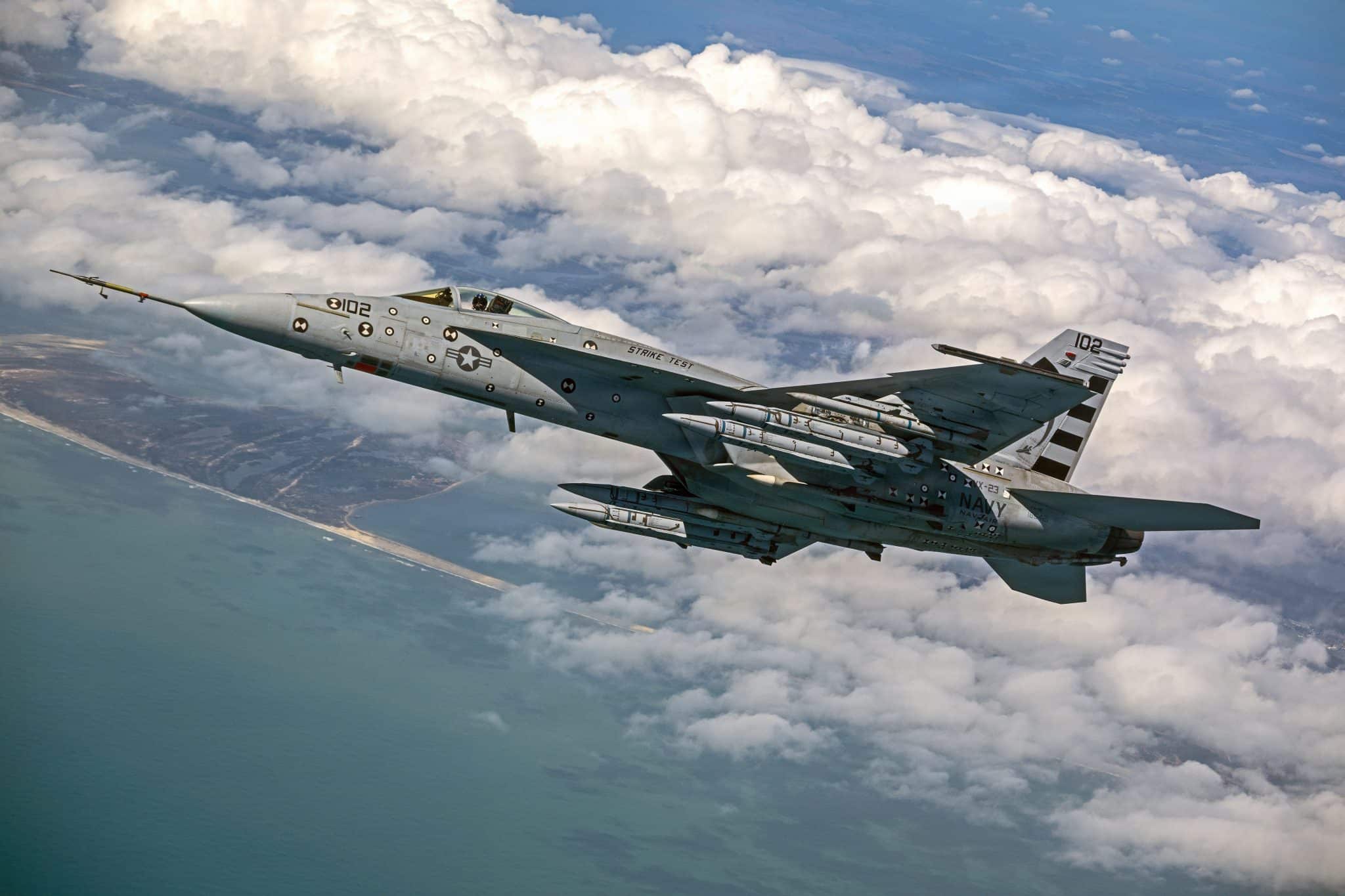
The broad range of aircraft include the U.S. Air Force’s sixth-generation F-47 and the U.S. Navy’s F-35C, F/A-18, and potentially the F/A-XX. At least one captive-carry flight test was disclosed in the Navy’s image release, dating back to April 2026. A fit test on an F-35 appears to have been conducted earlier this month in August.
Naval News understands that the missile has been in development much longer.
An AIM-424 Long Range Air-to-Air Missile (LRAAM) is mounted in the internal weapons bay of an F-35C. The AIM-424 LRAAM is the Department of the Navy’s next-generation, long-range air-to-air missile, built to give Marine and Naval aviators the capability they need to defeat advanced threats and defend the force. (U.S. Navy photo)
Confirmation of the missile’s existence from Raytheon came in a statement from the company’s president provided to
Naval News.
“Strengthening fleet defense and maintaining superiority are essential to address rapidly emerging long-range air-to-air threats,” said Phil Jasper, president of Raytheon, an RTX business.
“Our Advanced Technology team’s approach is at the core of doing just that with the development of the AIM-424. With increased range, lethality, and combat effectiveness for naval forces, the AIM-424 delivers a generational leap in air dominance combat capability that can out range any threat.”
The AIM-174B, once the U.S. Navy’s hottest air-to-air missile that was revealed to be operationally deployed in 2024, has been understood to serve as a stopgap for future capabilities that were in development through the past decade.
“[AIM-174] exists. That’s an operational capability. As you can see that one being revealed and shown into the area, there are many more behind [it],” Admiral Keith Hash, Commander, Naval Air Warfare Center, Weapons Division (NAWCWD) said at the WEST 2025 conference in San Diego, California. NAWCWD is the same Navy team that helped develop and field the AIM-174B for operational use.
Beyond AIM-174 and AIM-424, the Pentagon continues to refine requirements around its Air Force Long Range Weapon (AFLRW) that seeks an air-to-air missile for the U.S. Air Force with a 1,000 nautical mile (1,850 kilometer) range.
A U.S. Navy official provided the following statement to
Naval News on Saturday:
“The Department of the Navy is developing the AIM-424 Long Range Air-to-Air Missile (LRAAM), a next-generation missile intended to strengthen fleet defense and maintain a decisive air-domain overmatch against advanced threats. Also known as Malice, the LRAAM directly supports the Department’s contribution to integrated deterrence by increasing range, lethality, and combat effectiveness for Marine and Naval Aviation forces that are defending our fleets, our interests, and our homeland. Further details regarding specific capabilities and deployment timelines remain classified to protect operational security.”
The U.S. Navy and Raytheon have unveiled the AIM-424 Malice, a long-range air-to-air missile built to hit targets over 250 nautical miles away.

www.navalnews.com