US Perspective on the Iran - Israel / US War

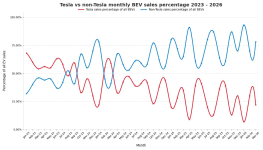
1. Tesla has overtaken BYD in Q1 2026 as BYD sales plummeted by 25%. No one cares about PHEVs. Tesla doesn’t sell those.

For a specific quarter that does not take into account seasonal differences between the markets. China is the super power when it comes to EV cars, and EV technology. The list is clear that China sells the bulk of all EV's globally.

Tesla is losing the overall race as new entrants displace Tesla.

1775929410076.png


2. Which is still a minuscule amount. Doesn’t change the fact that 95% of global vehicles run on gasoline.

The global trendline is away from the USA to China for the energy market. Solar, and renewables and battery technology are the future. China is winning strategically for the future while the USA's trying to win yesterdays battles on obsolete technology. We are past peak oil usage, and the trend line is negative and downwards from here on out. A car has a shelf life of 15 years. The only industry that may remain on oil is aviation, most other things will move on..

3. That’s still over 10% of global use. Another 25% is used in manufacturing, chemical, mining, and construction industries.

4. Great, 26% of US electricity generation last year was produced by renewables, that will be a third by 2030.

5. You can cope all you need to. It doesn’t change the fact the US now has a stranglehold over global energy.

Here, and now for a short period, but what this highlights and reinforces my point. USA empire from now on, is fleeting and all people from the MAGA crowd have is cope to pretend they are winning on things that the world is moving away from.

Oil is not the future. It will become a niche product mostly for chemicals, and aviation ( and for aviation, we have the spectre of Aviation biofuel on the horizon .. ).
 
Last edited:
To view this content we will need your consent to set third party cookies.
For more detailed information, see our cookies page.


To view this content we will need your consent to set third party cookies.
For more detailed information, see our cookies page.


US destroyers have begun mine clearance operations in the Strait


To view this content we will need your consent to set third party cookies.
For more detailed information, see our cookies page.


According to Bloomberg, the USN turned tail and ran away ?
 
For a specific quarter that does not take into account seasonal differences between the markets. China is the super power when it comes to EV cars, and EV technology. The list is clear that China sells the bulk of all EV's globally.

Tesla is losing the overall race as new entrants displace Tesla.

View attachment 191897


The global trendline is away from the USA to China for the energy market. Solar, and renewables and battery technology are the future. China is winning strategically for the future while the USA's trying to win yesterdays battles on obsolete technology. We are past peak oil usage, and the trend line is negative and downwards from here on out. A car has a shelf life of 15 years. The only industry that may remain on oil is aviation, most other things will move on..


Here, and now for a short period, but what this highlights and reinforces my point. USA empire from now on, is fleeting and all people from the MAGA crowd have is cope to pretend they are winning on things that the world is moving away from.

Oil is not the future. It will become a niche product mostly for chemicals, and aviation ( and for aviation, we have the spectre of Aviation biofuel on the horizon .. ).

Tesla produces the best EVs in the world. The fact Tesla is outselling BYD at 2-3X the ASP of BYD says it all. BYD is also massively subsidized with little profit to show for it. No one is replacing Tesla, it’s literally the top BEV seller in the world.

Again, 95% of the global fleet are gasoline. At current rate of adoption, it will take decades to put a dent into that number and that’s if the trendline EV adoption holds.

The reality today is the US has a stranglehold on the global energy market. The future belongs to the US, for many reasons, but we’re getting too far off topic.
 
To view this content we will need your consent to set third party cookies.
For more detailed information, see our cookies page.


According to Bloomberg, the USN turned tail and ran away ?


Centcom confirmed mine clearing operations have begun, and more warships and underwater drones will participate in the coming days.
 
Centcom confirmed mine clearing operations have begun, and more warships and underwater drones will participate in the coming days.


To view this content we will need your consent to set third party cookies.
For more detailed information, see our cookies page.


CENTCOM lied ..
 
To view this content we will need your consent to set third party cookies.
For more detailed information, see our cookies page.


To view this content we will need your consent to set third party cookies.
For more detailed information, see our cookies page.
 
To view this content we will need your consent to set third party cookies.
For more detailed information, see our cookies page.


CENTCOM lied ..


To view this content we will need your consent to set third party cookies.
For more detailed information, see our cookies page.


It’s been confirmed by Sec Hegseth.
 
To view this content we will need your consent to set third party cookies.
For more detailed information, see our cookies page.


The Hormuz Get Out Of Jail Card Turned To a Grave

For decades the IRGC relied on its ability to threaten closure of the waterway as its premier economic shield and golden get out of jail card.

Roughly 21 million barrels per day of oil and petroleum products normally transit the strait. That volume accounts for one fifth of global petroleum liquids consumption and one quarter of all seaborne traded oil.

Yet the destinations of those flows expose the asymmetry that ultimately doomed the strategy.

In the first half of 2025 ~89% percent of crude oil and condensate flowed eastward to Asian markets.

China absorbed 37.7 percent of the total followed by India at 14.7 percent South Korea at 12 percent Japan at 10.9 percent and other Asian buyers at 13.9 percent.

Europe received just 3.8 percent and the United States only 2.5 percent. The IRGC was never holding the West hostage. It holds the East.By throttling traffic during the conflict the regime exercised its only economic "card". Ship transits collapsed to under ten percent of normal levels even after the ceasefire. Insurance rates soared and oil prices spiked.

The move they thought would delivered short term tactical breathing room and helped force negotiations. Yet the decision transformed a potent deterrent into a wasting asset.

The primary victims were Asian importers especially China and India. Those nations faced immediate cost spikes and supply uncertainty.

Beijing responded by drawing down its strategic petroleum reserve which covers more than four months of imports while accelerating purchases of Russian African and Latin American crude.

India pursued parallel diversification.
More critically Gulf producers gained the political urgency and capital they needed to lock in permanent bypass infrastructure.🇸🇦

Saudi Arabia ramped its East West Petroline to near its seven million barrels per day capacity routing crude to Red Sea terminals at Yanbu.

The United Arab Emirates expanded the Abu Dhabi Crude Oil Pipeline to Fujairah on the Gulf of Oman. Additional overland proposals and expanded export terminals emerged almost immediately.
Once those routes reach commercial scale the strait loses its status as a global chokepoint. It becomes a regional inconvenience whose disruption matters far less to the broader market.
🇺🇸

Simultaneously United States crude exports have surged to a record 4.9 million barrels per day in April 2026 with forecasts pointing toward five million or higher in coming months. That volume covers roughly 23 percent of normal full Hormuz traffic and about one third of the crude and condensate segment.

Asian refiners have redirected demand toward US Gulf Coast barrels to fill the shortfall from Middle East shut ins estimated at 7.5 to 9.1 million barrels per day. The surge not only caps price spikes but also cements American producers as the flexible swing supplier to Asia.
This development accelerates the very diversification that erodes Iranian leverage.
The one year five year and ten year horizons reveal starkly divergent outcomes.

For IRGC the picture darkens at every stage. In the first year oil revenues collapse despite temporary price spikes because export volumes remain minimal. The economy already contracting from war damage and sanctions faces hyperinflation in food prices and widespread shortages.

Over five years bypass pipelines and alternative supply chains become permanent fixtures. Petrodollar inflows never recover and sanctions compound the isolation.

By year ten Iran confronts structural marginalization as a secondary supplier at best. Internal pressures from economic rot and factional rivalry mount inexorably.
The regime is forced to move first. It cannot sustain years of revenue denial while rivals reroute around it. Diplomatic capitulation or escalated domestic repression becomes inevitable well before the five year mark.

China absorbs the heaviest short term pain yet emerges stronger. Higher import costs slow some refinery runs in the first year but strategic reserves Russian pipelines and surging United States imports prevent outright shortages.

Over five years Beijing locks in new sourcing habits and accelerates renewables and domestic production. By year ten China enjoys markedly improved energy security with far less exposure to any single chokepoint. The crisis ultimately serves as an expensive but effective catalyst for diversification but shines a light on Chinese dependency on US rendering any multipolar aspirations null, China isn't a pole probably never was if it can't survive without IRGC cheap oil paid with the blood of Iranians.
🇺🇸The United States stands as the unambiguous winner across all horizons. Export revenues boom in the first year as shale producers respond to sustained high prices.
Over five and ten years America solidifies its role as the reliable Atlantic basin supplier to Asian demand. Strategic leverage deepens without proportional domestic pain.
Gulf states also gain by converting crisis into durable infrastructure and expanded market access.In strategic terms the IRGC executed a classic use it or lose it blunder. By weaponizing the eastern hostage it compelled the very adaptations that render the hostage irrelevant. Global energy flows have begun a permanent eastward rerouting that favors flexible producers over vulnerable chokepoint holders.

The 2026 crisis therefore accelerates the long term isolation of Iran. It diminishes the regime's economic shield permanently and hastens the internal collapse dynamics already evident before the conflict.

What began as a tactical gambit to survive immediate pressure has instead locked in decades of strategic decline. The geography of oil trade the scale of United States export capacity and the self interest of Asian importers have combined to ensure that the IRGC traded its last "card" for time it didn't get and burned what it could not afford to waste relevance and economic potential to climb out of the grave it dug itself.

The Hormuz closure wasn't a surprise to any serious person, one might argue Trump turnd what the enemy believed to be a leverage to a ticking time bomb trap the IRGC just walked into.

IRGC was never the end goal, China is.
 

A Naval Standoff in Hormuz Shows the High Stakes in U.S.-Iran Talks​


ISLAMABAD—The U.S. sent two destroyers through the Strait of Hormuz for the first time during the war, triggering a tense confrontation Saturday while high-level American negotiators were preparing to meet with their Iranian counterparts in Pakistan in a long-shot attempt to make peace.

The incident underscored the high stakes of the negotiations, where Tehran’s continued control of the waterway has become the core sticking point.

The Islamic Revolutionary Guard Corps Navy, which has kept traffic in the strait to a trickle since the cease-fire and is imposing a system of tolls, challenged the U.S. ships as they tried to cross. A radio conversation recorded by crew members on a nearby civilian ship captured the incident.

“This is the last warning. This is the last warning,” the Iranian forces radioed to one of the destroyers.

“Passage in accordance with international law. No challenge is intended to you, and I intend to abide by rules of our government’s cease-fire,” the U.S. ship responded.

The U.S. Central Command said the destroyers operated in the Persian Gulf and departed as planned without incident. It said it sent them to signal the U.S. doesn’t accept Iran’s control of the strait and to begin the process of reopening it to commerce.

The crossing also kicked off a broader mission using underwater drones to rid the waterway of mines, Centcom said.

“We’re now starting the process of clearing out the Strait of Hormuz,” Trump said Saturday morning on social media.

 
To view this content we will need your consent to set third party cookies.
For more detailed information, see our cookies page.
 
Direct talks going on between US and Iran ...it gives credence to my earlier stance on this thread ! It's a show for the galleries.....deal is already done.
Some of us refer to it as bukkake theater.
 
To view this content we will need your consent to set third party cookies.
For more detailed information, see our cookies page.
 
To view this content we will need your consent to set third party cookies.
For more detailed information, see our cookies page.


War may be back on soon
 
To view this content we will need your consent to set third party cookies.
For more detailed information, see our cookies page.


War may be back on soon


To view this content we will need your consent to set third party cookies.
For more detailed information, see our cookies page.
 

Users who are viewing this thread

Latest Posts

Back
Top