US Perspective on the Iran - Israel / US War


USS Vinson is off the coast of San Diego doing a little training and though no announcement have been made my sister is saying her husband and USS Vinson are deploying again soon likely late November early December.
 
Once Iran runs out of money to pay its troops, then what happens?
Iran owns his currency, they can print all the fiat money, rials, they need.

Inflation will distribute the problem to the rest of the country.
 
3 carriers will be in middle east late November and Marines are also being deployed I think win or lose midterms Trump is going to restart kinetic hostilities end of November.

it may be sooner than that if Satanyahu has his way, which he probably will.
They need to do another war to show they're winning.
Other than Iran, it may also target some others.

Time will tell how quickly shit will hit the fan if the war resumes. Then the gulfies won't be sitting aight......expect airspace and airport closures again maybe more spread and more destruction

Are we expecting more plumbing issues aboard those ships again, feel sorry for the folks who gonna be at sea for long time again
:LOL:
 
Congress never funded the Iran war. The Pentagon is paying anyway


So, it seems that the ask to increase the Pentagon budget by 50% is so that the Pentagon can have a permanent budget to fight wars without having to ask each war to be paid for by congress. It is not just about recapitalisation of the armed forces, but a permanent war fighting fund.
we're in the end times, and that big war(war machine) on behalf of zions needs the money. And here comes the american taxpayer money (the sponsorship of world wars).....the CIA/Pentagon/Blackrock/WEF can sponsor anything now.
 
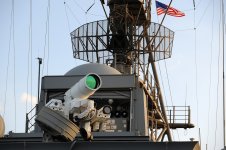
I disagree. At the least, the US demonstrated military capabilities that so far have been confined to the testing regime. Couple of new examples are the ODIN and HELIOS defensive laser systems. The F-35 moved from being the butt of jokes to making jokes out of contested airspaces. The A-10 got another reprieve. Precision bombs got more precise.

Lockheed Martin HELIOS lasers reportedly used operationally in Strait of Hormuz​


helios.jpeg
Lockheed Martin HELIOS lasers reportedly used operationally in Strait of Hormuz


What's the deal? The New York Post reported on 24 September 2026 that US forces are operating high-energy laser weapons in the Strait of Hormuz, using them to shoot down drones and incoming cruise missiles at a fraction of the cost of missile interceptors — with some systems operated by soldiers using reconfigured Xbox-style game controllers. The report, citing the US Department of War, describes the directed-energy systems as war-ready and part of roughly $500 million in US military spending on the technology.

Why it matters: The deployment is the latest sign that directed-energy weapons are moving from test ranges into operational use. Shipboard systems in this class include Lockheed Martin's HELIOS (High Energy Laser with Integrated Optical-dazzler and Surveillance), the US Navy's deployed 60 kW-class laser with integrated dazzler for blinding drone and missile sensors, which has been fitted to Arleigh Burke-class destroyers. The Post ties the Hormuz activity to parallel laser testing against cartel drones on the US southern border, where task force operators report at least 11 downed drones. The ~$500 million production figure the article highlights relates to AeroVironment's E-HEL/LOCUST programme, which secured the US Army's first high-energy laser production contract in September 2026 — a separate but complementary strand of the same directed-energy push.
 
The U.S. Treasury Department (@USTreasury) announced on Thursday, October 1, sweeping new sanctions against the Iranian regime’s automotive, railway, heavy industry, and steel sectors. These measures, part of the “economic exclusion” campaign, target Iran Khodro and Saipa, Iran’s two largest car manufacturers, along with a number of other automotive, railway, and steel companies and their foreign suppliers. The Treasury Department emphasized that the railway network and the automotive industry are among the Iranian regime’s most important remaining sources of revenue and logistical capabilities, noting that the new sanctions target the lifelines the regime relies on to sustain its economy and circumvent existing sanctions. In total, seven automotive companies were added to the new sanctions list. In addition to Iran Khodro and Saipa, the sanctions also targeted Iran Khodro Diesel, Pars Khodro, Zamyad, Niro Motor Shiraz, and Niro Motor Damavand. Iran Khodro and Saipa together control more than 90 percent of the Iranian domestic car market. The Treasury Department described the automotive industry as one of the most important remaining sectors of the Iranian regime's economy.
 

Users who are viewing this thread

Pakistan Defence Latest

Country Watch Latest

Back
Top