Vietnam switches on first LNG-fired power plants, plans 20 more by 2035
Early liquefied natural gas imports have come from Indonesia, Malaysia, Qatar and Russia, with growing interest in US supplies
Summarise
Published Sun, Dec 14, 2025 · 02:57 PM
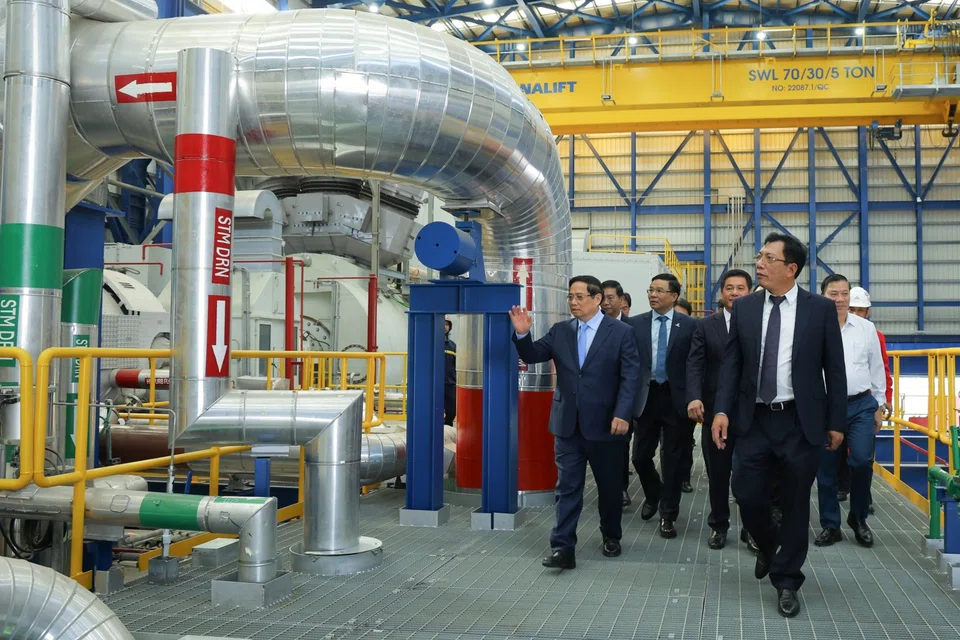
Vietnam’s Prime Minister Pham Minh Chinh (with raised hand) visited the Nhon Trach 3 and 4 LNG-fired power plants on Dec 14. PHOTO: PETROVIETNAM
[HO CHI MINH CITY] Vietnam has inaugurated its first cluster of power plants fuelled by imported liquefied natural gas (LNG), marking a milestone in the country’s push to secure electricity supplies from a cleaner fossil fuel in one of Asia’s fastest-growing economies.
The Nhon Trach 3 and 4 LNG-fired plants were inaugurated on Sunday (Dec 14) in Dong Nai province, an industrial hub north-east of Ho Chi Minh City.
The US$1.4 billion project has a total capacity of 1.6 gigawatts (GW), with investment from PetroVietnam Power Corporation (PV Power), a subsidiary of the state-owned PetroVietnam, with a Lilama-Samsung C&T consortium serving as the contractor.
With its ground-breaking in 2022, it is Vietnam’s first LNG-fired power plant project to secure nearly US$1 billion in financing without government guarantees – a milestone closely watched by both local and international investors.
Earlier this year, PV Power also signed a 25-year agreement with its sister company, PetroVietnam Gas (PV Gas) to supply LNG to the two plants, marking the country’s first long-term LNG supply contract with a committed volume of 530 million cubic metres (cu m) per year for the first five years.
Both PV Power and PV Gas are listed on the Ho Chi Minh City Stock Exchange, with market capitalisations of 27 trillion dong (S$1.3 billion) and 148 trillion dong, respectively, at market close on Friday.
Kick-starting the sector
Vietnam sees LNG as a critical “bridging fuel” between coal and renewables with significantly less carbon and air pollutants. More importantly, for Vietnam’s grid, gas-fired plants can serve as a reliable base load and help stabilise the power system as wind and solar – inherently intermittent sources – expand rapidly.
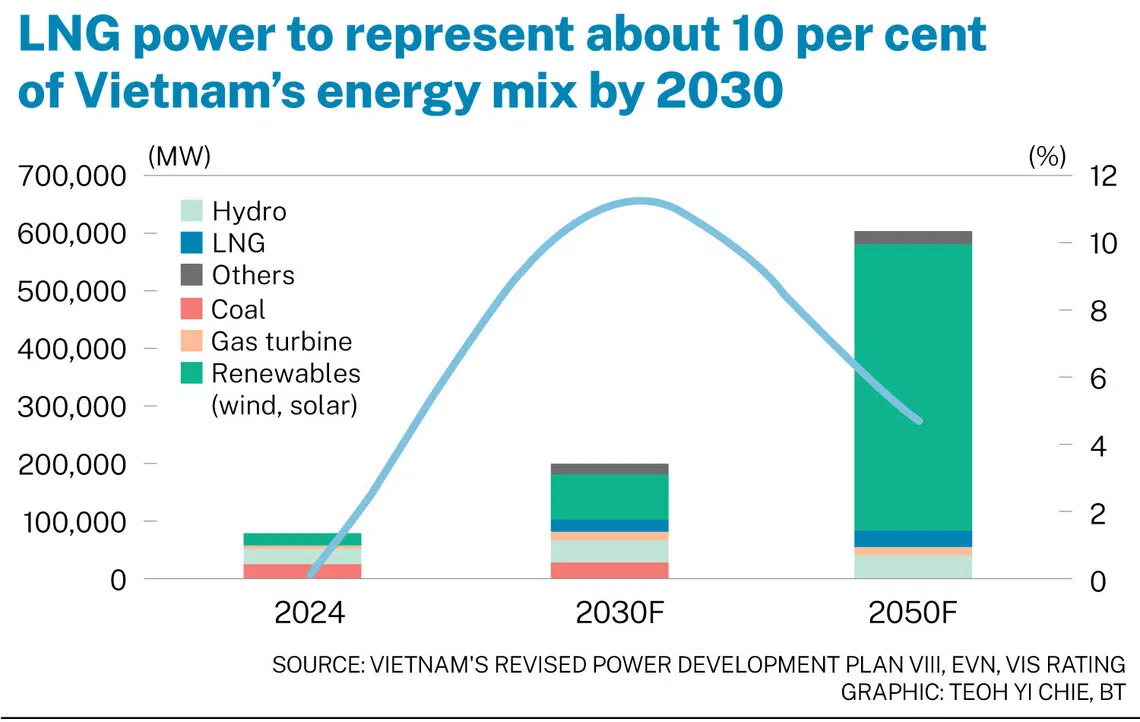
Under Vietnam’s revised Power Development Plan VIII (PDP8) approved in April, LNG-to-power capacity is targeted to reach 22.5 GW by 2030, from less than 1 GW today, accounting for roughly 10 per cent of the country’s power mix.
To kick-start the LNG sector, the government has rolled out a series of incentives. These include cutting preferential LNG import tariffs to 2 per cent from 5 per cent, and introducing an annual ceiling price for LNG power generation to provide a benchmark for power purchase agreement negotiations with state utility Vietnam Electricity (EVN).