Navigation
Install the app
How to install the app on iOS
Follow along with the video below to see how to install our site as a web app on your home screen.
Note: This feature may not be available in some browsers.
More options
Style variation
You are using an out of date browser. It may not display this or other websites correctly.
You should upgrade or use an alternative browser.
You should upgrade or use an alternative browser.
Vietnam Defense and News forum
- Thread starter Viet
- Start date
More options
Who Replied?


- Thread starter
- #1,700
Viettel to pilot Vietnam’s first 32-nm chip fab by 2027

Vietnam has initiated its first semiconductor wafer fabrication plant, led by Viettel Group, in Hanoi’s Hoa Lac Hi-Tech Park, marking a significant step in the country’s semiconductor industry development.
The plant aims to pilot the production of 32-nanometer chips by the end of 2027, with plans to optimize processes and explore advanced chipmaking technologies from 2028 to 2030.
The project, developed under the Ministry of National Defense, covers 27 hectares and is part of Vietnam’s broader strategy to establish a self-reliant semiconductor ecosystem by 2050.
While Vietnam currently focuses on chip design and back-end manufacturing, wafer fabrication remains a high-cost, complex stage that requires significant investment.
Industry experts estimate that building a semiconductor fab can cost between US$10 billion and US$50 billion, with long payback periods.
The new facility is expected to supply chips for sectors such as aerospace, telecommunications, and automotive manufacturing.
- Thread starter
- #1,702
Interesting technique. the combination of Industrial scale land reclamation, building bridges, sea crossing land road and sea water blocking dike
All will make Vietnam bigger in size.
Thailand is closer than ever.
All will make Vietnam bigger in size.
Thailand is closer than ever.
- Thread starter
- #1,703
Saigon simultaneously launches multiple infrastructure projects among them
- Metro 2
- football sports complex
- Can Gio sea bridge
- Phu My 2 bridge
all carried out by Vietnamese companies
- Metro 2
- football sports complex
- Can Gio sea bridge
- Phu My 2 bridge
all carried out by Vietnamese companies
- Thread starter
- #1,704
South-East Asia
Julietta Jameson
JANUARY 16, 2026
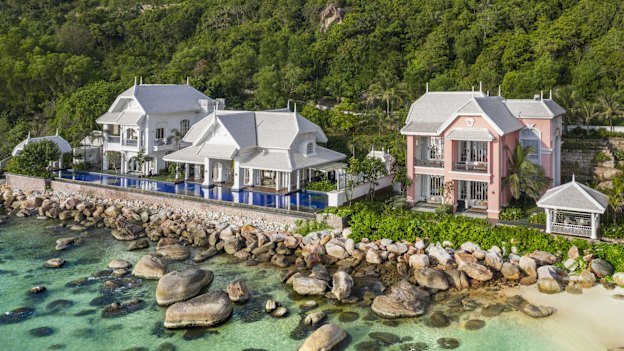
The JW Marriott Phu Quoc Emerald Bay Resort & Spa was designed to resemble a mythical, abandoned 19th-century French university.
“Wow, that looks straight out of Mussolini’s Rome,” I blurt out to no one in particular.
We’re being driven along a broad, multi-lane road flanked by the ramshackle jumble of permanent and temporary low-rise shops and homes that characterises much of South-East Asia, when, incongruously, our vehicle nears a commandingly large white gatehouse. It’s embellished with gilt detailing and, more startlingly, crowned by four huge gold statues of canines – ears erect, bodies taut and powerful – a sentry-like proclamation of authority.
A bit of everything… JW Marriott Phu Quoc Emerald Bay Resort & Spa Vietnam.
Our car turns towards that gatehouse.
“Oh.” Now words come less easily to me. This is the entryway to the JW Marriott Phu Quoc Emerald Bay Resort & Spa, where I will be staying for the next few days.
I’m on Phu Quoc, Vietnam’s largest island, and this guardhouse was built for the resort’s 2017 opening. Imposing monuments that would not look out of place in Mussolini-era Rome’s EUR district are not what I expect when arriving at a beachfront resort in Vietnam.
But, I soon learn, maverick designer Bill Bensley did intentionally reference early 20th-century architecture in crafting the resort’s aesthetic, fashioning it around an elaborate fictional backstory. Despite the statues at the entrance, Bensley’s blueprint for the resort may not reference the Italian dictator, but it imagines a defunct French university, established in the early 1900s, where the island’s French colonists once studied before the institution closed in the 1940s and was later converted into a hotel.
Accommodation wings are themed as if they were former departments of learning. There’s a miniature varsity running track. Old books and assorted curiosities abound in the library-styled lobby.
At least the statues are of a real local dog, albeit a rare one, the Phu Quoc ridgeback and the French did indeed rule Phu Quoc as part of their wider governance, handing it over in 1949. But developments such as VinWonders Grand World Phu Quoc and Sun Group’s Sunset Town are less easy to explain.
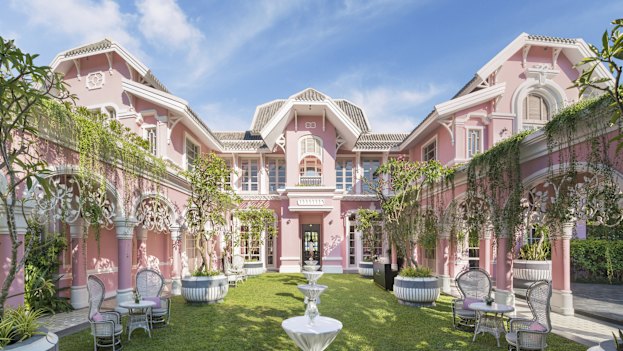
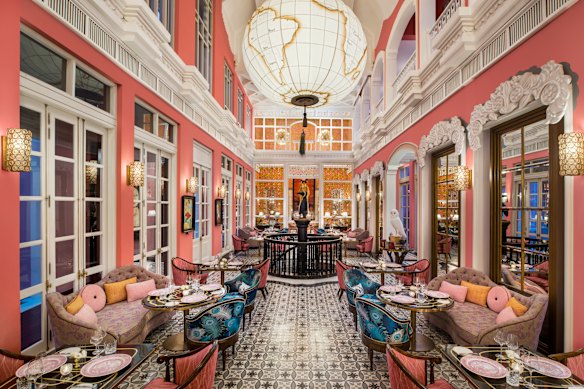
Pink Pearl, the resort’s fine dining restaurant.
The company that owns the resort, Sun Group, has also been instrumental in building what some have dubbed “Europe in Asia” here – with Disneyland-like residential streetscapes evoking a storybook European idyll. These places are often unevenly occupied, their broad boulevards and ornate exteriors sometimes feeling like abandoned film sets, though on the night we are at Sunset Town to dine at the Sun Bavaria Gastropub, a replica (kind of) German beer hall, its cobbled streets are busy.
Meanwhile, across the island and further north, Duong Dong, Phu Quoc’s largest town, remains unapologetically Vietnamese: bustling morning and night markets, lovely if weathered beaches, and a budget travel scene. I find myself wishing I had based more of my stay nearby.
Not that there is anything operationally wrong with the JW Marriott – and many people love it. My room is beautiful. The service is exceptional, as is the food. The resort is very pretty, within its singular aesthetic. It’s luxurious. I love luxurious. It just feels, for me, over-contrived and culturally disconnected.
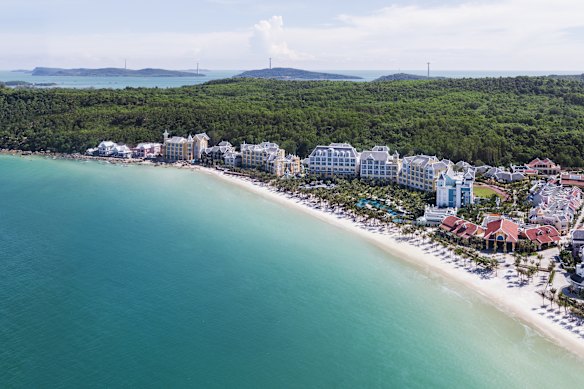
The JW Marriott Phu Quoc Emerald Bay Resort & Spa as viewed from above.
And right there lies what I would start to think of as the Vietnamese tipping point.
On one hand, there’s gung-ho tourism development as the country races to keep up with soaring global interest, and it sometimes trips over itself with visually insensitive and/or context-detached design. On the other hand, authenticity persists; after all, this is a nation that has endured and evolved through centuries of upheaval.
Fortunately, some places are performing a beautiful balancing act: the coastal city of Hue, for instance. It is home to the wonderful Pilgrimage Village Resort & Spa. One could argue that no resort is entirely culturally embedded – resorts are, by definition, experiential enclaves – but this family-owned property is an elegant melding of traditional Hue materials and styles with modern comfort and functionality. Across its 173 rooms and villas, three restaurants, a beautiful spa, extensive gardens, and pools (both shared and private), the resort feels rooted in place. Its Vietnamese founder, originally an architect, envisioned a handicraft village dedicated to his country’s history and tradition; that ethos remains palpable.
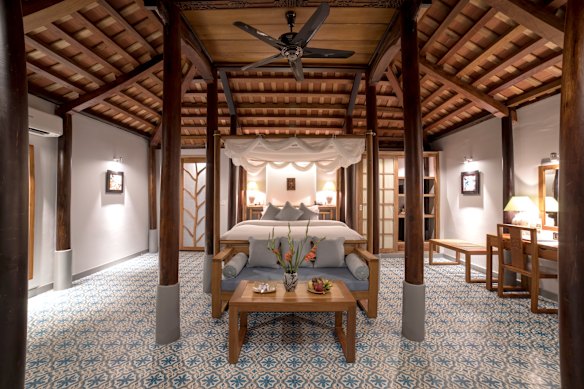
More in tune… Pilgrimage Village Resort & Spa.
It’s evident in the resort’s offerings, too. Guests can book an after-hours private dinner overlooking the Hue Citadel at the UNESCO World Heritage-listed (officially as the Complex of Hue Monuments) Imperial City, synergising cultural immersion and luxury comfort.
The Imperial City itself is another example of history presented with nuance and care. Now undergoing restoration, its extraordinary past – especially the destructive Battle of Hue during the Vietnam War – is visible in faded walls and renovated pavilions alike. For all the allure of beach life and mountain escapes, Vietnam’s history is an enriching, often overlooked facet of the visitor experience. Hue embraces that, making it easy for the visitor to do the same.
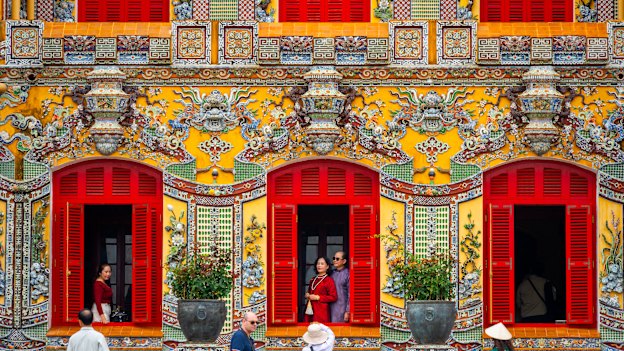
The Kien Trung Palace in the Imperial City in Hue.GETTY IMAGES
Across the Perfume River from the Citadel, the glamorous Azerai La Residence inhabits the former French colonial governor’s riverbank mansion. A 2019 renovation under hotelier Adrian Zecha – whose brands include Aman – added two modern wings while sympathetically restoring the original building. It’s the colonial aesthetic done well (acknowledging there’s a school of thought that finds the celebration of colonial architecture problematic).
Even a sunset “cultural cruise” – two words that can make seasoned travellers wince at the thought of cheesily packaged experiences – on Hue’s Perfume River is an unexpected delight. Our cruise aboard a beautifully appointed touring craft with Moon River Cruises includes a live performance of Hue folk music and a gentle glide towards the city’s newly completed Nguyen Huang Bridge. The elegant structure does more than connect banks; its decorative details reference elements of the Nguyen Dynasty, with dozens of lights fashioned from galvanised steel to resemble golden parasols. Changing coloured lighting across the whole structure creates a mesmerising evening spectacle.
Of course, Hue doesn’t always get it right. Nearby, the Thuy Xuan Incense Village, a centuries-old craft locale, has become an over-Instagrammed tourist trap. Its rows of near-identical stalls piled with colourful incense sticks are designed for photo ops more than cultural depth. At least here, the mock-authenticity mostly costs only time and money – not heritage.
A similar critique is harder to shrug off in Ninh Binh, an inland scenic district south of Hanoi often described as “Ha Long Bay on land”. Ha Long Bay itself – renowned for its dramatic limestone karsts rising from emerald waters – was first inscribed as a UNESCO World Heritage site in 1994 and again in 2000 under expanded criteria recognising its outstanding natural value.
But Ha Long Bay’s popularity has come at a cost: day-tripper crowds, motorboat exhaust and congestion have eroded the serenity that drew people there in the first place, prompting UNESCO concern over long-term management.
Ninh Binh’s Trang An Landscape Complex, inscribed as a UNESCO World Heritage site in 2014 for its own limestone karst scenery and waterways, had decades of Ha Long Bay lessons to lean on. Yet on the day I take a three-hour boat tour through its caves and waterways, rowboats line up bow to stern like vehicles in Hanoi at peak hour, and our captain nonchalantly flicks his cigarette butt into the channel. The landscape is breathtaking, but the experience is uneasy.
And it makes me think again about that crossroad Vietnam tourism is facing, and ask: what Vietnam are we choosing? And how are we helping local communities make good choices?
As Australians – and indeed global travellers – flock to a destination that, on December 15, 2025, officially welcomed its 20 millionth international visitor in a single year, marking a historic tourism milestone, the answer lies in mindful travel choices.
Vietnam is undeniably welcoming. That’s worth our time alone. But tourism citizenship demands consideration of culture – whether that means prioritising it on our itineraries beyond resort walls or simply being thoughtful in how we conduct ourselves.
Australians are flocking here. It might be the next victim of overtourism
Julietta Jameson
JANUARY 16, 2026
The JW Marriott Phu Quoc Emerald Bay Resort & Spa was designed to resemble a mythical, abandoned 19th-century French university.
“Wow, that looks straight out of Mussolini’s Rome,” I blurt out to no one in particular.
We’re being driven along a broad, multi-lane road flanked by the ramshackle jumble of permanent and temporary low-rise shops and homes that characterises much of South-East Asia, when, incongruously, our vehicle nears a commandingly large white gatehouse. It’s embellished with gilt detailing and, more startlingly, crowned by four huge gold statues of canines – ears erect, bodies taut and powerful – a sentry-like proclamation of authority.
A bit of everything… JW Marriott Phu Quoc Emerald Bay Resort & Spa Vietnam.
Our car turns towards that gatehouse.
“Oh.” Now words come less easily to me. This is the entryway to the JW Marriott Phu Quoc Emerald Bay Resort & Spa, where I will be staying for the next few days.
I’m on Phu Quoc, Vietnam’s largest island, and this guardhouse was built for the resort’s 2017 opening. Imposing monuments that would not look out of place in Mussolini-era Rome’s EUR district are not what I expect when arriving at a beachfront resort in Vietnam.
But, I soon learn, maverick designer Bill Bensley did intentionally reference early 20th-century architecture in crafting the resort’s aesthetic, fashioning it around an elaborate fictional backstory. Despite the statues at the entrance, Bensley’s blueprint for the resort may not reference the Italian dictator, but it imagines a defunct French university, established in the early 1900s, where the island’s French colonists once studied before the institution closed in the 1940s and was later converted into a hotel.
Accommodation wings are themed as if they were former departments of learning. There’s a miniature varsity running track. Old books and assorted curiosities abound in the library-styled lobby.
At least the statues are of a real local dog, albeit a rare one, the Phu Quoc ridgeback and the French did indeed rule Phu Quoc as part of their wider governance, handing it over in 1949. But developments such as VinWonders Grand World Phu Quoc and Sun Group’s Sunset Town are less easy to explain.
Pink Pearl, the resort’s fine dining restaurant.
The company that owns the resort, Sun Group, has also been instrumental in building what some have dubbed “Europe in Asia” here – with Disneyland-like residential streetscapes evoking a storybook European idyll. These places are often unevenly occupied, their broad boulevards and ornate exteriors sometimes feeling like abandoned film sets, though on the night we are at Sunset Town to dine at the Sun Bavaria Gastropub, a replica (kind of) German beer hall, its cobbled streets are busy.
Meanwhile, across the island and further north, Duong Dong, Phu Quoc’s largest town, remains unapologetically Vietnamese: bustling morning and night markets, lovely if weathered beaches, and a budget travel scene. I find myself wishing I had based more of my stay nearby.
Not that there is anything operationally wrong with the JW Marriott – and many people love it. My room is beautiful. The service is exceptional, as is the food. The resort is very pretty, within its singular aesthetic. It’s luxurious. I love luxurious. It just feels, for me, over-contrived and culturally disconnected.
The JW Marriott Phu Quoc Emerald Bay Resort & Spa as viewed from above.
And right there lies what I would start to think of as the Vietnamese tipping point.
On one hand, there’s gung-ho tourism development as the country races to keep up with soaring global interest, and it sometimes trips over itself with visually insensitive and/or context-detached design. On the other hand, authenticity persists; after all, this is a nation that has endured and evolved through centuries of upheaval.
Fortunately, some places are performing a beautiful balancing act: the coastal city of Hue, for instance. It is home to the wonderful Pilgrimage Village Resort & Spa. One could argue that no resort is entirely culturally embedded – resorts are, by definition, experiential enclaves – but this family-owned property is an elegant melding of traditional Hue materials and styles with modern comfort and functionality. Across its 173 rooms and villas, three restaurants, a beautiful spa, extensive gardens, and pools (both shared and private), the resort feels rooted in place. Its Vietnamese founder, originally an architect, envisioned a handicraft village dedicated to his country’s history and tradition; that ethos remains palpable.
More in tune… Pilgrimage Village Resort & Spa.
It’s evident in the resort’s offerings, too. Guests can book an after-hours private dinner overlooking the Hue Citadel at the UNESCO World Heritage-listed (officially as the Complex of Hue Monuments) Imperial City, synergising cultural immersion and luxury comfort.
The Imperial City itself is another example of history presented with nuance and care. Now undergoing restoration, its extraordinary past – especially the destructive Battle of Hue during the Vietnam War – is visible in faded walls and renovated pavilions alike. For all the allure of beach life and mountain escapes, Vietnam’s history is an enriching, often overlooked facet of the visitor experience. Hue embraces that, making it easy for the visitor to do the same.
The Kien Trung Palace in the Imperial City in Hue.GETTY IMAGES
Across the Perfume River from the Citadel, the glamorous Azerai La Residence inhabits the former French colonial governor’s riverbank mansion. A 2019 renovation under hotelier Adrian Zecha – whose brands include Aman – added two modern wings while sympathetically restoring the original building. It’s the colonial aesthetic done well (acknowledging there’s a school of thought that finds the celebration of colonial architecture problematic).
Even a sunset “cultural cruise” – two words that can make seasoned travellers wince at the thought of cheesily packaged experiences – on Hue’s Perfume River is an unexpected delight. Our cruise aboard a beautifully appointed touring craft with Moon River Cruises includes a live performance of Hue folk music and a gentle glide towards the city’s newly completed Nguyen Huang Bridge. The elegant structure does more than connect banks; its decorative details reference elements of the Nguyen Dynasty, with dozens of lights fashioned from galvanised steel to resemble golden parasols. Changing coloured lighting across the whole structure creates a mesmerising evening spectacle.
Of course, Hue doesn’t always get it right. Nearby, the Thuy Xuan Incense Village, a centuries-old craft locale, has become an over-Instagrammed tourist trap. Its rows of near-identical stalls piled with colourful incense sticks are designed for photo ops more than cultural depth. At least here, the mock-authenticity mostly costs only time and money – not heritage.
A similar critique is harder to shrug off in Ninh Binh, an inland scenic district south of Hanoi often described as “Ha Long Bay on land”. Ha Long Bay itself – renowned for its dramatic limestone karsts rising from emerald waters – was first inscribed as a UNESCO World Heritage site in 1994 and again in 2000 under expanded criteria recognising its outstanding natural value.
But Ha Long Bay’s popularity has come at a cost: day-tripper crowds, motorboat exhaust and congestion have eroded the serenity that drew people there in the first place, prompting UNESCO concern over long-term management.
Ninh Binh’s Trang An Landscape Complex, inscribed as a UNESCO World Heritage site in 2014 for its own limestone karst scenery and waterways, had decades of Ha Long Bay lessons to lean on. Yet on the day I take a three-hour boat tour through its caves and waterways, rowboats line up bow to stern like vehicles in Hanoi at peak hour, and our captain nonchalantly flicks his cigarette butt into the channel. The landscape is breathtaking, but the experience is uneasy.
And it makes me think again about that crossroad Vietnam tourism is facing, and ask: what Vietnam are we choosing? And how are we helping local communities make good choices?
As Australians – and indeed global travellers – flock to a destination that, on December 15, 2025, officially welcomed its 20 millionth international visitor in a single year, marking a historic tourism milestone, the answer lies in mindful travel choices.
Vietnam is undeniably welcoming. That’s worth our time alone. But tourism citizenship demands consideration of culture – whether that means prioritising it on our itineraries beyond resort walls or simply being thoughtful in how we conduct ourselves.
- Thread starter
- #1,706
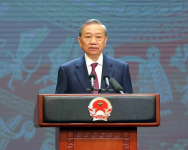
HÀ NỘI — Party General Secretary Tô Lâm has accepted an invitation from United States' President Donald Trump for Việt Nam to join the proposed Gaza “Board of Peace” as a founding member state, according to an announcement from Việt Nam's Ministry of Foreign Affairs on Sunday.
Earlier, on January 16, 2026, President Donald Trump sent a letter to General Secretary Tô Lâm inviting him and Việt Nam to participate in the Board of Peace, together with the international community, to promote a sustainable peaceful solution to the conflict between Israel and Palestine in the Gaza Strip.
In his reply, he said Việt Nam considers the establishment of the Board of Peace a necessary step to implement the Gaza Strip peace plan adopted by the United Nations Security Council under Resolution No. 2803 dated November 17, 2025. The resolution welcomes the participation of UN member states in the board to advance peacebuilding efforts, humanitarian assistance, and post-conflict reconstruction in the Gaza Strip.
General Secretary Tô Lâm affirmed Việt Nam’s readiness to participate as a founding member state, working closely with the US and the international community to make substantive contributions toward a long-term and comprehensive solution to the Middle East peace process, including the establishment of an independent Palestinian state coexisting peacefully alongside the State of Israel.
In his letter, General Secretary Tô Lâm also proposed that Việt Nam and the US continue to cooperate in further promoting their Comprehensive Strategic Partnership in a more substantive and effective manner, enhancing cooperation across various fields in line with the needs and priorities of both sides, on the basis of mutual respect, safeguarding each country’s legitimate interests, and contributing positively to regional and global peace, cooperation and development.


- Thread starter
- #1,708
$1 billion fee for permanent membership or rich people, rich countries1 billion entry fee?
I don't understand what Vietnam will exactly contribute to resolving this conflict.
Vietnam probably doesn’t need to pay as founding member.
I don’t know, either what we can contribute.
You may ask Donald Trump.
He wants this “peace club” to replace the UN.
EugeneP
Trusted Member

Vietnam will exactly contribute $1B. That is very welcome.what Vietnam will exactly contribute
- Thread starter
- #1,710
We will give Trump a red envelope with $1.Vietnam will exactly contribute $1B. That is very welcome.
Users who are viewing this thread
Total: 7 (members: 0, guests: 7)
Pakistan Defence Latest
-
 Federal cabinet gives nod to imposition of emergency in KP; summary sent to president (15 Viewers)
- Latest: Forsvaret
-

-

-


Country Watch Latest


Latest Posts
-
-

-
Federal cabinet gives nod to imposition of emergency in KP; summary sent to president (15 Viewers)
- Latest: Forsvaret
-
-