What book are you reading?

Anyway, here's something interesting;

ISI Kolkata's Prof Neena Gupta wins Infosys Prize 2024 for her exemplary work in the field of Mathematical Sciences

(couldn't really find a better news link, so this has to do)

Summarizing, Dr. Gupta solved the Zariski Cancellation Theorem, which had been unsolved for 70-ish years. She solved it 2014 but received the Infosys prize recently. This is a rather big achievement, and I'm surprised all the gun-ho chest-thumpers are not discussing it here. I think it might be the best news for India this whole year.


Here is she delivering a lecture on it:
To view this content we will need your consent to set third party cookies.
For more detailed information, see our cookies page.


And finally heres the paper (not the original, but from the same author):


Like it usually happens, mathematicians would pose problems and then die lol. This guy Oscar Zariski came with it, and from then on it had been a major unsolved problem in algebraic geometry.

So basically, how do you make a plane in 2d? with 2 lines. So if Q is a line the cross-product QxQ would make a plane. Lets call this plane Z. Its in 2d, so what would happen if we cross it once again with Q? The result would be a 3d plane. and so on to the nth dimensional space. Note that all these resultant spaces are affine in nature, which means that in the same plane there are pairs of lines which are parallel to each other but never meet. easy peasy. This was us going forward, the problem concerns going backwards. so if, lets say we are given a product DxQ which is a 3d plane, can we prove that the D here is a 2d plane? and so on going backwards to a singular point. This was understood to generally the case, Dr. Gupta proved that its not necessarily the case. the lady says, assume you are given a 5f space (not affine space, simple euclidean space) U (running out of letters lol), if you cross it with a line Q the result can be a 6 dimensional affine space. generally, given k dimensional euclidean space, crossed with a line Q, can give k+1 dimensional affice space.

(algebraic geometry is not my area of expertise so take my explanation with a grain of salt, also because I didn't understand the proof either lol.)

I like to hear from others about how they found reading the work and generally the work itself. I really think that the best investments India made early on was in the IITs (ik shes not from there, but same-same), alongside the keynesian reforms from the great Dr. Monmohan Singh. @VCheng @Joe Shearer and others.

It's 2am and I'm writing about an Indian math witch on a Pakistani forum. Need to get myself a life.


Edit: there are so many spelling and grammar mistakes and I'm not gonna correct them now


Definitely beyond me, but I will submit it to a dear friend whose academic record was Physics, followed by Operations Research, followed by Game Theory, his PhD subject, followed by Economics, where he was practically ambushed by known and well-accepted economists and dragged away to write papers with them, kicking and screaming. He has lately been educating the rest of us on some of the finer aspects of mathematical development, within a group where the other members (@Nilgiri excepted) have had no crimes to stain their spotless record with regard to mathematics since the group started.

Thanks for the write-up. It will be useful.

No worries. Your post has enough structure and shape to brush those aside.

Incidentally, the Indian Statistical Institute was founded by Mahalanobis, and was roughly opposite us on the old IIMC campus on BT Road. It has always been in the forefront of statistical practice and theory in India, and was responsible for the design of the world-recognised NSS, until it was corrupted and the figures manipulated by a person or persons unknown.

View attachment 86030

The beauty of science is that it knows no religion or nationality. Knowledge is knowledge, and it serves those who seek it well. :D

I thought I would bring the convo to this book thread as I do have a book suggestion for larger audience of forum that is interested and/or has aptitude in the topic (and/or its history).....and I like to keep quality convo in one area to see where it goes rather than lose track with it in various smaller threads and various characters.

Ms. Neena Gupta is obviously very accomplished in her field, I will have to parse through her presentation more slowly a bit later.

@markhor , w.r.t:

So basically, how do you make a plane in 2d? with 2 lines. So if Q is a line the cross-product QxQ would make a plane. Lets call this plane Z. Its in 2d, so what would happen if we cross it once again with Q? The result would be a 3d plane. and so on to the nth dimensional space. Note that all these resultant spaces are affine in nature, which means that in the same plane there are pairs of lines which are parallel to each other but never meet. easy peasy. This was us going forward, the problem concerns going backwards. so if, lets say we are given a product DxQ which is a 3d plane, can we prove that the D here is a 2d plane? and so on going backwards to a singular point. This was understood to generally the case, Dr. Gupta proved that its not necessarily the case. the lady says, assume you are given a 5f space (not affine space, simple euclidean space) U (running out of letters lol), if you cross it with a line Q the result can be a 6 dimensional affine space. generally, given k dimensional euclidean space, crossed with a line Q, can give k+1 dimensional affice space.

You essentially understand whats going on though I will have to watch the presentation in more detail to maybe get the context of your conclusion which I think you have confused a bit between what n (dimension) and k (variety) are pertaining to w.r.t affine space and its mapping among euclidean space as n inflates.

She basically proved that the general affine space is not cancellative for n>=3

Given euclidean spaces all have affines as subspaces w.r.t the characteristics that are independent of distances and angles (things like parallelism and ratios), are these naturally retained/preserved in both directions no matter the n inflation?

It would take me quite some time to explain this in my own words further....after spending the time to grapple with this particular rabbit hole first....as to maybe why this deteriorates here.

The thing is these are archetypes (for lack of better word) of larger general scale at the frontier theory area. Downstream to it, where I made most my bread and butter, I see consequences of what is found to be baked in (i.e where inductive assumption breaks down and leaves immediate vast voids that must be understood and worked around).

i.e for me it has been (in decreasing strength of overall aptitude and expertise):

a) Linear algebra and Eigen(values, vectors and spaces).... (the concept of what is preserved between transforms, what that signifies regarding invertibility which is related to commutativity/cancellativity in hyperplanes in this frontier area Ms. Gupta has furthered in her way). i.e full reversibility while retaining intrinsic properties...the bounds of this, and the relevance of knowing these bounds

b) Quaternions (their advantage+efficiency when applicable and what they fundamentally represent and the broader transform archetype in general w.r.t dimensions and spaces...i.e the deeper reason of why they are efficient approach when a matter is within relevant bounds)

c) lie groups, lie algebra (field that is ongoing one for me in forming some early understanding for application, w.r.t again efficienct mapping knowing degradation that occurs past bounds).

Simplest way I can express the basis of what underlies this (and expresses itself for Mrs. Gupta to find in this tree as she did in this vast orchard in vast planet beyond it) as to why degradation happens past bounds in transforms.... in a way maybe most folks that have intersected with math so far is to think of roots, radicals and when their math teacher first wrote down the quadratic eqn and solution for it:
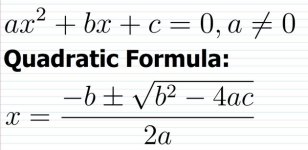
1733278484574.png

Always annoyed me its called the quadratic (since quad is 4 rather than 2 which would be bi, but I guess there are 4 terms), but thats besides the point.

Only those with more knowledge know general solutions exist for the cubic (order 3) and quartic (order 4).

But this degrades at order 5 (the quintic), no general formula can be given anymore....when one might have assumed inductively that this continues forever given the experience with orders 1, 2, 3 and 4 preceding.

Why that is has to do with particularly degrades in the mapping, what doesnt line up anymore (and suddenly) like it once did. This is the underlying phenomenon, from the baked in reality, that connects to Mrs. Gupta today in her higher way and that I have seen in lower application way.

It was Galois that showed this the most elegantly with his prodigious talent, before he cut his life so short in such a meaningless way....one of the most striking sad contrasts of all time.

Anyway this will have to do for now, I am out of time. To go into too much detail likely will get boring as well. I will think how to proceed meaningfully to maybe give large understandable takeaway (the general pathway of interest to try thing about the larger matter being expressed again in its unique form here)..... for interested folks here, for most levels of aptitude/interest regd maths hopefully....at least from my perspective/feeling/experience so far on it (sadly maths is often taught/approached in a most non-interesting way and lot of budding talent is squandered early).

The books that present the easiest + accessible bridges with great detail (pertaining to the widest basis that has to do with the refined point Mrs. Gupta has honed).... relevant to almost any aptitude with math (relative layperson with budding interest of at least math history....all the way to advanced mathematical theoretician) that I have sitting on my shelf is definitely : "Theory of determinants in the historical order of development" by Thomas Muir, 4 original volumes generally published as 2 volumes or 1 large volume nowadays.

Amazon has this for 1 of 2 volumes for anyone interested (or you can refer to that you find later in forum to discuss math matters with here):


I have (now out of print revised edition from the 60s).

Rest of say my linear algebra books (that offer more specific pathways to Mrs. Gupta work, depending on one's follow up of course).... are way too specific, require sizeable aptitude/interest and would be boring in comparison for 99% of folks out there.
 
I thought I would bring the convo to this book thread as I do have a book suggestion for larger audience of forum that is interested and/or has aptitude in the topic (and/or its history).....and I like to keep quality convo in one area to see where it goes rather than lose track with it in various smaller threads and various characters.

Ms. Neena Gupta is obviously very accomplished in her field, I will have to parse through her presentation more slowly a bit later.

@markhor , w.r.t:


You essentially understand whats going on though I will have to watch the presentation in more detail to maybe get the context of your conclusion which I think you have confused a bit between what n (dimension) and k (variety) are pertaining to w.r.t affine space and its mapping among euclidean space as n inflates.

She basically proved that the general affine space is not cancellative for n>=3

Given euclidean spaces all have affines as subspaces w.r.t the characteristics that are independent of distances and angles (things like parallelism and ratios), are these naturally retained/preserved in both directions no matter the n inflation?

It would take me quite some time to explain this in my own words further....after spending the time to grapple with this particular rabbit hole first....as to maybe why this deteriorates here.

The thing is these are archetypes (for lack of better word) of larger general scale at the frontier theory area. Downstream to it, where I made most my bread and butter, I see consequences of what is found to be baked in (i.e where inductive assumption breaks down and leaves immediate vast voids that must be understood and worked around).

i.e for me it has been (in decreasing strength of overall aptitude and expertise):

a) Linear algebra and Eigen(values, vectors and spaces).... (the concept of what is preserved between transforms, what that signifies regarding invertibility which is related to commutativity/cancellativity in hyperplanes in this frontier area Ms. Gupta has furthered in her way). i.e full reversibility while retaining intrinsic properties...the bounds of this, and the relevance of knowing these bounds

b) Quaternions (their advantage+efficiency when applicable and what they fundamentally represent and the broader transform archetype in general w.r.t dimensions and spaces...i.e the deeper reason of why they are efficient approach when a matter is within relevant bounds)

c) lie groups, lie algebra (field that is ongoing one for me in forming some early understanding for application, w.r.t again efficienct mapping knowing degradation that occurs past bounds).

Simplest way I can express the basis of what underlies this (and expresses itself for Mrs. Gupta to find in this tree as she did in this vast orchard in vast planet beyond it) as to why degradation happens past bounds in transforms.... in a way maybe most folks that have intersected with math so far is to think of roots, radicals and when their math teacher first wrote down the quadratic eqn and solution for it:

View attachment 86249

Always annoyed me its called the quadratic (since quad is 4 rather than 2 which would be bi, but I guess there are 4 terms), but thats besides the point.

Only those with more knowledge know general solutions exist for the cubic (order 3) and quartic (order 4).

But this degrades at order 5 (the quintic), no general formula can be given anymore....when one might have assumed inductively that this continues forever given the experience with orders 1, 2, 3 and 4 preceding.

Why that is has to do with particularly degrades in the mapping, what doesnt line up anymore (and suddenly) like it once did. This is the underlying phenomenon, from the baked in reality, that connects to Mrs. Gupta today in her higher way and that I have seen in lower application way.

It was Galois that showed this the most elegantly with his prodigious talent, before he cut his life so short in such a meaningless way....one of the most striking sad contrasts of all time.

Anyway this will have to do for now, I am out of time. To go into too much detail likely will get boring as well. I will think how to proceed meaningfully to maybe give large understandable takeaway (the general pathway of interest to try thing about the larger matter being expressed again in its unique form here)..... for interested folks here, for most levels of aptitude/interest regd maths hopefully....at least from my perspective/feeling/experience so far on it (sadly maths is often taught/approached in a most non-interesting way and lot of budding talent is squandered early).

The books that present the easiest + accessible bridges with great detail (pertaining to the widest basis that has to do with the refined point Mrs. Gupta has honed).... relevant to almost any aptitude with math (relative layperson with budding interest of at least math history....all the way to advanced mathematical theoretician) that I have sitting on my shelf is definitely : "Theory of determinants in the historical order of development" by Thomas Muir, 4 original volumes generally published as 2 volumes or 1 large volume nowadays.

Amazon has this for 1 of 2 volumes for anyone interested (or you can refer to that you find later in forum to discuss math matters with here):


I have (now out of print revised edition from the 60s).

Rest of say my linear algebra books (that offer more specific pathways to Mrs. Gupta work, depending on one's follow up of course).... are way too specific, require sizeable aptitude/interest and would be boring in comparison for 99% of folks out there.
Thank you so much for the post and the explanation. I'm gonna spend some time reading it and going through her lecture again. Ah, it's so nice to have somebody who is math savvy (or has an interest) especially in these obscure areas. These just fly over my head, topology, abstract algebra, category theory, I like them but they are also the bane of my existence.
 
I thought I would bring the convo to this book thread as I do have a book suggestion for larger audience of forum that is interested and/or has aptitude in the topic (and/or its history).....and I like to keep quality convo in one area to see where it goes rather than lose track with it in various smaller threads and various characters.


Right now I am aiming for this one:

The Stranger in the Woods: The Extraordinary Story of the Last True Hermit
by Michael Finkel (Author)

Many people dream of escaping modern life, but most will never act on it. This is the remarkable true story of a man who lived alone in the woods of Maine for 27 years, making this dream a reality; not out of anger at the world, but simply because he preferred to live on his own.

In 1986, a shy and intelligent twenty-year-old named Christopher Knight left his home in Massachusetts, drove to Maine, and disappeared into the forest. He would not have a conversation with another human being until nearly three decades later, when he was arrested for stealing food. Living in a tent even through brutal winters, he had survived by his wits and courage, developing ingenious ways to store edibles and water, and to avoid freezing to death. He broke into nearby cottages for food, clothing, reading material, and other provisions, taking only what he needed but terrifying a community never able to solve the mysterious burglaries.

Based on extensive interviews with Knight himself, this is a vividly detailed account of his secluded life - why did he leave? what did he learn? - as well as the challenges he has faced since returning to the world. It is a gripping story of survival that asks fundamental questions about solitude, community, and what makes a good life, and a deeply moving portrait of a man who was determined to live his own way, and succeeded.
 
Right now I am aiming for this one:

The Stranger in the Woods: The Extraordinary Story of the Last True Hermit
by Michael Finkel (Author)

Many people dream of escaping modern life, but most will never act on it. This is the remarkable true story of a man who lived alone in the woods of Maine for 27 years, making this dream a reality; not out of anger at the world, but simply because he preferred to live on his own.

In 1986, a shy and intelligent twenty-year-old named Christopher Knight left his home in Massachusetts, drove to Maine, and disappeared into the forest. He would not have a conversation with another human being until nearly three decades later, when he was arrested for stealing food. Living in a tent even through brutal winters, he had survived by his wits and courage, developing ingenious ways to store edibles and water, and to avoid freezing to death. He broke into nearby cottages for food, clothing, reading material, and other provisions, taking only what he needed but terrifying a community never able to solve the mysterious burglaries.

Based on extensive interviews with Knight himself, this is a vividly detailed account of his secluded life - why did he leave? what did he learn? - as well as the challenges he has faced since returning to the world. It is a gripping story of survival that asks fundamental questions about solitude, community, and what makes a good life, and a deeply moving portrait of a man who was determined to live his own way, and succeeded.
I am sold. I will order this book before the end of this year.
 
Right now I am aiming for this one:

The Stranger in the Woods: The Extraordinary Story of the Last True Hermit
by Michael Finkel (Author)

Many people dream of escaping modern life, but most will never act on it. This is the remarkable true story of a man who lived alone in the woods of Maine for 27 years, making this dream a reality; not out of anger at the world, but simply because he preferred to live on his own.

In 1986, a shy and intelligent twenty-year-old named Christopher Knight left his home in Massachusetts, drove to Maine, and disappeared into the forest. He would not have a conversation with another human being until nearly three decades later, when he was arrested for stealing food. Living in a tent even through brutal winters, he had survived by his wits and courage, developing ingenious ways to store edibles and water, and to avoid freezing to death. He broke into nearby cottages for food, clothing, reading material, and other provisions, taking only what he needed but terrifying a community never able to solve the mysterious burglaries.

Based on extensive interviews with Knight himself, this is a vividly detailed account of his secluded life - why did he leave? what did he learn? - as well as the challenges he has faced since returning to the world. It is a gripping story of survival that asks fundamental questions about solitude, community, and what makes a good life, and a deeply moving portrait of a man who was determined to live his own way, and succeeded.

WILLLLSSSSOONNNNN!!!!! ..... but I guess the seclusion was out of choice rather than circumstance.
 
Thank you so much for the post and the explanation. I'm gonna spend some time reading it and going through her lecture again. Ah, it's so nice to have somebody who is math savvy (or has an interest) especially in these obscure areas. These just fly over my head, topology, abstract algebra, category theory, I like them but they are also the bane of my existence.

Would love to give some of my thoughts in a deeper, visual way a bit later....the obscure stuff is just the simple stuff you see every day taken to new levels....but the concept of pattern and structure (and where these are bounded depending on circumstance, reference and context) remains permanent.

Math is really about patterns and structures in the end.
 
WILLLLSSSSOONNNNN!!!!! ..... but I guess the seclusion was out of choice rather than circumstance.
Here in India we have enough sages, saints and babas etc who live just such a life, they'll come down to the maha kumbha mela every 12 years and disappear into the forests and mountains of the Himalya again.

I've even known of the odd gora living the crazy hermit life (not babas, just extreme isolationists), one apparently built his own mini damn, enough to power some lights, forage fruits and berries in the woods.. ekdum pagal. :D
 
He broke into nearby cottages for food, clothing, reading material, and other provisions, taking only what he needed but terrifying a community never able to solve the mysterious burglaries.

So, basically, just a serial petty thief.

Judge: "why did you steal?"
Thief: "I am too lazy to work like normal people so I, er, take whatever I need on a, er, long term loan..."
Judge: "without permission... you are a thief!"
Thief: "I prefer to call myself a hermit, a maverick, a sage... They wrote a book about me and all".
 
WILLLLSSSSOONNNNN!!!!! ..... but I guess the seclusion was out of choice rather than circumstance.


Exactly. Although I appreciate your comments about maths, and science in general above, the voluntary choice of a social creature by nature to opt for voluntary seclusion in this manner, and for such a prolonged period of time, is what caught my eye, although, given the state of the world today, especially online - present forum included (no offense to you and a few others here) -, it appears to be increasingly attractive to me too. :D
 
although, given the state of the world today, especially online - present forum included (no offense to you and a few others here) -, it appears to be increasingly attractive to me too.
You are a bad boy!
 
Exactly. Although I appreciate your comments about maths, and science in general above, the voluntary choice of a social creature by nature to opt for voluntary seclusion in this manner, and for such a prolonged period of time, is what caught my eye, although, given the state of the world today, especially online - present forum included (no offense to you and a few others here) -, it appears to be increasingly attractive to me too. :D

you will be back to nick things here and there though right? :P... for a little help on the upkeep in seclusion/exile.

Which made me think that even social forces have patterns and structures in the end that we try to explain and make models for. The social sciences so to speak....when we talk about materialist aspect of this we have fields like economics (which I am acquainted with to some good degree compared to rest)....when its authority aspect, its things like political science and so on.

Normal distribution of the (linear or even non linear or highly exponentially arranged) components in these social forces means you get outliers for sure....compared to the norm of humans being highly social creatures by default. In a way its inevitable, the vast majority of us are born into family units that we rely on....that has lasting inductive transmission default to rest of humans we see past it...though we do place bounds and have erosions on this by various reasons. Though I personally think social media (i.e virtual social component) cataylses and emboldens parts of this that are actually harmful in end compared to what it is trying to mimic in real world (that has its pace and diverse signalling we are more traditionally acquainted with in the psyche). So seclusion from part of it or all of it is very understandable.

Takes me back to earlier part of this thread, with @_NOBODY_ (who seems interested for me to continue regd patterns and structures in math, which I will do in a later reply hopefully) bringing up the brave new world. In that the dystopian society has gotten rid of the family unit and human beings very much have a non-social unit upbringing by totalitarian state.

Yet huxley leans more jungian than freudian in the state of the tabula rasa (though blank) not being entirely level one....it leans towards something from the grand inertia of many millenia upon millenia of social units in human civilisation and the recognition of the golden rule....that cannot be undone so quickly....it is embedded and social engineered supression dulls it only to the degree it can.
 
you will be back to nick things here and there though right? :P... for a little help on the upkeep in seclusion/exile.

Which made me think that even social forces have patterns and structures in the end that we try to explain and make models for. The social sciences so to speak....when we talk about materialist aspect of this we have fields like economics (which I am acquainted with to some good degree compared to rest)....when its authority aspect, its things like political science and so on.

Normal distribution of the (linear or even non linear or highly exponentially arranged) components in these social forces means you get outliers for sure....compared to the norm of humans being highly social creatures by default. In a way its inevitable, the vast majority of us are born into family units that we rely on....that has lasting inductive transmission default to rest of humans we see past it...though we do place bounds and have erosions on this by various reasons. Though I personally think social media (i.e virtual social component) cataylses and emboldens parts of this that are actually harmful in end compared to what it is trying to mimic in real world (that has its pace and diverse signalling we are more traditionally acquainted with in the psyche). So seclusion from part of it or all of it is very understandable.

Takes me back to earlier part of this thread, with @_NOBODY_ (who seems interested for me to continue regd patterns and structures in math, which I will do in a later reply hopefully) bringing up the brave new world. In that the dystopian society has gotten rid of the family unit and human beings very much have a non-social unit upbringing by totalitarian state.

Yet huxley leans more jungian than freudian in the state of the tabula rasa (though blank) not being entirely level one....it leans towards something from the grand inertia of many millenia upon millenia of social units in human civilisation and the recognition of the golden rule....that cannot be undone so quickly....it is embedded and social engineered supression dulls it only to the degree it can.
My university continues to teach me rubbish so I am currently studying Game Theory and borderline obsessed with it right now. I also came across a fascinating snippet about Game Theory from an academic journal which I will in a few minutes.
 

Users who are viewing this thread

Latest Posts

Back
Top