Beijingwalker
VIP Member

What China's unattended packages taught me about trust
DEEP CULTUREJuly 26, 2026·9 min read
I saw it for the first time on a Tuesday afternoon.
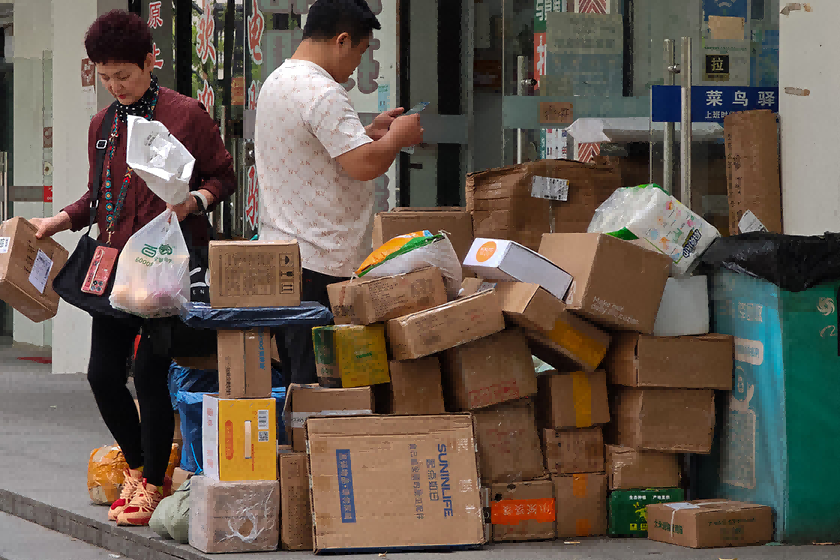
A row of cardboard boxes sitting on a metal shelf outside a Shanghai apartment complex. No security guard. No locked compartment. No one watching.
Just packages. Dozens of them. Some stacked three high. A few had been there long enough to collect a thin layer of dust.
Back home in the US, a package left on a porch for more than ten minutes is basically an invitation. Porch piracy has become so routine that American retailers now advertise “porch pirate-proof” delivery boxes and require signatures for anything worth more than twenty dollars. Ring doorbell videos of thieves snatching packages in broad daylight have become their own genre of internet content.
Here, nobody even looked at the shelf.
I stood there for a while, waiting for someone to take something that wasn’t theirs. A delivery driver dropped off another box, added it to the pile, and walked away. A woman in her sixties walked up, glanced at the labels, found her package, and left. She didn’t check to see if anyone was watching. She just picked it up like she was taking mail from her own mailbox.
This is the part that took me the longest to understand: the codes on Chinese packages aren’t locks. They’re just addresses.
The locked vs. the unlocked
In the US, getting a package delivered is a game of defense. You hide it behind a planter. You ask a neighbor to grab it. You buy a special box with a lock. The delivery person rings the doorbell and runs. The whole system operates on a baseline assumption: if you don’t protect it, someone will take it.That assumption isn’t unreasonable. America’s “porch pirate” culture has spawned an entire industry of anti-theft solutions. Locked parcel boxes, security cameras, package intercept services — these exist because the problem is real.
China’s approach is the opposite.
The package shelf in my neighborhood has no lock. It’s just a rack. The delivery person leaves the package, logs it in the app, and the recipient gets a notification with a pickup code. That code exists to tell them where the package is, not to unlock anything. Anyone could walk up and grab any box.
They just don’t.
A French YouTuber’s experiment
A French video blogger named Tincho wanted to test this. He left his laptop on a table at a shopping mall in Chengdu and walked away. No one watching. No hidden camera crew. Just a laptop sitting in a public space.Twenty-nine minutes later, he came back. The laptop was exactly where he left it. No one had touched it.
“I would never dare leave such a valuable item unattended for even one minute in Paris,” he wrote in the video caption. “But in China, safety and public trust are just different.”
The comment section filled with responses from around the world. A viewer from Brazil wrote: “In Brazil, they would take the laptop, the chair, and the table.” Someone from South Africa said: “Back home, someone would have taken it straight from your hands.”
One comment stuck with me. A traveler described leaving their wallet and phone at a Chinese restaurant — 10,000 yuan inside. They returned eight hours later. Everything was still there.
The luggage wall
Then there were the suitcases.During the 2026 May Day holiday, Wuhan Metro’s Liyuan Station became famous for what locals call the “unattended luggage wall.” Tourists — in town to visit East Lake — started stacking their suitcases in an empty area near the station exit. No lockers. No fee. No attendant. Just a row of luggage against the wall.
The suitcases stayed. No one touched them. The phenomenon spread. Similar luggage walls popped up at metro stations in Changsha, Nanjing, Foshan, and Fuzhou.
Chinese Foreign Ministry spokesperson Mao Ning shared a video of the Wuhan luggage wall on social media, captioning it “safe and worry-free”.
Here’s what made it more remarkable: there was no formal system. No QR codes. No numbered cubbies. Just tourists deciding, collectively, that this was a safe place to leave their stuff. The metro station responded by adding some barriers and extra cameras — not because anything had been stolen, but because the volume of luggage had grown.
A Chinese media commentary described the scene this way: “On one side, tourists voluntarily lined up their luggage neatly and avoided blocking walkways; on the other, police and station staff quietly increased patrols. The unguarded luggage wall is just the surface. The underlying logic is a society where you can walk safely at midnight, where packages left at the door don’t go missing, where a laptop on a café table doesn’t get touched — and if it does, someone will probably remind you that you forgot it.”
Not just tech
A common Western explanation for China’s security is surveillance. And yes, cameras exist. But cameras don’t explain the package shelf at my neighborhood entrance, or the suitcases in Wuhan, or the laptop in Chengdu. Those places all have something more fundamental at work.A Portuguese legal scholar who moved to Beijing described it as cultural whiplash: “I have witnessed several thefts of personal property [in Portugal and Italy] and been the victim of bicycle theft myself. Illicit drug dealers and visibly intoxicated individuals are a common sight back home, whereas here they are functionally non-existent. Back in Portugal, people would be lucky to keep their belongings if left unattended.”
He pointed to research showing China now ranks alongside Nordic countries in interpersonal trust, with 63% of adults saying “most people can be trusted” according to World Values Survey data. For comparison, a Hacker News discussion on the same topic noted that while the US is a “medium-high trust society,” its trust levels have been declining for years — and are still lower than China’s.
How it happened
This trust isn’t a product of the last decade. It’s something China built intentionally, over a long period.Public security in the US and Europe is largely reactive — you call when something happens. China invested heavily in prevention and order. At the same time, cameras and public surveillance created an environment where, increasingly, people knew that someone might be watching. In crowded spaces and transit hubs, security networks became extensive, and patrols were common. The result isn’t just safety, it’s also a shared expectation of accountability.
Economic development played a role. As China lifted hundreds of millions out of poverty through the 1990s and 2000s, the desperation that fuels petty crime diminished. When people have stability, they’re less likely to take risks that could cost them everything.
Education mattered too. A generation grew up with access to schooling, to jobs, to the idea that society works better when people follow its rules. And enforcement got serious. A nationwide crackdown on organized crime in the 2010s disrupted criminal networks at their roots.
In China, order doesn’t just happen — it’s enforced, repeatedly, until it becomes a habit.
The result is a population that trusts the system, trusts the people around them, and — crucially — trusts that violations will have consequences. Theft isn’t just wrong. It’s also stupid, because someone will find out.
What it means for travelers
When I first arrived in China, I kept checking my pockets. My hand would instinctively go to my wallet on the subway. I’d look over my shoulder when I left my backpack at a café table.After a few weeks, I started to relax. Not because I stopped caring about my stuff. Because I started noticing what everyone else was doing. People leaving phones on restaurant tables to save seats. People asking strangers to watch their bags at train stations. People trusting the system.
You can see it in the way deliveries work. A delivery person drops off an order at a hotel reception. The staff might not even look up. Hours later, the guest arrives, finds their package, and takes it. No signature. No ID check. No proof that this bag actually belongs to them.
A local man I spoke with summed it up simply: “I don’t take other people’s things because I don’t want my things taken.”
That reciprocal logic — a sense of mutual obligation — is the backbone of it all.
The real lesson
The unattended packages taught me something I didn’t expect.I came to China expecting the country to be complicated. It is. But some things are simpler than I imagined. The package shelf is a small thing — a metal rack with cardboard boxes. But it’s also not a small thing. It’s evidence that trust can work at scale.
America’s unlocked doors are a memory. In most cities, you lock everything. We’ve accepted that basic honesty is a luxury we can’t afford. I used to think that was just how modern life worked.
Now I’m not so sure.
Maybe it’s not about technology. Maybe it’s not about cameras or codes or smart locks. Maybe it’s about whether you believe, deep down, that your neighbor will do the right thing. And whether your neighbor believes the same about you.
I left a package on that shelf once, just to test it. It sat there for a full day. When I came back, it was exactly where I’d left it.
That’s the part I’ll remember. Not the system. Not the efficiency. Just the shelf, with its packages, and no one watching them — because nobody needed to.
You might also like: Trust is the default — another look at how trust shapes everyday life in China.





 Interpersonal Trust: Higher in China for Acquaintances and Strangers
 Institutional Trust: Significantly Higher in China