Why an army chief as CDF fits Pakistan's strategic realities

Any source for this information?

Hard to believe. Please provide reference(s) if any on above.

There is no publicly available source on this "GHQ/Government's Insistence" information.

The source people quote (even I quoted earlier for the sake of argument) are "secondary" - these secondary sources quote the primary source "Hamood-ur-Rahman Commission Main Report" - which to this day hasn't been declassified. Some excerpts from the Supplementary Report (1974) were declassified, however, that public document doesn't contain any detail on PNS Ghazi.

The main report, in summary, is critical of almost all the war-time operations. Owing to the outcome of 1971, and for the sake of argument, it can be said that blunders were committed but then again the details are shrouded in the dark except for the few testimonial accounts, that again aren't entirely reliable.

Anyhow, the blame gets pinned on the army generals of the time, and rightly so (again due to the outcome of the war) - but the issue is hindsight is always 20/20.

The problem is that a number of people would not include the nuances that led to the failure e.g. the most significant one being the gross discrepancy of military assets shared b/w East and West Pakistan, and then the gross strategic and operational disasters owing to ad hoc measures to deal with such a discrepancy in the middle of an all out war.

Surely all blame, whether supported by evidence or not, can be pinned on a few corrupt and negligent generals in power at the time but to use that history as an argument against the CDF restructure is incorrect, because as I already mentioned in one of my previous responses that the same disastrous outcome can occur whether you have a CDF or not, and whether armed forces are put under civilian oversight or not simply because at the end of the day there is going to one person who has the final authority and is no less likely to commit the same mistake that we are discussing currently.

Trivia: The same Hamood-ur-Rahman Commission Report concluded that another reason for 1971 failure was the lack of inter-services operational planning and coordination 🥲 and recommended the formation of JS HQ, which came into being in 1976 as a result - the reasoning behind this recommendation is actually detailed in the Supplementary Report 1974, which is publicly available.
 

Pakistan's army has always been influential - now its chief has new powers​


Caroline Davies
BBC Pakistan correspondent, Islamabad

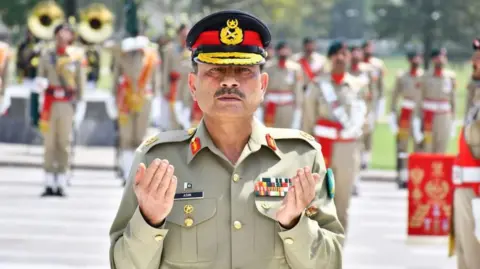
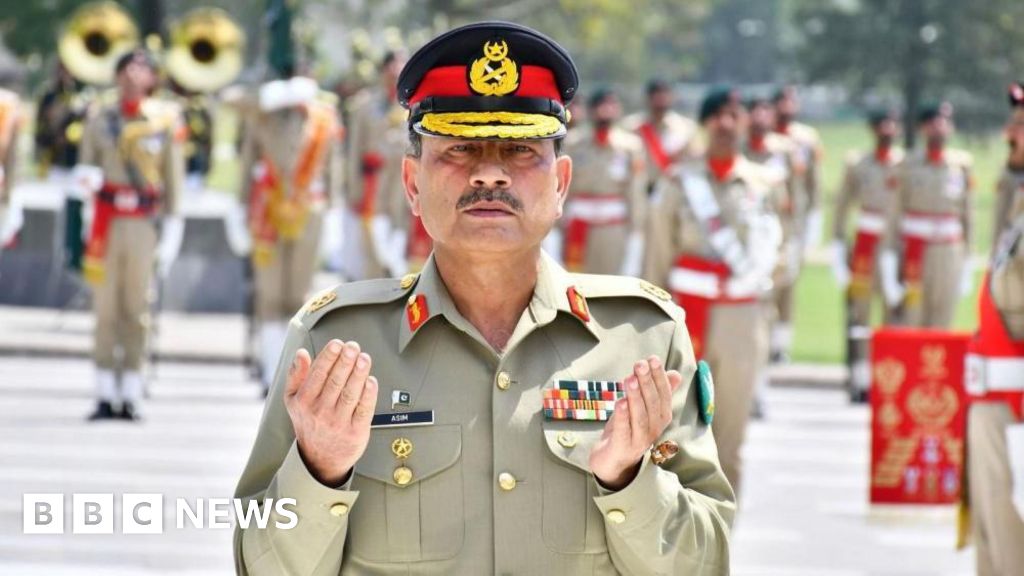
EPA Pakistan's Army Chief Asim Munir lifts his hands in prayer to honour soldiers who lost their lives in line of duty at the army headquarters in Rawalpindi, Pakistan. Other uniformed soldiers are seen in the background
EPA

Field Marshal Munir, who has been army chief since November 2022, will now also oversee the navy and air force

Pakistan's parliament has voted to give army chief Field Marshal Asim Munir new powers and lifetime immunity from arrest and prosecution, a move that critics say paves the way towards autocracy.

The 27th constitutional amendment, which was signed into law on Thursday, will also make significant changes to the way the country's top courts operate.

Those defending the changes say they provide clarity and administrative structure to the armed forces, while helping to ease a backlog in the courts.

Pakistan's military has long played a prominent role in the nuclear-armed country's politics - sometimes seizing power in coups, and, on other occasions, pulling levers behind the scenes.

Throughout its history, Pakistan has oscillated from more civilian autonomy to overt control under military leaders like General Pervez Musharraf and General Zia-ul-Haq. Analysts refer to the balance between civilian and military as hybrid rule.

Some see the amendment as a sign that the balance is shifting in the military's favour.

"For me, this amendment is the latest indication, perhaps the strongest yet, that Pakistan is now experiencing not a hybrid system, but a post-hybrid system," says Michael Kugelman, director of the Wilson Center's South Asia Institute in Washington.

"We're essentially looking at a situation where the civil-military imbalance is about as imbalanced as it could possibly be."

The latest amendment means that Munir, who has been army chief since November 2022, will now also oversee Pakistan's navy and air force.

His field marshal title and uniform are for life and he will be given "responsibilities and duties" even after retirement determined by the president with the advice of the prime minister.

The expectation is that this will give him a prominent role in public life for as long as he is alive.

Supporters of the bill have argued it clarifies Pakistan's military command structure.

Pakistan's government-operated news agency, the Associated Press of Pakistan, cited Prime Minister Shehbaz Sharif as saying that the changes were part of a broader reform agenda to ensure Pakistan's defence keeps pace with modern warfare requirements.

But others see it as ceding power to the military.

"There is no balance between the military and the civilians," says Munizae Jahangir, journalist and co-chair of the Human Rights Commission of Pakistan.

"They have tilted again that power dynamic towards the military and empowered the military at a time when the military needed to be reined in."


Why an army chief as CDF fits Pakistan's strategic realities​


Pakistan's unique geography and threat environment make appointment a logical choice

Khalid Mehmood
November 09, 2025

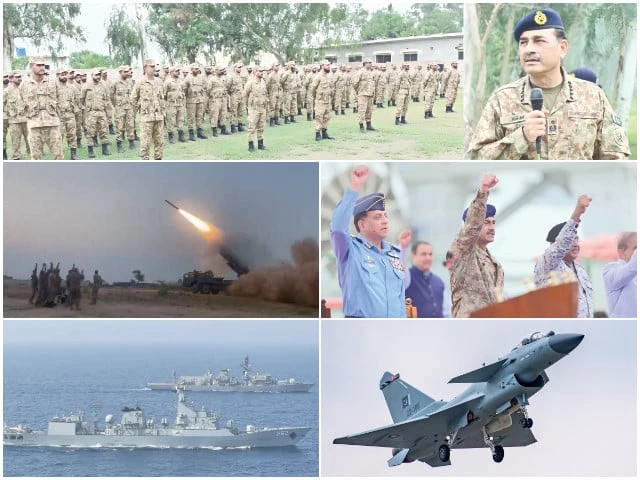
pakistan force

Pakistan force


ISLAMABAD: Pakistan's unique geography, threat environment, and military history make the appointment of an army chief as Chief of Defence Forces (CDF) a logical choice, analysts say, provided the arrangement preserves the autonomy and domain expertise of the air force and navy.

Military experts argue that Pakistan's strategic landscape is overwhelmingly continental and population-centric. "The decisive effects that shape policy are produced on land," said one analyst. A senior commander with deep land-warfare experience, empowered to integrate air and naval capabilities, can align ends, ways, and means across the joint force without diluting the roles of other services.

Classical military theory reinforces this approach. Former Russian general and military theorist Carl von Clausewitz stressed that war serves political purposes, and the decisive outcomes — control of territory, people, and government — are secured on land. Unity of command reduces friction, shortens decision cycles, and ensures campaigns are synchronised with policy objectives.

Similarly, a Swiss-French general and military theorist Antoine-Henri Jomini advocated concentration of force on decisive points and interior lines, favouring commanders who understand maneuver over terrain and logistics — core concerns in Pakistan's context.

From a strategic geography perspective, British geographer, academic and politician Halford Mackinder's continental theory highlights that states located along major land corridors must first secure borders, passes, and interior basins before projecting influence outward. Pakistan, positioned at the junction of South, Central, and West Asia, with long land frontiers, fits this continental model.

Modern strategists also note that while air and sea power enable and shape operations, land control remains the ultimate determinant in resolving political contests.

Pakistan's threat environment reinforces this model, according to defence experts. Border management, counterterrorism, urban security in the Indus corridor, gray-zone pressures along the Line of Control, and insurgencies manifest primarily on land. While campaigns are joint in nature — requiring intelligence, precision fires, air mobility, and maritime interdiction — the scheme of maneuver remains land-led.

Ground forces also carry the logistical and mobilisation burden, secure key infrastructure, and provide disaster relief. Defence experts say that a land-experienced CDF can synchronise these civil-military tasks with air force lift and navy sea-lift capabilities. Similarly, integrating ground-based, air-delivered, and emerging sea-based deterrence systems under a single commander ensures cohesive targeting and command-and-control.
$7000 straight into your account
 
Nothing is going to change in reality. COAS will remain all powerful no matter how decorated CDF post is. This is why Asim will remain COAS as well. He once again deceived the nation. Instead of taking extension in traditional way, he created a new post to desguise his extension. This is why he has decided to rein over both COAS and CDF posts concurrently. Had this post of CDF created for anything meaningful, we would have seen a new appointee there. Congratulations Asim "The Deceiver" ... Now he has issued gag orders on media for even discussing changes in Article 243. Entire discussion is on resignation of Ather and Mansoor from SCP which in itself is a smoke screen created as diversion. With CDF post in hand, now he can give himself extensions as COAS one after another. He will be removed from within Army like Zia and Musharraf. Wait and watch. My only concern is what's in all of this for Pakistan and its defesne and security. Only question that matters and there is nothing good in this. Whoever believes otherwise is either too naive to see it's old power grab game or he is simply on ISPR/M-cell employee.
 

Users who are viewing this thread

Pakistan Defence Latest

Back
Top