Yemen Civil War News and Discussion.. an evolving situation

i dnt belive this . its not good statement . weapons how much precise is always has some sort of error
.one mistake can start a new fanatic relgious war that will destroy everything that muslim world has. Israel would dream that type of scenario

It sounds morbid but I think it will be okay. There is about 80km distance between Taif and Jeddah bases to Makkah. Houthi missiles are based on Iranian design so we know they have some pedigree. Would have to be wildly off track to hit Makkah and even then, the chance it hits an actual religious site vs a random street or house is even less.

There is enough intelligence monitoring to figure out any false flag attack as well. I am sure Pakistan, Turkey and all middle eastern countries are watching carefully.
 
Religious discussions are not allowed on PDF and we need to return to the topic of the thread.
I have only asked for a factual position and you can fact check me, if you want with GPT!

and have stated a factual position of many Pak. about IR state and Ibn e Arabi so called PAkistani thinker!

IR are in their eyes, what I have described!
 

Yemen’s Houthi Militants Are Learning to Arm Themselves​

The Houthis are increasingly using artificial intelligence and other tools to produce advanced weaponry on their own, making them less reliant on Iran.

The popular image of Yemen’s Houthi rebels is of men on the backs of pickup trucks, firing AK-47s into the desert air.

Yet the group has launched long-range missile strikes at Israel, more than a thousand miles away. The Houthis prey on ship traffic in the Red Sea with naval drones. And evidence points to their growing ambition to use artificial intelligence and other means to produce more advanced weaponry themselves, making them less reliant on their sponsors in Iran.

Though they are backed by Iran, for months the Houthis remained on the sidelines of this year’s fighting in the region. That ended in July, when they declared a maritime blockade on Saudi Arabia. Since then, they have marched south, seizing the historic port city of Mokha last week while capturing islands near the narrow strait known as the Bab al-Mandab, tightening the group’s grip on the choke point at the southern end of the Red Sea.

“They use every opportunity to build their capability, to test their capability, such that they are now the most lethal nonstate actor in the entire Middle East,” said Timothy A. Lenderking, the former U.S. special envoy for Yemen, speaking at a Middle East Institute forum on Friday.

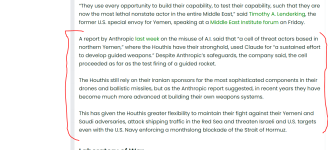
A report by Anthropic last week on the misuse of A.I. said that “a cell of threat actors based in northern Yemen,” where the Houthis have their stronghold, used Claude for “a sustained effort to develop guided weapons.” Despite Anthropic’s safeguards, the company said, the cell proceeded as far as the test firing of a guided rocket.

The Houthis still rely on their Iranian sponsors for the most sophisticated components in their drones and ballistic missiles, but as the Anthropic report suggested, in recent years they have become much more advanced at building their own weapons systems.

This has given the Houthis greater flexibility to maintain their fight against their Yemeni and Saudi adversaries, attack shipping traffic in the Red Sea and threaten Israeli and U.S. targets even with the U.S. Navy enforcing a monthslong blockade of the Strait of Hormuz.

Laboratory of War​

The Houthis and their Iranian advisers were already experimenting with unmanned surface vessels a decade ago. The militant group used a remote-controlled boat loaded with explosives to attack a Saudi frigate all the way back in 2017, killing two people in the process.

After the Houthis captured Yemen’s capital, Sanaa, in 2014, Saudi Arabia led a military coalition propping up the country’s government and fighting back against the militants. A cease-fire was declared in 2022, but experts say the group has used the intervening years to dramatically advance its capabilities.
The truce gave the Houthis time “to regroup, retrain, refit, restock,” said Mr. Lenderking.
Image
A group of fighters in camouflage ride in the back of a camo pickup truck armed with a mounted gun.

Houthi fighters in the Bani Matar district in Yemen on Saturday.Credit...Associated Press
“The volume of goods being brought into Yemen to make weapons increased exponentially and the number of routes being used increased exponentially after the truce was announced in Yemen in 2022,” said Peter Salisbury, an adjunct professor at Columbia University’s School of International and Public Affairs, who has studied Houthi weapons manufacturing closely.

At first, Yemen was a laboratory for Iran’s pursuit of warfare. Increasingly, it is the factory, too. Mr. Salisbury said that larger parts like missile chassis are fabricated in Houthi-controlled territory rather than sent from Iran.

“Iran and Hezbollah have invested heavily in continuing to up-skill the Houthis in the manufacture and use of weapons,” Mr. Salisbury said. “Increasingly they’ve been able to indigenize the production of a lot of things like one-way attack drones.”

According to Farzin Nadimi, a senior fellow with the Washington Institute for Near East Policy, the Iranian defense industry has dedicated design bureaus and factories for weapons systems specifically for proxy forces like the Houthis that are “simple to assemble, simple to move, simple to prepare for launch and simple to use.”


Resilient Supply Chains

The Iranians encouraged the Houthis to develop additional supply chains for components from places like China, whose factories supply many of the drone parts used around the world.

“There’s a lot the Houthis don’t need anymore, and the reason they don’t need it anymore is because they’ve been able to use the global black market supply chain to get most of the things they need,” said Kevin Donegan, a former commander of the U.S. 5th fleet, whose area of responsibility included the Persian Gulf and the Red Sea, and who built the first intelligence fusion cell to study Iranian support for the Houthis.

“They do need key components still, especially for the missiles to make them effective,” Mr. Donegan said. “They have the ratlines that still can bring those components because they’re not the big pieces.”

Those might include guidance systems, rocket engines, and wing tips and fins that require a higher degree of precision engineering, Mr. Salisbury said.
Image
A large commercial vessel off the rugged coast of Yemen, flanked by two smaller boats.

A commercial vessel off Yemen’s coast on Saturday.Credit...Agence France-Presse — Getty Images
While the U.S. Navy’s blockade focuses on large container ships and tankers, smaller components can be smuggled on medium-size vessels like the traditional dhows plowing the region’s waters. Shipments can be sent directly to Houthi-controlled areas of Yemen, transshipped via the Horn of Africa or even transferred ship-to-ship in the waters off the coast of Somalia. Mr. Salisbury calls it a “giant game of three card monte.”

Increased self-sufficiency is not necessarily the same thing as complete independence from their sponsors in Iran’s Islamic Revolutionary Guards Corps. “I think they pretty much still need a lot of help from the I.R.G.C.,” Mr. Nadimi said. He said that he believed there were “significant numbers” of I.R.G.C. officers involved in the planning and execution of the current phase of the fighting in Yemen.

The need for Iranian advisers and the more advanced components may explain how the renewed fighting in Yemen started this summer in the first place.

A Houthi delegation traveled to Tehran in July for the funeral of Iran’s supreme leader, Ayatollah Ali Khamenei. After, they boarded a flight home operated by Iran’s Mahan Air, which is under sanctions imposed by the United States government, back to Sanaa.

The Saudis and the Yemeni government believe that the aircraft carried Iranian military personnel and weaponry. When airstrikes prevented the plane from landing at Sanaa International Airport, the flight diverted and managed to land elsewhere in Houthi-controlled territory.

The Houthis then launched retaliatory attacks on Abha International Airport, in the southern part of Saudi Arabia. It was the first Houthi attack on Saudi Arabia since 2022, and began a new and unpredictable phase of fighting, with an adversary that spent years planning and advancing its tactics and technology.

If the Anthropic report is accurate, the group that was using Claude in northern Yemen tried to develop a multistage ballistic missile with a range of over 1,200 miles and a hypersonic glide vehicle. The would-be weapons designers were careful to avoid the company’s safeguards, hiding the true purpose of the guidance systems they were designing from the very system helping them design it.

Anthropic said there was no evidence that they were successful in “fielding an operational device.” The users queried Claude Code about why their field test had failed. “Nevertheless, we have evidence that the actors had already built an offline simulation toolkit that does not rely on Claude,” the report said.

Recent history suggests they will keep working to improve their capabilities.

“Keep in mind that the Houthis are always on the move,” said Mr. Lenderking, the former U.S. envoy. “They’re extremely entrepreneurial.”
 
It sounds morbid but I think it will be okay. There is about 80km distance between Taif and Jeddah bases to Makkah. Houthi missiles are based on Iranian design so we know they have some pedigree. Would have to be wildly off track to hit Makkah and even then, the chance it hits an actual religious site vs a random street or house is even less.

There is enough intelligence monitoring to figure out any false flag attack as well. I am sure Pakistan, Turkey and all middle eastern countries are watching carefully.
yes i agree and i hope
you are right.my point was that if some sect attack Makkah and if it misses target and reach near even kaaba or even 20 to 50 km its will alarm the muslim world . no weapk how precise it is will always be. error prone
 
yes i agree and i hope
you are right.my point was that if some sect attack Makkah and if it misses target and reach near even kaaba or even 20 to 50 km its will alarm the muslim world . no weapk how precise it is will always be. error prone
Fine, I accept your argument. Now what do you think of the article I just posted ? It describes the Houthis and how they are able to make weapons and maintain supply lines.
 
Fine, I accept your argument. Now what do you think of the article I just posted ? It describes the Houthis and how they are able to make weapons and maintain supply lines.
what article? man just somply tell me. we all know houthis have irani missile tech
 
what article? man just somply tell me. we all know houthis have irani missile tech
This post man , which talks about how Houthis are going indigenous

 
then we are living in dangerous time. one of the worst time

in this region, there are many players, who are neither IR nor KSA!

in other words, CIA and zios make them look like daE** or Is** (i hope im not breaking any PDF rules!)

who have in the past have done some ghastly acts and called it, acts of muslims!

and muslims have gone on to cheer for those acts, now the time has come to cheer more!
(bec, no body cared about the ghastly acts before, now they will do it more to take advantage!)
tough times, if one has eyes without any mind!
 
How cute. Iran has spent the past several months attacking almost every country it could reach while Israel continues operating with near impunity. Yet you had to paste a screenshot of an unverified propaganda story just to prove that Saudi Arabia is supposedly working for Israel.

A headline is not evidence, especially when no source, author, date or supporting details are even visible ( Mod Quality). But I understand, when reality becomes difficult, paste a screenshot, shout MBS and Israel, call everyone sectarian and declare victory.

Brilliant logic.
American message to the Saudis and other Arab countries is clear ! Saudi defence budget is 70 + billion dollars , more than the GDP of Yemen ... these countries have spent 100s of billions of dollars on military equipment and training and yet fatass dummies are looking towards America and other countries to protect them from ragtag militias and insurgents.... message is clear , get your act together and fight or go to hell..
 
This post man , which talks about how Houthis are going indigenous

its irani tech nothing more brother. wothout iran houthis wnt survive
 
I asked Ai the following:

please provide me a succint list of all mercenaries that fought against the Houthis from 2014 to Present that were backed by the Saudis and UAE.

this was the response:

For the Saudi/UAE-led intervention against the Houthis, which began in March 2015, the publicly documented foreign mercenary pool is actually fairly concentrated. A succinct, evidence-weighted list is:

  • Colombians — UAE-backed. By far the best-documented foreign mercenaries. The UAE deployed hundreds of former Colombian soldiers to Yemen; roughly 450 Latin American personnel were reported in the initial contingent. They were used as ground troops against Houthi/Saleh forces. (Human Rights Watch)
  • Panamanians — UAE-backed. Part of the same roughly 450-man Latin American contingent deployed by the UAE. (Europa Press)
  • Salvadorans — UAE-backed. Also reported within the UAE's Latin American force. (BostonGlobe.com)
  • Chileans — UAE-backed. Likewise recruited into the UAE's foreign force and deployed to Yemen. (BostonGlobe.com)
  • Sudanese RSF/Janjaweed fighters — Saudi/UAE-backed. This was vastly larger than the Latin American contingent. The Rapid Support Forces under Mohamed Hamdan Dagalo ("Hemedti") supplied fighters to the Saudi/UAE coalition; some reporting described the arrangement explicitly as mercenary or "state mercenarism." Estimates reached tens of thousands, with one account putting as many as 40,000 RSF personnel in Yemen by 2017. Saudi Arabia and the UAE financially supported Sudan's participation. (The Guardian)
  • Australian contractor(s) — UAE-backed. An Australian commander identified as Philip Stitman was reported killed in December 2015 while leading Colombian mercenaries against Houthi forces near Taiz. (The Guardian)
  • Eritrean personnel — reported, but less firmly established as mercenaries. Eritrea gave the Saudi/UAE coalition use of Assab and supported the Yemen campaign; some contemporary reports claimed Eritrean personnel were recruited, but credible evidence establishing a distinct Eritrean mercenary combat contingent against the Houthis is substantially weaker than for Colombians or the RSF. (Human Rights Watch)
Two important distinctions: regular Sudanese military troops also fought in Yemen, but technically they were forces of a coalition member rather than mercenaries; HRW records Sudan, Saudi Arabia and the UAE all deploying ground forces. (Human Rights Watch) Likewise, the UAE-funded Yemeni Security Belt, Giants Brigades, Elite Forces, National Resistance Forces and STC-aligned forces are better classified as local proxies, not foreign mercenaries. (Amnesty International)

There are also claims of American, British, French, Mexican, South African, Israeli, Rwandan and other individual mercenaries/“Blackwater” personnel fighting Houthis, especially around Taiz in 2015. I would not put those on the confirmed list: much of that material traces back to Houthi-aligned or otherwise poorly corroborated reporting. The strongest independently documented foreign groups are therefore Colombian, Panamanian, Salvadoran, Chilean, Sudanese RSF, plus at least one Australian commander.

Also worth noting: although Erik Prince/Blackwater is frequently mentioned, the better-supported reporting says the UAE's foreign battalion had originally been organized through a company connected with Prince but was under direct Emirati military management by the time it deployed to Yemen. (houstonchronicle.com)

Non-Shias really love their Foreign Christian allies and mercenaries don't they?
 
its irani tech nothing more brother. wothout iran houthis wnt survive


it is IR and there are CIA operative also, who are making it look like, as if Houthis are doing it!
(bec there are two sides of Yemeni factions!)


this article suggests, Houthis are using AI, when in fact, any body can use AI to invovle some one else!

whats clear is, Houthis wont ask help from Zios, would KSA do the same?!


Further, to provide help, this artilce also makes it clear, how the zios would actually operate!


1789483819703.png
 

Users who are viewing this thread

Country Watch Latest

Back
Top