Yemen Civil War News and Discussion.. an evolving situation

Iran gains leverage with Bab al-Mandab Strait under Houthi control​

The waterway, which links the Red Sea to the Gulf of Aden and Indian Ocean, is a busy transit point for crude oil, cars and other manufactured goods.

A lightning offensive along Yemen’s Red Sea coast by Iranian-backed Houthi militants has strengthened Tehran’s leverage in its war of economic attrition with Washington — giving it the ability to threaten a waterway that plays an even broader role in global shipping than the Strait of Hormuz.

The Houthis last week swept through the coastal towns of Mokha and Dhabab and took the island of Perim, cementing their grip over the Bab al-Mandab Strait, which is at the entrance to the Red Sea and known as the “Gate of Tears.”


“This is a major, almost unprecedented, strategic achievement for Iran and the Houthis,” said Dennis Citrinowicz, an Iran expert at the Institute for National Security Studies in Tel Aviv and a former Israeli military intelligence analyst. “At precisely the moment when Tehran is trying to drive up the economic cost of its confrontation with the United States, the Houthi advance gives Iran enormous additional leverage.”


About 8.7 percent of global seaborne trade passes through the Bab al-Mandab Strait, making it one of the busiest chokepoints for maritime transport, according to 2023 figures published by the United Nations. That includes 20 percent shares of both cars and containers, 15 percent of oil products and 13 percent of crude oil.
The strait, which links the Red Sea to the Gulf of Aden and the broader Indian Ocean, is about 18 miles wide at its narrowest point. It is bordered by Djibouti and Eritrea to the west and Yemen to the east.

Perim Island naturally divides the strait into two channels for traffic. Transiting vessels carry bulk commodities, manufactured goods and energy, allowing disruptions in the bottleneck to have global repercussions.
Saudi Arabia, a key U.S. ally in region with the Red Sea on its west coast and the Persian Gulf on its east, is literally caught in the middle.
Now, the threat of Iran-backed forces controlling both straits, Hormuz and Bab al-Mandab, could allow Tehran to use multiple fronts to ramp up pressure on Washington.
The unpopular Iran war and soaring energy prices have created an increasingly heavy burden for President Donald Trump and his Republican allies in Congress less than two months before the Nov. 3 midterm elections.

Trump last week accused Iran of trying to influence the midterm elections and acknowledged he wasn’t poised to resolve the six-month-old conflict or reduce pump prices until after the midterms.

Amid the Houthis’ advance, the price of oil jumped above $100 per barrel and has stayed there — its highest levels since May. Friday was “the first day that Iran really started winning the war,” one Yemeni official, who is part of the country’s internationally recognized, Saudi-backed government, told The Washington Post, speaking on the condition of anonymity because of the sensitivity of the situation.Ask The Post AIDive deeper
3a018451cf59ae05b1b3a07c473b2802b02b0990.avif

Boats float in the Bab al-Mandab Strait on July 24. (Khaled Ziad/AFP/Getty Images)
On Saturday, Trump sounded a conciliatory note, telling reporters that “the Houthis called us” and said “they don’t want to fight with us.”
“They would much prefer not having us involved,” Trump said during a meeting with Irish Prime Minister Micheál Martin. “They are letting most ships go through.”


Iran appeared to further flex its regional influence when drones launched last week from Iraqi territory, most likely by Iran-backed militias, hit the Saudi-operated East-West Pipeline, which funneled up to 7 million barrels of oil per day toward the Red Sea, further squeezing global supplies.

Taken together, the developments suggested a degree of coordination by Iran at a crucial juncture, as Tehran seeks to regain leverage after Trump and his administration imposed sweeping sanctions to choke the Iranian economy, and began using naval and air forces to escort tankers through Hormuz.

The drone attack shows that “energy supplies are highly vulnerable, whether it’s by sea or by pipeline,” said Rob Haworth, a strategist at U.S. Bank.

For now, it’s not clear whether the Houthis will use their territorial gains to impose a broad blockade — or how Trump will respond.

A significant U.S. military operation to force a reopening of the Bab al-Mandab or a prolonged shutdown of the East-West Pipeline could send oil prices “much higher than what we’ve already seen this week,” Haworth said.
In July, the Houthis also vowed to block the access of Saudi Arabian ships to the Red Sea while Iranian-backed militias in Iraq fired at — but failed to hit — the Saudi pipeline in what also appeared to be a coordinated effort.
1cdf225e8e557bef55652d49e0b3e3d255e9b23c.avif

Commercial vessels sit anchored in the Strait of Hormuz off Bandar Abbas, Iran, on Sept. 7. (Vahid Salemi/AP)

Sima Shine, a senior researcher at the Institute for National Security Studies and former head of analysis at Mossad, said Iran was taking advantage of the window before the Nov. 3 midterm elections to drive up oil prices and pressure Trump with a multipronged maneuver.

Although the Houthis historically are not known to coordinate with Tehran as closely as other Iran-backed groups in the Middle East, last week’s events showed Iran’s interests aligning perfectly with those of the Yemeni militia, which seeks to overthrow the Yemeni government backed by Saudi Arabia. In Iraq, several Iran-backed militias have sought to rebuff the government’s attempts in recent weeks to disarm them.


“It’s much more coordinated between the Iranians and the Iraqi militias and the Houthis,” said Shine, who noted that even if the East-West Pipeline came back online, the Houthis could still threaten tanker traffic by positioning drones and artillery near the Bab al-Mandab coast.
Analysts say it’s not immediately clear how the events of the past week will affect the oil market.


Saudi Arabia announced the pipeline’s closure on Friday, and the Iraqi government said it had launched an investigation. The attack sent a message that pipelines across the region — present and future — are potential targets.

Persian Gulf oil exporters have advanced plans to build alternative pipelines, such as through the United Arab Emirates and across Iraq and Syria, to circumvent the chokepoint.

8168cae1652bb0032351dca1bdd0d82b6891bf21.webp

U.S. President Donald Trump downplayed the Houthi threat, telling reporters that “the Houthis called us” and said “they don’t want to fight with us.” (Kin Cheung/AP)

Abdullah al-Junaid, a geopolitical commentator in Bahrain, said a renewed U.S. campaign against the Houthis was unlikely. The two sides reached a ceasefire agreement during the first few months of Trump’s second term in May 2025, and Gulf countries should recognize that the U.S. military is not in a position to open another front, al-Junaid said.

“The U.S. Navy is stretched far too thin at the present time. The assets are not available to address multiple threats like Iran and now Yemen,” al-Junaid said. “The regional powers need to step up and address this issue. We can’t just depend on the U.S. to solve our regional issues anymore.”


The Red Sea is such a crucial waterway that international powers in the past have cooperated to keep the area free of piracy — for instance, from Somalia. The United States, France, Japan and Italy all operate naval bases in Djibouti, just across the Bab al-Mandab from Yemen, and in 2017 China chose the small East African country’s coast for its first overseas military base.

If the Houthis widen a blockade of ships traversing the strait, cargo ships traveling between Europe and Asia would be denied access to the Suez Canal and have to travel around the Cape of Good Hope at the southern tip of Africa, adding weeks to their journey.Ask The Post AIDive deeper

Citrinowicz said Iran was now close to choking all export routes for Saudi Arabia — the region’s largest oil exporter.

“What makes this particularly serious is that there is no obvious solution on the horizon, military or economic,” he said. “This is not simply another Houthi battlefield victory in Yemen. It fundamentally changes Iran’s leverage in its confrontation with the United States and places much greater pressure on the global energy system.”
 
آپ نے تو مضمون پڑھا ہی نہیں۔
Brother irgc commanders are in yemen and planning all.Houthis dnt have anything and that depth of planning and precise execution . its irgc that is giving real fight here in yemen.
 
I asked Ai the following:

please provide me a succint list of all mercenaries that fought against the Houthis from 2014 to Present that were backed by the Saudis and UAE.

this was the response:

For the Saudi/UAE-led intervention against the Houthis, which began in March 2015, the publicly documented foreign mercenary pool is actually fairly concentrated. A succinct, evidence-weighted list is:

  • Colombians — UAE-backed. By far the best-documented foreign mercenaries. The UAE deployed hundreds of former Colombian soldiers to Yemen; roughly 450 Latin American personnel were reported in the initial contingent. They were used as ground troops against Houthi/Saleh forces. (Human Rights Watch)
  • Panamanians — UAE-backed. Part of the same roughly 450-man Latin American contingent deployed by the UAE. (Europa Press)
  • Salvadorans — UAE-backed. Also reported within the UAE's Latin American force. (BostonGlobe.com)
  • Chileans — UAE-backed. Likewise recruited into the UAE's foreign force and deployed to Yemen. (BostonGlobe.com)
  • Sudanese RSF/Janjaweed fighters — Saudi/UAE-backed. This was vastly larger than the Latin American contingent. The Rapid Support Forces under Mohamed Hamdan Dagalo ("Hemedti") supplied fighters to the Saudi/UAE coalition; some reporting described the arrangement explicitly as mercenary or "state mercenarism." Estimates reached tens of thousands, with one account putting as many as 40,000 RSF personnel in Yemen by 2017. Saudi Arabia and the UAE financially supported Sudan's participation. (The Guardian)
  • Australian contractor(s) — UAE-backed. An Australian commander identified as Philip Stitman was reported killed in December 2015 while leading Colombian mercenaries against Houthi forces near Taiz. (The Guardian)
  • Eritrean personnel — reported, but less firmly established as mercenaries. Eritrea gave the Saudi/UAE coalition use of Assab and supported the Yemen campaign; some contemporary reports claimed Eritrean personnel were recruited, but credible evidence establishing a distinct Eritrean mercenary combat contingent against the Houthis is substantially weaker than for Colombians or the RSF. (Human Rights Watch)
Two important distinctions: regular Sudanese military troops also fought in Yemen, but technically they were forces of a coalition member rather than mercenaries; HRW records Sudan, Saudi Arabia and the UAE all deploying ground forces. (Human Rights Watch) Likewise, the UAE-funded Yemeni Security Belt, Giants Brigades, Elite Forces, National Resistance Forces and STC-aligned forces are better classified as local proxies, not foreign mercenaries. (Amnesty International)

There are also claims of American, British, French, Mexican, South African, Israeli, Rwandan and other individual mercenaries/“Blackwater” personnel fighting Houthis, especially around Taiz in 2015. I would not put those on the confirmed list: much of that material traces back to Houthi-aligned or otherwise poorly corroborated reporting. The strongest independently documented foreign groups are therefore Colombian, Panamanian, Salvadoran, Chilean, Sudanese RSF, plus at least one Australian commander.

Also worth noting: although Erik Prince/Blackwater is frequently mentioned, the better-supported reporting says the UAE's foreign battalion had originally been organized through a company connected with Prince but was under direct Emirati military management by the time it deployed to Yemen. (houstonchronicle.com)

Non-Shias really love their Foreign Christian allies and mercenaries don't they?

you mean every body apart from CIA and the zios!

right!
 
It sounds morbid but I think it will be okay. There is about 80km distance between Taif and Jeddah bases to Makkah. Houthi missiles are based on Iranian design so we know they have some pedigree. Would have to be wildly off track to hit Makkah and even then, the chance it hits an actual religious site vs a random street or house is even less.

There is enough intelligence monitoring to figure out any false flag attack as well. I am sure Pakistan, Turkey and all middle eastern countries are watching carefully.
I said it in another comment that now we wait for the Saudis and their supporters here start claiming that the Houthis are targeting Mecca and Media just to rile up support amongst the Sunnis. I already saw a disinformation on one of the Pakistani sub reddits. The Saudis don't give af about Mecca, Its a cash cow for them and their backers who use it to influence 1.3bn masses by pushing pro or anti whatever messaging they want. These guys "converted" French SF in 1979 so they could go storm Mecca, do you think they care about the religion itself. The famine and starvation from 2015 in Yemen rivals that of what Israel has done in Gaza. The death rate from triple tap bombings of funerals and other areas was also close to 500k, but but but MuH Syrian Sunniz. As far as I know the Shias never solely put the blame on Sunnis for this, unlike the Mecca Defense Pact supporters have been doing on their thread which I got banned from/ What a fkn embarrassment, dead on arrival pact with the sugar daddy begging the US and Israel to help them. Kudos to the Turks and Pakistan for staying out of this mess. The Sauds thought they were slick, sign this pact without naming an enemy and then do a modus operandi and attack other Muslims thereby activating the pact and drawing in Pakistan and Turkey and therefore making it a Muslim vs Muslim war awhile they sit back and get fat
 
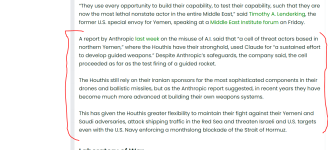
it is IR and there are CIA operative also, who are making it look like, as if Houthis are doing it!


this article suggests, Houthis are using AI, when in fact, any body can use AI to invovle some one else!

whats clear is, Houthis wont ask help from Zios, would KSA do the same?!


Further, to provide help, this artilce also makes it clear, how the zios would actually operate!


View attachment 215608
why houthis should go for cia and zio when iran is giving them all.
as for ksa i think soon Pak and turkiye will inviove covertly .
 
I asked Ai the following:

please provide me a succint list of all mercenaries that fought against the Houthis from 2014 to Present that were backed by the Saudis and UAE.

this was the response:

For the Saudi/UAE-led intervention against the Houthis, which began in March 2015, the publicly documented foreign mercenary pool is actually fairly concentrated. A succinct, evidence-weighted list is:

  • Colombians — UAE-backed. By far the best-documented foreign mercenaries. The UAE deployed hundreds of former Colombian soldiers to Yemen; roughly 450 Latin American personnel were reported in the initial contingent. They were used as ground troops against Houthi/Saleh forces. (Human Rights Watch)
  • Panamanians — UAE-backed. Part of the same roughly 450-man Latin American contingent deployed by the UAE. (Europa Press)
  • Salvadorans — UAE-backed. Also reported within the UAE's Latin American force. (BostonGlobe.com)
  • Chileans — UAE-backed. Likewise recruited into the UAE's foreign force and deployed to Yemen. (BostonGlobe.com)
  • Sudanese RSF/Janjaweed fighters — Saudi/UAE-backed. This was vastly larger than the Latin American contingent. The Rapid Support Forces under Mohamed Hamdan Dagalo ("Hemedti") supplied fighters to the Saudi/UAE coalition; some reporting described the arrangement explicitly as mercenary or "state mercenarism." Estimates reached tens of thousands, with one account putting as many as 40,000 RSF personnel in Yemen by 2017. Saudi Arabia and the UAE financially supported Sudan's participation. (The Guardian)
  • Australian contractor(s) — UAE-backed. An Australian commander identified as Philip Stitman was reported killed in December 2015 while leading Colombian mercenaries against Houthi forces near Taiz. (The Guardian)
  • Eritrean personnel — reported, but less firmly established as mercenaries. Eritrea gave the Saudi/UAE coalition use of Assab and supported the Yemen campaign; some contemporary reports claimed Eritrean personnel were recruited, but credible evidence establishing a distinct Eritrean mercenary combat contingent against the Houthis is substantially weaker than for Colombians or the RSF. (Human Rights Watch)
Two important distinctions: regular Sudanese military troops also fought in Yemen, but technically they were forces of a coalition member rather than mercenaries; HRW records Sudan, Saudi Arabia and the UAE all deploying ground forces. (Human Rights Watch) Likewise, the UAE-funded Yemeni Security Belt, Giants Brigades, Elite Forces, National Resistance Forces and STC-aligned forces are better classified as local proxies, not foreign mercenaries. (Amnesty International)

There are also claims of American, British, French, Mexican, South African, Israeli, Rwandan and other individual mercenaries/“Blackwater” personnel fighting Houthis, especially around Taiz in 2015. I would not put those on the confirmed list: much of that material traces back to Houthi-aligned or otherwise poorly corroborated reporting. The strongest independently documented foreign groups are therefore Colombian, Panamanian, Salvadoran, Chilean, Sudanese RSF, plus at least one Australian commander.

Also worth noting: although Erik Prince/Blackwater is frequently mentioned, the better-supported reporting says the UAE's foreign battalion had originally been organized through a company connected with Prince but was under direct Emirati military management by the time it deployed to Yemen. (houstonchronicle.com)

Non-Shias really love their Foreign Christian allies and mercenaries don't they?
Regarding the LATAM mercenaries; I'm not surprised. Those men are tough jungle fighters not that there is an abundance of jungle in Yemen. Many of them trained at the Benning School for Boys back in the day. They were well-trained at counter-insurgency warfare.
 
why houthis should go for cia and zio when iran is giving them all.
as for ksa i think soon Pak and turkiye will inviove covertly .


they are not Houthis; there are Yemenis who are working with other foreign influence who are fighting against Houthis and making it look as if Houthis are doing the same!


and your insistence, IR support is for Houthis?

whats your point, it is their country, they can ask anybody for the support, it is their right!

just as the opposing faction has the right to call mercenaries

what are you arguing, Houthis, should wait for their enemy to maul them?!!
 
Regarding the LATAM mercenaries; I'm not surprised. Those men are tough jungle fighters not that there is an abundance of jungle in Yemen. Many of them trained at the Benning School for Boys back in the day. They were well-trained at counter-insurgency warfare.
too bad they are as incompetent as everyone else fighting in Yemen. Its one thing r*ping and k*lling Christian priests and Nuns in South America, and another waging wars against a determined enemy.
 
they are not Houthis; there are Yemenis who are working with other foreign influence who are fighting against Houthis and making it look as if Houthis are doing the same!


and your insistence, IR support is for Houthis?

whats your point, it is their country, they can ask anybody for the support, it is their right!

just as the opposing faction has the right to call mercenaries

what are you arguing, Houthis, should wait for their enemy to maul them?!!
For your argument why iran was crying hard about azeebaijan's relation with israel? azerbaijan soverign country why cry for. ? its simple point
 
For your argument why iran was crying hard about azeebaijan's relation with israel? azerbaijan soverign country why cry for. ? its simple point


I dont know anything about Azerbaijan!


but, that country is also kafir and majoosi (fav. terms at PDF!) just like IR, it seems

(judging by the popularity!)
 
sorry dnt get it . which country is majosi ?
IR and Azerbaijan..

fav. terms of many members here!

laughable though!

i cannot get past those sentiment, suppose they are what you call them!

does that give PAk. a free pass to be their masters, are they our slaves?!

does that mean, they should forget what serves their interests?!!

this is hilarious and quite damaging for Pak, if you ask me!
 

Users who are viewing this thread

Country Watch Latest

Back
Top