M829 DU shell - the hidden spear of Saudi and Kuwaiti Abrams tanks
In a world where military superiority is measured by a shield's resilience and a projectile's penetrating ability, the M829 APFSDS-T stands out as a symbol of technical superiority and a weapon given only to those closest to them.
It is a rare depleted uranium (Depleted Uranium) ammunition subject to strict US export restrictions, licensed only to allies that Washington trusts can preserve this unique technology.
When this missile entered the arsenals of the Kingdom of Saudi Arabia and the State of Kuwait, it was not just a passing military deal, but a clear indication of the depth of the strategic alliance and the two countries' position within the circle of reliable allies. This ammunition gave the Saudi and Kuwaiti M1A2 Abrams tanks a firepower comparable to their counterparts in the US Army, standing among the armored forces capable of imposing dominance on any field of confrontation.
It is not an ordinary shell, but a silent message of deterrence that sums up years of development and secrecy, and practically translates into superiority at a moment when no second chance is given.
The APFSDS-T M829 shell was born out of a clear, uncourtesy military need. How does a modern tank encounter advanced armor specifically designed to withstand a medium weapon? The answer came in the form of a densely mounted longitudinal projectile, a core made of high-density material driven by elaborate ballistic engineering, and a flagellum that dislodges to allow the rod to fly toward its target without additional resistance.
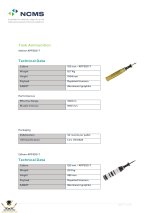
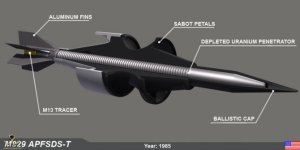
APFSDS-T (Armor-Piercing Fin-Stabilized Discarding Sabot - Tracer) - M829 APFSDS-T Rod Kinetic Energy (Kinetic-Energy) Shell. The idea is based on a thin, high-density rod that is fired at high speeds after the sapot (sabot) is abandoned when exiting the pipe, so the penile nucleus flies straight towards the shield while maintaining its focused kinetic energy. The design balances mass and speed for maximum practical penetration depth, while the Tracer element provides a visual impact for trajectory tracking and injury assessment.
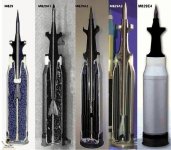
The development of the M829 series came through decades of research and testing, involving leading American defense companies, led by companies such as Alliant Techsystems (ATK), which later became part of major entities such as Orbital ATK and Northrop Grumman, while other companies played a role in manufacturing sapote components, caps, and accessories such as General Dynamics and multiple industrial partners. The series has seen successive updates up to version (M829A4), which combines physical and ballistic improvements and supply components for greater accuracy and penetration.
This series is not the product of just one manufacturer, but rather an integrated industrial supply system that combines projectile design, uranium alloy processing, and the manufacture of sabut and accessories to ensure compatibility with the M256 gun and required combat specifications.
At the material level, the core of the M829 consists of a dense thermal rod made of purified uranium (DU) that is characterized by high density and unique mechanical behavior under high shocks, this rod is surrounded by a spout that allows it to withstand inside the gun barrel and a clean exit from the nozzle, while the external and supporting parts are made of composite aluminum alloys and treated materials to withstand ballistic pressures.
The field importance of this combination lies in the fact that the DU rod not only penetrates the shield but also maintains the sharpness of the penetration section as it crosses the plates, enabling it to achieve greater penetration depth and stronger internal effect. In practice, this means that a single intact shot could take an entire combat platform off the battlefield, or turn enemy tanks into a logistical and field burden that cannot be ignored.
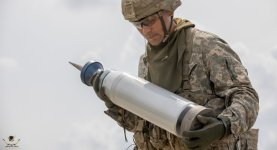
The M829 cannot be talked about in isolation from the cannon that was prepared for it, because the cannon and ammunition are an integrated unit. The M256, an American installation based primarily on the German Rheinmetall Rh-120 gun with an L/44 barrel length, gives the projectile sufficient acceleration time inside the barrel to exit at a constant and effective nozzle speed.
The length of the barrel is a practical factor, as increasing the length means a longer time for the projectile to accelerate under the influence of charge, and thus the possibility of generating a higher nozzle speed without the need for an excessive increase in pressure. However, the possibility of increasing the speed depends on strict geometric limits. The maximum stresses on the spout are borne by the inner casing of the pipe, and there are risks of dynamic stress that may lead to spout fragmentation or damage to the inner cylinder. Therefore, any modification in the projectile design must respect the ballistic limits of this structure.
In the course of my work, the M829 series has adjusted the balance so that the longitudinal rod and its spout work efficiently with the thrust charge designed to make the M256, and this integration is the secret to achieving true and consistent penetrating performance that is not subject to theoretical tests alone.

The simple mathematical equation for the kinetic energy of a projectile puts velocity at the forefront in terms of impact, but practical application in the design of penetrating projectiles reveals greater complexity: velocity is affected by a quadratic force, mass is affected linearly, but the behavior of the material and how energy is distributed during the collision are the decisive item. So, in a long projectile design, it is not enough to pursue speed alone, because increasing speed by reducing the mass of the rod or changing the Verhältnis L/D may be counterproductive upon impact.
Developments in the M829 series have tended to balance these factors: maintaining a high enough nozzle speed while at the same time increasing the mass and length of the rod in some versions (particularly A3 and A4) to ensure greater overall power and better penetrating behavior upon impact with multi-layer armor and ERA. This design approach reflects a practical understanding: preferring actual penetrability over impressive speed numbers that could be deceptive if not translated into resistance to deformation during collision.
Self-sharpening and materials Why the DU rod excels at penetration
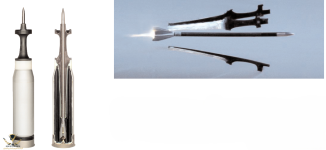
The difference between one material and another at the moment of impact is what determines the practical result of two hundred milliseconds of friction and shear. The DU rod exhibits a behavior known in the technical literature as self-sharpening or self-sharpening upon impact, the outer layers splitting in such a way that the tip maintains its sharpness rather than bulging or flattening that leads to energy (scattering) and loss of permeability. This behavior ensures that energy is directed toward penetrating the shield rather than being wasted distorting the projectile material itself.
The direct field result is that a DU projectile is capable of achieving greater penetration depth at the same nozzle speed than a projectile of other materials or achieving similar performance at a lower speed if the rod is designed to be longer and heavier. Therefore, a tactical design that increases mass and accepts a slight drop in speed often results in a better penetrating result than a design that has to increase speed to compensate for a less efficient material. This difference in practical energy utilization makes DU a strategic choice in situations where results are measured by the price of field presence rather than by theoretical numbers on paper.
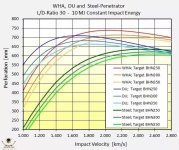
The difference between DU and tungsten is not just a difference in numbers, but a difference in behavior at the shadow of the collision.In common tests, comparisons and operational models, DU shows a practical superiority in penetration depth of approximately 10-20% under standard conditions when comparing rods of almost identical dimensions.
This does not mean that tungsten is ineffective, tungsten alloys have evolved a lot and provide good results in many cases, but the self-sharpening behavior of uranium keeps the projectile head sharp and increases the conversion of energy into actual penetration rather than distortion.
In addition, friction and shear contribute to the generation of sparks and heat when the DU rod collides with the shield, which may ignite stocks inside the target vehicle (fuel or ammunition) and maximize lethality after penetration. The downside is the environmental and political cost of DU residues, which necessitate health and environmental concerns, leaving their use and export subject to strict restrictions and control policies. But from the perspective of pure combat capability, having DU ammunition in a country's stockpile gives practical and direct superiority on the battlefield.
At the moment of decision on the armored front line, it is not enough to have an advanced combat platform, but you must have the bullet that turns that platform into an actual cutter of military toil.
The M829 DU shell is not just technical ammunition, it is a declaration of military and political power that places its holder on a new regional accounting table.
When Saudi and Kuwaiti M1A2 tanks place this bullet in their convoys, they not only update their ammunition stocks, but also give their systems a real parity in firepower with American models, and send a clear message of deterrence to anyone who is burdened by the idea of confrontation. In the end, victory in armored battles may actually be decided with the blink of an eye, and owning the M829 makes that blink in favor of whoever owns it.


 www.jpost.com