Operation Ghazab Lil Haq (Pakistan - Afghanistan War)

To view this content we will need your consent to set third party cookies.
For more detailed information, see our cookies page.

The narrative needs to be taken back completely from the Afghans, who despite Pakistan's absolute assistance and massive sacrifices in their support, have nothing but never-ending complaints and rancor. It has been a thankless duty for Pakistan and since all we have gotten is ingratitude from those who either shamelessly celebrate or stay silent when Pakistani citizens are being killed, why continue with this charade?

Here are the facts:
  • We aren't killing their citizens. They are!
  • We have no designs on their territory. They do!
  • We have no overt dependency on trade via them. They do!
  • Traditionally Pakistan has gotten nothing but flak for supporting Taliban, to Pakistan there has never been any benefit in terms of security with the Taliban in Kabul. The only thing that some can claim is that we have Pakhtuns ruling in Kabul. Benefit to Pakistan = None!
  • We get no support from Afghans at International forums (and even on Social Media, it is hideous hate and rancor towards Pakistan), yet they rely on the good offices of Pakistan, Qatar etc. to make their case to the world.
  • The only upside that Pakistan expects is that Afghans stop sponsoring the TTP/BLA terrorists, if that were to happen, there would be absolute peace on our borders. Even that is not acceptable to these bastards ruling Kabul.
So the net-net is that Pakistan does not need to expend its goodwill on Taliban. Pakistan, both the government and the citizenry, need to push back on the Afghan blackmail of Pakistan (which they have been doing quite successfully using Pakistani sellouts like PTM to aid their propaganda).

Clearly, all Taliban need to do is stop their terrorists from attacking Pakistan and there will be a sea-change in Pakistan's engagement with them. However, they clearly think their investment in their proxies is worth more than stability between the two countries.
 
The narrative needs to be taken back completely from the Afghans, who despite Pakistan's absolute assistance and massive sacrifices in their support, have nothing but never-ending complaints and rancor. It has been a thankless duty for Pakistan and since all we have gotten is ingratitude from those who either shamelessly celebrate or stay silent when Pakistani citizens are being killed, why continue with this charade?

Here are the facts:
  • We aren't killing their citizens. They are!
  • We have no designs on their territory. They do!
  • We have no overt dependency on trade via them. They do!
  • Traditionally Pakistan has gotten nothing but flak for supporting Taliban, to Pakistan there has never been any benefit in terms of security with the Taliban in Kabul. The only thing that some can claim is that we have Pakhtuns ruling in Kabul. Benefit to Pakistan = None!
  • We get no support from Afghans at International forums (and even on Social Media, it is hideous hate and rancor towards Pakistan), yet they rely on the good offices of Pakistan, Qatar etc. to make their case to the world.
  • The only upside that Pakistan expects is that Afghans stop sponsoring the TTP/BLA terrorists, if that were to happen, there would be absolute peace on our borders. Even that is not acceptable to these bastards ruling Kabul.
So the net-net is that Pakistan does not need to expend its goodwill on Taliban. Pakistan, both the government and the citizenry, need to push back on the Afghan blackmail of Pakistan (which they have been doing quite successfully using Pakistani sellouts like PTM to aid their propaganda).

Clearly, all Taliban need to do is stop their terrorists from attacking Pakistan and there will be a sea-change in Pakistan's engagement with them. However, they clearly think their investment in their proxies is worth more than stability between the two countries.

You should have listened to Musharaf and immediately distanced yourself from the taliban after 9/11 with full border closure. Total non cooperation, cut all ties.

You didn't and you paid a very heavy price. They used you, they extracted the maximum and attacked you to make money from India. You got f**ked over. Learn from this.
 
You should have listened to Musharaf and immediately distanced yourself from the taliban after 9/11 with full border closure. Total non cooperation, cut all ties.

You didn't and you paid a very heavy price. They used you, they extracted the maximum and attacked you to make money from India. You got f**ked over. Learn from this.
National interests and policy require constant changes, 180 degree turns etc. aren't unusual and also this is not specific to Pakistan. Happens all around the world. India's BD policy in tatters, Iran's influence in ME suffering serious reverses, US influence eroding all over the world etc. etc.

Musharraf did what made sense then. Current dispensation has to do what makes sense now. Taliban and Afghanistan are a sunk-cost proposition for Pakistan currently. Cutting losses and applying an entirely new approach which is punitive with a carrot and stick (a serious stick) policy will allow better calibration in resetting ties.

"There are no permanent friends, no permanent enemies, only permanent interests." - William Clay
 

Despite the Taliban's murderous spree, Pakistan has kept its diplomatic door open.

Pakistani diplomat, Afghan governor meet to ease bilateral tensions

Tahir Khan Published November 25, 2025 Updated about 3 hours ago
https://www.dawn.com/news/print/1957104#comments
https://whatsapp.com/channel/0029VaMc238IiRov8okfYy3n
A Pakistani diplomat in Afghanistan met a key Afghan governor amid tensions over rising terror incidents in Pakistan, saying efforts were underway to thaw bilateral ties, according to Afghan state media and Pakistani sources who spoke to Dawn.

The meeting was held hours after three Federal Constabulary men were martyred in a suicide attack on the force’s headquarters in Peshawar’s Saddar area this morning. Security forces quickly neutralised the attackers.

This was the first high-level contact in months between the Pakistani Consul General in Jalalabad, Shafqatullah Khan and Nangarhar Governor Mullah Muhammad Naeem Akhund.

Akhund is an important Taliban leader and is considered a confidant of Taliban Supreme Leader Hibatullah Akhundzada.

Governor Akhund has previously served as deputy minister of Borders and Tribal Affairs and deputy minister of Civil Aviation during the Taliban’s first government from 1996-2001. He had played a key role in the Taliban’s military commission during the 20-year war against the US and its NATO allies and also led the Taliban’s military activities in southern Helmand province.

He was a close confidante of the late Taliban’s chief, Mullah Akhtar Mansoor, and is considered a close associate of Defense Minister Mullah Yaqoob Mujahid.

“The Islamic Emirate has a constructive stance towards good relations, cooperation, and safeguarding common interests with the region, neighbouring countries, and other countries of the world, and relevant efforts in this regard are ongoing,” Afghanistan’s official Bakhtar news agency reported.

Pakistan has long said that terrorist groups have used Afghan soil to plot and stage attacks across the border; a charge the Afghan Taliban deny.

“The governor of Nangarhar noted the goodwill, brotherhood, and historical kinship of the Afghan people, and explained that the foundation of positive relations can remain strong in the presence of mutual respect, understanding and systematic coordination,” according to the report.

No statement was issued by the Pakistani consulate about the meeting. The consulate and the Foreign Office spokesman did not reply to queries when approached for comments.

However, sources with knowledge about the meeting said the Afghan governor told the diplomat that he has already “made efforts to reduce tension between the two countries”.

The diplomat explained Pakistan’s position on the current security issues to Akhund, who is also keen to bring the relationship back on track.

“The meeting discussed ethnicity, language, religion, culture, and other commonalities, and discussed the current situation in the region and the daily amenities of the people based on the tradition of good neighbourliness,” Bakhtar said.

The meeting was attended by Nangarhar Deputy Governor Maulvi Azizullah Mustafa, Foreign Affairs Director Maulvi Jan Mohammad Inqelab, provincial spokesman Qari Ehsanullah Usmani and a number of other officials.

Pakistan’s bilateral relations with Afghanistan have come under strain in recent times as the Tehreek-i-Taliban Pakistan (TTP) remains the main point of contention between the two countries.

Pakistan has demanded that the rulers in Kabul take action to stop cross-border terrorism, but the Afghan Taliban deny Islamabad’s allegations of terrorists being allowed to use Afghan soil to carry out attacks in Pakistan.

During a process of dialogue, which followed border clashes between the two countries in October, the two sides had met in an effort to work on mechanisms for lasting peace and stability between the two countries.

On October 25, the second round of talks between the two sides began in the Turkish capital. Information Minister Attaullah Tarar then announced that the talks “failed to bring about any workable solution”.

However, mediators Turkiye and Qatar intervened and managed to salvage the dialogue process with an October 31 joint statement released by Turkiye stating that “further modalities of the implementation will be discussed and decided” during a principal-level meeting in Istanbul on November 6.

On November 7, however, after the third round of talks, Defence Minister Khawaja Asif saidthat talks addressing cross-border terrorism were “over” and “entered an indefinite phase” as negotiators failed to bridge big differences between the two sides.

Following the failure of the talks, the Afghan Taliban suspended trade ties with Islamabad. Pakistan had already closed its border for trade soon after the October clashes.
 
Last edited:
To view this content we will need your consent to set third party cookies.
For more detailed information, see our cookies page.
 
To view this content we will need your consent to set third party cookies.
For more detailed information, see our cookies page.

As with all such incidents, be on the lookout for the PTM brigade and the likes showing up with "they were students playing on the playground"...the usual abetment of TTP terrorists.
 
As with all such incidents, be on the lookout for the PTM brigade and the likes showing up with "they were students playing on the playground"...the usual abetment of TTP terrorists.

So physical PE military education is part of Pakistani girls in Bannu schools to build a good character in them 😊
 

Military does not carry out unannounced strikes: DG ISPR

News Desk
November 25, 2025

Inter-Services Public Relations (ISPR) Director General (DG) Lieutenant General Ahmed Sharif Chaudhry said on Tuesday that the country does not carry out unannounced strikes, and that whenever it does conduct military action, it is announced.

The statement by the head of the military’s media wing came hours after the Afghan Taliban alleged that Pakistan had carried out overnight strikes in Afghanistan.

“Whenever Pakistan attacks someone, it announces it,” adding that Pakistan never attacked civilians, the DG ISPR said while speaking to senior journalists, according to local media.

“In our view, there are no good and bad Taliban,” he said, adding that there was “no distinction” between terrorists.

“The Taliban government should make decisions as a state, not as non-state actors,” said Gen Chaudhry. He also wondered how long the current set-up in Afghanistan would remain an interim one.

The military spokesperson also addressed the court martial proceedings against former intelligence chief Gen (r) Faiz Hameed, saying: “The trial is a legal matter; there should be no speculation about it. There will be an immediate announcement when the matter reaches its final conclusion.”
 

Military does not carry out unannounced strikes: DG ISPR

News Desk
November 25, 2025

Inter-Services Public Relations (ISPR) Director General (DG) Lieutenant General Ahmed Sharif Chaudhry said on Tuesday that the country does not carry out unannounced strikes, and that whenever it does conduct military action, it is announced.

The statement by the head of the military’s media wing came hours after the Afghan Taliban alleged that Pakistan had carried out overnight strikes in Afghanistan.

“Whenever Pakistan attacks someone, it announces it,” adding that Pakistan never attacked civilians, the DG ISPR said while speaking to senior journalists, according to local media.

“In our view, there are no good and bad Taliban,” he said, adding that there was “no distinction” between terrorists.

“The Taliban government should make decisions as a state, not as non-state actors,” said Gen Chaudhry. He also wondered how long the current set-up in Afghanistan would remain an interim one.

The military spokesperson also addressed the court martial proceedings against former intelligence chief Gen (r) Faiz Hameed, saying: “The trial is a legal matter; there should be no speculation about it. There will be an immediate announcement when the matter reaches its final conclusion.”
 

Pakistan carried out strikes in Afghanistan, claims Taliban spokesman

News Desk
November 25, 2025

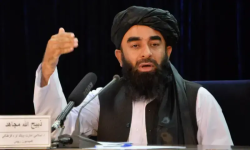
1764072588544.png

Afghanistan’s Acting Deputy Information Minister Zabihullah Mujahid speaks during a press conference in Kabul. — AFP/File

Zabiullah Mujahid, the spokesman for the Taliban government in Afghanistan, claimed on Tuesday that Pakistan had carried out overnight strikes in the neighbouring country.

In a post on social media platform X, he said that Pakistan had “bombed” Khost province, and carried out air strikes in Kunar and Paktika provinces.

No official statement has been issued by Pakistan thus far.

The strike was reported the same day a deadly suicide attack on the Federal Constabulary headquarters saw three personnel embrace martyrdom and 12 sustain injuries.

Pakistan’s bilateral relations with Afghanistan have come under strain in recent times as the Tehreek-i-Taliban Pakistan (TTP) remains the main point of contention between the two countries.

Pakistan has demanded that the rulers in Kabul take action to stop cross-border terrorism, but the Afghan Taliban deny Islamabad’s allegations of terrorists being allowed to use Afghan soil to carry out attacks in Pakistan.

During a process of dialogue, which followed border clashes between the two countries in October, the two sides had met in an effort to work on mechanisms for lasting peace and stability between the two countries.

On October 25, the second round of talks between the two sides began in Istanbul. Information Minister Attaullah Tarar then announced that the talks “failed to bring about any workable solution”.

However, mediators Turkiye and Qatar had intervened and managed to salvage the dialogue process with an October 31 joint statement released by Ankara stating that “further modalities of the implementation will be discussed and decided” during a principal-level meeting in Istanbul in November.

On November 7, however, after the third round of talks, Defence Minister Khawaja Asif said that talks addressing cross-border terrorism were “over” and “entered an indefinite phase” as negotiators failed to bridge big differences between the two sides.

Following the failure of the talks, the Afghan Taliban suspended trade ties with Islamabad. Pakistan had already closed its border for trade soon after the October clashes.

Subsequently, Turkiye announced that its top officials would visit Pakistan to discuss tensions between Islamabad and Kabul. Pakistan welcomed Turkiye’s and Doha’s “sincere efforts” on Nov 14, but the delegation’s arrival is still awaited, amid reports of complexities in the process.

Last week, the Foreign Office (FO) said that the resumption of trade with Afghanistan depended on the Taliban regime ending cross-border terrorism, and also linked the fate of key regional energy projects to Kabul halting its support for terrorist groups.
 

Questions for Kabul

Editorial
November 22, 2025

WHILE Pakistan has suffered the most from terrorist groups finding refuge in Afghanistan, and the Afghan Taliban have done practically nothing to stop these outfits from conducting cross-border attacks, the world is now waking up to the seriousness of the threat.

At a meeting of the ISIL and Al Qaeda Sanctions Committee held recently at the UN Security Council, Denmark, in its position as the current chair of the committee, said that the banned TTP posed a “serious threat” to Central and South Asia, while pointing out that the terrorist group received “logistical and substantial support” from the Afghan authorities, namely the Taliban.

The Danish representative also mentioned the frequent cross-border attacks that TTP terrorists have conducted against Pakistan, while alerting the international community to the threat that IS-K — also based in Afghanistan but opposed to its rulers — posed to the region.

The Pakistani representative used the forum to criticise both the Taliban and their newfound ally, India, when he observed that terrorist groups, including the TTP and BLA, were thriving “under the patronage of their hosts”, and were backed by “our principal adversary and net destabiliser in the region”.

While the Taliban are often dismissive of Pakistan’s concerns in this regard, it will be hard for them to brush aside the issues raised by the UN body.

The sanctions committee has reaffirmed what Pakistan has been saying for long: that the Taliban are supporting the TTP, and that terrorist groups in Afghanistan can destabilise the entire region.
 

Users who are viewing this thread

Latest Posts

Back
Top