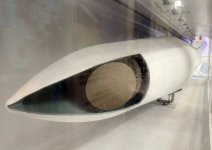
SMASH SLBM Testing - Nov 2025

Our missiles do seem short legged when compared with other missiles of equivalent type and size, most probably due to materials and inefficient propulsion.
Exactly, local material science and manafucturing plus most importantly lack of local talent is the problem with Pakistan
Iran is one third of us in population
But produces 7-10 times more STEM engineers and is in top ten countries even more per Capita then USA
This is the reason of their success in many fields of science
We just get lucky with china relations and don't develop anything military or civial spheres
 
Possible, Bahwalpur attack was a mix of munitions, LM/CM-Scalp etc. However there was one BrahMos used to attack Bahwalpur mosque.

Could be. I'm only going by the evidence available. I can't make out the language the woman is speaking in the video but the man is speaking Punjabi with a very strong 'D' phonetic which is typical of Punjabi spoken around Amritsar/Lahore - you know how inner city Lahorians will pronounce "Lahodhe" - The video description is in Punjabi as well and translates to "Bomb hit the fields." Aura Guy and ISPR also mentioned BrahMos falling into the fields in Indian Punjab near Amritsar (if I recall correctly), and then lastly dates and time periods.

The vector trajectory is of a surface skimming CM (typical of BrahMos) - notice how the vector is not very high above the buildings - our F1, F2, and CM-400 don't fly that close to surface even at their flattest trajectory.
 
Not deployed yet but soon will be. India on this Diwali tested 800 KM range Brahmos. Along with that their satellites systems are getting better. So soon they would be able to fully utilize the protentional of those 800 KM Range missiles. Plus, their 1500 KM Nirbhay cruise missile is also ready. That is a 1500 KM subsonic cruise missile basically same design philosophy as Tomahawk. Equipping our ships with only 350 to 450 KM range missiles is suicide. Same mindset caused us Operation Trident and Python, and we are headed towards the same fate again.

@Oscar Sir if a Navy is designing its policies that enemy satellites are bad, you need a lot more to fully utilize the protentional of an 800 KM range supersonic missile than no offense that is a self-destructive policy which would backfire really badly. Just like it did in 1971. Yes, we have improved a lot since 1971 but so has India specially in field of missiles and Navy. Like manifolds. Using a 350 to 450 KM range missile means you are getting so close to your enemy that basically you are going for suicide mission. You never were in the game in the first place if you have to go this close.
It is not a case of navy policy - its a case of physics.
What's this 1970s?
Missiles will be 1000 km range
Not targeting at 1000 km range from shore
You fire missiles
Guide them via MPA, j10c aew drone and satellite that are already about 300 km near Indian navy assets in ocean
They are outside Sam envelope
Targeting gets hard but you need to do hard to keep enemy away in a2 ad
Also 500 km brahmos already available for few years
800 km brahmos tested couple years ago from different ships
You can't outdo IN in magazine depth
They have 8 to 16 brahmos 500 to 800 km per vessel
You will need years to build destroyers or still years to build many Fac or type 54B size frogates to get 8 to 16 smash per vessel
While it is simple to just deploy longer range smash from shore
Guide via areal assets
And don't say j10 c don't have range
Refuel in our airspace over sea
Already 300 km from shore
Then with it's 750 km radiuses it can guide it to in destroyers

Also nobody in forces downplay enemy like Indian can't target at longers ranges and we should sit back and relax
If that were the case
PAF should also have relaxed since Indian Rafael can't target meteor to maximum range
But they did outgun them
AWACS guiding at long ranges being outside of Indian AD coverage for both fighters and AWACS

Simply put
Indian navy can outnumber and outrange Pakistani ships with number of ships number of missiles per ships and range of missiles
But they can't touch long range targeting aircraft guiding 1000km shore based missiles due to their 150 max barak range and that too consider s400 had double range against j10c but those are theoretically ranges
Also, IN cannot defend against ballistic missile
Barak has no such capabilities
Not did Indian radar of navy

You are repeating the same exact thing without looking at the actual crux of it.

No one is arguing the awesome firepower IN has - but at the same time you missed the part where I stated that PN already has a fairly decent A2/AD element in place.

Now they are looking to reinforce it with a ballistic element.

However, 1970s or 2070s - physics is physics and limitations still apply.

Ships move and maneuver. Even at a modest 25 knots, a ship travels ~46 km in an hour. A 1000 km subsonic cruise missile might take well over an hour to reach its target; even a supersonic missile will take many tens of minutes at extreme range. Any initial targeting cue that is not continuously updated becomes stale quickly, and the missile may end up searching a large area full of decoys, chaff, and clutter.

Long range anti‑ship or counter air missiles are only useful if they are embedded in a very high‑quality “kill web”. This means wide‑area ISR, high‑bandwidth networking, and robust fire‑control grade tracks maintained over time. U.S. work on future 1000 mile counter air missiles explicitly says these weapons are useless without a deeply networked, resilient sensor and comms architecture.

Does india have that throughout your EEZ? Do you?

“300 km from Indian Navy assets” is not magically “outside the SAM envelope.” - slow ASW or AEW assets within this space invites severe risk to these assets. What is the loitering time for a J-10C(as if your 20 are available everywhere everytime) to maintain a CAP over your ships some 100km off shore? Please consider and advise before asking the world of what is barely 8% of your combat fleet.

So what about satellites ? Well even in the most advanced Western concepts, getting “targeting‑grade” tracks for long‑range missiles from space requires:
  • Large constellations of LEO/MEO sensors for near‑continuous coverage.
  • High‑speed data fusion and dissemination (the “tracking layer” and BMC3 functions) to turn raw data into 3D tracks suitable for weapons control.
  • Latency and update rate matter. A satellite in a high orbit may only briefly see a given area with sufficient geometry for precise track, and then must hand off to others. Maintaining continuous, high‑fidelity tracking on a maneuvering naval force over the ocean is a non‑trivial enterprise and currently at the cutting edge of U.S. and allied R&D, not a solved commodity service from maxar.
You have two satellites which can be considered quasi useful for generating static imagery of ships in ideal weather conditions.

So while your wishlist is backed with some frustration - none of it is grounded in reality for both sides and in the case of Pakistan little funds to support such an effort.

Lets be realistic and consider your position as a Pakistani asking fellow Pakistanis to make some unrealistic decisions which even if they had funds would struggle to implement effectively.
 
B
I wouldn't go that far, no ADS is 100% reliable, and they defeated most of the Iranian missiles, some of course got through. The point being made is that indian navy ships can fire more anti ship missiles per vessel than PN ships.
Barak usage is not credible to stop iskandar
Iskandar is even going through Mac 3 patriot version that has double the speed far advance
Also Iran itself used most old missiles higher rcs, low maneuver, also most interceptions by thaad, sm3, sm6, arrow 2 and 3, even David sling that is superior to barak 8 did not intercept
Also Israel had USA largest satellite recon, early warning detection, and tracking by thaad in Qatar, Saudi Arabia turkey, E3, E7 F35s
Indian navy does navy have that
Longer range smash with land based for higher salvo of 8-12 per destroyer can do the job
Also barak 8 has lower speed among sam's and lower energy due to smaller size
 
Exactly, local material science and manafucturing plus most importantly lack of local talent is the problem with Pakistan
Iran is one third of us in population
But produces 7-10 times more STEM engineers and is in top ten countries even more per Capita then USA
This is the reason of their success in many fields of science
We just get lucky with china relations and don't develop anything military or civial spheres
Actually there is no comparison in any aspect of life ....their rich cultural values , education system, governance ...all are ahead of not only Pakistan but also many neighboring countries.

They are carrying the legacy of oldest civilization on earth....
 
Pakistan had
So Pak AD has lost even more credibility since May?
Different threat different problem
Israel has lost credibility because Iran can fire more and better missiles than this for longer time
And all of missiles Israel wasted for 12 days will need 6-10 years to replenish while Iran used old ones and can make same quantity news ones in months
Pakistan however need to fix lower tier air defense
Buy more batteries
And launch offence with all conventional options of highest order like India did
India used most highest tier misiles in highest number
While Pakistan used just lower tier rockets and some PAF milles in lower number
So many cruise missiles and thier analogous drones
Fatah two would have took down all s400 barak 8 batteries and airbases near border like ATCAMS did with Russian forces sam's
 
@Quwa

Looks like we need you here. God, this forum is filled bunch of nagging kids. Why should i even ask this question, but anyways.

What say you about CM-400AKG? Is it a cruise missile or a ballistic missile?

Quwa - CM400AKG - QBM

"Rather than sea-skimming, CASIC stated that the CM-400AKG relies on high-altitude launch, which CASIC claims lends to “higher aircraft survivability”.[6] According to IHS Jane’s, the CM-400AKG “climbs to a high altitude and terminates with a high-speed drive on the target.”[7] In effect, it appears that the CM-400AKG operates with an arc, thus owing to its quasi-ballistic missile ties. Besides its flight trajectory, the CM-400AKG reportedly has a range of 180-250 km, using a terminal-stage seeker – optional between imaging infrared (IIR) and active radar-homing (ARH)"

Can we please get over the CM/BM debate and get back to SMASH? 🥲
 
It is not a case of navy policy - its a case of physics.


You are repeating the same exact thing without looking at the actual crux of it.

No one is arguing the awesome firepower IN has - but at the same time you missed the part where I stated that PN already has a fairly decent A2/AD element in place.

Now they are looking to reinforce it with a ballistic element.

However, 1970s or 2070s - physics is physics and limitations still apply.

Ships move and maneuver. Even at a modest 25 knots, a ship travels ~46 km in an hour. A 1000 km subsonic cruise missile might take well over an hour to reach its target; even a supersonic missile will take many tens of minutes at extreme range. Any initial targeting cue that is not continuously updated becomes stale quickly, and the missile may end up searching a large area full of decoys, chaff, and clutter.

Long range anti‑ship or counter air missiles are only useful if they are embedded in a very high‑quality “kill web”. This means wide‑area ISR, high‑bandwidth networking, and robust fire‑control grade tracks maintained over time. U.S. work on future 1000 mile counter air missiles explicitly says these weapons are useless without a deeply networked, resilient sensor and comms architecture.

Does india have that throughout your EEZ? Do you?

“300 km from Indian Navy assets” is not magically “outside the SAM envelope.” - slow ASW or AEW assets within this space invites severe risk to these assets. What is the loitering time for a J-10C(as if your 20 are available everywhere everytime) to maintain a CAP over your ships some 100km off shore? Please consider and advise before asking the world of what is barely 8% of your combat fleet.

So what about satellites ? Well even in the most advanced Western concepts, getting “targeting‑grade” tracks for long‑range missiles from space requires:
  • Large constellations of LEO/MEO sensors for near‑continuous coverage.
  • High‑speed data fusion and dissemination (the “tracking layer” and BMC3 functions) to turn raw data into 3D tracks suitable for weapons control.
  • Latency and update rate matter. A satellite in a high orbit may only briefly see a given area with sufficient geometry for precise track, and then must hand off to others. Maintaining continuous, high‑fidelity tracking on a maneuvering naval force over the ocean is a non‑trivial enterprise and currently at the cutting edge of U.S. and allied R&D, not a solved commodity service from maxar.
You have two satellites which can be considered quasi useful for generating static imagery of ships in ideal weather conditions.

So while your wishlist is backed with some frustration - none of it is grounded in reality for both sides and in the case of Pakistan little funds to support such an effort.

Lets be realistic and consider your position as a Pakistani asking fellow Pakistanis to make some unrealistic decisions which even if they had funds would struggle to implement effectively.
Can this approach solve the problem of scoot and shooting of ship in sea?
images (17).jpeg
 
Of course i won't trust the whole world and instead i will take a nobody forum-er's words for it such as you.

Chinese military industrial complex and their marketers are amateurs and liars for naming a marketed cruise missile as CM-400AKG. They should've named it BM-400AKG. Lol, dude get a life and try to learn. Stop embarrassing yourself and wasting my time.
ارے! کون ہے یہ اتنا پڑھا لکھا مورکھ ۔۔۔ اور یہاں کیا کر رہا ہے؟

(Hey! Who is this scholar .. and what he is doing here?)
 
Pakistan's surface fleet is at a disadvantage against the IN for sure, but then Naval procurement is very capital intensive so Pakistan can never effectively compete. Therefore the approach is of deterrence which is why the Yuan class submarines are soo important. That will bring an overall level of balance, where the risks for the IN are significant when you combine the submarines, with the Sea Sultan platform. So, a lot of things inflight to modernise to return to a level of balanced deterrence.

India's navy is structured for offensive operations, Pakistan's doctrine is defensive, deterrence based to keep sea lanes open and not much more than that.

The reason why the Indians are leaning on the Indian Navy so much, is because it is the only place where they currently have an advantage. We know about the IAF, and when it comes to the Army, they are balanced to the point of being a meat grinder, so Navy is what they are left with.
Indian navy is offensive everybody knows
And to keep Indian navy out of Karachi's reach 1000 km range smash version with Arial targeting will be needed
It can be fielded in enough numbers with spending very small amount can be fielded in great number 200 or so a year is more survivable due to mobile launcher and PAF and SAM coverage far greater then any defense ship based smash will have
And not constrained in size by our warships dimensions

It will keep Pakistan safe from Indian navy offensive posturing

Plus yuan class have more crucial role of sea based nukes and should remain stealth for deterrence

Because Indian navy will remain in its MPAs reach
If yuan fires it's 300 km range weopons (only export weopons available for few years) it will be risky when IN mpa is in air
 
B

Barak usage is not credible to stop iskandar
Iskandar is even going through Mac 3 patriot version that has double the speed far advance
Also Iran itself used most old missiles higher rcs, low maneuver, also most interceptions by thaad, sm3, sm6, arrow 2 and 3, even David sling that is superior to barak 8 did not intercept
Also Israel had USA largest satellite recon, early warning detection, and tracking by thaad in Qatar, Saudi Arabia turkey, E3, E7 F35s
Indian navy does navy have that
Longer range smash with land based for higher salvo of 8-12 per destroyer can do the job
Also barak 8 has lower speed among sam's and lower energy due to smaller size
We can debate all day about how effective Israeli ADS is, and as I mentioned no ADS of 100% effective, but what is clear they stopped MOST incoming missiles. With regard to IN vessels, that's another question, but clearly PN vessels having at most 2 SMASH may not be enough to defeat IN defences, which is what the original topic was.
 
Yes it would be futile to compete on a vessel by vessel basis. I think an asymmetric approach is needed for area denial for offensive operations of the IN. Similar to the PAF's multi domain operations, I think an equivalent approach is needed for the navy. In my view, this should leverage what we already have, and tactics that we have perfected. I would adopt the following elements.

1). A dedicated air arm for the fleet - a couple of squadrons of J10C backed up by their own AWACS and aerial refuelers providing anti air cover as well as anti-ship capability, under the command of the PN.

2). Land based anti-ship ballistic missiles based on our existing missiles with hypersonic manoeuvring warheads, range of about 1,000km.

3). MPA and satellite based target tracking and targeting, data linked to the anti-ship ballistic missiles and the air fleet.

4). Smaller hypersonic cruise missile equipped frigates and corvettes - P282 if that is what it is.

There's no reason why any of these can't be developed, we already have these capabilities in other domains. It's all a matter of will, and it shouldn't cost too much given it leverages what we already have or developing to a certain extent.
Cm400 akg is a really old missiles
It's is Chinese export equivalent of pl12 with 100km range version
Pakistan should develop its own new version with Fatah 2 technology Pakistan can easily create a 800-1000 km range air launched missile
For example mako from usa and 300 er from turkey both have 500km to 800km range with about 700 kg weight
Employ two jf17 block 3 sqd
One j10c sqn
Couple AWACS and 10-12 heavy surface search radar carrying drones for naval deployment with these missiles
Coupled with shore based 1000km range smash
Pakistan shoreline is safe from in offensive posturing
Surface ships will take so much time to make
Next 6 years are for Jinnah which can't carry many smash
Then only new warship will be ordered
Should make 800km range lighter faster msah verison with Chinese material science help to equip 2x3 on all Jinnah tughril, zulfiqar ships
It can be used in offensive operation if needed
 
Cruise missiles are equiped with air breathing engines.
Ballistic Missiles have solid/liq rocket motors with in built oxidizers.
Nowadays, classifying missiles based on their propulsion systems is no longer very meaningful, as missiles with combined propulsion systems are becoming increasingly popular.

The DF-100 missile, for example, first uses a rocket engine to launch the missile to a high altitude and achieve a high speed. Then, it discards the rocket engine and activates a ramjet engine to enter cruise mode...

Current air-breathing hypersonic cruise missiles also employ this combined propulsion scheme.

Furthermore, some cruise missiles, in order to achieve higher terminal attack speeds, activate a small rocket engine at the end of their flight to increase the speed of the warhead, thereby generating greater impact kinetic energy.

Both type of ships you mentioned are not ordered by PLAN.
Senodefence forum details the ships and ones ordered by plan or coast guard
These ships made by shipyard as technology demonstrators
Aside from jari
Many other types of usv have been made by private firms for technology validation

dered b
Hey. Have you ever seen or heard of any country's coast guard vessels using stealth design and equipped with VLS?

The PLA Navy operates many experimental warships. These warships are primarily operated by the PLA Navy's internal research and development and testing institutions. They are part of the PLA Navy's official organizational structure.
But, there is currently no official information available about this new warship. What is certain, however, is that it is a project of the PLA Navy.
 
I think Pakistan should concern itself with establishing a zone of denial that it can enforce, and if VLS numbers give it then, then that is one way. Additionally, more land based systems with longer ranges will help for that denial capability, just look at the concept behind the long range Neptune missile that Ukraine has with a range of 1000km. It is a successful platform that took down some of the Russian ships, and Pakistan should develop a similar capability.


Is Pakistan designing systems for actual defence of Pakistan, or is it range restricting(or MTCR concerns) them so that it an focus on exports and selling them for cash as it is one of the few money making schemes that is profitable for the armed forces ?
Harbah already showed 900 km (consider 1000km) range
 

Users who are viewing this thread

Back
Top