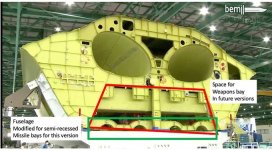
One thing to notice with the 5+ (KAAN) and 6-gen designs (J-36, J-XX) is that they're all multi-engine fighters using WS-10/F100/F110-class engines.
So, if the PAF is looking for an optimal configuration for the onboard sensor and LPI/LPD TDL output, it'll likely need a large twin-engine aircraft. I mean, the next-gen TDL stack is itself a full sensor node, thanks to its AESA-based arrays, cognitive radios, and possibly even a computational setup with a mini-LLM for automation/ML processing. Now let's combine that with the actual main AESA radar, EOTS, IRST, etc., and you'll clearly need a big airframe. Not surprising the Chinese went with a tri-engine setup for J-36 and with US investing in big boi planes like B-21 and F-47.
This is why the PAF likely showed interest in the KAAN (during ACM Mujahid Anwar Khan) because TAI designed it as a large platform theoretically capable of both housing the sensor suite and powering it via the engines (
@JamD). In fact, the original ASR for AZM essentially called for a large twin-engine platform capable of powering DEW/HELs and sensors. So, one way or another, if the PAF wants a true next-gen sensory powerhouse, it will need a KAAN or J-20-sized fighter.
The J-35AE is, IMO, more of a conventional fighter meant to work alongside a J-20 or J-36-type system (with the latter being the main CCA/UCAV-command and sensor nodes, respectively). It's good to have; I'd rather be sending in J-35AEs with UCAVs across LoC vs. J-10CEs, but it's not enough to really build that strike edge.
Let's see; there have been folks at AHQ over the years pushing the Chinese for the J-20, and it never quite made sense why until now. Evidently, there have always been people with foresight we never quite caught until much later.
@Oscar