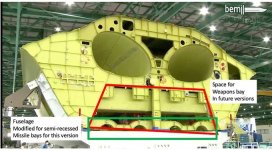
JF-17 PFX program

One thing to notice with the 5+ (KAAN) and 6-gen designs (J-36, J-XX) is that they're all multi-engine fighters using WS-10/F100/F110-class engines.

So, if the PAF is looking for an optimal configuration for the onboard sensor and LPI/LPD TDL output, it'll likely need a large twin-engine aircraft. I mean, the next-gen TDL stack is itself a full sensor node, thanks to its AESA-based arrays, cognitive radios, and possibly even a computational setup with a mini-LLM for automation/ML processing. Now let's combine that with the actual main AESA radar, EOTS, IRST, etc., and you'll clearly need a big airframe. Not surprising the Chinese went with a tri-engine setup for J-36 and with US investing in big boi planes like B-21 and F-47.

This is why the PAF likely showed interest in the KAAN (during ACM Mujahid Anwar Khan) because TAI designed it as a large platform theoretically capable of both housing the sensor suite and powering it via the engines (@JamD). In fact, the original ASR for AZM essentially called for a large twin-engine platform capable of powering DEW/HELs and sensors. So, one way or another, if the PAF wants a true next-gen sensory powerhouse, it will need a KAAN or J-20-sized fighter.

The J-35AE is, IMO, more of a conventional fighter meant to work alongside a J-20 or J-36-type system (with the latter being the main CCA/UCAV-command and sensor nodes, respectively). It's good to have; I'd rather be sending in J-35AEs with UCAVs across LoC vs. J-10CEs, but it's not enough to really build that strike edge.

Let's see; there have been folks at AHQ over the years pushing the Chinese for the J-20, and it never quite made sense why until now. Evidently, there have always been people with foresight we never quite caught until much later. @Oscar
That would address a “comprehensive” 5th gen platform, but the PFX program seems to be indicating towards a bare bones workhorse solution. A manned shooter platform, which would be economical, and wouldn’t necessary need to have long legs for deep strike missions. An internal may that could hold 4 PL-15 sized missile would probably be sufficient to the requirement, but considering the importance of electrical power in powering sensors for effective standoff engagements, I figured a more powerful engine in the WS-10/F-110 class would be necessary, unless we see a breakthrough as well as approval for export of the WS-19, once it its fully developed, which I don’t expect anytime soon.
 
That would address a “comprehensive” 5th gen platform, but the PFX program seems to be indicating towards a bare bones workhorse solution. A manned shooter platform, which would be economical, and wouldn’t necessary need to have long legs for deep strike missions. An internal may that could hold 4 PL-15 sized missile would probably be sufficient to the requirement, but considering the importance of electrical power in powering sensors for effective standoff engagements, I figured a more powerful engine in the WS-10/F-110 class would be necessary, unless we see a breakthrough as well as approval for export of the WS-19, once it its fully developed, which I don’t expect anytime soon.
IMO, that could be it. However, for that role, they wouldn't need an internal bay. Ultimately, a worked-up JF-17 (likely what PFX A is) will be inherently range and endurance-limited, so there should be no need to send it across the border. The cross-border stuff will be left to the J-35 and UCAV (e.g., possibly Bayraktar Kizilelma); the PFX A is going to sit on the Pakistani side and be a thorn on whichever enemy's toes. The PAF is better served by emulating as much of the Gripen E/F approach more than trying to turn the JF-17 into something it's fundamentally not (i.e., a stealth LO platform with internal bays).
 
The reason why Pakistan needs to choose between a RD-93 and a WS-10 sized engines.
These are two completely different types of turbofan engines. They are not comparable.
They can only be used on different fighter jet platforms; it's impossible for them to be used on the same fighter jet platform.
That would address a “comprehensive” 5th gen platform, but the PFX program seems to be indicating towards a bare bones workhorse solution. A manned shooter platform, which would be economical, and wouldn’t necessary need to have long legs for deep strike missions. An internal may that could hold 4 PL-15 sized missile would probably be sufficient to the requirement, but considering the importance of electrical power in powering sensors for effective standoff engagements, I figured a more powerful engine in the WS-10/F-110 class would be necessary, unless we see a breakthrough as well as approval for export of the WS-19, once it its fully developed, which I don’t expect anytime soon.
Currently, the turbofan engines that China can export are the WS-10 and WS-21.

As for the WS-15/WS-19, there's no need to speculate about them; that would be a waste of time. Their export is prohibited based on national security concerns, which has nothing to do with whether their technology is mature or not.
 
That would address a “comprehensive” 5th gen platform, but the PFX program seems to be indicating towards a bare bones workhorse solution. A manned shooter platform, which would be economical, and wouldn’t necessary need to have long legs for deep strike missions. An internal may that could hold 4 PL-15 sized missile would probably be sufficient to the requirement, but considering the importance of electrical power in powering sensors for effective standoff engagements, I figured a more powerful engine in the WS-10/F-110 class would be necessary, unless we see a breakthrough as well as approval for export of the WS-19, once it its fully developed, which I don’t expect anytime soon.

This is highly unrealistic and outside of Pakistan's technical abilities to achieve, and I think even with all the bluster inside the PAF, they must by now know this too after the Azm fiasco.
 
These are two completely different types of turbofan engines. They are not comparable.
They can only be used on different fighter jet platforms; it's impossible for them to be used on the same fighter jet platform.

Currently, the turbofan engines that China can export are the WS-10 and WS-21.

As for the WS-15/WS-19, there's no need to speculate about them; that would be a waste of time. Their export is prohibited based on national security concerns, which has nothing to do with whether their technology is mature or not.

btw - this is one of the reasons why Pakistan continues to building on its military relations with Türkiye for collaboration and procurement, even with all the 'export' variants available to it from China. Türkiye provides on request, the absolute best that it has to Pakistan, there are no restrictions. China on the other hand seems to 'cap' what it is prepared to share as you have shown with the WS-19 restrictions, and that approach feeds into perceptions of military planners who are always looking for the best to get that military advantage.
 
btw - this is one of the reasons why Pakistan continues to building on its military relations with Türkiye for collaboration and procurement, even with all the 'export' variants available to it from China. Türkiye provides on request, the absolute best that it has to Pakistan, there are no restrictions. China on the other hand seems to 'cap' what it is prepared to share as you have shown with the WS-19 restrictions, and that approach feeds into perceptions of military planners who are always looking for the best to get that military advantage.

China needs to be careful, it will potentially confront the US in the future. Do not blame them for keeping their best tech secret
 
btw - this is one of the reasons why Pakistan continues to building on its military relations with Türkiye for collaboration and procurement, even with all the 'export' variants available to it from China. Türkiye provides on request, the absolute best that it has to Pakistan, there are no restrictions. China on the other hand seems to 'cap' what it is prepared to share as you have shown with the WS-19 restrictions, and that approach feeds into perceptions of military planners who are always looking for the best to get that military advantage.
This is a common misconception among many Pakistanis.

First, we need to distinguish between "JF-17 PFX" and "PFX."

If the Pakistani official agencies define the project as "JF-17 PFX," then we can be certain that the project will continue the JF-17 model, i.e., China + Pakistan. Turkey is completely outside the scope of this project and cannot participate in any aspect of it. Whether the JF-17 PFX can use (or is compatible with) payload systems developed through Turkish-Pakistani cooperation is irrelevant to this project.

If the Pakistani official agencies define the project as "PFX," then many possibilities exist. It means that China will no longer be deeply involved in the project. China might sell certain subsystems, but only as a subsystem supplier.

As for how Pakistan chooses, the power lies with Pakistan.

You need to understand this clearly. Although there are currently no major disputes between China and Turkey, the two countries are not friendly. A potential adversarial relationship still exists between us. These issues could erupt at any time. We cannot provide any sensitive technology to any country that is militarily close to them.
 
Why are you wasting your time feeding the troll? Just avoid and completely ignore them. You are acting like sensitive thin skinned indians.
He is indeed very sensitive and fragile. And also talkative.
 
In my personal opinion, PAF should position the PFX project as a large stealth UAV with penetration and air superiority capabilities. It can not only significantly reduce the investment required for the project, but also form a complementary relationship with future fifth generation aircraft to fill the air force's equipment gap in the future.
 
You need to understand this clearly. Although there are currently no major disputes between China and Turkey, the two countries are not friendly. A potential adversarial relationship still exists between us. These issues could erupt at any time. We cannot provide any sensitive technology to any country that is militarily close to them.

Give your opinion. But be careful not to talk as if you are in official capacity.
 
This is a common misconception among many Pakistanis.

First, we need to distinguish between "JF-17 PFX" and "PFX."

If the Pakistani official agencies define the project as "JF-17 PFX," then we can be certain that the project will continue the JF-17 model, i.e., China + Pakistan. Turkey is completely outside the scope of this project and cannot participate in any aspect of it. Whether the JF-17 PFX can use (or is compatible with) payload systems developed through Turkish-Pakistani cooperation is irrelevant to this project.

If the Pakistani official agencies define the project as "PFX," then many possibilities exist. It means that China will no longer be deeply involved in the project. China might sell certain subsystems, but only as a subsystem supplier.

As for how Pakistan chooses, the power lies with Pakistan.

You need to understand this clearly. Although there are currently no major disputes between China and Turkey, the two countries are not friendly. A potential adversarial relationship still exists between us. These issues could erupt at any time. We cannot provide any sensitive technology to any country that is militarily close to them.

- JF17 is a joint project between China and Pakistan with the bulk of the funding coming from Pakistan. The rights of what either party can do, or not or what they can object to have been specified in the contract and no one here will know the terms of that contract.

- Pakistan has setup a JF-17 integration facility at the Pakistan Aeronautical Complex (PAC) in Kamra, which handles the avionics integration and upgrades for the JF-17 Thunder fighter jet. This implies that Pakistan has the source code the plane and the mission computers, otherwise such integration work is not possible. Pakistan has already integrated a number of Turkish systems onto the JF17, as well as its own products, so the precedent of Turkish involvement is already there. Pakistan therefore has a lot of capability as far as technical freedom goes on what it can do with the plane with the type of access it has, otherwise there would not need to be a 'JF17 Integration facility'.

I don't think personally that PAF knows what PFX is, other than lots of Chai and samosa meetings.. Azm was an indication of the organisation overreaching and not understanding the limitations of what Pakistan can do, and I think the same will happen with whatever they think PFX is.
 
Why do you have this misconception?

This is, of course, a personal opinion.
The language used portrays an absolute decision and policy statement.

Pakistan China collaboration and cooperation happen at the highest levels of leadership. Do not undermine the leadership of the China and Pakistan with posts that sound like absolute decision and state policy of China while actually they are your personal opinions.

Be respectful to the two states, don’t create confusions and clearly use a language that shows it to be your opinion.
 
These are two completely different types of turbofan engines. They are not comparable.
They can only be used on different fighter jet platforms; it's impossible for them to be used on the same fighter jet platform.

Currently, the turbofan engines that China can export are the WS-10 and WS-21.

As for the WS-15/WS-19, there's no need to speculate about them; that would be a waste of time. Their export is prohibited based on national security concerns, which has nothing to do with whether their technology is mature or not.
I know they are two different engine classes, different lengths but especially different diameters. This is about what the design of the PFX should be, so we are not limited by the design in future use, and require to purchase another type to backfill the need we should have envisioned at the design stage.

Considering the export of the WS-19 is restricted, focusing around the WS-10 engine, would IMHO, be more prudent, for long term needs. Accommodating an internal bay as well as having enough electrical power should be more easier with a more powerful engine. Also no need to wait on an engines to reach full development to meet required parameters; the WS-10 engine is powerful enough to match a design like the McDonnell Douglas JAST which seems to be an inspiration for the PFX.
 
This is highly unrealistic and outside of Pakistan's technical abilities to achieve, and I think even with all the bluster inside the PAF, they must by now know this too after the Azm fiasco.
The gap between design a low observable design with and without an internal bay is not as far as it seems. Look at the example of the KFX. Also, I’m not talking about exquisite stealth, but at least Equivalent to Chinese export approved UCAV levels. heck, consider the maintained facility that will have to be built to support the J-35A in the PAF, that level of export approved stealth could be standardized to the PFX without much more work.

1765119284869.jpeg
 

Users who are viewing this thread

Country Watch Latest

Latest Posts

Back
Top