Iran Economy

%D9%88%D8%B6%D8%B9%DB%8C%D8%AA+%D8%AA%D9%88%D8%B2%DB%8C%D8%B9+%D8%AE%D9%88%D8%AF%D8%B1%D9%88+%D8%AF%D8%B1+%D8%AF%D9%87%DA%A9+%D9%87%D8%A7.png


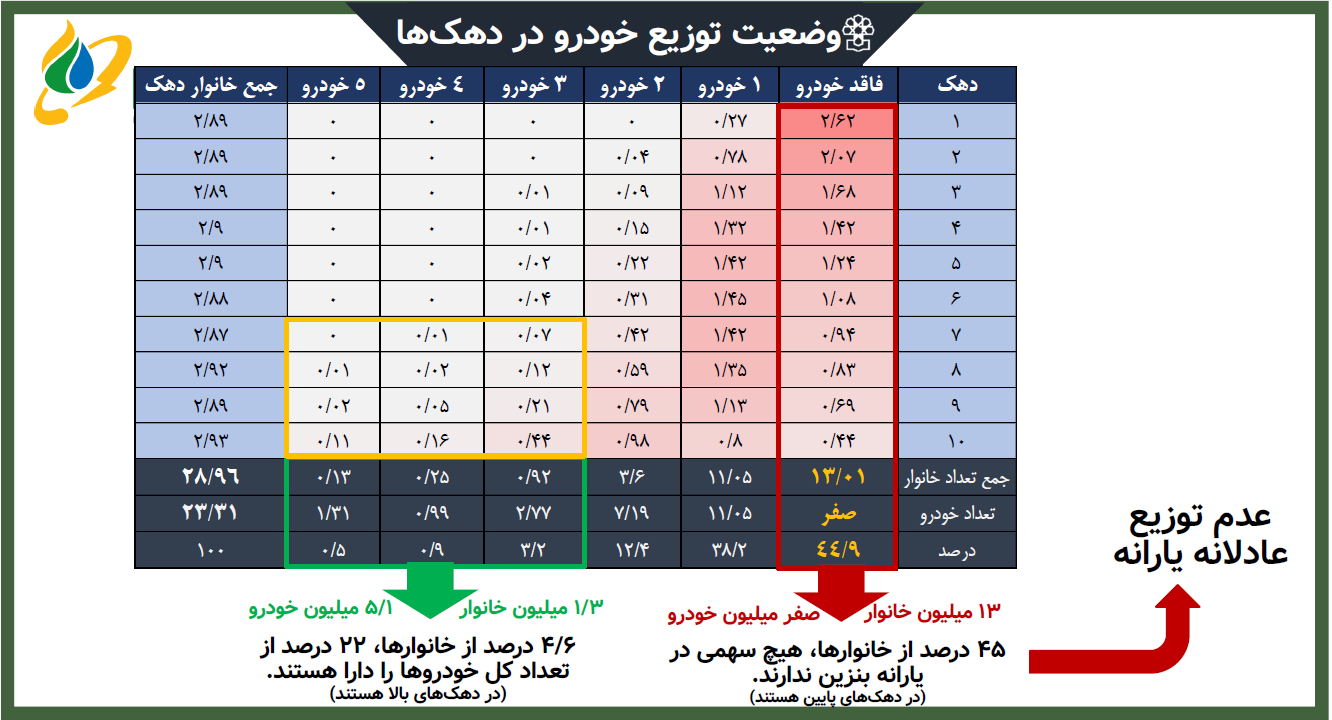
45% of households in Iran have no personal car.
4.6 percent of households have more than 2 cars.

83.1% of households have 1 or no car.

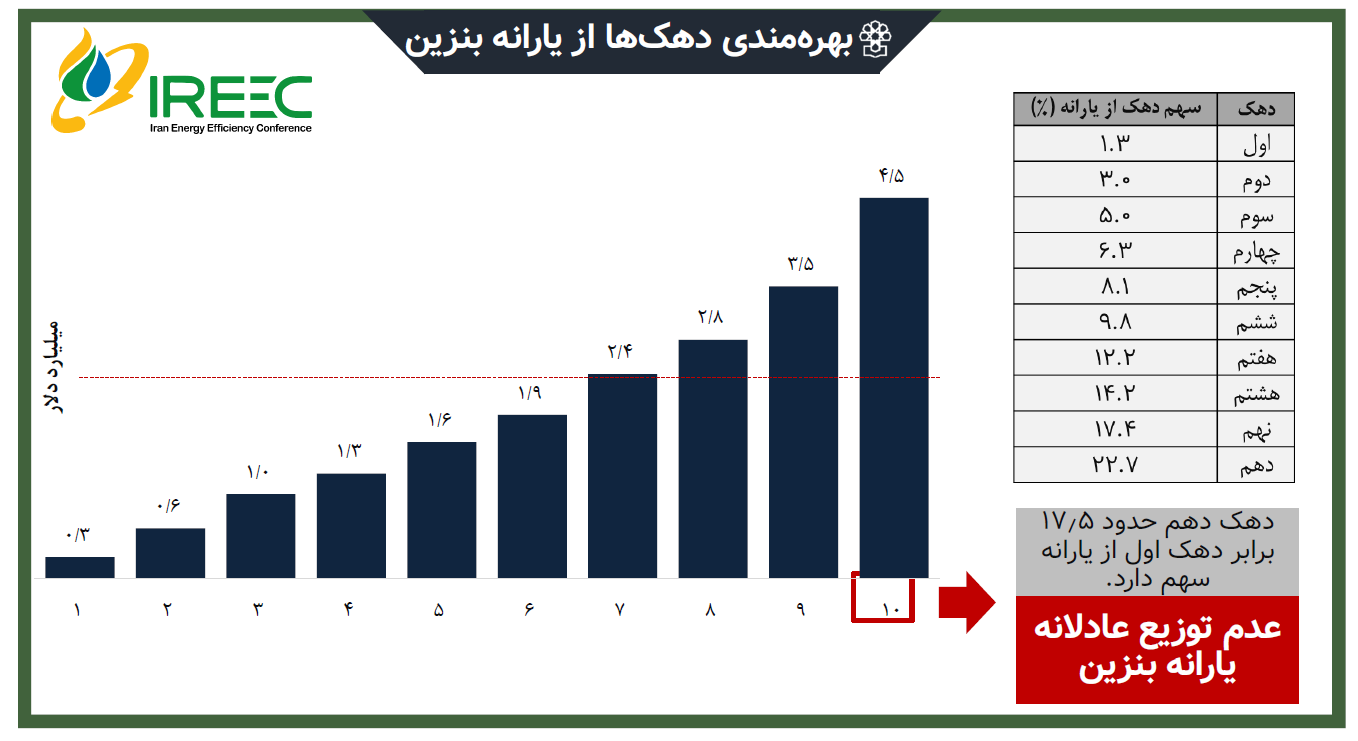
%D8%A8%D9%87%D8%B1%D9%87+%D9%85%D9%86%D8%AF%DB%8C+%D8%AF%D9%87%DA%A9+%D9%87%D8%A7+%D8%A7%D8%B2+%DB%8C%D8%A7%D8%B1%D8%A7%D9%86%D9%87+%D8%A8%D9%86%D8%B2%DB%8C%D9%86.png

Source

Top 10%(richest) uses 17.5 times of subsidized gasoline more than bottom 10%(poorest) ~2022 data. it used to be ~9x difference with 2016 data.

This gap between rich and poor when it comes to gasoline usage is :
USA 5.5x gap
Pakistan ~8.5x
Saudi Arabia 7.5x
Norway 4.33x
Indonesia 10x

To add more salt to the wound this year Iran imported $1.7 billion gasoline in order to cover possible shortages. (Nahj al-balagha ?!)


When other countries ( most of them ) import fuel they usually add little bit (or more :) ) tax to it then sell it at home but when Iran imports they subsidize it and give it to the "barefoot" !

images
subsidies should not be helping the top 10%
 
%D9%88%D8%B6%D8%B9%DB%8C%D8%AA+%D8%AA%D9%88%D8%B2%DB%8C%D8%B9+%D8%AE%D9%88%D8%AF%D8%B1%D9%88+%D8%AF%D8%B1+%D8%AF%D9%87%DA%A9+%D9%87%D8%A7.png


45% of households in Iran have no personal car.
4.6 percent of households have more than 2 cars.

83.1% of households have 1 or no car.

%D8%A8%D9%87%D8%B1%D9%87+%D9%85%D9%86%D8%AF%DB%8C+%D8%AF%D9%87%DA%A9+%D9%87%D8%A7+%D8%A7%D8%B2+%DB%8C%D8%A7%D8%B1%D8%A7%D9%86%D9%87+%D8%A8%D9%86%D8%B2%DB%8C%D9%86.png

Source

Top 10%(richest) uses 17.5 times of subsidized gasoline more than bottom 10%(poorest) ~2022 data. it used to be ~9x difference with 2016 data.

This gap between rich and poor when it comes to gasoline usage is :
USA 5.5x gap
Pakistan ~8.5x
Saudi Arabia 7.5x
Norway 4.33x
Indonesia 10x

To add more salt to the wound this year Iran imported $1.7 billion gasoline in order to cover possible shortages. (Nahj al-balagha ?!)


When other countries ( most of them ) import fuel they usually add little bit (or more :) ) tax to it then sell it at home but when Iran imports they subsidize it and give it to the "barefoot" !

images

You are naive ... people who don't have car are forced to live in town and rural area and have to pay transport charges to go their work , go to baazar , go to hospital ... when the price of gasoline goes up , the people who don't have cars are the one who pay the highest cost ....
 
You are naive ... people who don't have car are forced to live in town and rural area and have to pay transport charges to go their work , go to baazar , go to hospital ... when the price of gasoline goes up , the people who don't have cars are the one who pay the highest cost ....
then by that logic at 2016 or 2018 vs today our poorest should be in better position in comparison to richest right ?(if we remove all other economic factors and compare society solely based on changes to fuel usage)
 
then by that logic at 2016 or 2018 vs today our poorest should be in better position in comparison to richest right ?(if we remove all other economic factors and compare society solely based on changes to fuel usage)
no , richest people are richer and for sure they are in better position .... but currently due the liberal policies of reformist, most of our middle-class people are pushed downed to poor class and our poor people condition become hopeless .
 
subsidies should not be helping the top 10%
This is where my problem with Mr Raesi's government started he had a similar approach too. then he kicked out top 30% from cash transfer program (yarane)

They say it's resources of all people so if some people want to get their share you should give it to them even if they are in top 10% since they have rights like everybody else. problem starts when their distribution of subsidizes are moving forward with that crazy gap differences.
 
no , richest people are richer and for sure they are in better position .... but currently due the liberal policies of reformist, most of our middle-class people are pushed downed to poor class and our poor people condition become hopeless .
let's put aside all these liberal , reformist .... labels aside for a moment.

Case 1 : 1 person gets 18 litters and other one gets 1 litter.
Case 2: 1 person gets 9 litters and other one gets 1 litter.


both case 1 and 2 also are getting "their share" with 2 prices of fuel with let's say at 5 cents and 10 cents prices. (Sahmie va bedon Sahmie ) it is still far below world prices.

how do u defend case 1 with these conditions ? how it is a more Fair and Just case ?
 
Other part of your comment is true transportation cost takes higher percentage of the poor man's income compared to rich but if you sell fuel at world price and give it's (fully!!!) cash back to the both poor and rich its impact with close the gap in favor of poor side ( heavily favors poor)

some people at middle brackets will slightly lose and some people at middle will slightly gain but it's almost nothing for top 10%.
 
%D9%88%D8%B6%D8%B9%DB%8C%D8%AA+%D8%AA%D9%88%D8%B2%DB%8C%D8%B9+%D8%AE%D9%88%D8%AF%D8%B1%D9%88+%D8%AF%D8%B1+%D8%AF%D9%87%DA%A9+%D9%87%D8%A7.png


45% of households in Iran have no personal car.
4.6 percent of households have more than 2 cars.

83.1% of households have 1 or no car.

%D8%A8%D9%87%D8%B1%D9%87+%D9%85%D9%86%D8%AF%DB%8C+%D8%AF%D9%87%DA%A9+%D9%87%D8%A7+%D8%A7%D8%B2+%DB%8C%D8%A7%D8%B1%D8%A7%D9%86%D9%87+%D8%A8%D9%86%D8%B2%DB%8C%D9%86.png

Source

Top 10%(richest) uses 17.5 times of subsidized gasoline more than bottom 10%(poorest) ~2022 data. it used to be ~9x difference with 2016 data.

This gap between rich and poor when it comes to gasoline usage is :
USA 5.5x gap
Pakistan ~8.5x
Saudi Arabia 7.5x
Norway 4.33x
Indonesia 10x

To add more salt to the wound this year Iran imported $1.7 billion gasoline in order to cover possible shortages. (Nahj al-balagha ?!)


When other countries ( most of them ) import fuel they usually add little bit (or more :) ) tax to it then sell it at home but when Iran imports they subsidize it and give it to the "barefoot" !
images
Disaster policy. Hope it will improve. I cant add anything to it. It is in the hand of government. Either change radically or keep this "slow death" situation.
 
the people who don't have cars are the one who pay the highest cost ....
they are usually in same bottom brackets (poor)

Next part of your (or whom may have similar takes) argument targets indirect and hidden costs of current system of fuel distribution.

What will happen if you sell fuel at world prices then transfer it's cash back to all people equally ?

I'm not expert here but from thing i've heard and read from era of Mr Ahmad Tavakoli to recent expert and economists :
1391
توکلی در خصوص اقدامات مرکز پژوهش‌ها برای اجرای فاز دوم هدفمندی یارانه ها گفت: «دولت معتقد است از اجرای فاز دوم هدفمندی باید 135 هزار میلیارد تومان درآمد داشته باشد. کمیسیون تلفیق این درآمد را به 72 هزار میلیارد تومان تقلیل داده اما طبق پژوهش‌های دفتر زیربنایی مرکز پژوهش‌ها در صورتی که نظر کمیسیون تلفیق اجرا شود قیمت حالم‌های انرژی بین 2.2 تا 4.3 برابر افزایش می‌یابد.»

Donya-e-eqtesad :
حجم نقدینگی در انتهای سال ۹۰ معادل ۳۵۲ هزار و ۲۰۰ میلیارد تومانی بود که با توجه به رشد اعلام شده این حجم در پایان سال ۹۱ به رقم ۴۶۰ هزار و ۷۰۰ میلیارد تومان رسیده است.

400% inflation was an incorrect title (yet effective it seems!)

file.jpg

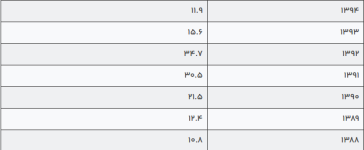
Inflation is 30.5% at 1391 and it is 34.7% at year 1392.
Capture.PNG
Inflation has direct relationship with both growth rate and fiscal policy.

it may have only one time impact on your inflation if after fixing issue of fuel you stick your fuel price to price of oil and real expenses of refining.

At peak of Mr Ahmadi Nejad's plan we didn't have this kind of close to 50% inflation that we experience in recent years.


Grok's take :

In the current context, with Iran's inflation already at 40–42% and a larger relative price hike (potentially 30–100x for subsidized tiers), the inflationary impact could be more pronounced. Estimates suggest an additional 10–20 percentage points added to the annual inflation rate in the short term (1–2 years), pushing it toward 50–60%, though rebates could mitigate some demand-pull effects by boosting household spending power. Long-term effects would depend on implementation, economic conditions, and whether the reform triggers protests or supply disruptions, as seen in past efforts.


DeepSeek's :

Quantitative Conclusion​

Considering all factors:

The one-time, direct inflationary shock of globalizing Iran's gasoline price would likely increase the annual inflation rate by 25-30 percentage points in the first year.

If Iran's inflation is, for example, 40% at the time of implementation, it would jump to ~65-70%.

The cash transfers would moderate the social impact but not prevent the broad price shock, and could even add to inflation if not carefully calibrated.

Final Note: Such a reform is economically rational for long-term efficiency but is politically and socially explosive.
 

Iranian oligarchy is more stronger and more vicious than Russian
 
There are multiple ways to reduce inflation for short term ( 6 months - 1 year) in order to buy time to fix issue of fuel.

Possible options (without changing fiscal policies)

Borrowing from outside ( Not recommend )
Bring in cheap foreign workers (Not recommend )
Innovation and using more efficient technologies ( it's ok )
Raising interest rate ( it's ok )
Mobilization (it's ok , but leave Armed forces outside it since you might need them somewhere else )
And ...


Whole idea is that even at ~40% inflation you have multiple options.
 
This would not work for the government. The country is bankrupt and as such has to increase the money supply by 50% or so per year.

So the government and banks would then also have to mine and put an extra 50% of copper reserves in their vaults every year. This means that over 6 years, if vaults untouched, it would have to hold 10x more copper reserves from the start of this time period

And if they did manage to actually mine this massive amount it would cause price of copper to collapse internally harming copper businesses, copper would be smuggled out and sold for higher prices externally which would also increase corruption.

And if they don't increase the copper reserves and just keep it fixed, but increase the money supply like they are now, well that means u need more paper to buy copper which is essentially inflation.

The only real way to stop the long term inflation is to stop creating so much money. And best, stable way is to tax people and reduce Subsidies.
Actually when I suggested this over 5 years ago it would have worked. It is fractional reserve, meaning you don't have a 1:1 of copper to banknotes. You have only a small factional reserve to back the currency because not 100% of Iranians are going to rush to get copper. They would prefer to have the banknotes backed by a fractional reserve currency. US mint spends 3-6 billion USD for operations and minting per year. This would be closer to one billion per year in copper, with the first year more.
 
Actually when I suggested this over 5 years ago it would have worked. It is fractional reserve, meaning you don't have a 1:1 of copper to banknotes. You have only a small factional reserve to back the currency because not 100% of Iranians are going to rush to get copper. They would prefer to have the banknotes backed by a fractional reserve currency. US mint spends 3-6 billion USD for operations and minting per year. This would be closer to one billion per year in copper, with the first year more.
Again it wouldn't work because increasing the money supply is the problem. When there is increased money supply in circulation but same goods and services, then U have inflation.

Because u have more paper notes representing the same goods and services.
 

پزشکیان و چالش اصلاح یارانه‌ها؛ حذف 3 دهک‌ بالای درآمدی از این طرح میسر می‌شود؟


untitled.jpg


او در ادامه تاکید کرد که بر اساس این قانون باید ۲۴ میلیون نفر حذف می‌شدند که با توجه به این که تعدادی از این افراد یارانه دریافت نمی‌کردند مقرر شد ۱۷ میلیون نفر حذف شوند.

Government's view:
Based on this law, 24 million people were supposed to be removed (from the subsidy list), but considering that some of these individuals were not receiving subsidies, it was decided to remove 17 million people.


این دقیقا همون ایده ای هست که پای سطل ماست رو توی سیاست باز میکنه و باعث تفرقه بین مردم میشه و اون قشر بالایی جامعه شاید میزان این پول براش مهم نباشه ولی کاملا رفتار قانون گذار و دولت براش اهمیت داره


بنا بر این گزارش، مالکان خانه با ۳۰۰ میلیون ریال درآمد جز ۳ دهک بالا خواهند بود.

According to this report, homeowners with an income of 300 million rials will be placed in the top 3 deciles.

This is the same reasoning that I'm against Maskan Mehr/Public housing in a way that was implemented.

Why are u punishing rational actor and rewarding irrational ones ?
If they were investing for like 10-30 years in order to buy their house now after they have achieve their goal you come and punish them by these stupid policies ?

The only message i get from this is that , you are destroying people with long term visions and blocking people to move between different brackets.who are u to decide which path is the correct investment and which path is the incorrect one ?

In a healthy society when you make dumb investment you lose and when you make smart investment be it with your time and/or money you gain.
DO NOT INTERFERE HERE.
 
When we divide people into 10 deciles and want to take from the top 3 deciles and redistribute (or help) the bottom 3 deciles, several fundamental mistakes are made in this approach:

  1. The bottom three deciles will try to stay exactly where they are—whether by hiding income or by genuinely ensuring their income does not exceed the defined threshold—because crossing that line would mean losing the benefits associated with being in the bottom three deciles.
  2. This system sends a message to the middle group (deciles 4–7) that they should not let their income reach the higher levels, because the amount they receive would decrease. And if they can, whether through false reporting and concealment or by actually reducing their effort, they will try to position themselves lower to gain access to more resources.
These two issues effectively mean that 70% of society is incentivized toward idleness, reduced effort, and not utilizing innovation. In both the short and long term, this will completely negate any positive effects of the targeted subsidies or redistribution policy.
 

Users who are viewing this thread

Latest Posts

Back
Top