NASA Space Program

Nov 16, 2022
To view this content we will need your consent to set third party cookies.
For more detailed information, see our cookies page.

Blastoff! NASA's Artemis 1 moon rocket launches on historic first mission
 

NASA's Artemis 2 mission will send four astronauts on a 10-day trip around the moon​


Four astronauts are on the verge of becoming the first humans to venture near the moon in more than half a century since NASA's iconic Apollo era came to an end.

As early as February, the crew of a mission known as Artemis 2 will board the U.S. space agency's Orion capsule atop NASA's Space Launch System rocket for a 10-day trip circumnavigating the moon.

The mission doesn't include plans for a moon landing – yet. Instead, the four astronauts will venture on a cosmic journey that will lay the groundwork for future astronauts to step foot on the lunar surface in the years ahead.

Why does NASA have a renewed interest in the moon decades since Neil Armstrong and Buzz Aldrin became the first humans to reach its surface? It's all part of a larger plan to reach Mars by establishing a permanent human lunar presence.

Here's everything to know about Artemis 2, and how the mission fits in with NASA's larger goals for space exploration.

What are NASA's Artemis missions?​

NASA's Artemis program is the agency's ambitious campaign to return Americans to the surface of the moon for the first time in more than 50 years.

In the years ahead, NASA's Artemis campaign aims to launch a series of crewed missions to establish a continuous human presence on the moon with a lunar settlement on the south pole. That's where water ice thought to be abundant in the region could be extracted and used for drinking, breathing and as a source of hydrogen and oxygen for rocket fuel.

Why does NASA want to go to the moon?​

Ultimately, Artemis reflects NASA's moon-to-Mars approach to getting the first humans to the Red Planet.

The lunar settlement – which includes plans for a nuclear reactor – would serve as a base of operations to make further crewed space missions, including trips to Mars, possible.

When was the last time Americans landed on the moon?​

The last U.S. astronaut to land on the moon was on Dec. 19, 1972, during NASA's Apollo 17 mission. All told, NASA astronauts have been to the moon on six separate Apollo missions, beginning with Apollo 11 in 1969.

What is Artemis 2? Orion capsule to take 4 astronauts around moon​

View attachment 170399
The astronauts of Artemis II (from left) Victor Glover, Jeremy Hansen, Reid Wiseman and Christina Koch leave crew quarters December 20, 2025 during their pre-launch rehearsal. Craig Bailey, FLORIDA TODAY via USA TODAY NETWORK


The crew of Artemis 2 are due to circle the moon on a 10-day trip.

The Orion capsule the crew will pilot – built by Lockheed Martin – is due to travel about 4,700 miles beyond the far side of the moon before returning to Earth. From that vantage, the astronauts should be able to see Earth and the moon from the capsule's windows – with our planet nearly a quarter-million miles away, according to NASA.

The planned trajectory for the four-day return journey will use Earth's gravity to naturally pull Orion back home after flying by the moon, negating the need for propulsion or much fuel.

When will Artemis 2 launch?​

NASA's Artemis 2 mission could get off the ground as early as Feb. 6 and no later than April.

The mission would come more than three years after Artemis 1 launched Nov. 16, 2022, from the Kennedy Space Center, sending the Orion capsule on a moon orbiting mission without a crew in the first test of the vehicle. The Orion splashed down Dec. 11, 2022, in the Pacific Ocean.

Who are the Artemis 2 astronauts?​


Here's a look at the four-member crew of Artemis 2:

  • NASA astronaut Reid Wiseman, a Baltimore native and the mission's commander who last flew to space in 2014 on a Russian Soyuz rocket to the International Space Station.
  • NASA astronaut Victor Glover, the pilot from Pomona, California, who flew to space in 2020 on a SpaceX mission to the space station.
  • NASA astronaut Christina Koch, a mission specialist from Grand Rapids, Michigan, who holds several space agency records and who flew in 2019 on a Soyuz ISS mission.
  • Canadian Space Agency astronaut Jeremy Hansen, another mission specialist who will fly to space for the first time.

Koch and Glover represent the first woman and first African American, respectively, assigned to a NASA lunar mission. Additionally, Hansen is set to become the first Canadian to fly close to the moon, according to Reuters.

When would a moon landing happen?​

While no moon landing is in store for the Artemis 2 astronauts, the mission serves a vital role in testing the systems and hardware on the spacecraft needed for future expeditions to the lunar surface.

The first of those could happen no earlier than 2027 with the much more ambitious Artemis 3 mission, which will return astronauts to the surface of the moon for the first time in more than half a century. President Donald Trump has signaled he wants to see the moon landing before the end of his second term in 2028.

Where will the Artemis missions launch?​


Both the Artemis 2 and Artemis 3 missions will get off the ground from NASA's Kennedy Space Center along Florida's Space Coast near Cape Canaveral. The astronauts themselves will be aboard an Orion capsule that will hitch a ride out of Earth's atmosphere atop NASA's Space Launch System rocket, built by Boeing and Northrop Grumman.

Artemis 2 will be the first time that the giant, 322-foot-tall SLS rocket and the Orion capsule will fly with humans aboard.
More like Been there- Done that
 
Agreed it is a waste of time. we should listen to Elon Musk and go to Mars instead of some waste of time thing with the Chinese.

To what end? Musk is a dimwit riding on other's ideas and success chasing after corporate gimmicks. The waste of time and money right now is trying to land people on Mars.

NASA knows exactly what it's doing and what it needs to do.
 
To what end? Musk is a dimwit riding on other's ideas and success chasing after corporate gimmicks. The waste of time and money right now is trying to land people on Mars.

NASA knows exactly what it's doing and what it needs to do.

I'll take 10 "dimwit" Elon Musk types any day over 10 of anybody else on this planet who don't do absolute sh*t for space exploration.

Unless you can name somebody better...best not to say anything.
 
Last edited:
I'll take 10 "dimwit" Elon Musk types any day over 10 of anybody else who doesn't do absolute sh*t for space exploration.

What has Elon done for "space exploration"? I'll take tangibles only please.

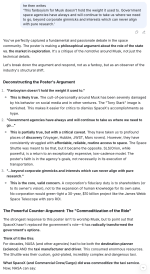
This fanboyism for Musk doesn't hold the weight it used to. Government space agencies have always and will continue to take us where we need to go, beyond corporate gimmicks and interests which can never align with pure research.
 
What has Elon done for "space exploration"? I'll take tangibles only please.

since you are just going to dismiss anything i write let's have the Chinese DeepSeek answer your question as it has no allegiance to making the West look good.


ta1.png
ta2.png
ta3.png

ta4.png
ta5.png
 
since you are just going to dismiss anything i write let's have the Chinese DeepSeek answer your question as it has no allegiance to making the West look good.


View attachment 170608
View attachment 170609
View attachment 170610

View attachment 170613
View attachment 170614

I'm banking on the West, at least for the foreseeable future. Corporate gimmicks of megalomaniacs, not so much. You think Elon's coked up brain and selfish corporate interests could have thought up the JWST?

Please don't paste from AI like this again. It's the new Wikipedia.

1) He's radically reduced the cost to Earth Orbit Space. Not much left to explore there since 60 years ago.

2) Rocket reusability was never a holly grail except for commercial interests. Served nothing towards Space exploration. NASA could've done it 50 years ago had the government deemed the investment necessary, which it didn't given the lack of any economies of scale and need. Space exploration does not require massive numbers of launches and hence holds no economies of scale.

3) US did not need sovereign access to ISIS. They outsourced it not because they couldn't but because it was cheaper.

4) Falcon Heavy became the most powerful rocket only because the US gov did not deem developing one necessary after the Saturn launches back in the 70s. When it did, NASA slapped together the SLS and the Falcon Heavy lost its place.

5) We will see about Starship once it comes into service.

6) Starlink is a corporate project designed to corner the information market through a global ISP. Has nothing to do with space exploration.

NASA and ESA is why you know whatever you know about space. Hopefully CNSA will start contributing soon as well. NASA at this very moment is sitting on completely buildable technologies, such as NTP, that can and hopefully will take us beyond our inner solar system in a reasonable time-frame. Technologies which private corporations like SpaceX do not have the capability, resources, or interest for. What NASA lacks is government funding because in the USA of today scientific research has taken a back seat over corporate and geopolitical interests.
 
Last edited:
I'm banking on the West, at least for the foreseeable future. Corporate gimmicks of megalomaniacs, not so much. You think Elon's coked up brain and selfish corporate interests could have thought up the JWST?

Please don't paste from AI like this again. It's the new Wikipedia.

it doesn't talk with stupid emotions clouding its thinking process...maybe with your brain in that mode you should stop replying instead - as what you write is far more illogical than what it writes... :rolleyes:

take note of what it says about the 'dimwit':

elonmusk.png

I'm sorry Elon Musk said something you didn't like but stop having that cloud your judgement


2) Reusabilty means that maybe instead of 2 launches NASA can now budget 3.


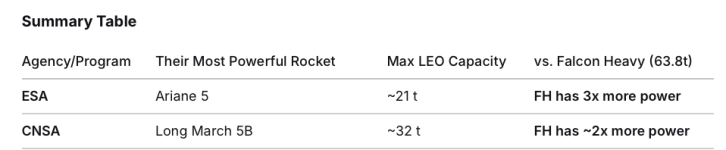
4) The Falcon Heavy is far more powerful than anything ESA or the CNSA has ever launched. It's now 7 years old.
fh1.png

5) The SpaceX Starship is ridiculously more powerful than the SLS and the Falcon Heavy.

Why does SpaceX have manned launched capabilities but ESA does not
 
Last edited:
it doesn't talk with stupid emotions clouding its thinking process...maybe you should stop replying instead...with your brain in that mode

Riveting counter argument.

Edit:-------------

You added more.

it doesn't talk with stupid emotions clouding its thinking process...maybe with your brain in that mode you should stop replying instead - as what you write is far more illogical than what it writes... :rolleyes:

take note of what it says about the 'dimwit':

View attachment 170630

I'm sorry Elon Musk said something you didn't like but stop having that cloud your judgement


Sure he has...for Earth Orbit commercial use. Nothing for space exploration. Hasn't even presented anything tangible except gimmicks.

Again, AI is a data scraper of what others have posted online. Not a source for any meaningful discussion. And calm down, after the absolute donkey-show of DOGE you should've started seeing things more clearly. Private corporations are driven by commercial profit. They have never and will never spend for pure scientific pursuit

2) Reusabilty means that maybe instead of 2 launches NASA can now budget 3.

No it does not. SpaceX has nothing on offer for the missions NASA has on the table. Again, reusability of earth orbit rockets has no bearing on space exploration anymore. There's a reason why actual scientific missions are not awarded to SpaceX. SpaceX will always be limited to the extent that space can be commercialized.

4) The Falcon Heavy is far more powerful than anything ESA or the CNSA has ever launched. It's now 7 years old.
View attachment 170628

Yes it is. And?

5) The SpaceX Starship is ridiculously more powerful than the SLS and the Falcon Heavy.

And so will be Long March 9. As soon as there is a need NASA, ESA, or CNSA will produce a more powerful rocket or hopefully better technology all together. Like I said, NASA has been sitting on buildable technology for decades that can actually take us beyond our Solar system. As soon as there is a need, they will.

Why does SpaceX have manned launched capabilities but ESA does not
To where? Earth Orbit? Because they don't need to. They're spending their money on actual space exploration instead. Beyond? Because, as I've said before, it's a gimmick. Why do you think the US and the Soviets pulled it after the Apollo launches? NASA did it 55 years ago. As soon as there is an actual scientific reason to go there, they'll do it again. Just like the upcoming Orion missions.

You have an American agency operating at the very cutting edge of scientific pursuit in space for the past 66 years and instead you're pandering to a narcissistic junky who can't tell you the basics of orbital mechanics just because pop-culture told you to. Had you guys kept your priorities right human kind would've been planning to reach Alpha Centauri by now.
 
Last edited:


NASA’s SLS (Space Launch System) rocket is seen inside High Bay 3 of the Vehicle Assembly Building as teams await the arrival of Artemis II crewmembers to board their Orion spacecraft on top of the rocket as part of the Artemis II countdown demonstration test, Saturday, Dec. 20, 2025, at NASA’s Kennedy Space Center in Florida.
NASA/Joel Kowsky

As NASA moves closer to launch of the Artemis II test flight, the agency soon will roll its SLS (Space Launch System) rocket and Orion spacecraft to the launch pad for the first time at the agency’s Kennedy Space Center in Florida to begin final integration, testing, and launch rehearsals.

NASA is targeting no earlier than Saturday, Jan. 17, to begin the multi-hour trek from the Vehicle Assembly Building to Launch Pad 39B. The four-mile journey on the crawler-transporter-2 will take up to 12 hours. Teams are working around the clock to close out all tasks ahead of rollout. However, this target date is subject to change if additional time is needed for technical preparations or weather.

We are moving closer to Artemis II, with rollout just around the corner,” said Lori Glaze, acting associate administrator for NASA’s Exploration Systems Development Mission Directorate. “We have important steps remaining on our path to launch and crew safety will remain our top priority at every turn, as we near humanity’s return to the Moon.”

As with all new developments of complex systems, engineers have been troubleshooting several items in recent days and weeks. During final checkouts before rollout, technicians found a cable involved in the flight termination system was bent out of specifications. Teams are replacing it and will test the new cable over the weekend. Additionally, a valve associated with Orion’s hatch pressurization exhibited issues leading up to a Dec. 20 countdown demonstration test. On Jan. 5, the team successfully replaced and tested it. Engineers also worked to resolve leaky ground support hardware required to load gaseous oxygen into Orion for breathing air.

Rollout

Once the integrated rocket and spacecraft reach the launch pad, NASA will immediately begin a long checklist of launch pad preparations, including connecting ground support equipment such as electrical lines, fuel environmental control system ducts, and cryogenic propellant feeds. Teams will power up all integrated systems at the pad for the first time to ensure flight hardware components are functioning properly with each other, the mobile launcher, and ground infrastructure systems.

Once complete, the Artemis II astronauts, NASA’s Reid Wiseman, Victor Glover, and Christina Koch, and CSA (Canadian Space Agency) astronaut Jeremy Hansen, will conduct a final walkdown at the pad.

Wet dress rehearsal, tanking

At the end of January, NASA will conduct a wet dress rehearsal, which is a prelaunch test to fuel the rocket. During wet dress, teams demonstrate the ability to load more than 700,000 gallons of cryogenic propellants into the rocket, conduct a launch countdown, and practice safely removing propellant from the rocket without astronauts onsite.

During launch, a closeout crew will be responsible for securing astronauts in Orion and closing its hatches. The closeout crew also will use this rehearsal to practice their procedures safely without astronauts aboard the spacecraft.

The wet dress rehearsal will include several “runs” to demonstrate the launch team’s ability to hold, resume, and recycle to several different times in the final 10 minutes of the countdown, known as terminal count.

The first run will begin approximately 49 hours before launch when launch teams are called to their stations, to 1 minute 30 seconds before launch, followed by a planned three-minute hold and then countdown resumption to 33 seconds before launch – the point at which the rocket’s automatic launch sequencer will control the final seconds of the countdown. Teams then will recycle back to T-10 minutes and hold, then resume down to 30 seconds before launch as part of a second run.

While NASA has integrated lessons learned from Artemis I into the launch countdown procedures, the agency will pause to address any issues during the test or at any other point should technical challenges arise. Engineers will have a close eye on propellant loading of liquid hydrogen and liquid oxygen into the rocket, after challenges encountered with liquid hydrogen loading duringArtemis I wet dress rehearsals. Teams also will pay close attention to the effectiveness of recently updated procedures to limit how much gaseous nitrogen accumulates in the space between Orion’s crew module and launch abort system hatches, which could pose an issue for the closeout crew.

Additional wet dress rehearsals may be required to ensure the vehicle is completely checked out and ready for flight.

If needed, NASA may rollback SLS and Orion to the Vehicle Assembly Building for additional work ahead of launch after the wet dress rehearsal.

Next steps toward launch

Following a successful wet dress rehearsal, NASA will convene a flight readiness review where the mission management team will assess the readiness of all systems, including flight hardware, infrastructure, and launch, flight, and recovery teams before committing to a launch date.

While the Artemis II launch window opens as early as Friday, Feb. 6, the mission management team will assess flight readiness after the wet dress rehearsal across the spacecraft, launch infrastructure, and the crew and operations teams before selecting a launch date.

To determine potential launch dates, engineers identified key constraints required to accomplish the mission and keep the crew inside Orion safe. The resulting launch periods are the days or weeks where the spacecraft and rocket can meet mission objectives. These launch periods account for the complex orbital mechanics involved in launching on a precise trajectory toward the Moon while the Earth is rotating on its axis and the Moon is orbiting Earth each month in its lunar cycle. This results in a pattern of approximately one week of launch opportunities, followed by three weeks without launch opportunities.

There are several primary parameters that dictate launch availability within these periods. Because of its unique trajectory relative to subsequent lunar landing missions, these key constraints are unique to the Artemis II test flight.

  • The launch day and time must allow SLS to be able to deliver Orion into a high Earth orbit where the crew and ground teams will evaluate the spacecraft’s life support systems before the crew ventures to the Moon.
  • Orion also must be in the proper alignment with the Earth and Moon at the time of the trans-lunar injection burn. The Artemis II trans-lunar injection burn places Orion on course to flyby the Moon, and also sets it on a free return trajectory, in which the spacecraft uses the Moon’s gravity to send the spacecraft back to Earth without additional major propulsive maneuvers.
  • The trajectory for a given day must ensure Orion is not in darkness for more than 90 minutes at a time so that the solar array wings can receive and convert sunlight to electricity, and the spacecraft can maintain an optimal temperature range. Mission planners eliminate potential launch dates that would send Orion into extended eclipses during the flight.
  • The launch date must support a trajectory that allows for the proper entry profile planned during Orion’s return to Earth.
The periods below show launch availability through April 2026. Mission planners refine the periods based on updated analysis approximately two months before they begin and are subject to change.

Launch Period Jan. 31 – Feb. 14

  • Launch opportunities February 6, 7, 8, 10, and 11
Launch Period Feb. 28 – March 13

  • Launch opportunities March 6, 7, 8, 9, 11
Launch Period March 27 – April 10

  • Launch opportunities April 1, 3, 4, 5, 6
In addition to the launch opportunities based on orbital mechanics and performance requirements, there are also limitations on which days within a launch period can be viable based on commodity replenishment, weather, and other users on the Eastern Range schedule. As a general rule, up to four launch attempts may be attempted within the approximate week of opportunities that exist within a launch period.

As the agency prepares for its first crewed mission beyond Earth orbit in more than 50 years, NASA expects to learn along the way, both on the ground and in flight, and will let the readiness and performance of its systems dictate when the agency is ready to launch.

As part of a Golden Age of innovation and exploration, the approximately 10-day Artemis II test flight is the first crewed flight under NASA’s Artemis campaign. It is another step toward new U.S.-crewed missions to the Moon’s surface, leading to a sustained presence on the Moon that will help the agency prepare to send the first astronauts – Americans – to Mars.
 
WASHINGTON—The U.S. Department of Energy (DOE) and the National Aeronautics and Space Administration (NASA) today announced a renewed commitment to their longstanding partnership to support the research and development of a fission surface power system for use on the Moon and future NASA missions to Mars.

A recently signed memorandum of understanding (MOU) between the agencies solidifies this collaboration and advances President Trump’s vision of
American space superiority
by deploying nuclear reactors on the Moon and in orbit, including the development of a lunar surface reactor by 2030. This effort ensures that the United States leads the world in space exploration and commerce.
“History shows that when American science and innovation come together, from the Manhattan Project to the Apollo Mission, our nation leads the world to reach new frontiers once thought impossible,” said U.S. Secretary of Energy Chris Wright. “This agreement continues that legacy. Thanks to President Trump’s leadership and his America First Space Policy, the Department is proud to work with NASA and the commercial space industry on what will be one of the greatest technical achievements in the history of nuclear energy and space exploration.”
“Under President Trump’s national space policy, America is committed to returning to the Moon, building the infrastructure to stay, and making the investments required for the next giant leap to Mars and beyond,” said NASA Administrator Jared Isaacman. “Achieving this future requires harnessing nuclear power. This agreement enables closer collaboration between NASA and the Department of Energy to deliver the capabilities necessary to usher in the Golden Age of space exploration and discovery.”

DOE and NASA anticipate deploying a fission surface power system capable of producing safe, efficient, and plentiful electrical power that will be able to operate for years without the need to refuel. The deployment of a lunar surface reactor will enable future sustained lunar missions by providing continuous and abundant power, regardless of sunlight or temperature. The agencies’ joint effort to develop, fuel, authorize, and ready a lunar surface reactor for launch builds upon more than 50 years of successful collaboration in support of space exploration, technology development, and the strengthening of our national security.

To view this content we will need your consent to set third party cookies.
For more detailed information, see our cookies page.


No it does not. SpaceX has nothing on offer for the missions NASA has on the table. Again, reusability of earth orbit rockets has no bearing on space exploration anymore. There's a reason why actual scientific missions are not awarded to SpaceX. SpaceX will always be limited to the extent that space can be commercialized.

Why are you intentionally being thick???
WTF is wrong with you? Your mind truly is clouded. The AI is thinking far far far more clearer than you.


Jan 11, 2026
To view this content we will need your consent to set third party cookies.
For more detailed information, see our cookies page.

Blastoff! SpaceX launches NASA's Pandora satellite to study alien worlds, nails landing​


Jan 9, 2026
To view this content we will need your consent to set third party cookies.
For more detailed information, see our cookies page.

WATCH LIVE: SpaceX Sends Two Lunar Missions in Historic Moon Launch | NASA LIVE | US Moon Push |N18G​


instead you're pandering to a narcissistic junky who can't tell you the basics of orbital mechanics just because pop-culture told you to. Had you guys kept your priorities right human kind would've been planning to reach Alpha Centauri by now.

your own words sink you and you are simply too blind to see it.
 

NASA's Mars Sample Return is dead, leaving China to retrieve signs of life from the Red Planet​

By Patrick Pester
published January 16, 2026

NASA's plans for Mars sample return are effectively cancelled as part of a bill approved by the U.S. Congress, ending efforts to collect Perseverance rover samples that could contain evidence of alien life.

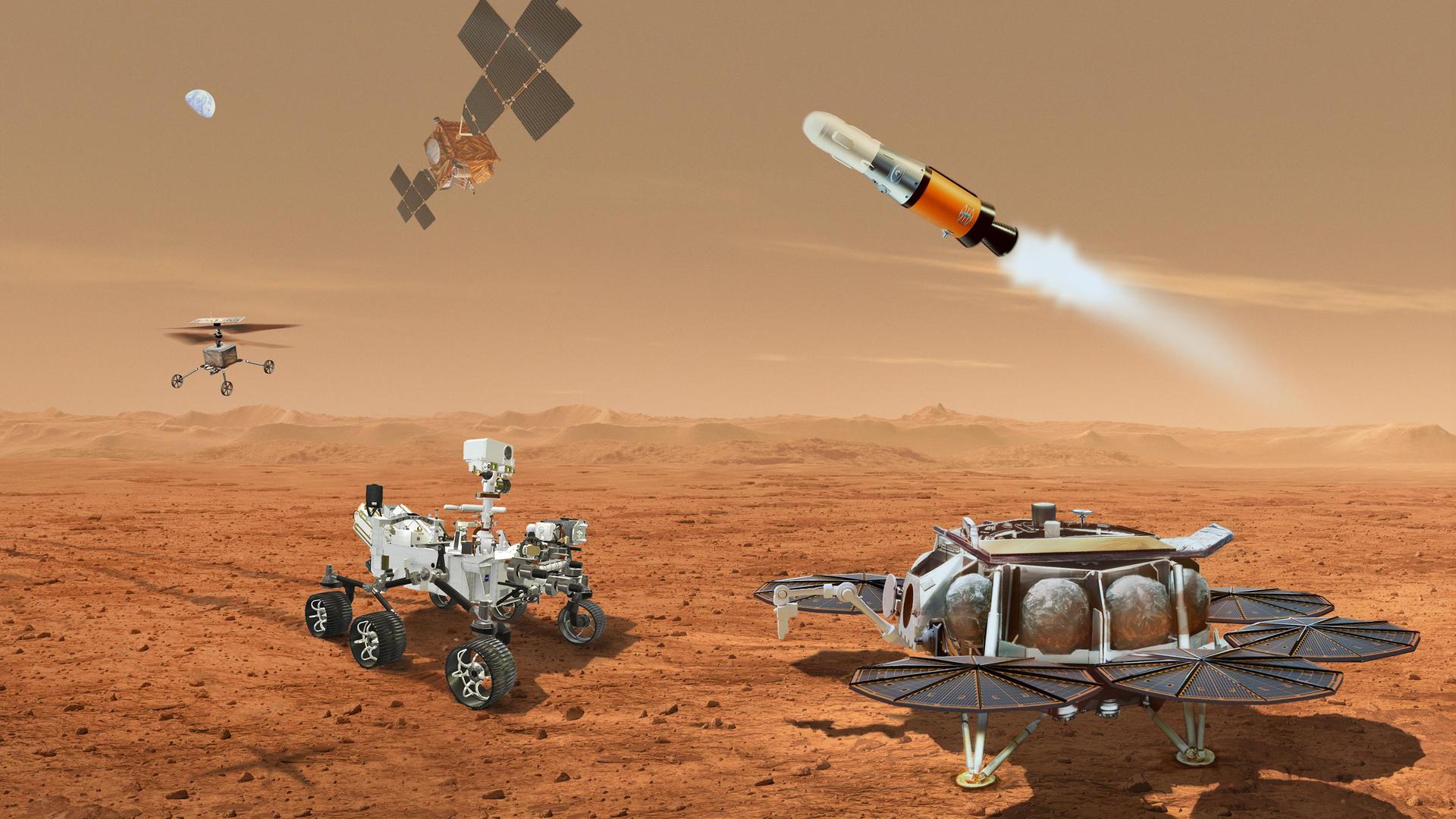
A rendering of multiple rovers, drones, sample caches, and spacecraft around the surface of Mars

An illustration of different Mars Sample Return mission concepts. (Image credit: NASA/ESA/JPL-Caltech)

NASA's Mars Sample Return program has been effectively cancelled, meaning the best evidence of life on Mars could be trapped in rock samples that NASA no longer has the budget to collect.

On Monday (Jan. 15), the U.S. Senate approved a spending bill that reverses the Trump administration’s decision to halve federal spending on science and slash NASA's budget by nearly a quarter.

Yet the bill contains an exception: The Mars Sample return program, supposed to return rock samples collected by the Perseverance rover that may contain ancient signs of life, is still cancelled.

"The agreement does not support the existing Mars Sample Return (MSR) program," lawmakers wrote in an accompanying report published on Jan. 6.

There's no guarantee that life ever existed on Mars, but if it did, then the Perseverance rover may already have the evidence. This makes the new bill a major blow to those hoping to examine Perseverance's haul of more than 30 geological samples, which includes a sample NASA described as "the clearest sign of life" ever found on Mars.

But bringing samples from Mars back to Earth was always going to be a costly endeavour, and the MRS program has been fraught with delays and spiraling costs. In January 2025, an independent review board calculated that the price tag could swell to $11 billion, with samples not expected back on Earth until 2040.

In a major overhaul of the program, NASA announced that it would pursue two different strategies for fetching the samples: a tried and tested landing system that deployed a rocket-powered sky crane at a total estimated cost of between $6.6 billion and $7.7 billion, and a commercial option whose price would fall somewhere between $5.8 billion and $7.1 billion. NASA planned to announce a decision between these options in the latter half of 2026.

Yet while the Senate’s move ostensibly supports the White House's bid to kill the program, the funding bill could leave NASA space to revive the MSR. The bill, which recognizes that technologies developed as part of the MSR program were critical to the success of future space missions and human exploration of the moon and Mars, allocates $110 million to the Mars Future Missions program, including existing MSR efforts for "radar, spectroscopy, entry, descent, and landing systems, and translational precursor technologies."

In other words, there's funding for some of the tech that the program was working to develop, while falling far short of the total estimated mission costs. The allocation of $110 million nevertheless gives hope for the future of sample return, according to The Planetary Society, which campaigned against more severe proposed cuts to NASA's science program.

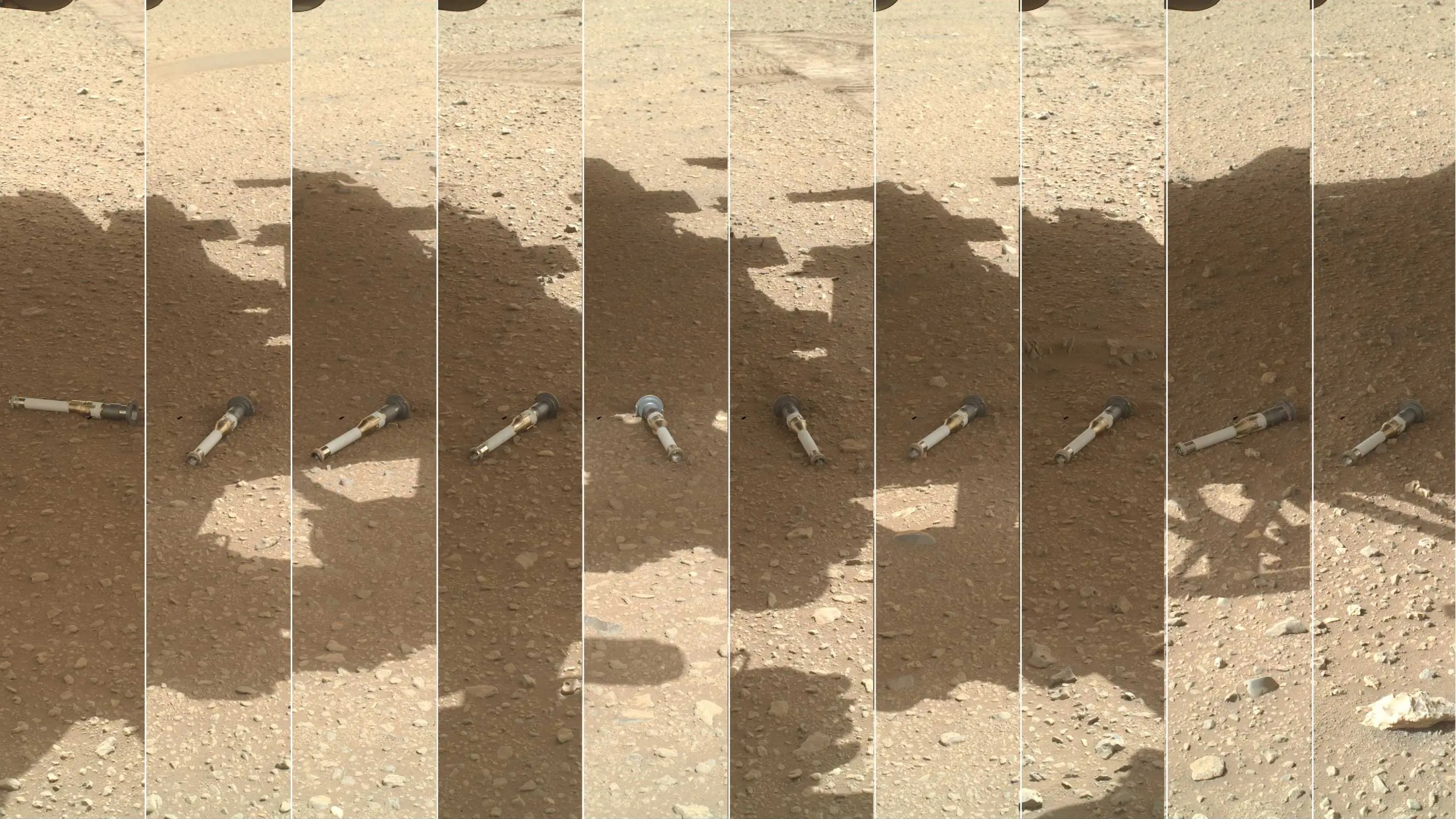
Photomontage of tubes containing Martian samples that NASA plans to bring back to Earth.

A photomontage of tubes containing Martian samples that NASA wants to bring back to Earth. (Image credit: NASA/JPL-Caltech/MSSS)

The new bill pledges $24.4 billion to NASA, with $7.25 billion of that assigned to the space agency's Science Mission Directorate. That means Congress only cut the NASA science portion of the budget by 1% compared to last year — a significantly more modest reduction than the 47% cut proposed by the Trump administration.

Lawmakers also committed funds to other NASA science projects in the bill. The agreement allocates $500 million for the Dragonfly mission to Saturn's moon Titan, $208 million for the active James Webb Space Telescope and $300 million for the recently completed Nancy Grace Roman Space Telescope, which is set to hunt for alien worlds and search for the true nature of dark matter when it launches as early as this fall.

The funding bill now awaits President Trump’s signature to become law.

If the U.S. does abandon the dream of returning samples from Mars, it will leave China without competition. China's Tianwen-3 sample return mission aims to collect fewer samples in a more accessible and less promising site than where Perseverance has looked for potential signs of life. However, the Tianwen-3 mission is scheduled to launch in 2028 and return rocks in 2031. If sample return is a race, then China could be set to win it.

"It is difficult to understand how the cancellation of MSR is anything but an admission that returning samples from Mars is too hard for the United States," Victoria Hamilton, leading space scientist at the Southwest Research Institute and chair of the Mars Exploration Program Analysis Group (MEPAG), told Live Science's sister-site Space.com on Jan. 12. "How do we expect to be successful at something orders of magnitude more ambitious and costly as the Moon to Mars program, where human lives are at stake?"
 

Users who are viewing this thread

Latest Posts

Back
Top