US Defence related thread

Disaster Looms on the Horizon: Dangerous Escalation Threatens Global ConfrontationIn a stunning and unprecedented incident, the United States of America pounced on the famous oil tanker today named "Marinera," registered under the Russian flag, following a fierce and exhausting chase that lasted more than two weeks across the treacherous waves of the Atlantic Ocean. Powerful Russian warships, including a menacing military submarine, were lurking in the same area, raising the specter of a devastating military escalation.They mentioned that this tanker is linked to relationships with Venezuela and secret oil transport networks subject to American sanctions, and it was an essential part of the mysterious "shadow fleet," which smuggles oil from countries like Venezuela and Iran, defying everyone.In late December of last year, U.S. Coast Guard forces in the Caribbean launched a violent attack attempting to board the tanker as it headed toward Venezuela, but the crew firmly refused to submit, continuing their bold journey toward the northern Atlantic Ocean, turning the situation into an open confrontation.During this epic journey, the crew performed clever and deceptive maneuvers: they changed its name from "Bella-1" to "Marinera," raised the Russian flag, and registered it in Russian records during the voyage itself, in an attempt to hide under the umbrella of Russian protection, which portends an international disaster that could ignite at any moment. Especially since the Russian Ministry of Transport said it had lost contact with the ship.

To view this content we will need your consent to set third party cookies.
For more detailed information, see our cookies page.
 
To view this content we will need your consent to set third party cookies.
For more detailed information, see our cookies page.
 
A dangerous escalation. The US Army’s Central Command confirmed the seizure of the Russian oil tanker “Marinera”:

The command stated in a statement: “The ship was detained in the North Atlantic Ocean based on an order issued by a US federal court.”

The tanker, formerly known as Bella-1, was detained for violating the US blockade.

During the pursuit, the ship changed its jurisdiction and was re-registered under the Russian flag, but according to US authorities, the first order to stop was given to its commander before the flag was changed, so the operation cannot be considered an attack on a Russian ship.

To view this content we will need your consent to set third party cookies.
For more detailed information, see our cookies page.
 
To view this content we will need your consent to set third party cookies.
For more detailed information, see our cookies page.


But reality strikes when it comes to the nuclear arsenal..
 
To view this content we will need your consent to set third party cookies.
For more detailed information, see our cookies page.


191 F-35s delivered to US forces and foreign customers in 2025. Nearly 1,300 F-35s in total have been delivered
 
News of utmost importance

For the first time in 51 years, the famous Doomsday Plane Boeing E-4B Nightwatch lands at Los Angeles Airport (LAX), in a step that raises profound questions and widespread concern.The officially announced reason is an "industrial tour"But the truth is that the cost of flying this legendary aircraft reaches 372,496 dollars per hour, compared to just 42,936 dollars for the presidential plane! This enormous difference confirms that its use is not frivolous and not for ordinary protocol reasons.The "Doomsday Plane" is a command platform for directing U.S. forces in cases of nuclear emergencies or major existential disasters, and for leading emergency warfare or world war, and for coordinating civilian measures during nuclear threats or other major disasters.The appearance of this aircraft at this timing amid these tensions in various countries, and after half a century of absence, is not a passing detail…

To view this content we will need your consent to set third party cookies.
For more detailed information, see our cookies page.


Boeing 747-200, crew 112, long-distance flight of more than 7,000 miles without refueling, refueling in the atmosphere, resistant to nuclear radiation and electromagnetic interference. It contains advanced communications systems that allow managing operations and issuing nuclear launch orders.
 
US Army to reshape its ammunition production structure:

 
To view this content we will need your consent to set third party cookies.
For more detailed information, see our cookies page.


But reality strikes when it comes to the nuclear arsenal..

Russian Navy is not even close to USN, but in a all out war between them too everyone will die as nukes will fly high.
 
When the United States fired a 15-kiloton nuclear artillery shell, in 1953

To view this content we will need your consent to set third party cookies.
For more detailed information, see our cookies page.
 
17 Jan 1991
Start of Operation Desert Storm, the first combat deployment for USAF F-16s. F-16s perform 25 percent of strike sorties (300-400 daily) throughout the war, totaling 13,500 sorties.
 
17 Jan 1991
Start of Operation Desert Storm, the first combat deployment for USAF F-16s. F-16s perform 25 percent of strike sorties (300-400 daily) throughout the war, totaling 13,500 sorties.
The "100 Hour War". F-117s also performed well.
 

THE PHANTOM​

  1. Aviation Features
  2. THE PHANTOM


13th January 2026
Feature


Several facts point towards the McDonnell F-4 Phantom II being the West’s greatest Cold War combat aircraft. David Willis outlines the development of the legendary fighter and the main variants built for the US military
img_84-1.jpg

The gun-armed F-4E was the definitive US Air Force Phantom variant, built in greater numbers than any other version. This 90th Tactical Fighter Squadron, 3rd Tactical Fighter Wing F-4E is dropping a GBU-15 electro-optical guided bomb
USAF
The Phantom was the only fighter to equip the squadrons of the US Navy, Marine Corps and Air Force. It also served with the armed forces of 11 other countries. The seven major variants produced gave rise to more than 50 different sub-types. Between 1958 and May 1981, when Mitsubishi rolled out the last, a total of 5,195 Phantoms were built.

Phantoms chalked up more than 320 aerial victories during conflicts in the Middle East and Asia. From the 1970s, more than 400 US airframes were modified as drones and suffered the indignity of being shot at by ‘their own side’. More than six and a half decades after making its first flight, it still flies with the air forces of Greece, Iran, and Turkey. However, back in the early 1950s, McDonnell’s problem was persuading the US Navy that it had a needed a new fighter at all.

A better Demon

Failure can be a powerful motivator. For James S McDonnell, it was his company’s failure to secure the contract for the US Navy’s first supersonic fleet interceptor in September 1953. Rival Vought won that contract, producing the F8U Crusader. Having designed the US Navy’s first jet powered carrier-based fighter – the FD/FH-1 Phantom, followed by the F2H Banshee – the company made the mistake of using the ‘wrong’ engine in the F3H Demon. The F3H-1N Demon was handicapped by the Westinghouse J40 turbojet, which was replaced by the Allison J71 from the F3H-2. Although McDonnell went on to build 521 Demons as interceptors, the type was viewed as a stopgap. McDonnell’s designers were sufficiently motivated to get it right next time.

img_85-2.jpg

The first Phantom prototype had an early inlet design and the low rear cockpit canopy and small radome of the early F4H-1Fs. Test pilot Gerald ‘Zeke’ Huelsbeck, who undertook most of the early flights in the YF4H-1, was killed in the aircraft in September 1959 during preparations for the ‘Top Flight’ altitude record attempt
US Navy
Work to produce a ‘better Demon’ began in May 1952, resulting in the F3H-C ‘Super Demon’ design with Wright J67-W-1 (Bristol Olympus) engines, with interchangeable nose sections for different roles. It was refined as the F3H-E(Model 98A), without the Demon’s nose-high attitude on the ground. The design was enlarged as the Model 98B (F3HG/H) with a larger wing and four 20mm cannons. Power was to come from a pair of Wright J65-W-4s (Armstrong Siddeley Sapphires), although the mock-up hedged its bets with both a J65 and General Electric J79-2. An unsolicited proposal was submitted to the Navy for review, but the F8U, selected in May 1953, remained the preferred option.

McDonnell continued to work on the basic configuration as a single-seat multirole fighter-bomber. In September 1954, it was asked to submit a more specific proposal, optimized for ground attack with 11 pylons and the four cannons, and that November a contract was issued for two flight test aircraft and a static test airframe as the AH-1.

The AH-1’s Demon ancestry remained evident. Much of this changed in early 1955, when several important alterations were incorporated, the most important being the adoption of the J79. The J79 was designed to power the Convair B-58 Hustler supersonic bomber and promised to give the AH-1 Mach 2 performance, although significant alterations were required to the design’s inlets and nozzles. Provision for a second crew member was added and the outer wing sections gained 12° of dihedral and an extended chord creating a distinctive ‘dogtooth’, while yaw stability was increased by giving the tailplanes 23.25° of anhedral. In April 1955, McDonnell was informed that the Navy no longer wanted an attack aircraft but a long-range interceptor; the 11 pylons (and later its four cannons) being removed and recesses for four AAM-N-6 (later AIM-7C) Sparrow III air-to-air missiles added under the fuselage. The AH-1 was redesignated the F4H-1.

Several different names were contemplated for the aircraft. Project manager Don Malvern wanted to name it Satan! James McDonnell originally considered Mithras – the Romanized version of Mithra, the Persian sun deity – before settling on Phantom II.

Early Phantoms

Test pilot Robert C Little completed the maiden flight of the new fighter on the morning of May 27, 1958, from Lambert-St Louis Municipal Airport in Missouri. All did not go as planned. The YF4H-1 (marked ‘F4H-1’ on the nose) suffered hydraulic problems during the flight, resulting in the nose wheel door remaining open after the landing gear cycled up. Post flight analysis discovered that one of the J79s had suffered foreign object damage. But further flights over the weeks that followed demonstrated that McDonnell had got the basics right.

The Phantom was a leap forward in performance but introduced new levels of complexity. Designed under the ‘weapon system’ concept then in vogue, a lot of developmental work was required to make it an operational platform. This was the task of most of the initial 45 F4H-1s, which were built to many different standards. The large number of pre-production and development aircraft allowed the program to progress quickly and a pool of pilots to be trained. Initial shipborne compatibility trials, from the USS Independence, occurred between February 15 and 20, 1960, off the Atlantic coast, followed that April by tests from the smaller USS Intrepid. Few difficulties were encountered.

Formation of the first Replacement Air Group – VF-101 ‘Grim Reapers’ – began in 1960. Integration of the Phantom’s AN/APQ-76 radar and Sparrow III radar-guided missile were relatively problem free.

img_86-1.jpg

The F3H-Gmock-up was the link between the F3H Demon and AH-1. McDonnell hedged its bets with the engines, installing a J79 on the starboard side and J65 to port
McDonnell
img_86-2.jpg

The short nose of the YF4H-1is evident from above. The prototype is possibly depicted during its first flight on May 27, 1958
McDonnell
On March 23, 1961, Thomas Harris flew what was considered to be the initial production F4H-1 – the 48th built – with J79-GE-8A engines in place of the -2A and -8 of earlier aircraft. The initial F4H-1s (along with the surviving prototype) were redesignated F4H-1Fs on May 1. When the tri-service Mission Design Series was introduced in September 1962, the F4H-1Fs became F-4As, and F4H-1s F-4Bs. The F-4B became the most numerous naval variant, with 649 built. It was the Marines that first embraced the potential of the Phantom in the air-to-ground role, retitling its squadrons flying the jet from Marine Fighter (All-Weather) (VMF(AW)) to Marine Fighter Attack (VMFA).

Air Force Phantoms

Phantom crews quickly discovered they could outfight the Convair F-106A Delta Dart, considered the US Air Force’s best fighter. An official fly-off between the two, Operation Highspeed, highlighted the superiority of the F4H-1 in virtually every parameter. The US Air Force arranged to borrow a pair of F4H-1s as F-110As for a 120-day evaluation from January 1962 and quickly decided to acquire a minimal change version, with added ground attack capability and air force specific equipment, as the F-4C. To speed up service entry, 27 additional F-4Bs were loaned to the US Air Force, most going to the 4453rd Combat Crew Training Wing at MacDill AFB, Florida. They were followed by 583 F-4Cs, the last of which was delivered to the US Air Force in May 1966.

The F-4C was followed by the F-4D; although externally almost identical, it incorporated all the changes the US Air Force wanted and was the first Phantom optimized for air-to-ground operations. The AN/APQ-100 radar of the F-4C was replaced by the -109 (part of the AN/APA-65 system) with ranging modes for ground targets. Deliveries began in March 1966 to the 36th Tactical Fighter Wing at Bitburg Air Base in West Germany. The US Air Force received 793, while a further 32 were built for Iran. Crews flying F-4Ds achieved 45 air-to-air kills in Vietnam, more than any other model of the aircraft.

img_87-4.jpg

Both McDonnell and the US Navy were keen to demonstrate the capabilities of the new fighter, making attempts on both speed and altitude records. Project LANA (50th – ‘L’ in Roman numerals – Anniversary of Naval Aviation) was a transcontinental speed attempt by five F4H-1Fs in May 1961. Here, one of the aircraft practices refueling from a VAH-9 A3D-2 Skywarrior
US Navy
img_87-1.jpg

The F-4B was the first fully operational version of the Phantom. Squadrons equipped with the type, including VF-111 ‘Sundowners’ – a late convert from the F8U Crusader – were heavily involved in the war over Vietnam
US Navy
 
Combat experience highlighted that the faith placed in missiles was not entirely justified. Close-in dogfights with nimble North Vietnamese MiGs highlighted the difficulty of getting a lock on the aircraft. Missiles were expensive and vulnerable to countermeasures, while the rules of engagement demanded visual confirmation, negating the advantage of being able to fire at range. Although Phantoms carried podded guns, this was far from an ideal solution. What was needed was an integral weapon.

Gun Fighter

Work on a gun-armed Phantom was funded in June 1965 and a YRF-4C was modified with a six-barrel General Electric M61A1 rotary cannon in the nose, becoming the YF-4E, followed by conversions of a single F-4C and F-4D. Considerable work was required to reduce vibration when fired, which disrupted the AN/APQ-120 radar, while systems found to be unreliable in combat were replaced.

Originally known as the F-4E Plus, for ‘plus gun’, the initial production aircraft flew on June 30, 1967, with the second introducing a slotted stabilator to become the first truly representative F-4E. The F-4E went on to become the most numerous Phantom version; in addition to 993 for the US Air Force 394 were built for Germany, Greece, Iran, Israel, South Korea and Turkey, while 24 were loaned to Australia and others later supplied to Egypt.

The F-4E also served as the basis for the majority of the export variants. Japan received 140 optimized as interceptors as F-4EJs, 125 of which were manufactured by Mitsubishi. Germany originally wanted the single-seat F-4E(F) before opting for 175 F-4Fs, a lighter and simplified F-4E, delivered between September 1973 and April 1976.

The model was also modified for the suppression of enemy air defenses as the F-4G Wild Weasel V. Building on the interim ‘EF-4C’ Wild Weasel IV, 36 of which were used between 1969 and the mid-1970s, a total of 136 F-4Gs were created.

img_87-3.jpg

Initial US Air Force procurement focused on a minimum change version of the F-4B originally designated the F-110A. This ‘F-110A’ was actually F4H-1 BuNo 149405, one of two borrowed from the US Navy and ‘delivered’ to the US Air Force on January 24, 1962. In reality, no Phantoms were ready for the air force at that point
USAF
img_88-1.jpg

Although externally similar to its predecessor, the F-4D was more closely tailored to the US Air Force’s requirements. The 194th Fighter Interceptor Squadron of the California Air National Guard flew F-4Ds for six years from late 1983
USAF
Carrier-based fighters

The US Navy also sought to build on the capabilities of its F-4Bs with the F-4J. Take-off and landing performance was improved by adding a slot to the stabilator leading-edge, creating a powerful nose-up force on launch or recovery. Locking the inboard wing leading-edge flap-up improved the effectiveness of the slotted stabilator, while lift at low speeds was increased by a 16.5° droop for the ailerons. These modifications reduced approach speed by 12kt to 125kt (231km/h). This was all the more remarkable as the F-4J was heavier and had higher sink rates,requiring a strengthened landing gear and the wider tires of the US Air Force variants, with a bulged inner wing root to accommodate them. Engines were upgraded to J79-GE-10s, with longer afterburner ‘feathers’, while a seventh fuel cell was added in the fuselage. The F-4B’s AN/APQ-72 radar was replaced by the bulkier and heavier AN/APG-59, part of the AN/AWG-10 radar and fire-control system, while the undernose infrared search and track sensor was deleted. The second production F-4J was the first to fly, on May 27, 1966, having been preceded by three YF-4J prototypes.

img_88-5.jpg

The F-4G was produced to locate, identify and neutralize enemy air defenses using a wide range of systems and armament. It was the last dedicated Wild Weasel airframe, remaining in service until 1996
USAF
img_89-2.jpg

The second main production version for the US Navy was the F-4J, which could be distinguished from the F-4B by lacking the undernose infrared sensor of the earlier version. This aircraft served with VF-96 ‘Fighting Falcons’, which flew the variant between late 1968 and November 1975
US Navy
Upgrades

Carrier operations and combat over Vietnam took its toll on the F-4B fleet. By the end of the 1960s, the fleet needed refurbishment and updating. Under Bee Line F-4Bs were flown to NAS North Island in California where the Naval Air Rework Facility (NARF) stripped and inspected the aircraft, replacing wiring and parts to increase service life, as well as updating the avionics. Those F-4Bs not already fitted with slotted stabilators had them installed, while the inboard leading-edge flaps were locked shut. Reworked F-4Bs were redesignated F-4Ns, the first rejoining the fleet in February 1973. Altogether, 228 F-4Bs were reworked.

The success of Bee Line prompted a similar program for the F-4Js, to bridge the gap until they could be replaced by Grumman F-14 Tomcats in the Navy, and McDonnell Douglas F/A-18 Hornets with the Marines. One significant change was the addition of two-position slats on the wing leading-edges, decreasing combat turning radius by 50%, although the initial 47 conversions initially lacked the modification until they were retrofitted.

The first upgraded F-4J – redesignated a F-4S – made its initial post-conversion flight on July 22, 1977, and VMFA-451 became the first of 13 Marine (plus 12 Navy) squadrons with the new model in June 1978. The F-4S had the distinction of being the last naval Phantom fighters in service; VF-202 performed the final carrier landing by a Phantom on October 18, 1986, on board USS America, while VMF-112 retired the last F-4Ss during January 1992.

Eyes in the sky

Its performance made the Phantom a natural choice for a reconnaissance platform. The US Air Force ordered a variant of the F-4C as the RF-4C, with an elongated nose incorporating windows for a variety of cameras. The RF-4C also had equipment for laser reconnaissance, radar mapping and infrared detection. No provision for armament was provided, although the RF-4C did retain the ability to carry a single nuclear bomb on the centerline pylon. The first of 503 RF-4Cs flew on May 18, 1964, entering service that September. Deliveries continued until December 1973. While the RF-4B was externally similar to the RF-4C, the Marine Corps reconnaissance platform was based on the F-4B and flew after the US Air Force variant, on March 12, 1965. A total of 27 of the 46 built underwent a Sensor Update and Refurbishment Effort from 1978, which also added slotted stabilators.

CAJ

img_89-3.jpg

The RF-4B was the second reconnaissance variant, after the RF-4C of the US Air Force. It served with only the US Marine Corps, all survivors of the 46 built being assigned to VMFP-3 from 1975. The last was retired in 1990
US Navy

 
To view this content we will need your consent to set third party cookies.
For more detailed information, see our cookies page.


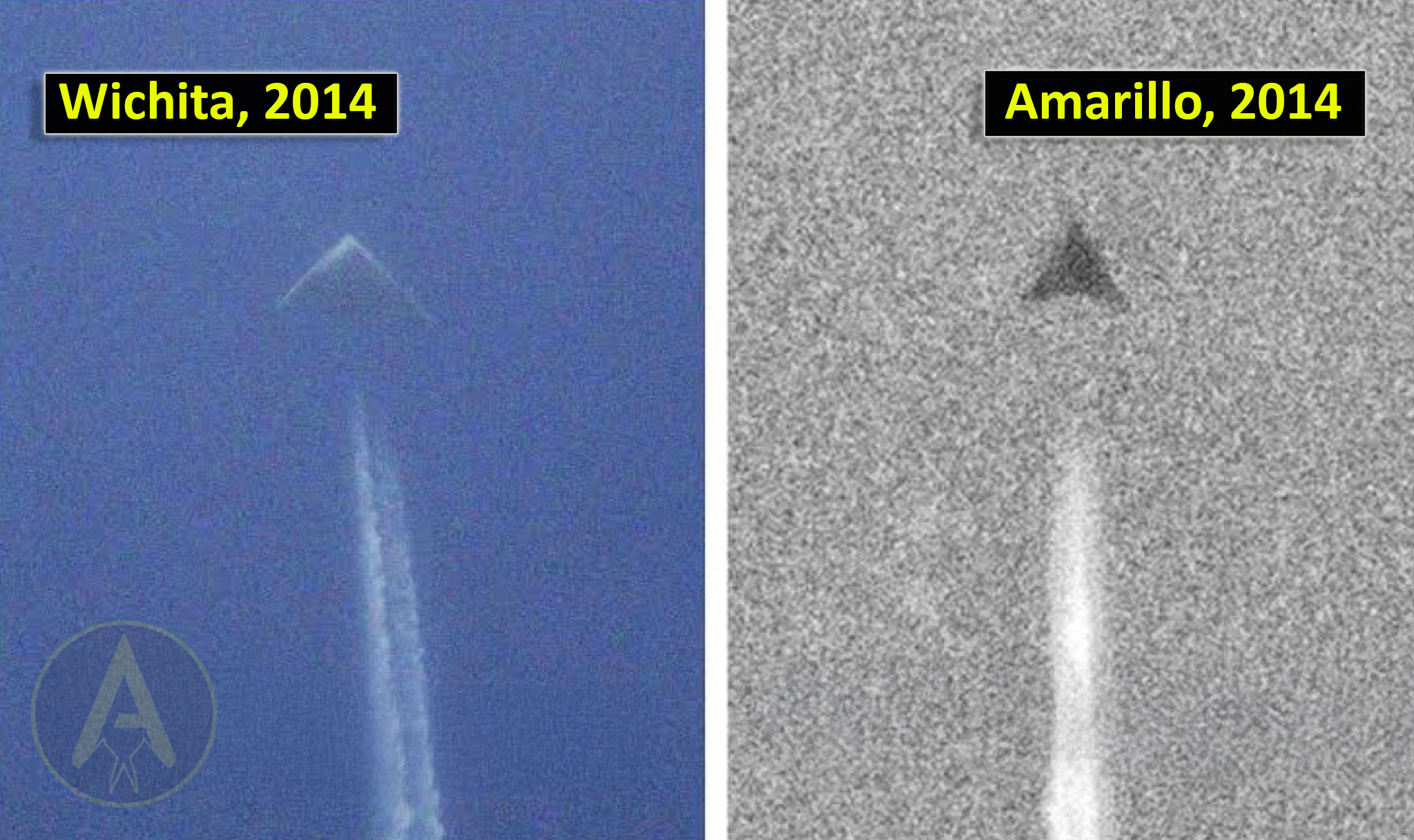
The two mysterious aircraft spotted over Texas and Kansas in 2014. (Image credit: The Aviationist based on Muskett and Templin shots)


The dorito aircraft has been spotted again after a decade
 
Combat experience highlighted that the faith placed in missiles was not entirely justified. Close-in dogfights with nimble North Vietnamese MiGs highlighted the difficulty of getting a lock on the aircraft. Missiles were expensive and vulnerable to countermeasures, while the rules of engagement demanded visual confirmation, negating the advantage of being able to fire at range. Although Phantoms carried podded guns, this was far from an ideal solution. What was needed was an integral weapon.

Gun Fighter

Work on a gun-armed Phantom was funded in June 1965 and a YRF-4C was modified with a six-barrel General Electric M61A1 rotary cannon in the nose, becoming the YF-4E, followed by conversions of a single F-4C and F-4D. Considerable work was required to reduce vibration when fired, which disrupted the AN/APQ-120 radar, while systems found to be unreliable in combat were replaced.

Originally known as the F-4E Plus, for ‘plus gun’, the initial production aircraft flew on June 30, 1967, with the second introducing a slotted stabilator to become the first truly representative F-4E. The F-4E went on to become the most numerous Phantom version; in addition to 993 for the US Air Force 394 were built for Germany, Greece, Iran, Israel, South Korea and Turkey, while 24 were loaned to Australia and others later supplied to Egypt.

The F-4E also served as the basis for the majority of the export variants. Japan received 140 optimized as interceptors as F-4EJs, 125 of which were manufactured by Mitsubishi. Germany originally wanted the single-seat F-4E(F) before opting for 175 F-4Fs, a lighter and simplified F-4E, delivered between September 1973 and April 1976.

The model was also modified for the suppression of enemy air defenses as the F-4G Wild Weasel V. Building on the interim ‘EF-4C’ Wild Weasel IV, 36 of which were used between 1969 and the mid-1970s, a total of 136 F-4Gs were created.

img_87-3.jpg

Initial US Air Force procurement focused on a minimum change version of the F-4B originally designated the F-110A. This ‘F-110A’ was actually F4H-1 BuNo 149405, one of two borrowed from the US Navy and ‘delivered’ to the US Air Force on January 24, 1962. In reality, no Phantoms were ready for the air force at that point
USAF
img_88-1.jpg

Although externally similar to its predecessor, the F-4D was more closely tailored to the US Air Force’s requirements. The 194th Fighter Interceptor Squadron of the California Air National Guard flew F-4Ds for six years from late 1983
USAF
Carrier-based fighters

The US Navy also sought to build on the capabilities of its F-4Bs with the F-4J. Take-off and landing performance was improved by adding a slot to the stabilator leading-edge, creating a powerful nose-up force on launch or recovery. Locking the inboard wing leading-edge flap-up improved the effectiveness of the slotted stabilator, while lift at low speeds was increased by a 16.5° droop for the ailerons. These modifications reduced approach speed by 12kt to 125kt (231km/h). This was all the more remarkable as the F-4J was heavier and had higher sink rates,requiring a strengthened landing gear and the wider tires of the US Air Force variants, with a bulged inner wing root to accommodate them. Engines were upgraded to J79-GE-10s, with longer afterburner ‘feathers’, while a seventh fuel cell was added in the fuselage. The F-4B’s AN/APQ-72 radar was replaced by the bulkier and heavier AN/APG-59, part of the AN/AWG-10 radar and fire-control system, while the undernose infrared search and track sensor was deleted. The second production F-4J was the first to fly, on May 27, 1966, having been preceded by three YF-4J prototypes.

img_88-5.jpg

The F-4G was produced to locate, identify and neutralize enemy air defenses using a wide range of systems and armament. It was the last dedicated Wild Weasel airframe, remaining in service until 1996
USAF
img_89-2.jpg

The second main production version for the US Navy was the F-4J, which could be distinguished from the F-4B by lacking the undernose infrared sensor of the earlier version. This aircraft served with VF-96 ‘Fighting Falcons’, which flew the variant between late 1968 and November 1975
US Navy
Upgrades

Carrier operations and combat over Vietnam took its toll on the F-4B fleet. By the end of the 1960s, the fleet needed refurbishment and updating. Under Bee Line F-4Bs were flown to NAS North Island in California where the Naval Air Rework Facility (NARF) stripped and inspected the aircraft, replacing wiring and parts to increase service life, as well as updating the avionics. Those F-4Bs not already fitted with slotted stabilators had them installed, while the inboard leading-edge flaps were locked shut. Reworked F-4Bs were redesignated F-4Ns, the first rejoining the fleet in February 1973. Altogether, 228 F-4Bs were reworked.

The success of Bee Line prompted a similar program for the F-4Js, to bridge the gap until they could be replaced by Grumman F-14 Tomcats in the Navy, and McDonnell Douglas F/A-18 Hornets with the Marines. One significant change was the addition of two-position slats on the wing leading-edges, decreasing combat turning radius by 50%, although the initial 47 conversions initially lacked the modification until they were retrofitted.

The first upgraded F-4J – redesignated a F-4S – made its initial post-conversion flight on July 22, 1977, and VMFA-451 became the first of 13 Marine (plus 12 Navy) squadrons with the new model in June 1978. The F-4S had the distinction of being the last naval Phantom fighters in service; VF-202 performed the final carrier landing by a Phantom on October 18, 1986, on board USS America, while VMF-112 retired the last F-4Ss during January 1992.

Eyes in the sky

Its performance made the Phantom a natural choice for a reconnaissance platform. The US Air Force ordered a variant of the F-4C as the RF-4C, with an elongated nose incorporating windows for a variety of cameras. The RF-4C also had equipment for laser reconnaissance, radar mapping and infrared detection. No provision for armament was provided, although the RF-4C did retain the ability to carry a single nuclear bomb on the centerline pylon. The first of 503 RF-4Cs flew on May 18, 1964, entering service that September. Deliveries continued until December 1973. While the RF-4B was externally similar to the RF-4C, the Marine Corps reconnaissance platform was based on the F-4B and flew after the US Air Force variant, on March 12, 1965. A total of 27 of the 46 built underwent a Sensor Update and Refurbishment Effort from 1978, which also added slotted stabilators.

CAJ

img_89-3.jpg

The RF-4B was the second reconnaissance variant, after the RF-4C of the US Air Force. It served with only the US Marine Corps, all survivors of the 46 built being assigned to VMFP-3 from 1975. The last was retired in 1990
US Navy

Wonder what it would have been like had the US provided Pakistan with the F-4.
 

Users who are viewing this thread

  • Back
    Top