Thing is, if you develop up the JF-17 into something more than what it is right now, the NRE overhead of that development will have to factor into the total cost of subsequent JF-17 variants. So, the difference between the upgraded JF-17 and the J-10CE might not be much, if at all.
IMO, the better alternative is to pursue a clean-sheen light/medium-weight fighter platform built for current/next-gen subsystems from the ground-up.
JF-17 was designed at a time when the PAF wanted a multi-mode PD radar similar to AN/APG-66. We're now in an era of integrating AESA-based arrays across the entire airframe; times have changed and things are coming into play that the Thunder wasn't necessarily designed for (e.g., having enough space to house the electronics necessary for MUM-T).
Yes, there'll be a higher cost to developing such a fighter (let's call it a 5-minus generation), but if we tie to an industrial program, we can actually channel some of that spending inwards.
Overall, the PAF needs a versatile medium-weight fighter capable of executing strike missions, achieving high sortie rates and high availability, and integrating with modern warfighting elements (MUM-T, CEC, etc.).
One option to look at could literally be a simpler version of the J-35AE, i.e., take out the high-maintenance LO skins, turn the internal weapons bay into a subsystems bay (for EW/ECM, DEWs, etc) or expanded fuel bay, go back to the FC-31 approach of mounting munitions under the wings via hardpoints (intentionally ditching the stealth), and use that in conjunction with the stealth J-35AEs. Basically, make a version of the J-35AE that's like South Korea's KF-21 in its current state, basically.
I agree with the first half of the argument, the needs have exceeded what the JF-17 can modified into. IMHO, the needs exceed the capabilities of the J-10CE in some aspects. Pakistan also has a need for numbers as well as to keep within a budget, for R&D, to build, and to operate.
Going for a less capable J-35AE would, IMHO, defeat the utility of having such a design. Why bother all the R&D for a design nearly as expensive but much less capable.
If we assume, the WS-19 is cleared for export in about a decade, and the price has been brought down, a design can be built around a single WS-19 engine.
To justify the expense of a clean sheet design, we need a revolutionary design, not just an evolutionary design. With the current JF-17 design, we are talking about what the F-16 became; addition of RAM paint, improvement in electronics, improved engine, and a longer lifespan for the air frame. The PAF has to make the call if it wants to spend the money or get a partner to help fund a clean sheet design.
If the PAF is seeking the KAAN and J-35AE for the high end role, they will need a workhorse that can be competitive in a domain where Th e Indians will have layers of air defense and every one of their fighters armed with 200+km missiles.
In such a domain, EW may not be enough. A clean sheet design; a modestly stealthy design most likely, with
layers of offensive and defensive capabilities, will be
necessary. Putting all the burden on a few squadrons of J-35AE and KAAN maybe stretching the force too thin. Commonality of engine and sub-systems with the J-35AE could make this clean sheet design an attractive offering to countries seeking a trainer, and lighter strike platform to operate alongside the J-35AE, which would be the air cover.
As I said earlier, the calculation is one the PAF to makes but for perhaps 20-30% more per aircraft, the PAF could field a clean sheet design that could attract buyers, and cover its higher costs, and get a much more capable platform in the long run. I have a design in mind, and I put it this way the J-35AE has two weapons bay with a total 2000 kg of weapons carriage. Imagine a clean sheet design around the WS-19 with a 1000 kg of internal carriage; with one of those J-35AE weapons bays. Imagine the kinds of munition that design could carry; especially in the strike role, including in the nuclear role. Such a design would be given the Pakistan-Saudi agreement the teeth they have been seeking.
P.s. similar to the JF-17 program acquiring R&D from the MiG companies MiG-33 research program, the clean sheet design I envision could build on R&D from the now defunct MiG’s LMFS; which envisioned a design around a single RD-33 sized engine, in one configuration.
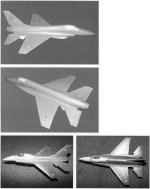
Here is a look at the LMFS,
designed decades ago, with a view focused on its single internal weapons bay. In my opinion, the wheels will have to be housed similar to the Gripen E, to maximize the use of that internal bay; room enough (4 meters long) to house 4 BVR missiles internally; stored in a two on top of two configuration. The tail configuration could be improved to mirror the “4 poster” similar to the J-35AE. DSI intake similar to the J-35AE as well.
With the WS-19, each missile could have its weight increased from 200-230 kg of the PL-15 to perhaps 300 kg of a next generation, longer ranged A2A missile. Something like the 400 km GoKhan-ER.
A 1000-1200 kg increased range version of the SOM-J could be carried internally (designed to fit inside an F-35 weapons bay) for conventional or even nuclear missions.
This was one design studied, the twin engine design fed into the Indians work with the Russians on their AMCA project. But just like Microsoft borrowing from Xerox, after Apple was already borrowing from Xerox…
Remember the MiG-33, and its design contributions to the JF-17: