JF-17 PFX program

Any news when the first Prototype for PFX will emerge ?
If it is a scale up design , should not be too difficult

If an attempt is made for it to be a "scale up design", then it will never happen. Pakistan lacks the capabilities to do that.
 
Based on the agreed framework, my analysis is relatively conservative. This applies to versions after the JF-17B3, regardless of the suffix the PAF ultimately assigns to it.
1. The current RD-93 engine is insufficient to fully support the avionics system of the JF-17B3. Therefore, the power supply capacity needs to be addressed first. Deep modification or improvement of the RD-93 engine is one option; replacing it with a new engine is another. Both approaches are feasible, as long as they ultimately increase the power supply capacity.
2. After that, if the power supply capacity is sufficient, the missing IRST needs to be added.
3. The internal cannon can be removed and replaced with an external gun pod. This would save space and weight.
Other aspects can be slightly upgraded or improved, but there won't be significant changes.

If the PAF/PAC wants to further develop this platform, significant structural modifications are needed. My suggestion is to develop it into a UCAV. It could operate independently or in a MUM-T configuration with other fighter platforms. Of course, this would require significant involvement from the 611 Institute.
However, this might not be as cost-effective as simply purchasing an existing UCAV platform.

The development of lightweight, manned fighter jets based on a single medium-thrust engine has essentially reached its peak. Further significant advancements along this path are difficult. The options are either to switch to UCAVs, or to abandon the current platform and develop a new medium-sized manned fighter jet from scratch. The existing JF-17B3 can continue to be produced and undergo minor upgrades, but it's not worth investing heavily in further development.
All fair and reasonable options. Now it is up to the PAF to lay out the parameters of the platform they seek.
 
I agree with the first half of the argument, the needs have exceeded what the JF-17 can modified into. IMHO, the needs exceed the capabilities of the J-10CE in some aspects. Pakistan also has a need for numbers as well as to keep within a budget, for R&D, to build, and to operate.

Going for a less capable J-35AE would, IMHO, defeat the utility of having such a design. Why bother all the R&D for a design nearly as expensive but much less capable.

If we assume, the WS-19 is cleared for export in about a decade, and the price has been brought down, a design can be built around a single WS-19 engine.

To justify the expense of a clean sheet design, we need a revolutionary design, not just an evolutionary design. With the current JF-17 design, we are talking about what the F-16 became; addition of RAM paint, improvement in electronics, improved engine, and a longer lifespan for the air frame. The PAF has to make the call if it wants to spend the money or get a partner to help fund a clean sheet design.

If the PAF is seeking the KAAN and J-35AE for the high end role, they will need a workhorse that can be competitive in a domain where Th e Indians will have layers of air defense and every one of their fighters armed with 200+km missiles.

In such a domain, EW may not be enough. A clean sheet design; a modestly stealthy design most likely, with layers of offensive and defensive capabilities, will be necessary. Putting all the burden on a few squadrons of J-35AE and KAAN maybe stretching the force too thin. Commonality of engine and sub-systems with the J-35AE could make this clean sheet design an attractive offering to countries seeking a trainer, and lighter strike platform to operate alongside the J-35AE, which would be the air cover.

As I said earlier, the calculation is one the PAF to makes but for perhaps 20-30% more per aircraft, the PAF could field a clean sheet design that could attract buyers, and cover its higher costs, and get a much more capable platform in the long run. I have a design in mind, and I put it this way the J-35AE has two weapons bay with a total 2000 kg of weapons carriage. Imagine a clean sheet design around the WS-19 with a 1000 kg of internal carriage; with one of those J-35AE weapons bays. Imagine the kinds of munition that design could carry; especially in the strike role, including in the nuclear role. Such a design would be given the Pakistan-Saudi agreement the teeth they have been seeking.

P.s. similar to the JF-17 program acquiring R&D from the MiG companies MiG-33 research program, the clean sheet design I envision could build on R&D from the now defunct MiG’s LMFS; which envisioned a design around a single RD-33 sized engine, in one configuration.

Here is a look at the LMFS, designed decades ago, with a view focused on its single internal weapons bay. In my opinion, the wheels will have to be housed similar to the Gripen E, to maximize the use of that internal bay; room enough (4 meters long) to house 4 BVR missiles internally; stored in a two on top of two configuration. The tail configuration could be improved to mirror the “4 poster” similar to the J-35AE. DSI intake similar to the J-35AE as well.

With the WS-19, each missile could have its weight increased from 200-230 kg of the PL-15 to perhaps 300 kg of a next generation, longer ranged A2A missile. Something like the 400 km GoKhan-ER.

To view this content we will need your consent to set third party cookies.
For more detailed information, see our cookies page.


A 1000-1200 kg increased range version of the SOM-J could be carried internally (designed to fit inside an F-35 weapons bay) for conventional or even nuclear missions.

This was one design studied, the twin engine design fed into the Indians work with the Russians on their AMCA project. But just like Microsoft borrowing from Xerox, after Apple was already borrowing from Xerox…

FTIMyiTOC5VfqpIKWqTakPzdoTZhEKWgG7hzJEPsBIom_xfKXB3rYfYes2WeZwt5d6geKTiORIE1GzP_BxZWQA.webp


Remember the MiG-33, and its design contributions to the JF-17:
View attachment 174946

tbh a simpler variant of the J-35 is the more economical and impactful route versus a clean-sheet lightweight fighter.

First, not only does the J-35 exist, but the design and development work for that simpler version was already done via the FC-31. Yes, it's true that you wouldn't want to pick an FC-31 over a J-35, but what about together?

The J-35 is a stealth fighter with likely high-maintenance (relative to how the PAF operates) issues compared to 4.5- and 4+-generation fighters.

It could be a suitable platform to lead a penetration strike package, but which platforms will deliver the payload mass at scale?

The JF-17 lacks the range, and God knows what's up with the J-10CE at this point. We don't have access to any Flanker or F-15 variant. So, what's left?

You can design a single-engine, medium-weight platform from scratch, but I don't think the internal payload, electronics capacity, and other expectations you're setting will make for a simple or low-cost project.

Alternatively, you can re-use the existing R&D work for the J-35 and extend it a little further to make it simpler.

The added R&D overhead in this context would be to remove the stealth/LO skins, reinforce the wings (if necessary) for A2A and A2G munition pylons, and repurpose the internal bay for modules that can accommodate either fuel or EW/ECM equipment.

The FC-31 had a pretty good stated range and payload, so I'm sure the slightly bigger J-35 carried that forward, and the added work to make it a simpler strike aircraft won't cost as much as doing a clean-sheet inherently suboptimal (i.e., single-weight, payload-constrained) design with complex attributes such as an internal bay, etc.

Rather, I think the more optimal, cost-effective approach is to repurpose an existing design like the J-35, but pivot away from the stealth and focus more on achieving higher sortie rates, greater weapons compatibility, range, etc.

In one sense, it'd be like having our own F/A-18E/F-class fighter to complement actual stealth platforms suc has the J-35AE. One other benefit is that if derived from the same platform, you could save tremendously on logistics in terms of engines, many common subassemblies and parts, etc.
 
tbh a simpler variant of the J-35 is the more economical and impactful route versus a clean-sheet lightweight fighter.

First, not only does the J-35 exist, but the design and development work for that simpler version was already done via the FC-31. Yes, it's true that you wouldn't want to pick an FC-31 over a J-35, but what about together?

The J-35 is a stealth fighter with likely high-maintenance (relative to how the PAF operates) issues compared to 4.5- and 4+-generation fighters.

It could be a suitable platform to lead a penetration strike package, but which platforms will deliver the payload mass at scale?

The JF-17 lacks the range, and God knows what's up with the J-10CE at this point. We don't have access to any Flanker or F-15 variant. So, what's left?

You can design a single-engine, medium-weight platform from scratch, but I don't think the internal payload, electronics capacity, and other expectations you're setting will make for a simple or low-cost project.

Alternatively, you can re-use the existing R&D work for the J-35 and extend it a little further to make it simpler.

The added R&D overhead in this context would be to remove the stealth/LO skins, reinforce the wings (if necessary) for A2A and A2G munition pylons, and repurpose the internal bay for modules that can accommodate either fuel or EW/ECM equipment.

The FC-31 had a pretty good stated range and payload, so I'm sure the slightly bigger J-35 carried that forward, and the added work to make it a simpler strike aircraft won't cost as much as doing a clean-sheet inherently suboptimal (i.e., single-weight, payload-constrained) design with complex attributes such as an internal bay, etc.

Rather, I think the more optimal, cost-effective approach is to repurpose an existing design like the J-35, but pivot away from the stealth and focus more on achieving higher sortie rates, greater weapons compatibility, range, etc.

In one sense, it'd be like having our own F/A-18E/F-class fighter to complement actual stealth platforms suc has the J-35AE. One other benefit is that if derived from the same platform, you could save tremendously on logistics in terms of engines, many common subassemblies and parts, etc.
It’s true, this could be an option. A design akin to the current variant of the KF-21. If costs can be kept in the J-10CE price range, it’s a good option to consider.

Good suggestion.
 
tbh a simpler variant of the J-35 is the more economical and impactful route versus a clean-sheet lightweight fighter.

First, not only does the J-35 exist, but the design and development work for that simpler version was already done via the FC-31. Yes, it's true that you wouldn't want to pick an FC-31 over a J-35, but what about together?

The J-35 is a stealth fighter with likely high-maintenance (relative to how the PAF operates) issues compared to 4.5- and 4+-generation fighters.

It could be a suitable platform to lead a penetration strike package, but which platforms will deliver the payload mass at scale?

The JF-17 lacks the range, and God knows what's up with the J-10CE at this point. We don't have access to any Flanker or F-15 variant. So, what's left?

You can design a single-engine, medium-weight platform from scratch, but I don't think the internal payload, electronics capacity, and other expectations you're setting will make for a simple or low-cost project.

Alternatively, you can re-use the existing R&D work for the J-35 and extend it a little further to make it simpler.

The added R&D overhead in this context would be to remove the stealth/LO skins, reinforce the wings (if necessary) for A2A and A2G munition pylons, and repurpose the internal bay for modules that can accommodate either fuel or EW/ECM equipment.

The FC-31 had a pretty good stated range and payload, so I'm sure the slightly bigger J-35 carried that forward, and the added work to make it a simpler strike aircraft won't cost as much as doing a clean-sheet inherently suboptimal (i.e., single-weight, payload-constrained) design with complex attributes such as an internal bay, etc.

Rather, I think the more optimal, cost-effective approach is to repurpose an existing design like the J-35, but pivot away from the stealth and focus more on achieving higher sortie rates, greater weapons compatibility, range, etc.

In one sense, it'd be like having our own F/A-18E/F-class fighter to complement actual stealth platforms suc has the J-35AE. One other benefit is that if derived from the same platform, you could save tremendously on logistics in terms of engines, many common subassemblies and parts, etc.
It's important to clarify something first: the FC-31 you mentioned likely refers to the prototype. Through multiple development iterations, it has evolved into today's J-35. CATIC still refers to the export version of the J-35 as the FC-31. That is, they are the same fighter jet at different stages of development, not two different fighter jets.

Following your line of reasoning, this can be interpreted as: the simplified version you mentioned is actually an ultra-low configuration version of the J-35; and the J-35AE is the highest configuration version. Is it right?

This approach is theoretically feasible. Purchasing both top-of-the-line and ultra-low-configuration versions for combined use could achieve a balance in economic terms. However, in reality, it presents many problems.

First, we must be clear that the core platform architecture cannot be changed!
Once this is involved, the J-35's airframe would need to be redesigned and optimized. The additional costs of this optimization would be separately allocated to the cost structure of these ultra-low-configuration J-35s. This would be a considerable expense, clearly not meeting the requirements of economic efficiency.

Secondly, based on the existing J-35 core platform architecture, how low can the configuration of the ultra-low-configuration version actually be?
Based on a general analysis of the cost structures of various 5th-generation fighter jets worldwide:

Avionics and sensors: 30-35%. All airborne avionics and sensors, with AESA accounting for the largest share of the cost.​
Engines: 20-25%.​
Airframe structure: 15-20%.​
Stealth system: 10-15%. Radar-absorbent materials, stealth skin, stealth structural design, etc.​
Weapon integration: 5-10%. Refers to the cost of weapon integration, as well as launch and fire control systems, excluding the weapons themselves.​
Other systems: 10-15%. Flight control system, life support system, hydraulic system, environmental control system, etc.​
This is a general, comprehensive analysis of all 5th-generation fighter jets worldwide. While there are differences between countries, the overall cost structure is similar.​

From your perspective, where do you think costs can be reduced? And by how much ultimately?

If we forcibly reduce the cost of this fighter jet by 20%, it will still be a fighter jet. However, its performance will plummet, falling below that of a 4.5th-generation fighter jet. But even with a 20% price reduction, it would still be much more expensive than a 4.5th-generation fighter jet. So, what would be the point of doing this?
 
Last edited:
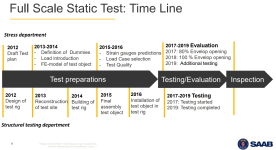
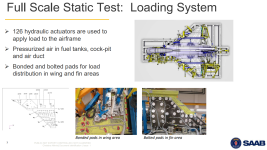
I have found this link to a powerpoint regarding JAS Gripen E/F full scale structural testing. Obviously they have enlarged the airframe in the new Gripen and that's why in order to do that they performed some stress and structural testing as they were developing the airframe. Now I don't know if the engineers at PAC will follow the same methodology if they decide to enlarge the airframe for PFX (or not). Saab even made a whole time line of the project from testing prep to evaluation and inspection. Sharing the link to the powerpoint below.

Source: Full Scale Structural Testing of Gripen E/F

Screenshot 2026-01-28 100614.png
Stress.png
 
It’s true, this could be an option. A design akin to the current variant of the KF-21. If costs can be kept in the J-10CE price range, it’s a good option to consider.

Good suggestion.
I used AI tools to conduct this simulation.
All 5th-generation stealth fighters have a "beast mode." We transformed the non-standard "beast mode" into a standard mode, then removed all functions that caused performance degradation or failure in beast mode, resulting in a deeply simplified design. I ultimately obtained an ultra-low-configuration J-35 (Low).
It cannot operate independently and must operate in conjunction with the high-configuration version of the J-35. You can consider it as replacing the J-10CE in the "J-35 + J-10CE" joint combat system, but they cannot be separated. This is the biggest difference between it and the J-10CE. Its appearance still resembles a 5th-generation fighter, but it actually belongs to the 4.75th-generation.

Based on the original J-35 fighter, the parts that were cut or downgraded are mainly:
Advanced avionics, sensor fusion system, electronic warfare system, stealth maintenance system, independent combat software stack
Parts that cannot be cut or downgraded:
5th-generation aircraft airframe structure, twin engines, stealth structure

There will be additional costs for necessary adaptation, testing, and other improvement work, approximately equivalent to 3%-8% of the complete J-35 development cost.

Ultimately, its cost is approximately 20-40% higher than the J-10CE fighter. This is the limit; it cannot be lower. It requires a large procurement scale. For example, the PAF would need to procure at least 40 high-configuration J-35s + 80 or more of this ultra-low-configuration J-35. This needs to be done in a single procurement batch. If procured in multiple batches, the cost will increase further.

In a system-based combat scenario, it is more powerful than the J-10CE. However, it cannot operate independently. Therefore, a direct comparison is not possible.

This is a hypothetical discussion for entertainment purposes; please don't take it too seriously.
 
I have found this link to a powerpoint regarding JAS Gripen E/F full scale structural testing. Obviously they have enlarged the airframe in the new Gripen and that's why in order to do that they performed some stress and structural testing as they were developing the airframe. Now I don't know if the engineers at PAC will follow the same methodology if they decide to enlarge the airframe for PFX (or not). Saab even made a whole time line of the project from testing prep to evaluation and inspection. Sharing the link to the powerpoint below.

Source: Full Scale Structural Testing of Gripen E/F

View attachment 175268
View attachment 175269

Pakistan/PAC lack the design capabilities, testing and verification facilities to do this, which is why any concept of enlargement is pointless. This is not going to happen.
 
Pakistan/PAC lack the design capabilities, testing and verification facilities to do this, which is why any concept of enlargement is pointless. This is not going to happen.
In that case, can't they outsource this process to lets say Turkish TAI or any Chinese firms? I mean this will kill the objective of achieving full indigenization, but overall this will make the concept of enlargement of airframe achievable and then once that is done, PAC can take over from there and start working on the areas in which they are proficient. I think collaboration is key here but of course I am no expert on this, but I am just giving my two cents.
 
In that case, can't they outsource this process to lets say Turkish TAI or any Chinese firms? I mean this will kill the objective of achieving full indigenization, but overall this will make the concept of enlargement of airframe achievable and then once that is done, PAC can take over from there and start working on the areas in which they are proficient. I think collaboration is key here but of course I am no expert on this, but I am just giving my two cents.
Design is the most critical aspect of product development, whether it is a fighter jet or a sports shoe. Manufacturing can be outsourced, but design should remain in-house. In fact, most large engineering companies are fundamentally design-driven organizations. They develop their own concepts and then send detailed blueprints to manufacturers.


For everything—from small engine components to massive offshore oil platforms—major companies typically create a complete functional design and distribute individual component drawings to specialized suppliers and vendors. I am sure that fighter jet development follows a similar approach.


Only the parent design team truly understands the intended objectives, performance requirements, and operational parameters. It is nearly impossible for an external party to create a meaningful design without this deep, internal knowledge.
 
In that case, can't they outsource this process to lets say Turkish TAI or any Chinese firms? I mean this will kill the objective of achieving full indigenization, but overall this will make the concept of enlargement of airframe achievable and then once that is done, PAC can take over from there and start working on the areas in which they are proficient. I think collaboration is key here but of course I am no expert on this, but I am just giving my two cents.

Turkish TAI have no experience with the platform, and Chinese are moving onto 6th Gen platforms where their focus is right now. Aerial engineering time is a very very valuable commodity aside from being expensive and limited. Why should China focus on 4.5 gen project just for money, when you can spend that engineering time on 6th Gen with UCAVs etc that is more profitable ?
 
I used AI tools to conduct this simulation.
All 5th-generation stealth fighters have a "beast mode." We transformed the non-standard "beast mode" into a standard mode, then removed all functions that caused performance degradation or failure in beast mode, resulting in a deeply simplified design. I ultimately obtained an ultra-low-configuration J-35 (Low).
It cannot operate independently and must operate in conjunction with the high-configuration version of the J-35. You can consider it as replacing the J-10CE in the "J-35 + J-10CE" joint combat system, but they cannot be separated. This is the biggest difference between it and the J-10CE. Its appearance still resembles a 5th-generation fighter, but it actually belongs to the 4.75th-generation.

Based on the original J-35 fighter, the parts that were cut or downgraded are mainly:
Advanced avionics, sensor fusion system, electronic warfare system, stealth maintenance system, independent combat software stack
Parts that cannot be cut or downgraded:
5th-generation aircraft airframe structure, twin engines, stealth structure

There will be additional costs for necessary adaptation, testing, and other improvement work, approximately equivalent to 3%-8% of the complete J-35 development cost.

Ultimately, its cost is approximately 20-40% higher than the J-10CE fighter. This is the limit; it cannot be lower. It requires a large procurement scale. For example, the PAF would need to procure at least 40 high-configuration J-35s + 80 or more of this ultra-low-configuration J-35. This needs to be done in a single procurement batch. If procured in multiple batches, the cost will increase further.

In a system-based combat scenario, it is more powerful than the J-10CE. However, it cannot operate independently. Therefore, a direct comparison is not possible.

This is a hypothetical discussion for entertainment purposes; please don't take it too seriously.
I went back to look at the requirement that I laid out; to be able to do what the J-10CE can’t. With two WS-19 class engines (eventually), but even with WS-21 engines it should have enough electrical power and thrust to open up carrying more capable systems and heavier munitions respectively. This jet would also have the range to support the Pakistan Navy, even more so than the J-10CE.

This design also be better suited to design in from the start the focus on controlling UCAVs.

The South Korean KF-21 has a variant proposed to be similar to the EA-18G growler. Something similar could be done to this 5th Gen minus fighter concept.

Yes, we would need economies of scale to bring costs down. The PAF, look at an Indian Air Force set to rebuild to a 45 squadron strength with the following Orbat;
(10 squadrons of Tejas Mk. 1 and 2, 16 squadrons of Su-30MKI (with the super sukhoi upgrade), 10 squadrons of Rafales and 9 squadrons of AMCA),
will be countered by 10 squadrons of JF-17 and J-10CE, 4 F-16s, and 2 J-35AE. Eventually, if the PAF will need more 3 more squadrons of 5th gen fighters (1 more J-35AE and 2 KAAN), but to fill its current 25 squadrons strength will probably need 10 squadrons of this 5th Gen Minus fighter of about 180 fighters to hold some kind of balance, IMHO, especially outclassing all but the AMCA, and even giving that aircraft a run for its money. Supplementation of this ORBAT with UCAVs, and having 3 of the squadrons be “Growler” squadrons should allow the PAF to hold its own.

Btw; here is the KF-21 in “Growler mode”, source weapons detective YouTube video. (Btw this growler version is the Block I KF-21; does not have an internal weapons bay)
IMG_6462.jpeg
To view this content we will need your consent to set third party cookies.
For more detailed information, see our cookies page.


@Michael what do you estimate the R&D timeline of developing such a design would be? And then how long would it take to set up PAC karma to be able to produce the jets, and possibly the WS-21 engines?

Also, how much lower of the price would this design be than the J-35AE?

If most of the PAF squadrons (all JF-17, J-35AE, and the proposed gen 5 minus design) will be using the same WS-21 engine, it would go a long way to streamlining maintenance and increasing availability of aircraft.
 
Last edited:
@Michael what do you estimate the R&D timeline of developing such a design would be? And then how long would it take to set up PAC karma to be able to produce the jets, and possibly the WS-21 engines?

What you are describing turns out to be a J-35AE. So, problem solved as China has already solved the requirement you have stated. Just buy more J-35AEs if that is the requirement. Do a pretend "TOT" like the JF17 where you get stuck at only building 58% of the airframe structure alone, if that makes people happier ?

What problem are you trying to solve for?

For the PAF.
Single engine jet = JF17(Block 2/3/PFX) alongside F16 upgrades.
Single Engine Stealth Jet is currently F-35(unlikely) or nothing, Su-75 if that ever happens(!?) is not really on Pakistan's plate.
Twin engine jet is J-35AE, Long range twin engine jet is Kaan.

If you want to turn PFX into a Twin Engine Stealth jet, then just buy the J-35AE. It will be both cheaper, and far more capable than anything Pakistan can come up with.

Here is a bigger, broader question.

What do we want Pakistan future aerospace industry to be(feels like a new thread in it self called "Pakistan Aerospace Strategic developments News and Updates" ?) And, why do we want that? What is the goal ? There seems to be no "strategic goal" by the PAF or PAC, just a desire to "meet current operational requirements".

That is all PAF has ever been interested in, as that is its reason to be, i.e. a fighting arm. It is not interested in formulating an "industrial aerospace strategy" for Pakistan and the less that can be said for the "Defence Minister" whose jobs it would be, to help formulate that as part of "his job", then the better.

Pakistan's aerospace industry has no strategic goals or objectives, or end state. Just a suite of current operational requirements with no vision of what the aerospace industry will look like once those projects are "done". It is muddled, and fragmented with no center of gravity and quite frankly very confused. Indians have a game plan, they have been very poor in its "execution" with Tejas etc, but they are getting there, incrementally and progressively. Nothing like this planning that India has, is being done in Pakistan.
 
Last edited:
@Michael what do you estimate the R&D timeline of developing such a design would be? And then how long would it take to set up PAC karma to be able to produce the jets, and possibly the WS-21 engines?
I haven't been following the development of the South Korean KF-21 fighter jet very closely. I'm not familiar with the "Growler" version of the KF-21 fighter jet that you mentioned.

I can only offer my personal opinion:

1. The operational concept of EW (Electronic Warfare) aircraft like the "Growler" is completely opposite to that of 5th-generation fighter jets. They cannot be combined on the same aircraft. ------ All 5th-generation fighter jets inherently possess some EW capabilities; this is one of their defining characteristics. However, this capability is completely different from that of dedicated EW aircraft. Their capability is primarily for self-defense and localized suppression in emergencies. Once the EW system is activated, it's equivalent to actively exposing oneself, and the objective must be achieved quickly before accelerating withdrawal. Dedicated electronic warfare aircraft, on the other hand, need to be able to continuously and extensively suppress the entire operational airspace, providing protection for other fighter aircraft during their operations.

2. The KF-21 fighter jet is currently only a 4.5th or 4.75th generation fighter (this is the official South Korean classification). It does not belong to the 5th generation. Therefore, developing a version similar to the "Growler" based on the operational concept of 4.5/4.75th-generation fighters is normal. However, this concept is completely inapplicable to the J-35 fighter jet.

Regarding your question about how long it would take to independently produce fighter jets and engines, that depends on how you define "independent production."

For example, in your opinion, does the KAAN fighter jet count as being independently produced by Turkey? If you consider it to be independently produced by Turkey, then, provided Pakistan is willing and prepared to bear the cost, we can help Pakistan achieve this capability within 3-5 years. However, we can be certain that products manufactured in Pakistan will be significantly more expensive than finished products imported directly from China. This is determined by the production methods and scale of production, and is unavoidable.
 
Last edited:
I haven't been following the development of the South Korean KF-21 fighter jet very closely. I'm not familiar with the "Growler" version of the KF-21 fighter jet that you mentioned.

I can only offer my personal opinion:

1. The operational concept of EW (Electronic Warfare) aircraft like the "Growler" is completely opposite to that of 5th-generation fighter jets. They cannot be combined on the same aircraft. ------ All 5th-generation fighter jets inherently possess some EW capabilities; this is one of their defining characteristics. However, this capability is completely different from that of dedicated EW aircraft. Their capability is primarily for self-defense and localized suppression in emergencies. Once the EW system is activated, it's equivalent to actively exposing oneself, and the objective must be achieved quickly before accelerating withdrawal. Dedicated electronic warfare aircraft, on the other hand, need to be able to continuously and extensively suppress the entire operational airspace, providing protection for other fighter aircraft during their operations.

2. The KF-21 fighter jet is currently only a 4.5th or 4.75th generation fighter (this is the official South Korean classification). It does not belong to the 5th generation. Therefore, developing a version similar to the "Growler" based on the operational concept of 4.5/4.75th-generation fighters is normal. However, this concept is completely inapplicable to the J-35 fighter jet.

Regarding your question about how long it would take to independently produce fighter jets and engines, that depends on how you define "independent production."

For example, in your opinion, does the KAAN fighter jet count as being independently produced by Turkey? If you consider it to be independently produced by Turkey, then, provided Pakistan is willing and prepared to bear the cost, we can help Pakistan achieve this capability within 3-5 years. However, we can be certain that products manufactured in Pakistan will be significantly more expensive than finished products imported directly from China. This is determined by the production methods and scale of production, and is unavoidable.
What is the estimated cost of a J-35AE for the PAF?

Frankly, If the cost is say $75 Million each, and Pakistan needs 12-13 Squadrons of highly competitive platforms, the most effective thing would be to raise a $20 billion budget to purchase these jets over the next 10-15 years. Some amount of ToT would be helpful, to enable better and quicker maintenance, but realistically focusing on a way of raising exports to pay $1.5-2 billion a year till the end of 2040 would be the most cost effective option. With a need for 200-250 jets, as you said, buying from China would be the most cost effective option.

Japan, with a plan to procure nearly 150 F-35 finds it more economical to procure the jets, than wait till its local stealthjets are ready, as is the case with South Korea and the KF-21.

Raising exports would be the best kind of “ToT” China could help Pakistan with, but now we would be venturing into a topic for a different thread.
 
Last edited:

Users who are viewing this thread

Pakistan Defence Latest

Country Watch Latest

Latest Posts

Back
Top