falcon34
Registered Member


China’s Piesat Soars Over 15% on USD406.4 Million Pakistan Satellite Deal
www.yicaiglobal.com
Follow along with the video below to see how to install our site as a web app on your home screen.
Note: This feature may not be available in some browsers.

As it goes through a pass - it can do multiple things.So other fields basically?

No idea at all about the specs of this one, but I'd hazard a guess that for internal civilian use we'd want a satellite with a North South orbit, while for 'other fields' we'd want one on a more East-West track?As it goes through a pass - it can do multiple things.
Question is overall lifespan of satellite including ability to reposition and robustness of downlink/uplink.


 has successfully been launched into orbit today from China .All launch parameters were optimal. Satellite is currently in it’s intended, stable orbit.
View attachment 178323
Pakistani PRSC-EO2 satellite of SUPARCO
View attachment 178323
Pakistani PRSC-EO2 satellite of SUPARCO




| No. | Date | Satellite | Type | Gov. | Comment |
| - | 10/01/1989 | Unknown | Experimental / Military | PPP | Secret 'payload" sent to space from Pakistani launch pad |
| 001 | 09/12/1990 | BADR-1 | Experimental | PML-N | - |
| 002 | 10/12/2001 | BADR-B | Experimental | Military | - |
| 003 | 06/07/2002 | PAKSAT-1 | Communications | Military | Leased (formerly Anatolia 1) |
| 004 | 11/08/2007 | PAKSAT-1R | Communications | Military | First Pakistani owned/built Pakistani communications satellite |
| 005 | 21/11/2013 | iCUBE-1 | Cube Satellite | PML-N | First Pakistani cube satellite |
| 006 | 22/03/2018 | PAKSAT-MMI | Communications | PML-N | Acquired (formerly AsiaSat 4) |
| 007 | 09/07/2018 | PRSS-1 | Remote Sensing | Caretaker | - |
| 008 | 09/07/2018 | PakTES-1A | Experimental Remote Sensing | Caretaker | - |
| 009 | 03/05/2024 | ICUBE-Qamar | Cube Satellite / Lunar Orbiter | PML-N | First Pakistani Lunar Orbiter |
| 010 | 30/05/2024 | PakSat-MM1 | Communications | PML-N | - |
| 011 | 27/09/2024 | ”Payload” | ? | PML-N | Part of China’s experimental Shijian-19 satellite. SatNews |
| 012 | 14/01/2025 | PAUSAT-1 | Cube Satellite | PML-N | - |
| 013 | 17/01/2025 | PRSC-EO1 | Earth Observation | PML-N | - |
| 014 | 31/07/2025 | PRSC-S1 | Imaging | PML-N | - |
| 015 | 19/10/2025 | HS-1 | Imaging | PML-N | Pakistan’s first Hyperspectral imaging satellite. |
| 016 | 12/02/2026 | PRSC-EO2 | Earth Observation | PML-N | - |

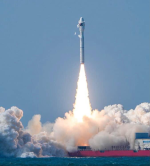
 successful launch of its second indigenous Earth Observation Satellite, EO-2, from Chinas Yangjiang Seashore Launch Centre, on Thursday. —Photo courtesy X
Pakistan’s 2nd indigenous earth observation satellite launched from China’s space centre
Published February 12, 2026
Updated about an hour ago
View attachment 178402successful launch of its second indigenous Earth Observation Satellite, EO-2, from Chinas Yangjiang Seashore Launch Centre, on Thursday. —Photo courtesy X
Pakistan has marked a major achievement in its national space programme with the successful launch of its second indigenous Earth Observation Satellite, EO-2, from China’s Yangjiang Seashore Launch Centre on Thursday.
Developed by the Space and Upper Atmosphere Research Commission (Suparco), the EO-2 satellite is designed to significantly enhance the country’s earth observation and high-resolution imaging capabilities.
The officials of Suparco said the satellite will provide critical data to support national development planning, natural resource management, environmental monitoring, and urban expansion.
It will also strengthen governance, disaster management, climate analysis, and strategic decision-making by delivering accurate and timely satellite imagery.
With the addition of EO-2, Pakistan has expanded its satellite fleet, ensuring improved continuity, coverage, and precision of earth observation data, added the space agency.
Suparco officials termed the launch a milestone in Pakistan’s space journey, noting that the successful indigenous development of EO-2 reflects the country’s growing technical expertise and self-reliance in advanced satellite technology.
Earlier on February 7, Pakistan marked a major step forward in its Human Spaceflight Programme as two candidates were officially shortlisted by the Astronauts Centre of China (ACC), according to the Inter-Services Public Relations (ISPR).
The development followed a cooperation agreement signed in February 2025 between Suparco and the China Manned Space Agency (CMSA).
Under the agreement, two Pakistanis will undergo astronaut training in China, with one ultimately selected to travel to the Tiangong space station.
Last year, Pakistan launched its first indigenous Electro-Optical (EO-1) satellite from the Jiuquan Satellite Launch Centre in northern China.
Prime Minister Shehbaz Sharif said that Pakistan had achieved “another space milestone”.
“This success reflects our growing technological footprint and is yet another manifestation of the enduring Pakistan-China all-weather strategic cooperative partnership that is now transcending into space,” he said.
“ Great job done by Suparco and our brilliant scientists. I look forward to more good news in the coming days with Pakistan-China cooperation in this vital area of national development,” he said.
Deputy Prime Minister Ishaq Dar congratulated the nation on the “historic milestone”, highlighting that it was Pakistan’s fifth earth observation satellite and second indigenous electro-optical satellite.
“This achievement reflects Pakistan’s steady progress in strengthening its national space capabilities and advancing technological self-reliance,” he affirmed, noting that the satellite was launched in collaboration with China.
“I express my sincere gratitude to the Government of the People’s Republic of China for its continued cooperation and steadfast support,” Dar said.
The foreign minister noted that the Pakistan–China All-Weather Strategic Cooperative Partnership “continues to scale new heights, including in space technology”.
He also commended Suparco, Pakistani scientists, engineers and the entire team for their “tireless efforts in expanding Pakistan’s indigenous space infrastructure and developing reliable, domestically engineered space systems for national development”.


