Pakistan Telecom, IT, Tech updates

Chinese brands dominate Pakistan’s locally manufactured handset market.
Chinese Brands Lead Pakistan’s Mobile Manufacturing to 30.2M Units in 2025


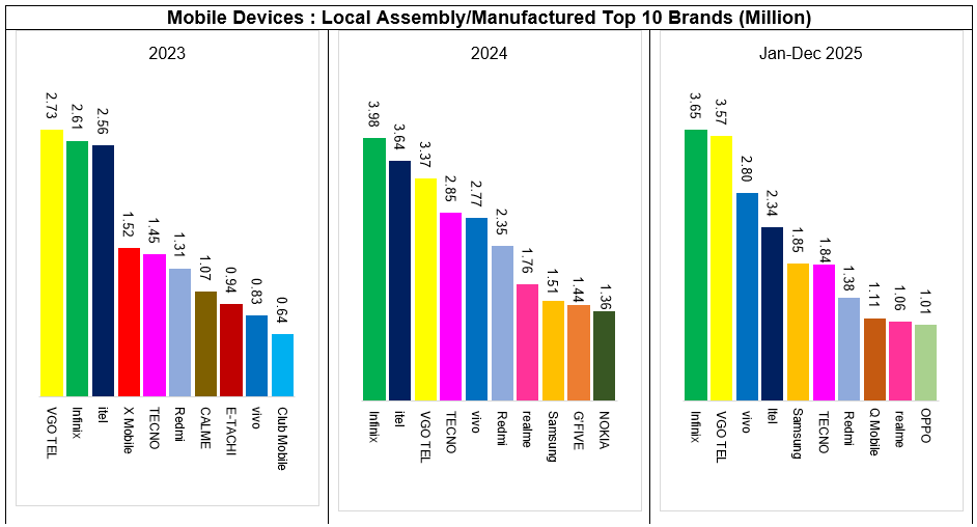
Leading locally manufactured mobile brands in Pakistan, 2023 to Jan-Dec 2025 (PTA data)

PTA’s latest “Top 10 Brands” charts show Transsion Holdings’ Infinix leading local production in 2025 with about 3.65 million units, followed closely by Vivo at roughly 2.8 million units, while other Chinese-backed brands such as itel, Tecno and Xiaomi’s Redmi line also feature prominently among the top assembled devices.

Collectively, Chinese manufacturers account for a substantial share of Pakistan’s locally produced smartphones, highlighting their central role in the country’s handset value chain, PTA data shows

The growing presence of Chinese brands has helped expand affordable smartphone access while strengthening Pakistan’s industrial base.

The momentum is also reflected in PTA’s Annual Report, which is based on data available up to June, notes that by 2025 more than 95% of mobile devices used on Pakistani networks were locally manufactured, including 68% of all smartphones, a dramatic shift from reliance on imports just a few years ago.

The report adds that dozens of manufacturing authorizations have been issued to domestic and international players, positioning Pakistan as an emerging regional hub for handset assembly.

Beyond reducing pressure on foreign exchange reserves, the transition has supported job creation and technology transfer, while helping formalize the mobile market through tighter compliance and registration frameworks.
 

Local manufacturers target 2mn 5G mobile handsets ahead of service launch

  • Local assemblers have already manufactured/assembled about 0.5mn 5G-enabled mobile handsets
Tahir Amin
January 28, 2026

With local mobile phone assemblers/manufacturers targeting the availability of around 2 million 5G-enabled handsets by the time services are launched—and the government pushing for installment-based sales to improve affordability—officials said preparations were being fast-tracked to ensure a smooth rollout of 5G services in the country.

As part of these efforts, local assemblers have already manufactured/assembled about 0.5 million 5G-enabled mobile handsets, reflecting early readiness on the device side ahead of the commercial launch.

The government is pressing manufacturers to ensure that affordable 5G smartphones, with prices starting from around Rs30,000, are widely available to support mass adoption.


According to officials, the spectrum auction is scheduled by the end of next month, while 5G services are expected to be launched within the next five months in major cities, followed by a phased expansion to other parts of the country.
 
To align handset availability with network deployment, senior government officials, including representatives of the Pakistan Telecommunication Authority (PTA), held a meeting with the Mobile Device Manufacturers (MDM) Association, which represents around 35 mobile phone assemblers and manufacturers operating in Pakistan.

The meeting was informed that five companies including Samsung, Vivo, OPPO are already assembling/manufacturing 5G enabled handsets while other companies are all set to initiate work in this regard.

In the absence of 5G services, earlier there was no demand for 5G enabled handsets, however as the government has all set to initiate the services, work on such handsets were started and gaining momentum.

By the time 5G services are launched in the country, there would be no dearth of 5G enabled handsets in the market, official sources added.

During the meeting, the government assured the industry of full support in resolving regulatory and operational hurdles, including facilitation at the import stage and timely issuance of Certificates of Conformity (CoC).
 

PTA updates regulatory framework with IM amendments ahead of 5G auction

  • Reduces uplink speed benchmarks from 25% to 20% of downlink speeds for premium service
Tahir Amin
February 14, 2026

The Pakistan Telecommunication Authority (PTA) has notified amendments to the Information Memorandum (IM), including revisions to the licence template, ahead of the upcoming NGMS/5G spectrum auction, as authorities move to finalise the regulatory framework for next-generation mobile services rollout in Pakistan.

The base price, rollout obligations as well as licence fee terms and conditions have been maintained in the final IM.

Under the revised framework, the regulator has reduced uplink speed benchmarks from 25% to 20% of downlink speeds for premium service. The amendments also shift performance measurement from minimum to median downlink speeds.

According to the latest notification, changes have been introduced in the IM and licence template structure to further clarify compliance requirements, auction procedures, and post-award operational obligations for prospective operators. The notification forms part of the pre-auction documentation finalisation process.
 
According to the final IM, quality of service thresholds are defined in three phases:

(1) Phase 1: Baseline Standards (2026 – 2028)

  1. The initial QoS parameters to be achieved in first Phase:
  2. Median downlink speed of 20 Mbps for 4G;
  3. Median downlink speed of 50 Mbps for 5G; and
  4. Uplink speeds maintained at 20% of downlink speed.

(2) Phase 2: Enhanced Standards (2028- 2030)

(a) Mid-term QoS standards to be achieved in Second Phase:

  1. Median downlink speed of 35 Mbps for 4G;
  2. Median downlink speed of 75 Mbps for 5G; and
  3. Uplink speeds maintained at 20% of downlink speed.
(3) Phase 3 & 4 (combined): Premium Service Standards (2030 – 2035)

  1. Final phase QoS Standards to be achieved:
  2. Median downlink speed of 50 Mbps for 4G;
  3. Median downlink speed of 100 Mbps for 5G; and
  4. Uplink speeds maintained at 20% of downlink speed.
 
The upcoming auction includes multiple spectrum bands across low, mid and high frequency ranges to support nationwide 5G deployment, enhance mobile broadband capacity and enable advanced digital services.
 

Freelancers earn over USD500m in 1HFY26: SBP


KARACHI: Pakistani freelancers earned over USD500 million foreign exchange earnings during the first half of the current fiscal year (FY26), reflecting the growing strength of the country’s digital economy and the expanding global demand for Pakistan’s skilled workforce.

According to statistics released by the State Bank of Pakistan (SBP), the export receipts earned by freelancers of computer and information services surged to USD557 million during the July-December of FY26 as compared to USD352 million foreign exchange earned by freelancers’ community during a similar period of the last financial year (FY25), showing a staggering 58 percent year-on-year growth.


Analysts said that the milestone underscores Pakistan’s emergence as a competitive global hub for freelancing services, particularly in software development, digital marketing, graphic design, content creation, and e-commerce. Also, the increasing initiatives of the government and the private sector toward facilitations and training programs are developing a favorable ecosystem for freelancing and the Gig economy across the country, they added.


According to a report issued by the Asian Development Bank (ADB), Pakistan’s freelancer community is estimated to consist of 2.37 million full-time and part-time individuals. Pakistani freelancers are ranked among the top three or four on different global freelancing marketplaces.

READ MORE: Pakistan freelancers hold over $1bn yearly earning potential: experts

Federal Minister for Information Technology and Telecommunication (MoITT), Shaza Fatima Khawaja, said the government is taking multiple initiatives to facilitate freelancers and further enhance their contribution to the economy.

“The Ministry of IT and Telecommunication is actively working to create an enabling environment for freelancers through improved digital infrastructure, affordable broadband, simplified digital payment mechanisms, and targeted capacity-building programs. Our goal is to ensure that Pakistani freelancers can seamlessly access global markets and maximize their earning potential,” she said.

The government has facilitated freelancers to maintain foreign exchange accounts and retain up to 50 percent of their income in dollars in their bank accounts. Furthermore, freelancers registered with the Pakistan Software Export Board (PSEB) are paying a minimal tax of 0.25 percent.

Chairman of the Pakistan Freelancers Association (PAFLA), Ibrahim Amin, said freelancers are playing a critical role in strengthening Pakistan’s external account and creating employment opportunities for youth.

Freelancers are now among the leading contributors to Pakistan’s services exports. Their earnings not only bring valuable foreign exchange into the country but also help reduce unemployment and promote entrepreneurship, he said.

The contribution of these freelancers was also supported by different institutions and NGOs working in the country. These institutions must step forward with structured training programs, skill certification, and industry-relevant curricula to equip young people with in-demand digital skills, he noted.

He emphasized the need for stronger collaboration between government, academia, and industry to further support the freelancing ecosystem. “PAFLA is committed to working with universities and training centers to build a future-ready freelance workforce,” the PAFLA Chairman added. Stakeholders believe that with sustained policy support, improved ease of doing business, and investment in digital skills, Pakistan’s freelance earnings could cross the billion-dollar mark by the end of the current financial year, positioning the country as a leading player in the global gig economy.

Copyright Business Recorder, 2026
 

Indus AI Week conference at LCCI: 600 MHz spectrum to be auctioned next month: minister

Recorder Report
February 15, 2026

LAHORE: Federal Minister for IT & Telecom Shaza Fatima Khawaja said the government is taking rapid steps to promote the digital economy and investment in the technology sector.

She said that next month, the 600 MHz spectrum will be auctioned, significantly increasing mobile internet capacity and providing citizens with fast, high-quality, and reliable internet. She added that this will reduce connectivity issues for citizens and boost digital services, e-commerce, e-governance, and other online facilities.

She was speaking at the Indus AI Week conference at Lahore Chamber of Commerce and Industry. Alongside LCCI President Faheem Ur Rehman Saigol, she inaugurated the Chamber’s online membership portal and said LCCI has become the first chamber in the country to offer online services.

She explained that through this portal, new and existing businesses can easily obtain membership, access information, and increase business collaboration. She emphasized that using technology will make business processes easier, transparent, and faster, helping strengthen the national economy.
 
The Minister highlighted the “Smartphone for All” policy and said the government is taking steps to make smart phones accessible to citizens so everyone can benefit from modern technology.

She said one million people will be re-skilled and up-skilled in AI so youth, women, and professionals can meet digital market needs. She added that revolutionary steps are also being taken in education so students and professionals can gain skills for the future.
 

US envoy hosts webinar to connect American ICT firms to Pakistan​

Both sides discuss attractive business opportunities in Pakistan’s fast growing IT sector​

Our Correspondent
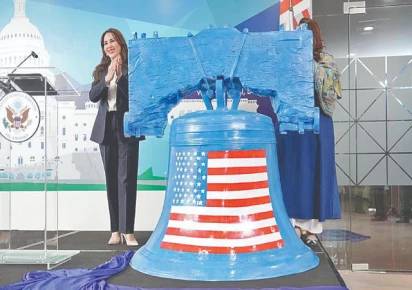
us charg d affaires natalie a baker unveils a full sized replica of the iconic liberty bell at a ceremony held at lincoln corner islamabad photo express

ISLAMABAD:
United States Chargé d’Affaires (CDA) Natalie A. Baker hosted a webinar on Thursday to connect 25 representatives from American information and communication technology (ICT) companies with senior Pakistani government officials and explore attractive business opportunities in the country's fast growing IT sector.

A press release from the embassy said several officials joined the webinar to discuss investment opportunities, regulatory frameworks and partnership potential in Pakistan’s ICT sector.

In her remarks, Baker said, “The US mission in Pakistan is committed to fostering strong economic ties between the two countries.”

She added, “We believe that by working together, we can unlock the full potential of Pakistan’s IT sector, create new opportunities for American businesses, and contribute to Pakistan’s economic development.”

She said the US embassy and consulates were here to support American companies, as they navigated the Pakistani market, by connecting them with local partners and ensuring they had the resources and information needed to succeed.

“We are committed to facilitate investment, promote trade, and advocate for policies to improve the business environment,” she said.

The webinar highlighted growth opportunities in cloud computing, data centres, cybersecurity and artificial intelligence — key areas where US companies offer proven expertise and innovation.

During the webinar, Pakistani officials outlined government initiatives to advance digital policies, expand broadband connectivity, promote technology parks and support innovation through regulatory reforms and incentives.

Baker also emphasised the timeliness of strengthening US-Pakistan technology cooperation, saying, “This year in the US, we are celebrating America’s 250th anniversary, which presents us with an opportunity to celebrate American innovation and leadership in the technology sector.”

The press release said the technology sector exemplified US ingenuity and leadership, which the Freedom 250 celebration honoured.

The webinar was part of the ‘Direct Line’ for American businesses programme, which provides the US businesses with direct access to foreign government officials and market experts, facilitating informed decision-making about international business opportunities.
 

IT Exports poised to hit 5B$ !!!

I am astounded it too sooo long for Pakistan to realise there was easy money to be made in IT Exports.

There is alot more on the table if Pakistan can get its university system sorted where they produce internationally recognised quality of degree( 3 years minimum ) in STEM based subjects.

People are looking to diversify away from India, to reduce risk in their portfolio and Pakistan(alongside Bangladesh) has a large enough population to be able to build a good sized IT industry for export.

If you work in IT, you realise that the only word was "outsource". New words have been introduce that include nearshore, local shore and diversification.

The actual role/impact of AI is an unknown but there is enough of India's lunch that Pakistan can take a swipe of anyway until that settles down.
 
Last edited:


Pakistan to train 1 million non-IT professionals in AI under nationwide productivity drive​


IT minister details $1bn AI ecosystem plan, digital identity rollout and global tech engagement at Indus AI Week
By
News Desk

1771330122683.png

Pakistan will launch a nationwide programme to train one million non-IT professionals in artificial intelligence as part of efforts to boost productivity and improve livelihoods, Minister for Information Technology and Telecommunication Shaza Fatima Khawaja said on Tuesday.

The training push forms part of a broader $1 billion plan to strengthen Pakistan’s artificial intelligence ecosystem, announced by the prime minister at the inauguration of Indus AI Week 2026, she said while addressing university students in Islamabad. The initiative also includes PhD scholarships in AI and mandatory AI education in schools and colleges.

Khawaja said Parliament passed the Digital Nation Pakistan Act last year, providing a roadmap for digital transformation, while the federal cabinet approved Pakistan’s first National Artificial Intelligence Policy in September 2025. She said the policy spans infrastructure, data centres, computing power, human resource development, education reforms, international cooperation and ethical AI deployment.

She said Pakistan had adopted a whole-of-government approach to emerging technologies over the past two years as artificial intelligence reshaped economies, education systems and labour markets globally. Around 300,000 young Pakistanis are already being trained in AI fundamentals under existing digital skills programmes, she added.

Outlining Indus AI Week’s objectives, the minister said the initiative was structured around three pillars: showcasing Pakistan’s technological readiness and youth potential, convening global policy dialogue with more than 50 international technology leaders and policymakers, and engaging Pakistani youth through technology expos, women-focused programmes, defence technology demonstrations, startup pitching and cloud acceleration initiatives. The discussions resulted in the Islamabad Declaration on AI governance and international cooperation.

She highlighted the expanding e-sports and gaming sector, describing it as a trillion-dollar global industry, and said more than 3,000 participants took part in regional qualifiers with Rs4.5 million in prizes awarded through Ignite and the Ministry of IT. Centres of Excellence for Gaming and Animation have been established in Karachi and Lahore to provide shared facilities and training.

Khawaja said Pakistan was rolling out blockchain-backed digital identities and public key infrastructure systems to enable centralised e-KYC, enhance trust, unlock private-sector lending and support agriculture and finance. She added the government was supporting data aggregators, protecting intellectual property and funding innovation through the Pakistan Startup Fund and digitisation initiatives.

Addressing concerns over job displacement, she said artificial intelligence would not replace humans but those who understood AI would replace those who did not, stressing the need to rapidly reskill and upskill the workforce. She said Pakistan’s large youth population, if equipped with AI skills, could significantly raise productivity and economic output.

She said Indus AI Week reflected Pakistan’s historical legacy of innovation and urged young people to engage with government, industry and academia as the country seeks to scale and showcase its AI ecosystem globally.
 

Mobile imports may face excise duty​


Under new policy govt targets $400m refurbished phone re-exports, Rs56b tech fund

ZAFAR BHUTTA
February 18, 2026

photo file


ISLAMABAD: Amid a target of $400 million in refurbished mobile phone re-exports, the government is likely to impose a federal excise duty to address competitive constraints arising from the Pakistan China Free Trade Agreement under a proposed Mobile and Electronics Manufacturing Framework.

The government also plans to set up a Rs56 billion technology investment fund to boost local manufacturing of mobile phones and other electronic devices.

The Engineering Development Board (EDB) has finalised the Mobile and Electronics Manufacturing Framework, under which refurbished mobile re-exports are projected to generate $400 million annually. The Ministry of Industries and Production is now set to submit the framework to Prime Minister Shehbaz Sharif for approval.

Sources told The Express Tribune that the government plans to impose a 20% federal excise duty on the completely built unit (CBU) structure of new mobile phones. At present, there is zero federal excise duty on such imports. Under the proposed policy, the government also plans to impose a 10% customs duty on the CBU structure of notebooks, desktops and tablets. Customs duty of up to 10% will also be imposed on the completely knocked down (CKD) structure. Initially, a 5% duty will be levied, which will be increased to 10% at a later stage.
 

PTA announces 5G spectrum auction on March 10​


Chairman says applications for auction must be submitted by February 27, with $15m bank guarantee

APP
February 19, 2026

a woman looks at her mobile phone next to a 5g sign photo reuters


A woman looks at her mobile phone next to a 5G sign. Photo: Reuters

Pakistan Telecommunication Authority (PTA) Chairman Hafeezur Rehman on Wednesday said that the much-anticipated 5G spectrum auction would be held on March 10 with plans to roll out services initially in federal and provincial capitals, expanding to other cities in the coming years.

"Improved connectivity is critical to achieving the Digital Pakistan vision," Rehman said during a media briefing. He also pointed out that the government had eliminated the right-of-way fee, which had previously delayed fibre-optic infrastructure projects.

"This initiative, supported by the Ministry of IT & Telecom, ensures faster execution of infrastructure projects," he added.
 

Users who are viewing this thread

Pakistan Defence Latest

Country Watch Latest

Back
Top