Navigation
Install the app
How to install the app on iOS
Follow along with the video below to see how to install our site as a web app on your home screen.
Note: This feature may not be available in some browsers.
More options
Style variation
You are using an out of date browser. It may not display this or other websites correctly.
You should upgrade or use an alternative browser.
You should upgrade or use an alternative browser.
European Defence News and Discussions
- Thread starter Zarvan
- Start date
More options
Who Replied?


Zarvan
Elite Member
- Thread starter
- #302
Germany unveils IRIS-T SLM/X air defense missile system with 100 km range to challenge U.S. Patriot
- 24 Feb, 2026 - 16:30
- Defense News Army 2026
Diehl Defence unveiled the IRIS-T SLM/X air defense system at Enforce Tac 2026, introducing a common eight-canister launcher capable of firing both SLM and SLX interceptors.
On February 24, 2026, at Enforce Tac 2026, Germany's Diehl Defence unveiled the IRIS-T SLM/X air defense system, introducing a common eight-canister launcher capable of firing both SLM and SLX interceptors. The configuration allows mixed missile loads while maintaining eight ready rounds per vehicle. The SLX extends engagement reach to 100 km range and 30 km altitude within the existing IRIS-T SL architecture.
Follow Army Recognition on Google News at this link
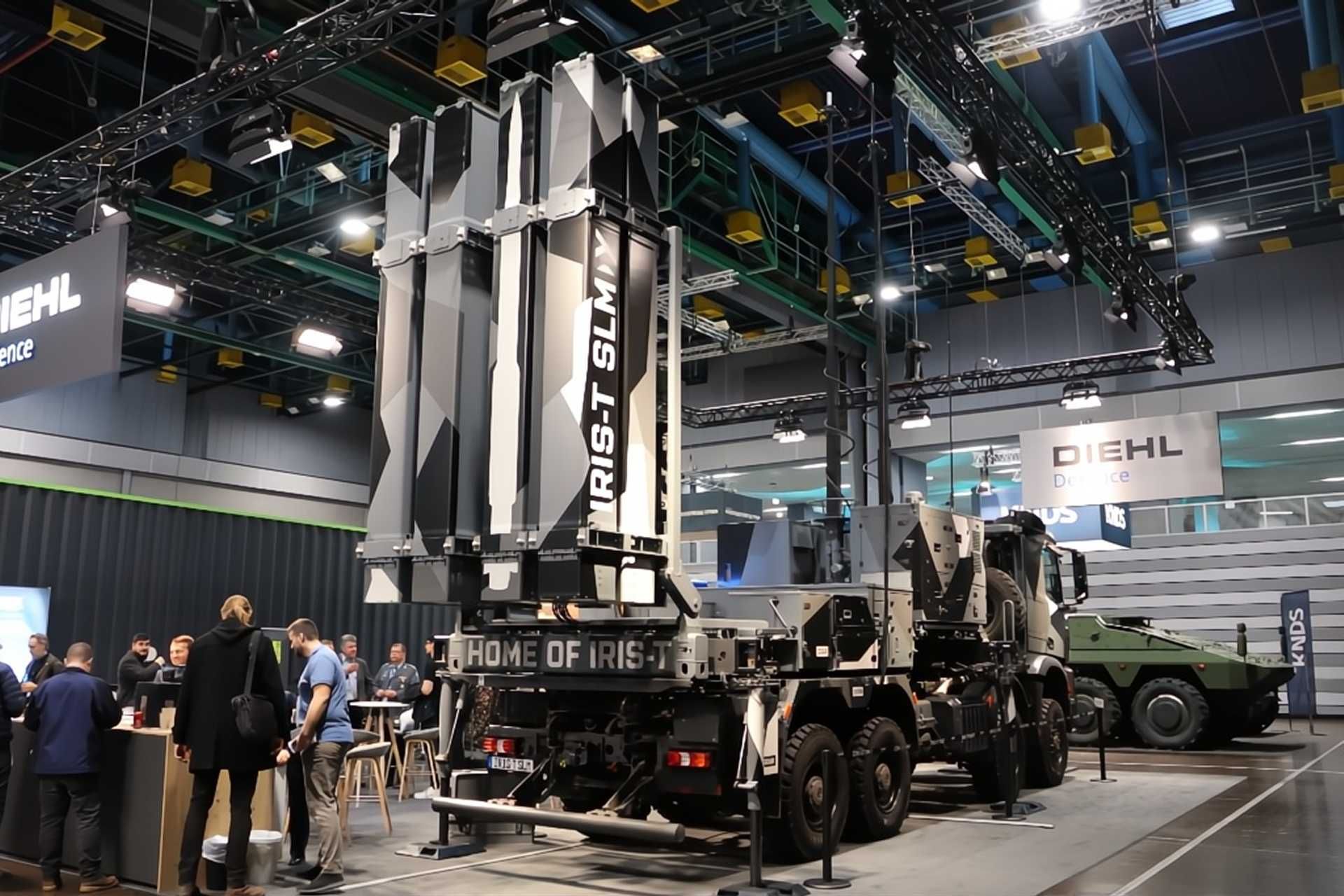
Combining the combat-proven IRIS-T SLM with the upcoming SLX variant within the IRIS-T SLM/X would offer a layered air defence capability to the IRIS-T SL air defense system while preserving a common command and launcher infrastructure. (Picture source: Army Recognition)
The launcher architecture enables mixed load configurations within the same vehicle, including combinations such as four SLM and four SLX missiles or seven of one type and one of the other, while maintaining eight ready missiles per launcher. The concept centers on retaining a single launcher design and adjusting engagement envelopes through missile selection rather than separate firing units. Performance figures highlighted with the new configuration indicate for SLX a 100 km range, 80 km interception range, and 30 km altitude coverage, while SLM is associated with 60 km range, 40 km interception range, and 20 km altitude coverage. The mixed load approach is intended to expand engagement flexibility within existing fire unit structures.
Combining the combat-proven IRIS-T SLM with the upcoming SLX variant within the IRIS-T SLM/X would offer a layered air defence capability to the IRIS-T SL air defense system while preserving a common command and launcher infrastructure. The current SLM missile engages aerial threats such as aircraft, helicopters, cruise missiles, and drones out to about 40 km and up to 20 km altitude, and it operates with a full 360-degree coverage and networked target data to coordinate with radar and control units. Adding the SLX fills the gap toward about 80 km range and roughly 30 km altitude, using a dual seeker and dual pulse motor to extend interception reach without requiring new fire control or sensor systems beyond those already fielded for the SLM.
This would allow forces to tailor launcher loads with mixed SLM and SLX interceptors to address different threat types from close to medium-long distances while using the same tactical operations center and radar inputs, reducing the need for separate specialised batteries for each engagement tier. The commonality in launcher and command systems supports logistical and training efficiencies and enables a more flexible distribution of defence assets in theatre, moving the IRIS-T SL closer to the lower end of what longer-range systems such as the Patriot provide.
The IRIS-T SLM is a medium-range surface-to-air missile derived from the IRIS-T air-to-air missile, with development initiated in 2007 and entry into service in 2022. The missile has a combat weight of 110 kg and uses a solid fuel rocket motor with thrust vector control, reaching a maximum speed of 1020 m/s, equivalent to Mach 3. Its guidance architecture combines inertial navigation, GPS, and a two-way data link for midcourse updates, followed by terminal homing through an imaging infrared seeker. The warhead is an 11.4 kg fragmentation type with impact and proximity fuzes. The missile body incorporates a modified ogive nose cone that is jettisoned prior to the terminal phase to expose the seeker, and the propulsion unit supplied by Nammo has an enlarged diameter of 152 mm compared with the original air-launched variant.
The IRIS-T SLM system architecture consists of a Tactical Operations Center, radar units, and multiple launchers mounted on standardized 20-foot ISO container frames for road, rail, sea, and air transport, including compatibility with C-130 and A400M aircraft. A German fire unit configuration includes one Hensoldt TRML-4D radar, one IBMS-FC command post, and three launchers with eight missiles each, totaling 24 ready interceptors. The launcher is unmanned and equipped with its own fire control computer, generator, and antennas, enabling deployment up to 20 km from the Tactical Operations Center. Time to achieve firing readiness after emplacement is 10 minutes through automated leveling, and reload time is 15 minutes. Vertical launch from sealed transport and launch canisters supports rapid sequential firing for multiple target engagements.
The Hensoldt TRML-4D 3D multifunction radar operates in the G band with AESA technology based on gallium nitride power amplifiers and provides 360° azimuth coverage through antenna rotation. Instrumented detection range is 250 km with altitude coverage up to 30 km, and the radar can track up to 1500 targets simultaneously in 3D mode. It can detect targets with a minimum radar cross section of 0.01 m², identify fighter-sized targets at 120 km, and detect supersonic missiles at 60 km. An integrated identification friend or foe capability is included. An alternative radar option includes the CEA Technologies CEAFAR 3D AESA radar adapted from naval use for vehicle-based employment, operating in the S/X band and compatible with vehicles such as the MAN SX45 8×8.
The IRIS-T SLX variant, currently in development, extends the engagement envelope beyond SLM parameters and integrates into existing SLM launchers and fire units without requiring changes to the command and radar structure. SLX incorporates a dual-mode seeker combining infrared and radio frequency guidance and uses a dual pulse motor to increase kinematic reach and endgame performance. The system is intended to counter cruise missiles, aircraft, drones, and standoff weapons at extended distances. A proof of concept could be scheduled for 2029 if procurement decisions are taken within the current planning cycle. Integration of SLX into mixed load launchers supports layered defence between medium-range SLM and longer range systems such as the MIM-104 Patriot.
The IRIS-T family includes multiple variants beyond SLM and SLX, forming a tiered structure from short to extended range. IRIS-T SLS has a horizontal engagement range of 12 km and altitude coverage up to 8 km, while SLM in its standard configuration has 40 km horizontal range and 20 km altitude coverage. SLX has been associated with 80 km horizontal engagement range and 25 km altitude coverage in variants overviews, alongside the extended 100 km range and 30 km altitude figures cited with the SLM/X configuration. IRIS-T HYDEF, under development for hypersonic defence, targets engagement ranges up to 100 km and altitude coverage up to 50 km. Unit cost estimates indicate €140 million for an SLM fire unit, including radar, command post, and launchers, while individual missile costs range from €250,000 to €560,000 depending on configuration and customer.
Written by Jérôme Brahy
Jérôme Brahy is a defense analyst and documentalist at Army Recognition. He specializes in naval modernization, aviation, drones, armored vehicles, and artillery, with a focus on strategic developments in the United States, China, Ukraine, Russia, Türkiye, and Belgium. His analyses go beyond the facts, providing context, identifying key actors, and explaining why defense news matters on a global scale.
Zarvan
Elite Member
- Thread starter
- #303
Denmark Unveils HD-606 Heavy Drone Armed with Twin .50 Cal Gun at Enforce Tac 2026
- 24 Feb, 2026 - 15:56
- Defense News Army 2026
Danish firm Hecto Drone has introduced the HD-606 heavy unmanned aerial system, armed with a twin-mounted .50-caliber DCR-50 weapon system, at Enforce Tac 2026 in Germany. The platform signals a shift in tactical drone design by bringing helicopter-class direct-fire capability into the multi-rotor UAS segment, with implications for close-combat and force-protection missions.
Hecto Drone of Denmark has unveiled the HD-606 heavy unmanned aerial system, equipped with a twin-mounted .50-caliber DCR-50 weapon system, a configuration that Army Recognition assesses as the first operational heavy multi-rotor drone to field .50-caliber firepower. Displayed at Enforce Tac 2026 in Germany, the platform combines large-caliber direct-fire capability with the extended endurance typical of heavy-lift UAS designs. By integrating stabilized precision weapons onto a multi-rotor airframe, the HD-606 effectively bridges the gap between small armed drones and traditional attack helicopters. The result is a system positioned for high-intensity tactical environments where persistent overwatch and immediate suppressive fire are critical.
Follow Army Recognition on Google News at this link
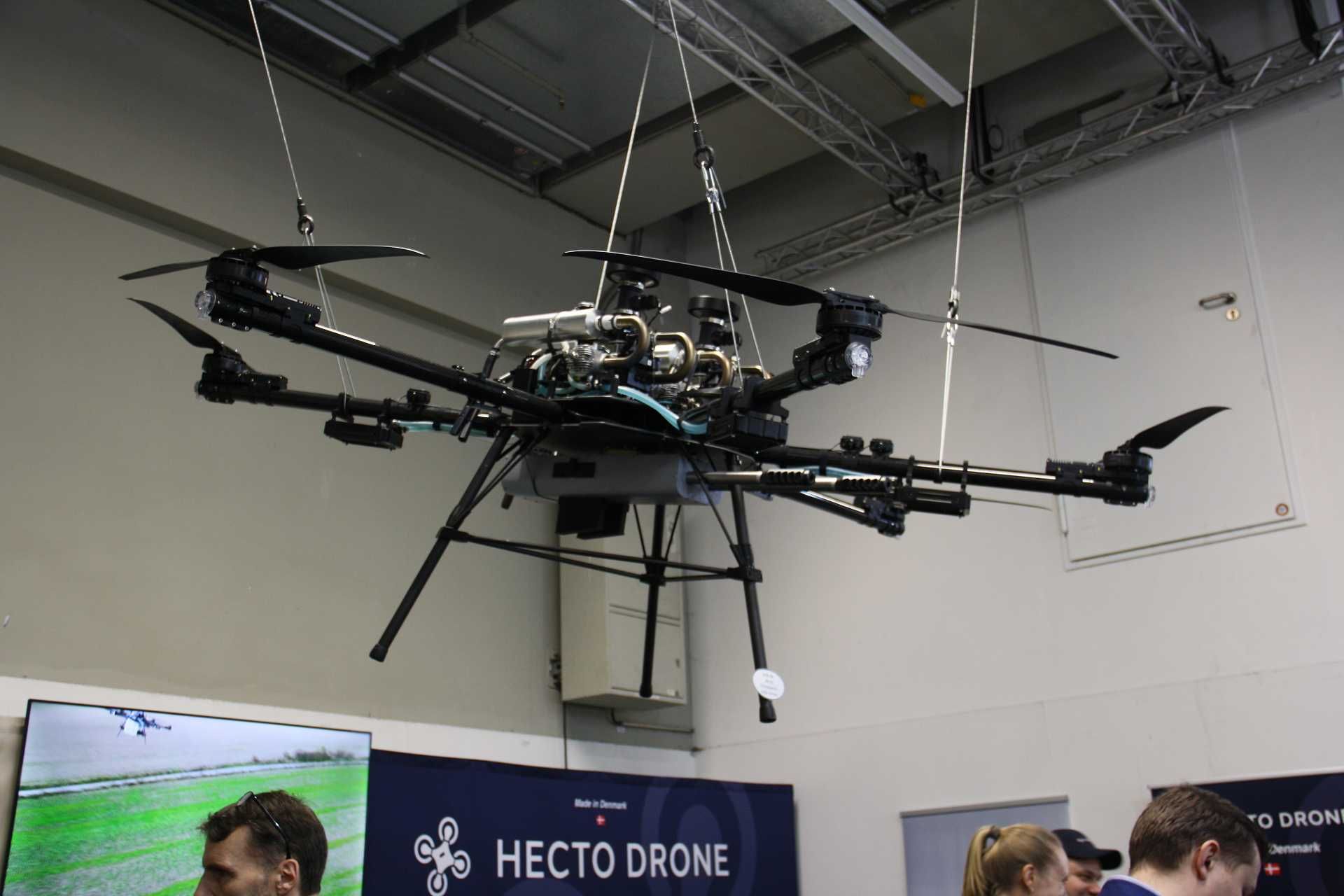
Danish HD-606 heavy UAS armed with twin .50 cal DCR-50 machine guns displayed at Enforce Tac 2026 in Germany, marking the first heavy drone configured with large-caliber direct fire capability. (Picture source: Army Recognition Group)
According to ARG (Army Recognition Group) analysis, while multiple drones have been adapted to carry light machine guns or rocket systems, no previously documented heavy multi-rotor UAS (Unmanned Aerial System) has been purpose-built around a stabilized twin .50 cal configuration with integrated recoil mitigation. This distinction places the HD-606 in a new capability category between loitering munitions and manned attack helicopters.
The DCR-50, developed jointly with Danish Company SAI, Small Arms Industries, consists of two semi-automatic .50 caliber machine guns mounted in a twin configuration. The complete system weighs 23.6 kg, including its electric interface, and is fed by two 10-round magazines. It operates at 25 rds/min, prioritizing controlled, deliberate engagement over suppressive fire. A key innovation is the recoiling reload mechanism, designed to significantly reduce the recoil forces transmitted to the airframe. Recoil management has historically been a limiting factor for mounting large-caliber weapons on rotary UAS platforms, and this technical solution enables stable firing without compromising flight control authority.
The HD-606 is engineered for heavy-lift and endurance. The platform can carry 50 kg for 30 min or 25 kg for more than 3 h, allowing mission planners to balance payload weight against loiter time. This makes the system suitable for armed overwatch, anti-vehicle interdiction, engagement of fortified positions, or high-value asset protection missions. With a maximum speed of 20 m/s (72 km/h or 38 kts), the drone can reposition rapidly while maintaining persistent coverage.
Power architecture is built around a 48 V system with six motors and dual generators delivering a continuous output of 14,000 W. The two-generator configuration ensures redundancy for critical operations, reducing the risk of total power loss during armed missions. The generators offer a time between overhauls of 200 h, and the system integrates a 10 Ah battery to support limited battery-only flight. Payload interfaces provide up to 1,500 W via Amass XT90 connectors, enabling modular integration of sensors, targeting systems, or alternative mission equipment.
Structurally, the carbon fiber airframe is rated for operations between −20 °C and +40 °C and can withstand wind speeds up to 15 m/s. The entire system is van-transportable, reducing logistical footprint and enabling discreet deployment by special operations forces, border security units, or rapid response elements.
Operationally, the combination of heavy endurance and twin .50 cal precision fire introduces a new tactical tool. The .50-cal round remains one of the most effective anti-materiel calibers for turning off light armored vehicles, technicals, radar systems, communications nodes, and fortified firing points. Integrating this capability onto a reusable UAS provides persistent standoff firepower without risking pilots or committing high-value rotary-wing assets.
From a strategic standpoint, this development signals a broader shift in how militaries may distribute firepower across the battlefield. Rather than concentrating heavy direct fire exclusively on manned platforms, armed heavy UAS such as the HD-606 allow decentralization of precision anti-materiel capability down to smaller units. This supports the distributed operations doctrine increasingly adopted by NATO forces.
In the assessment of Army Recognition, the emergence of a heavy drone armed with twin .50 cal machine guns represents a notable inflection point in UAS weaponization. The controlled 25 rds/min rate of fire indicates a precision engagement philosophy rather than area suppression, suggesting doctrinal evolution toward surgical, scalable force application from unmanned platforms.
From an editorial perspective, this development illustrates how rapidly the boundary between traditional air combat systems and unmanned platforms is eroding. What was once the exclusive domain of helicopter gunships is now migrating into modular, van-transportable UAS architectures. If validated through operational testing, systems like the HD-606 could redefine tactical fire support concepts, particularly for forces seeking high-impact capability without the financial and political cost of deploying manned attack aviation.
The long-term impact will depend on targeting integration, fire control stabilization, survivability in contested electromagnetic environments, and export adoption. However, by introducing what ARG identifies as the first heavy drone armed with twin .50-cal machine guns, Hecto Drone has positioned itself at the forefront of the evolution of armed UAS.
Written by Alain Servaes – Chief Editor, Army Recognition Group
Alain Servaes is a former infantry non-commissioned officer and the founder of Army Recognition. With over 20 years in defense journalism, he provides expert analysis on military equipment, NATO operations, and the global defense industry.

Ali_Baba
VIP Member

What is the last jet engine studied and serially produced alone by UK? Italy ? Japan?
The Rolls-Royce XG-40 which is what the EJ-200 based on. UK has Rolls Royce, second largest engine manufacturer in the world.

Top 5: The World's Largest Jet Engine Manufacturers
The manufacturers on this list hold some of the most significant accomplishments in commercial aviation.
 simpleflying.com
The UK knows what it is doing with regards to jet engine, only a fool would think otherwise.. The same can't be said for India, Rakesh.

AeronautIR
HemlockKhalid
Also, is Rafale equally potent without NATO's ecosystem?quick question
do you blame the rafales getting shot down on indian pilots etc or on the plane itself?

Raj-Hindustani
Elite Member

its not
This was not a situation where individual pilot skills played a decisive role. As reported by Chinese sources, even the J-10 pilot was not fully aware of the target; the engagement was coordinated using network-centric data and guidance from AWACS. Therefore, this incident was primarily related to planning and execution rather than pilot skill.Rafale is a good bird. But the pilots of India are quite bad. lol.

AZ_HighCountry
INT'L MOD

The former Red Air Force got its start thanks in part to a reverse engineered Rolls Royce engine because its own indigenous design at the time was junk.The Rolls-Royce XG-40 which is what the EJ-200 based on. UK has Rolls Royce, second largest engine manufacturer in the world.
Top 5: The World's Largest Jet Engine Manufacturers
The manufacturers on this list hold some of the most significant accomplishments in commercial aviation.
The UK knows what it is doing with regards to jet engine, only a fool would think otherwise.. The same can't be said for India, Rakesh.

BonPlan
Registered Member

Ask Egypt, India, Qatar, Indonesia. Then UAE.Also, is Rafale equally potent without NATO's ecosystem?
Rafale is ITAR free, so US leash free.

Bengal71
Trusted Member


its not
This was not a situation where individual pilot skills played a decisive role. As reported by Chinese sources, even the J-10 pilot was not fully aware of the target; the engagement was coordinated using network-centric data and guidance from AWACS. Therefore, this incident was primarily related to planning and execution rather than pilot skill.
The jamming worked though.
BonPlan
Registered Member
XG40 was never serially produce.The Rolls-Royce XG-40 which is what the EJ-200 based on. UK has Rolls Royce, second largest engine manufacturer in the world.
Top 5: The World's Largest Jet Engine Manufacturers
The manufacturers on this list hold some of the most significant accomplishments in commercial aviation.
The UK knows what it is doing with regards to jet engine, only a fool would think otherwise.. The same can't be said for India, Rakesh.
EJ200 is made and was studied by 4 country. Not a sigle one can use it without the other autorisation due to intelectual property. This is why when France & Germany imagined to built a SCAF flying prototyp, it was agreed to use a M88 derivative because free of this problem.
AeronautIR
HemlockKhalid
Asked them. Got my answer. Rafale has been employed well only by French.Ask Egypt, India, Qatar, Indonesia. Then UAE.
Rafale is ITAR free, so US leash free.
Ali_Baba
VIP Member
XG40 was never serially produce.
It was never meant to be .... it was a technology demonstrator for the EJ200. EJ200 is derived from the XG40.
EJ200 is made and was studied by 4 country. Not a sigle one can use it without the other autorisation due to intelectual property. This is why when France & Germany imagined to built a SCAF flying prototyp, it was agreed to use a M88 derivative because free of this problem.
Spain, Italy, Germany assemble the engine at local locations. Rolls Royce is the primary contractor for the EJ200.
Snecma M88 was rejected for the Typhoon in favour of a XG-40 derivative called the EJ200. FCAS has "no other" alternative to to M88 for FCAS as the initial engine.
Do some basic research will you Rakesh...
BonPlan
Registered Member
Seems that it was an Egyptian Rafale attack that struck a turkish base in Lybia (protected by SAM) some years ago.Asked them. Got my answer. Rafale has been employed well only by French.
BonPlan
Registered Member
NO.Snecma M88 was rejected for the Typhoon in favour of a XG-40 derivative called the EJ200. FCAS has "no other" alternative to to M88 for FCAS as the initial engine.
M88 was never promoted to fit EF2000, as EJ200 was never imagined for Rafale.
No promotion means no rejection.
Ali_Baba
VIP Member
NO.
M88 was never promoted to fit EF2000, as EJ200 was never imagined for Rafale.
No promotion means no rejection.
A very basic google search would have told you that the French tried very and failed to get the M88 as the basis of the engine for the Eurofighter.
Eurofighter Typhoon (EF2000) 4th Generation Multirole Fighter Aircraft
Page details technical specifications, development, and operational history of the Eurofighter Typhoon (EF2000) 4th Generation Multirole Fighter Aircraft including pictures.
www.militaryfactory.com

Eurofighter Typhoon - Wikipedia
The ECF project collapsed in 1981 for several reasons, including differing requirements, Dassault's insistence on "design leadership," and the British preference for a new version of the RB199 to power the aircraft versus the French preference for the new Snecma M88.<a href="https://en.wikipedia.org/wiki/Eurofighter_Typhoon#cite_note-butler3-10"><span>[</span>10<span>]</span></a>
I never spoke about EJ200 for the Rafale, so stop trying to distract.
Users who are viewing this thread
Total: 1 (members: 0, guests: 1)
Pakistan Defence Latest
-

-
 Federal cabinet gives nod to imposition of emergency in KP; summary sent to president (33 Viewers)
- Latest: Meengla
-
-
-
Country Watch Latest

Latest Posts
-

-

-
Federal Constitutional Court/ Supreme Court / High Courts of Pakistan, News (6 Viewers)
- Latest: ghazi52
-

-
