China Science And Technology News

Chinese scientists make breakthrough in optical communication, 6G technology​

Source: Xinhua

2026-02-20 20:32:16

To view this content we will need your consent to set third party cookies.
For more detailed information, see our cookies page.


A Chinese research team has developed an integrated communication system bridging optical fiber and wireless networks, setting a new world record for data transmission speed, according to a study published Thursday in the journal Nature. #XinhuaNews


Makera Z1 Review: Budget Friendly CNC Mill with Big Features​

To view this content we will need your consent to set third party cookies.
For more detailed information, see our cookies page.

To view this content we will need your consent to set third party cookies.
For more detailed information, see our cookies page.
 
Last edited:
However, the world will soon plunge into the WWIII, and this project will likely be delayed.

To view this content we will need your consent to set third party cookies.
For more detailed information, see our cookies page.
 
China is moving with full speed to transform its society to utilize new green sources energies while the US is going backward investing heavily in the old carbon fossil fuel industry. What a contrast.
 
China is moving with full speed to transform its society to utilize new green sources energies while the US is going backward investing heavily in the old carbon fossil fuel industry. What a contrast.

The fossil fuel lobby is too strong in the US.

In China, the central government controls everything, and it is asking the SOE oil companies to comply the green energy transition, and start to develop other green tech like the hydrogen power to replace the gasoline.

The SOE will follow the grand national strategy, whereas the private corporations only care about their profit.
 
The fossil fuel lobby is too strong in the US.

In China, the central government controls everything, and it is asking the SOE oil companies to comply the green energy transition, and start to develop other green tech like the hydrogen power to replace the gasoline.

The SOE will follow the grand national strategy, whereas the private corporations only care about their profit.
What the US doing with energy is bad for the planet for sure. Just like the aviation, automobile industry and oil companies are too strong with self-interests in US, that's why they can never build the HSR system there. What a corrupted system.
 
What the US doing with energy is bad for the planet for sure. Just like the aviation, automobile industry and oil companies are too strong with self-interests in US, that's why they can never build the HSR system there. What a corrupted system.

They have to stop the full electrification of the auto industry.

Otherwise, the next stop gonna be the aviation industry.
 
  • Like
Reactions: ety
To view this content we will need your consent to set third party cookies.
For more detailed information, see our cookies page.

Jets, fusion, moon shots: China unveils ambitious mega-projects in five-year blueprint​

Source:Xinhua 07-03-26 11:01 Updated BJT

BEIJING, March 6 (Xinhua) -- China has unveiled an ambitious slate of mega-projects in its five-year blueprint, featuring faster bullet trains, homegrown aircraft engines and wide-body jets, AI chips, controllable nuclear fusion, reusable heavy-lift rockets and lunar exploration missions.

In the draft outline of the 15th Five-Year Plan (2026-2030) submitted on Thursday to the country's top legislature for examination, China proposes a total of 28 major projects to spearhead the development of new quality productive forces, covering four key areas: upgrading industrial infrastructure, fostering emerging industries, breaking through with cutting-edge technologies, and enhancing innovation capabilities.

China plans to put the CR450, the world's fastest bullet train engineered for a top test speed of 450 km/h, into operation after trials, while developing homegrown operating systems and industrial software, high-end digital machine tools, large cruise ships, and liquefied natural gas carriers.

The country is seeking to accelerate breakthroughs for the C929 aircraft and validation of the CJ-1000A engine. The C929 is China's first independently developed jet-powered long-range wide-body aircraft, while the CJ-1000A is a high-bypass-ratio turbofan engine designed for commercial jetliners. It also vows to boost production capacity for the C919, as well as design and roll out plateau-variant C919 models and new-energy aircraft.

To break new ground in growth, China also looks to ramp up advanced semiconductor manufacturing, deploy high-density batteries and humanoid robots in real-world scenarios, strengthen proactive space defense capabilities, create long-range VTOL aircraft, discover more gene therapies, and apply brain-computer interface (BCI) products and intelligent surgical robots over the next five years.

BCI was also included in this year's government work report for the first time, listed alongside future energy, quantum technology, embodied AI and 6G as China's future industries.

In frontier innovations, the outline aims to develop high-performance AI chips and general-purpose quantum computers, engineer controllable nuclear fusion, and build brain-inspired artificial general intelligence systems.

China has also laid out programs for deep-sea mining and oil and gas extraction, and is preparing to build a deep-sea "space station." In outer space, it proposes studying or implementing new planetary probes, near-Earth asteroid defense and solar system boundary exploration, advancing the building of an international lunar research station, and developing reusable heavy-lift rockets.

The five-year plan also charts a course to build national laboratories and a host of major sci-tech facilities, and establish three world-class innovation centers, in a bid to enhance China's foundational innovation strength.

Editor: Suyue
 

Renewable Energy and National Security

The wind and the sun don’t need to transit the Strait of Hormuz​

Paul Krugman Mar 06, 2026, 500+ comments, 2,205 Likes

Donald Trump’s attack on Iran will have many unintended and unforeseen consequences. One consequence even I wasn’t thinking about, but which is already clear after less than a week, is that Trump has made a strong new case for renewable energy.

The usual argument for promoting solar and wind power is that relying on renewable energy avoids the environmental damage caused by burning fossil fuels. This environmental damage includes, but isn’t limited to, climate change. In addition, air pollution imposes shockingly large direct and immediate costs by harming our health and reducing our life expectancy.

But now we know that there is another reason for nations to reduce their dependence on fossil fuels: security. In a dangerous world, it’s infinitely safer to rely on the sun and the wind than to depend on fossil fuels that must be transported long distances, from nations that are untrustworthy, often exploitative and located in regions that frequently devolve into war zones.

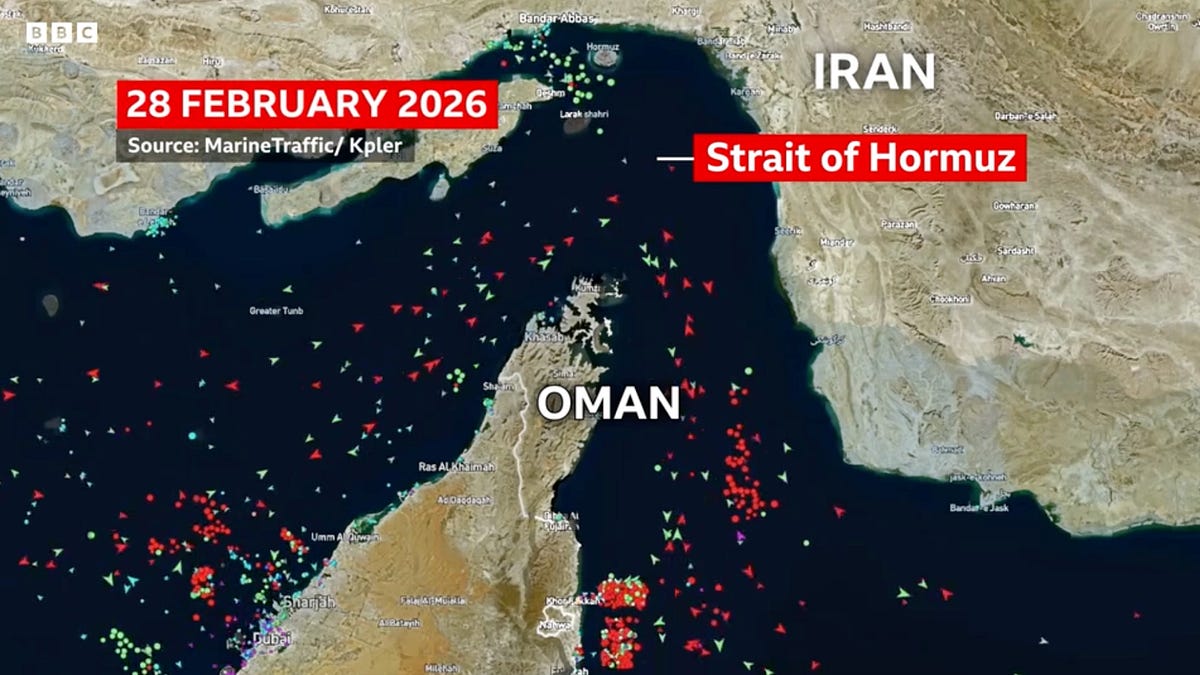
The current situation in the Middle East is essentially the worst-case scenario for world energy supplies. Normally around 20 percent of the world’s oil supply transits through the Strait of Hormuz. It’s also a crucial route for shipment of liquefied natural gas and fertilizer. That passage is now effectively closed and there are no good alternatives.

Donald Trump may say that he will reopen the strait. But short of regime change in Iran, it’s very hard to see how he can.Oil tankers are extremely vulnerable targets while drones, anti-ship missiles and mines are cheap. Moreover, the Iranian regime surely still has thousands of them in stock, in readiness for an attack just like this.

Ironically, the U.S. military, which has been using extremely expensive Patriot missiles — which are in limited supply — to shoot down Iranian drones, is now reportedly in negotiations to buy much cheaper drone interceptors and receive training in their use from … Ukraine, which has four years of experience in meeting such threats. But Ukrainian hardware and expertise will take time to arrive. In the meantime oil industry experts predict that the squeeze on oil supplies will become much more severe if the Strait isn’t opened within a few days.

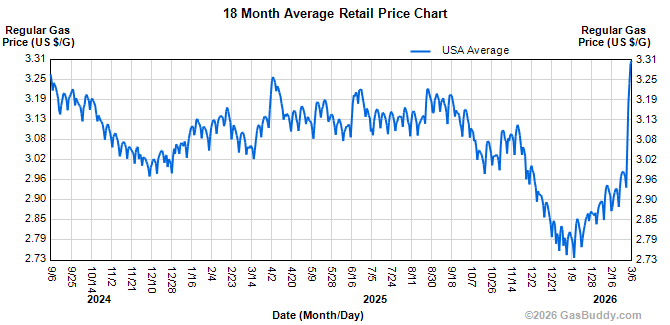
While we are in the midst of a worsening crisis, many – including myself – are surprised that oil prices haven’t risen even more than they have, although they took another leg up yesterday. I guess speculators still expect the disruption to end quickly. Why is anyone’s guess. However, consumers across the world are already feeling the effects. While it is surprising that crude oil prices haven’t increased more, it’s also surprising how quickly retail gasoline prices have surged:


Europe is especially vulnerable. Europe is far ahead of the US in renewable energy capacity, but it still depends on imported LNG for much of its heating and electricity generation needs. While it imports only a small fraction from the Persian Gulf (the US is its biggest LNG supplier), the war is nonetheless delivering a severe blow to European economies: Asian nations, scrambling to replace their LNG imports from the Middle East, are driving up prices worldwide.

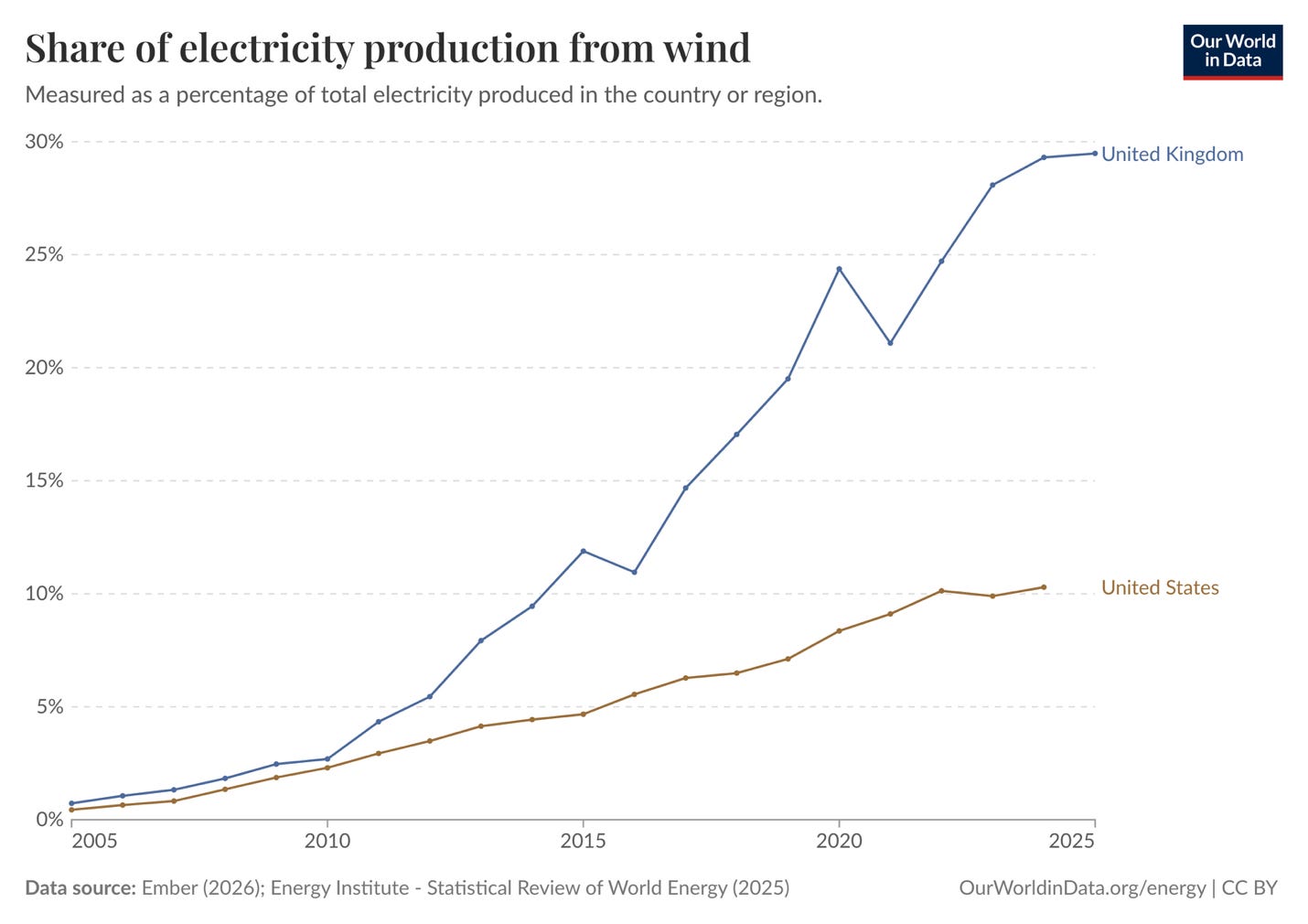
Now, Trump hates renewable energy, especially wind power. He has tried to destroy hundreds of millions of dollars’ worth of investment in offshore wind turbines and sought to block land-based projects as well, although in some cases he has been stopped by the courts. He has also put pressure on other countries to go back to fossil fuels. On Tuesday he lashed out at the UK, calling the British “very uncooperative” and attacking them for having “windmills all over the place that are ruining the country.” But Britain would be in much worse shape right now if wind power weren’t supplying about 30 percent of its electricity.

A graph showing the growth of electricityAI-generated content may be incorrect.
In fact, the British and other Europeans must be wishing that they were getting an even larger share of their energy from renewables rather than natural gas, freeing themselves from both the shackles of Trump’s delusions and Middle East war.

Writing in the Financial Times, Alan Beattie puts energy policy in the context of geopolitical rivalry:

The competing economic superpower offers are now as follows. From the US you get forced into trade deals promising a future of burning fossil fuels whose price is subject to wildly destructive US adventurism. From China you get reliably cheap EVs and green tech to generate renewables.
That may be a bit hyperbolic, but he has a point. I’d add that the problem with U.S. demands that nations burn, baby, burn isn’t just American adventurism. It’s also the fact that relying on the United States for LNG, which is what doing things Trump’s way would amount to, is itself unsafe. Are you sure that Trump or a Trump-like future president won’t cut off energy supplies to nations that annoy him? I’m not.

So the U.S. war against Iran is making a strong case for nations around the world to seek energy independence. And for those nations that don’t have large fossil fuel reserves, that means wind and solar (and, yes, nuclear.)

Donald Trump, hero of renewable energy? Who knew?
 

US think tank: China's renewable energy installed capacity led the world last year and may have reached its carbon peak​


19:29 2024/07/12
China Times News Network

Lu Bohua


The combined installed capacity of large-scale solar and wind power projects under construction in China accounts for nearly two-thirds of the world's total, and carbon emissions peaked about last year. (Photo/Xinhua News Agency)'s total, and carbon emissions peaked about last year. (Photo/Xinhua News Agency)

The combined installed capacity of large-scale solar and wind power projects under construction in China accounts for nearly two-thirds of the world's total, and carbon emissions peaked about last year. (Photo/Xinhua News Agency)


To view this content we will need your consent to set third party cookies.
For more detailed information, see our cookies page.


According to a latest report from a U.S. think tank, the combined installed capacity of large-scale utility-scale solar and wind power projects under construction in China accounts for nearly two-thirds of the world's total. If the projects under construction this year go smoothly, it will be able to reach the peak of wind power six years ahead of schedule. With the policy goal of solar installed capacity of 1.2 billion kilowatts. The research report also pointed out that according to relevant data analysis, China's carbon emissions may have reached a peak last year.


According to a report released by the American think tank Global Energy Monitor, cited by Deutsche Welle, the total installed capacity of large-scale utility-scale solar and wind power projects under construction in China reached 339 GW (1 GW = 1,000 MW), of which solar power accounted for 180 GW and wind power accounted for 159 GW. The installed capacity of 339 GW is twice that of all other countries in the world combined, and much higher than the 40 GW of the second-ranked United States.

The report predicts that if the large-scale utility-scale solar power and wind power projects planned to be connected to the grid by the end of this year are completed on schedule, China will complete the goal announced by CCP leader Xi Jinping six years ahead of schedule, that is, by 2030, "wind power, solar power The total installed capacity of power generation will reach more than 1.2 billion kilowatts."

Due to the rapid development of renewable energy, China is expected to achieve its carbon neutrality goal by 2060. The picture shows a photovoltaic farm located in Zhangjiakou City, Hebei Province. (Photo/Xinhua News Agency)

Due to the rapid development of renewable energy, China is expected to achieve its carbon neutrality goal by 2060. The picture shows a photovoltaic farm located in Zhangjiakou City, Hebei Province. (Photo/Xinhua News Agency)

The report said that although China is the world's largest emitter of greenhouse gases, its increasing renewable energy capacity has brought the proportion of coal-based power generation to a new low. The industry predicts that China will achieve its carbon peak goal as early as 2030 and is expected to achieve carbon neutrality before 2060.

The report quoted data released by the Carbon Briefing as saying that China's carbon dioxide emissions may have peaked in 2023. China's carbon emissions fell by 3% in March this year, which means that since it relaxed epidemic prevention measures and restarted economic activities in December 2022, the 14 consecutive months of growth in carbon emissions has come to an end. The main reasons for the decline in carbon emissions are that China's wind and solar power generation can already meet 90% of its new electricity demand, as well as the continued decline in real estate construction activities.

However, the Global Energy Monitor report also pointed out that despite considerable progress in the installation of new energy, China still faces a major challenge, that is, how to accommodate an unprecedented scale of renewable energy in a power grid designed based on coal power. energy generation and transmitting the new electricity to areas in need.

According to the report, energy analyst Liu Li published an article in "Carbon Briefing" and pointed out that the proportion of China's coal power generation dropped by seven percentage points year-on-year to 53% in May, setting a record low; the proportion of non-fossil fuel sources accounted for 44%. , hitting a record high. If this trend continues, it means China's carbon emissions may have peaked last year.

Link is in Chinese?
 
But now we know that there is another reason for nations to reduce their dependence on fossil fuels: security. In a dangerous world, it’s infinitely safer to rely on the sun and the wind than to depend on fossil fuels that must be transported long distances, from nations that are untrustworthy, often exploitative and located in regions that frequently devolve into war zones.

The current situation in the Middle East is essentially the worst-case scenario for world energy supplies.

500px-P20230814AS-0367_%28cropped%29.jpg

Is this Paul Krugman guy for real?
"Another reason" he says?
He's just figuring this out now?????

images

Did he live under a rock when gasoline prices were greater than $4/gallon due to Iraq?

This guy probably thinks most people in the world buy EVs because they "want to be green". :ROFLMAO:

Many just don't want anything to do with oil companies and their crony ICE supporters in legacy auto companies. If both were gone the world would be a better place.
 
Last edited:

China launches first urban underground vanadium flow battery energy storage project​

Amid tightening regulations on the deployment of lithium-ion-based storage technologies, the first-of-its-kind project is expected to pave the way for safer energy storage installations in dense urban environments.

Mar 10, 2026


Image: Asiachem, WeChat

In what is described as China’s first deployment of its kind, Sichuan Tianfu Energy Storage Technology and Sichuan Chemical Group have launched a 1.25 MW vanadium flow battery (VFB) energy storage system in the basement of a commercial office building.

The project aims to address the growing demand for energy storage in dense urban environments, where safety regulations and space constraints are increasingly limiting the use of conventional battery technologies.

The system is designed to support a 1.1 MW air-conditioning load, ensuring a stable power supply during periods of peak demand and grid restrictions. By charging during low-cost off-peak hours and discharging during daytime peak periods, the system helps reduce electricity costs while maintaining uninterrupted cooling during summer power shortages.

As a non-flammable chemistry, vanadium flow batteries are considered particularly suitable for underground deployments. The technology does not pose high-temperature hazards or emit toxic gases, allowing seamless integration with building safety and fire standards. In addition, thanks to its decoupled energy-and-power architecture, with separated electrolyte tanks and stacks, the system prevents chain reactions even in the event of electrolyte leakage.

The vanadium flow battery also offers strong lifecycle performance, with more than 20,000 charge–discharge cycles and an operational lifespan exceeding 20 years. The installation integrates an intelligent energy management system that enables automated peak shaving, demand response, and remote monitoring.

Its modular design allows the system to be installed in unused basement spaces without affecting parking areas or surrounding green spaces, making it particularly attractive for commercial and urban buildings.

The deployment comes amid tightening safety regulations for electrochemical energy storage systems in China. In February 2026, Hunan Province introduced new rules restricting the installation of lithium-ion and sodium-ion battery systems in underground, semi-underground, rooftop, or densely populated building areas due to thermal runaway risks.

Vanadium flow batteries, however, are not subject to these restrictions because they use non-flammable, water-based electrolytes, making them inherently safer for deployment in sensitive locations such as commercial buildings and underground facilities.
 

Users who are viewing this thread

Pakistan Defence Latest

Country Watch Latest

Latest Posts

Back
Top