US Economy - News, Updates and Discussion

1773348107131.jpeg

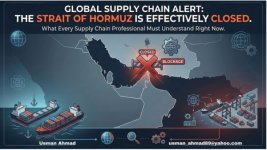
Choke Point: The Global Economic Consequences of the Persian Gulf Shutdown

How the disruption of oil, liquefied natural gas, and urea exports will cascade through the world economy
Larry C. Johnson • March 10, 2026
• 3,400 Words


1773348262204.jpeg


1773348296566.jpeg


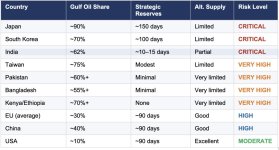
Which Countries Are Most Insulated?

Not all nations face equal exposure. Several are significantly better positioned to withstand a Gulf shutdown, either because they produce their own energy, have diversified supply, or hold large strategic reserves.

United States. The US has achieved near-energy-independence through its shale oil and gas revolution. It is a net oil exporter and the world’s largest LNG exporter. It produces large quantities of domestic urea. A Gulf shutdown would raise global prices and affect US consumers, but the supply shock would not directly threaten US energy security. The US is best placed of all major economies.
 
Last edited:
View attachment 185335

Choke Point: The Global Economic Consequences of the Persian Gulf Shutdown

How the disruption of oil, liquefied natural gas, and urea exports will cascade through the world economy
Larry C. Johnson • March 10, 2026
• 3,400 Words


View attachment 185336


View attachment 185337


Which Countries Are Most Insulated?

Not all nations face equal exposure. Several are significantly better positioned to withstand a Gulf shutdown, either because they produce their own energy, have diversified supply, or hold large strategic reserves.

United States. The US has achieved near-energy-independence through its shale oil and gas revolution. It is a net oil exporter and the world’s largest LNG exporter. It produces large quantities of domestic urea. A Gulf shutdown would raise global prices and affect US consumers, but the supply shock would not directly threaten US energy security. The US is best placed of all major economies.
for India the Oil criticality is almost fully mitigated with the Russian buy. If the bulk of it is ural crude there's hardly anything Indian refiners have to change but even of not, the mix is highly fungible with adjustments.

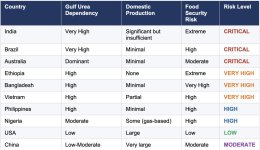
The 2nd one about urea (and affiliated) is importnt. As noted, India has high local production but will have to supplement both with alternate imports and farmetr subsidy I think.
 
To view this content we will need your consent to set third party cookies.
For more detailed information, see our cookies page.
 
Miss Biden yet?
Miss that sleepy Joe? A soundly sleeping Biden means you can hold your positions overnight, and it also means you can sleep soundly without a care.
 
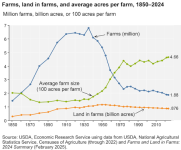
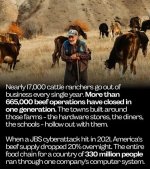
Everyone is watching the Iran war and oil prices. No one is noticing that American farms are disappearing at the fastest rate since the Civil War.In 2025, the number of U.S. farms decreased by 15,000, down to 1.87 million—the lowest since the 1850s. This marks the third consecutive year of decline, with six out of the past seven years seeing reductions. A total of 158,200 farms have vanished.Meanwhile, farmland acreage shrank by 24.9 million acres, down to 874 million acres—the lowest since the 1910s.Even more shocking: Farm bankruptcy filings surged 36% in the first nine months of 2025, reaching 293 cases.Why? A triple whammy:1. Interest rates: The Fed's sustained high rates have sent farm loan costs skyrocketing. Agriculture is one of the most loan-dependent industries in the U.S.2. Tariffs: Trump's tariff war has caused agricultural exports to plummet. China used to be America's biggest buyer of farm goods—now it's nearly zero.3. Labor: Tightened immigration policies mean farms can't find workers. 70% of agriculture's workforce is made up of immigrants.This is the overlooked crisis: America is losing its ability to feed itself.In the 1850s, the U.S. had 1.87 million farms and a population of 31 million. In 2025, the same 1.87 million farms, but a population of 342 million.The number of people each farm feeds has jumped from 17 to 183.If farms keep disappearing, who will feed America?Do you think this is "efficiency gains" or a "food security crisis"?
 
To view this content we will need your consent to set third party cookies.
For more detailed information, see our cookies page.

Remember, the number is grossly inflated by government spending. We are easily in negative GNP territory.
 
Everyone is watching the Iran war and oil prices. No one is noticing that American farms are disappearing at the fastest rate since the Civil War.In 2025, the number of U.S. farms decreased by 15,000, down to 1.87 million—the lowest since the 1850s. This marks the third consecutive year of decline, with six out of the past seven years seeing reductions. A total of 158,200 farms have vanished.Meanwhile, farmland acreage shrank by 24.9 million acres, down to 874 million acres—the lowest since the 1910s.Even more shocking: Farm bankruptcy filings surged 36% in the first nine months of 2025, reaching 293 cases.Why? A triple whammy:1. Interest rates: The Fed's sustained high rates have sent farm loan costs skyrocketing. Agriculture is one of the most loan-dependent industries in the U.S.2. Tariffs: Trump's tariff war has caused agricultural exports to plummet. China used to be America's biggest buyer of farm goods—now it's nearly zero.3. Labor: Tightened immigration policies mean farms can't find workers. 70% of agriculture's workforce is made up of immigrants.This is the overlooked crisis: America is losing its ability to feed itself.In the 1850s, the U.S. had 1.87 million farms and a population of 31 million. In 2025, the same 1.87 million farms, but a population of 342 million.The number of people each farm feeds has jumped from 17 to 183.If farms keep disappearing, who will feed America?Do you think this is "efficiency gains" or a "food security crisis"?
1773482831071.png
 
To view this content we will need your consent to set third party cookies.
For more detailed information, see our cookies page.
 

Surge in US gas prices deepens political peril for Trump over Iran​


Anthony Zurche
rNorth America correspondent

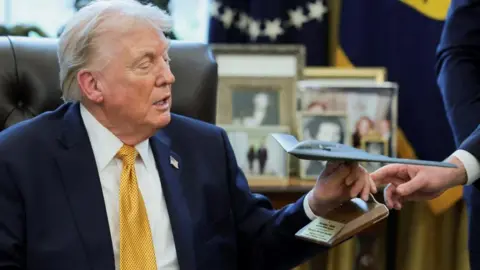
Reuters US President Donald Trump receives a model of a B‑2 bomber commemorating Operation Midnight Hammer during an event on Monday


Reuters

In the third week of the joint US-Israeli war against Iran, Donald Trump faces decisions that could define the rest of his presidency.

But if the American commander-in-chief is grappling with a war of choice that seems in danger of spiralling in ways he can't control, those concerns are not playing out in public.

In more than an hour of public remarks at the White House on Monday, he discussed his thinking on the state of the war effort - and also on Kennedy Center renovations, White House ballroom construction plans, this year's World Cup tournament, the health of a Republican congressman and a host of other unrelated topics.

It was classic Trump, as unscripted and wide-ranging as ever. This past weekend, he played golf at his Florida resort. And on his Truth Social website, he devoted nearly as much time to railing about the Supreme Court as he did to discussing the Iran War.

While Trump may be interested in other topics, he is confronting a lesson previous American presidents have learned the hard way - that war can consume a presidency whether they want it to or not.
 
Evidence continues to mount that a war that Trump had previously said was "already won" and "very complete" now has a timeline that could stretch for weeks or even longer.

On Monday afternoon, Trump announced that the US had requested that a planned presidential trip to China in early April be delayed for a month because of the war.

"The president's utmost responsibility right now as commander in chief is to ensure the continued success of Operation Epic Fury," White House Press Secretary Karoline Leavitt said when the move was first reported, referring to the military name for the Iran war.

Over the weekend, the president posted on social media that he was forming a coalition of forces to help protect shipping through the Strait of Hormuz, which has been threatened by Iranian attacks.

"Hopefully China, France, Japan, South Korea, the UK, and others, that are affected by this artificial constraint, will send Ships," he wrote. "One way or the other, we will soon get the Hormuz Strait OPEN, SAFE, and FREE!

Since his call, however, a growing list of nations – including Japan, Australia and many European powers – have indicated that they are not interested in joining the effort.

"We will not be drawn into the wider war," UK Prime Minister Keir Starmer said on Monday,
 
To view this content we will need your consent to set third party cookies.
For more detailed information, see our cookies page.
 
To view this content we will need your consent to set third party cookies.
For more detailed information, see our cookies page.
 
To view this content we will need your consent to set third party cookies.
For more detailed information, see our cookies page.
 

Users who are viewing this thread

Back
Top