RescueRanger
Meme Lord

Survivability analysis of the F35 vs proximity fused MANPADS. (Posted here to avoid usual hope and cope troll posts)
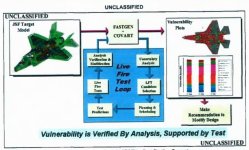
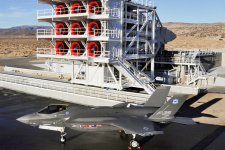
The F-35 underwent one of the most extensive survivability evaluation programs ever run on a fighter, spanning 20+ years.
Full scale jets, structural test airframes, subsystems and F135 engines were all subjected to ballistic threats to identify and assess vulnerabilities.
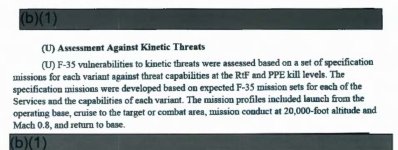
The program prioritized a wide range of threats incl. API/HEI rounds, SAM/MANPADS in its simulations using Advanced Diverging Ray Methodology (ADRAM).
Frag zones were mapped around IR lock-on areas where near-proximity detonations would occur under real world intercept velocities
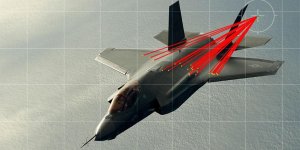
Wing and fuselage tanks took fragment hits, and tests evaluated how fuel blasts outward and whether fires would ignite in dry bays.
The F-35 kept those fires smaller and more contained than legacy jets, in part due to OBIGGS' inerting of fuel tanks and improved structural design.
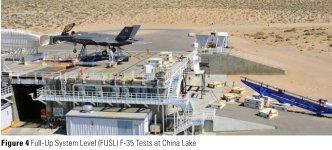
Fuel ingestion tests perforated tanks to create leaks into the engine path. The F135 tolerated single fragment hits at full thrust with no catastrophic failure, while multiple fragments were higher risk but the engine still kept running long enough in modeled scenarios.
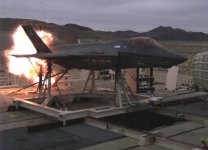
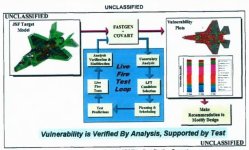
To gauge these threats the program used FASTGENv4 and COVARTv4, developed specifically for the F-35 LFT&E effort.
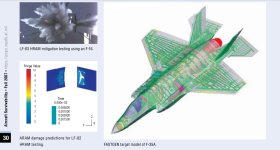
FASTGENv4 generated realistic shotlines by tracing thousands of virtual rays through the aircrafts 3D geometry from any direction to show where fragments from a near-miss/proximity explosion would hit under combat conditions.
(Cont - can only post 6 images )
)
The F-35 underwent one of the most extensive survivability evaluation programs ever run on a fighter, spanning 20+ years.
Full scale jets, structural test airframes, subsystems and F135 engines were all subjected to ballistic threats to identify and assess vulnerabilities.
The program prioritized a wide range of threats incl. API/HEI rounds, SAM/MANPADS in its simulations using Advanced Diverging Ray Methodology (ADRAM).
Frag zones were mapped around IR lock-on areas where near-proximity detonations would occur under real world intercept velocities
Wing and fuselage tanks took fragment hits, and tests evaluated how fuel blasts outward and whether fires would ignite in dry bays.
The F-35 kept those fires smaller and more contained than legacy jets, in part due to OBIGGS' inerting of fuel tanks and improved structural design.
Fuel ingestion tests perforated tanks to create leaks into the engine path. The F135 tolerated single fragment hits at full thrust with no catastrophic failure, while multiple fragments were higher risk but the engine still kept running long enough in modeled scenarios.
To gauge these threats the program used FASTGENv4 and COVARTv4, developed specifically for the F-35 LFT&E effort.
FASTGENv4 generated realistic shotlines by tracing thousands of virtual rays through the aircrafts 3D geometry from any direction to show where fragments from a near-miss/proximity explosion would hit under combat conditions.
(Cont - can only post 6 images
)