Navigation
Install the app
How to install the app on iOS
Follow along with the video below to see how to install our site as a web app on your home screen.
Note: This feature may not be available in some browsers.
More options
Style variation
You are using an out of date browser. It may not display this or other websites correctly.
You should upgrade or use an alternative browser.
You should upgrade or use an alternative browser.
Iran - Israel/US War: Israel-US declare war on Iran, Iran responds
- Thread starter Khorasan Black Flags
- Start date
More options
Who Replied?

Persian Gulf
INT'L MOD


Gryzor
Registered Member
Oh I know that the underground bases include not only storage and fire facilities , among which the notorious "missile cartridge" thing, but also and most importantly : assembly and R&D. Of all of Iran's valuable pieces of military-industrial infrastructure, the missile and drone sector are by far the most protected and deeply buried in such "cities" built upon decades of sweat by dedicated Iranian workers and engineers. What I'm wondering and very worried about is basically all of the rest. IEI, Sa-Iran, Optics and the like. All are part of a very complex weapons manufacturing chain and every loss of painstakingly sourced machine-tools and production line destroyed means months if not years of recovery ahead, during which there are critical, blocking missing links in producing many weapon systems or core components, and not only the missile core. And we lose as much time in producing direly needed items in numbers as it takes to get our hands on the right equipment again.Don't get me wrong, they have hit and destroyed many valuable things in Iran. I'm not saying it's all bullshit and propaganda.
I'm just saying that many of these facilities, like air ports, missiles bases, etc. are not that easy to destroy or permanently disable like what people assume because of some videos on the internet or some low-resolution satellite photos.
This is why Israel maintains a large network of spies in Iran for damage assessment.
Many of Israeli double taps or multi-taps are for the reason that their first attack failed. Sure, they're genocidal war criminals, but many of their first attempts fail and they never tell you that on X accounts like Vahid Online.
Prior to the June war, Iran's missile production was generally estimated to be in the 50-100 range, per month. There are reports on Western media that Iran's missile production post-war had increased to 300/month, or even up to 700/month in some resources. So much for destroying Iran's missiles bases, right?
What i'm constantly obsessing about is to try and have even an approximate idea of how long will the post-war "window of vulnerability" be for Iran, during which the "mowing the loan" doctrine from the zionazis can apply. Also a source of worry is : will those darn Chinese (I won't even mention Russia in that equation from now on) finally jump in and at least in pseudo-peace time furnish emergency deliveries of IADS elements and/or critical replacement components. This is the number one priority for Iran even before assessing damage to its missile, drone, or aerospace production facilities and capabilities.
We see that they were only very partial bridging of the many gaps left from the 12-day war in the upper-edge of their IADS. The OTH are mostly gone now I'm sure, so are the few Khordads and Bavars they got (at the minimum they withdrew them, I'm hoping), so imagine the work needed now with that beat-down.
For now, we can only wonder about what irreplaceable items of value have been wiped out or badly damaged and how many were redundant in backup inactive sites. But I certainly hope the brass did the proactive work of dissimulation and distribution especially after June '25. Iran is 1.6M km² after all.
They say you can't kill knowledge and that is true, despite some assassinations occurring in this mess. But for knowledge to work its magic you need hardware. One big question will be : how lenient and "generous" will be our superb Asian ally to provide what's needed to repair/rebuild/restructure anything of value.
Above all else, this war of aggression is technically a forced disarmament and dis-industrialization campaign against Iran.
Last edited:
Persian Gulf
INT'L MOD
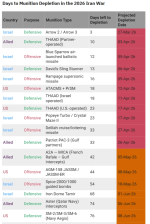
Source: RUSI
within 2 days Israel's Arrow-2/3 interceptors will be depleted, within 13 days David's Sling will be depleted, and within 18 days Israel's THAAD batteries will be depleted...
an early ceasefire when we are on the verge of depleting their interceptors would be a terrible mistake...
PK784
Registered Member

Iran’s attacks on U.S. bases in the Middle East are forcing some troops to work remotely.
Image
A satellite image of Al Udeid Air Base in Qatar in February.Credit...Planet Labs, via Reuters
Iran has bombed U.S. bases across the Middle East in retaliation for the U.S.-Israeli war, forcing many American troops to relocate to hotels and office spaces throughout the region, according to military personnel and American officials.
So now much of the land-based military is, in essence, fighting the war while working remotely, with the exception of fighter pilots and crews operating and maintaining warplanes and conducting strikes.
Iran’s Islamic Revolutionary Guards Corps has urged people to report these new locations as it hunts for the dispersed troops. U.S. military officials say that threat is not stopping the Pentagon from carrying out the war against Iran, which is in its fourth week.
“To date, we’ve struck over 7,000 targets across Iran and its military infrastructure,” Defense Secretary Pete Hegseth declared last week. He then repeated what has become a common refrain at his news briefings: “Today will be the largest strike package yet, just like yesterday was.”
But the relocation of troops to makeshift — one official called them “alternative” — sites raises questions about the Trump administration’s preparations for the war.
There were close to 40,000 U.S. troops in the region when the war started, and Central Command has dispersed thousands of them, some to as far away as Europe, American military officials said. But many have remained in the Middle East, although not on their original bases, military officials said.
The result, according to current and former military officials, is a war that is much harder to prosecute.
“Yes, we have the ability to set up expedient operation centers, but you’re absolutely going to lose capability,” said Master Sgt. Wes J. Bryant, a retired Special Operations targeting specialist in the U.S. Air Force. “You can’t just put all that equipment on the top of a hotel, for example. Some of it is unwieldy.” A U.S. military official said that troops are not working from the roofs of civilian hotels.
Iran responded forcefully to the joint American and Israeli strikes, targeting not only U.S. bases but also embassies and oil and gas infrastructure throughout the region. With its supreme leader and dozens of other leaders killed, the Iranian regime has retaliated by launching hundreds of drones and missiles into neighboring countries and largely shuttered the Strait of Hormuz, a vital shipping route, making sure the war would be felt by people across the globe.
Many of the 13 military bases in the region used by American troops are all but uninhabitable, with the ones in Kuwait, which is next door to Iran, suffering perhaps the most damage. Six U.S. service members were killed in a strike on Port Shuaiba that destroyed an Army tactical operations center. Iranian drones and missiles also targeted Ali Al Salem Air Base, damaging aircraft structures and injuring personnel, and Camp Buehring, damaging maintenance and fuel facilities.
In Qatar, Iran struck Al Udeid Air Base, the regional air headquarters of U.S. Central Command, damaging an early-warning radar system. In Bahrain, a one-way Iranian attack drone struck communications equipment at the headquarters of the U.S. Fifth Fleet. At Prince Sultan Air Base in Saudi Arabia, Iranian missiles and drones damaged communications equipment and several refueling tankers.
An Iranian-backed militia in Iraq launched a drone swarm attack on an upscale hotel in Erbil early in the war.
Iranian officials have even accused the U.S. military of using civilians as human shields by putting American troops in hotels.
“We are forced to identify and target the Americans,” the intelligence arm of the Islamic Revolutionary Guards Corps said in a message to people in the region, according to Tasnim News Agency. “Therefore, it is better not to shelter them in hotels and to stay away from their locations.”
The message added that “it is your Islamic duty to accurately report the hiding places of American terrorists and send the information to us on Telegram,” a social media app.
Despite a punishing air campaign, the Iranians “still retain some capability,” Gen. Dan Caine, the chairman of the Joint Chiefs of Staff, acknowledged in the Pentagon news conference last week.
General Caine said that “layered defenses throughout the region” were allowing the United States to protect troops and interests but that the Pentagon was trying to bolster defenses in the region.
Part of the problem for the Pentagon is that two decades of war in Iraq and Afghanistan — war zones where the United States quickly established air superiority — left the military with facilities and headquarters close to the current front lines.
While Bagram Air Base in Afghanistan and the U.S. Embassy in Baghdad, for example, were often targeted in suicide bombings and other attacks, neither the Taliban nor Iraqi militias possessed the kind of ballistic missile capability that Iran has.
During the war in Iraq in particular, the United States built up its bases there and in Kuwait, Bahrain, Saudi Arabia and Qatar. Now, the war in Iran has made all of those bases vulnerable — to the point where service members can’t really live or work there for extended periods, military officials said.
The lack of better planning, some military officials said, also reflects a miscalculation on the part of the administration about how Iran would respond. The Trump administration did not reduce staffing at American embassies and other facilities in the region before the war started, or order departures for nonessential government employees and family members. Nor did the State Department warn Americans to steer clear of the region until after the war began.
Two former U.S. officials briefed on military operations said there were no reinforced roofs on command centers at Prince Sultan Air Base in Saudi Arabia, where one service member was killed and several others were wounded in an attack.
Military officials say that American refueling tankers were rushed to the war with little time to orient or practice in the region before getting thrown into the round-the-clock operations. Two American KC-135 tankers collided this month, leading to deaths of six service members. A Central Command spokesman said that incident is under investigation.
Sergeant Bryant, the former Air Force special operator, pointed out that one area that the U.S. military excels at is what he called “decentralized execution,” or the ability to continue to do its job even from far afield.
“You could cut off the head of the snake and down to the last individual soldier, we’re still going to be operating,” he said.
But, he added, “you still lose something.”

Bengal71
Trusted Member


95%+ of Iranians in the West are diaspora liberashkas. Generally irreliguous, usually blindly loyal to whatever country they currently live in, hedonistic. That they all act like that shouldn't be surprising, if you've interacted with any beforehand. In fact, I'd be surprised if you had interacted with any that weren't like that
I interacted with many in the past. All were like that. Today is a new one I met.

Shags101
Trusted Member
Is it weird I don’t know any Iranians at allI interacted with many in the past. All were like that. Today is a new one I met.
 other than on this board I can spot an Arab from a mile away but I don’t recall ever meeting any Iranians personally in my life
ShapurII
Trusted Member

Where do you live in the US? I mean which state?Is it weird I don’t know any Iranians at all
There are many Iranians in the US. Some claim over 1.5 million Iranians live in the US.
Shags101
Trusted Member
South Florida no I’m assuming I have passed an Iranian in my life just never anyone who has introduced themselves as IranianWhere do you live in the US? I mean which state?
There are many Iranians in the US. Some claim over 1.5 million Iranians live in the US.
Immortals
Elite Member
Take a break for 30 minutes come back
11 hours, one of the longest gaps in the war. I believe record is 12 hours.
Magi
Registered Member

That sounds like a lot of big fat targets for MANPADS while landing, and drones after landing.Air power? Chinooks? C-130? C-17? C-5? Black Hawks? Maybe amphibious assault ships in Bahrain? I don't think they plan to pass through the Strait of Hormuz.
Immortals
Elite Member
but I don’t recall ever meeting any Iranians personally in my life
We are an endangered species.
Kyussis
SpeedLimited
Tehran should surrender now!Two MEUs and a BCT from the 82nd?
Don't underestimate their capabilities even for a second.
Users who are viewing this thread
Total: 46 (members: 9, guests: 37)


