China Science And Technology News

To view this content we will need your consent to set third party cookies.
For more detailed information, see our cookies page.

Electricity Feeds Computility? Ample Supply Guaranteed!
State Grid

Apr 20, 2026

What AI ultimately demands is not just computility—it’s electricity.Daily token consumption of large language models has skyrocketed by 1,400 times in just two years. As computing power surges ahead, the power grid bears the strain. China’s answer? Electricity-computing synergy.

AI data centers are no longer clustered in cities. Instead, they are moving to the Gobi Desert and other regions rich in green energy— abundant wind, solar resources and vast open land — where computility follows green power. Non-urgent AI training tasks actively step back during peak power demand: running more during off-peak times and less during peak times, turning computility into a flexible buffer for the power grid. Massive real-time data flows back to the grid. With AI-assisted grid dispatch, forecasts become more accurate and responses faster, ensuring every kilowatt-hour is used where it matters most.

This is China’s solution for the era of the global AI race.
 
China launches first Pre-6G test network, bringing 6G closer to reality: expert
By Yin Yeping
Published: Apr 21, 2026 09:18 PM

6G Photo: VCG

6G Photo: VCG

China's first Pre-6G test network was officially put into operation in Nanjing, the capital city of East China's Jiangsu Province, on Tuesday, according to CCTV News. A Chinese industry analyst said that the move represents another step closer for 6G technology toward real-world applications.

The test network integrates 6G innovative technologies into the existing 5G network and features high bandwidth, long-range coverage, deterministic low latency, and native artificial intelligence (AI) integration, with capabilities reportedly up to 10 times those of 5G, according to CCTV News.

The test network has been conducting systematic verification in areas such as low-altitude inspection, industrial manufacturing, embodied intelligence, and holographic communications. It marks a shift of 6G technology from key technology validation to a new stage of system-level capability verification, laying an important foundation for future 6G standardization and industrial applications, said the report.

There is already 5G-Advanced (5G-A), which is the evolutionary stage of 5G networks, and the emergence of Pre-6G means integrating 6G-related technologies into existing 5G networks to enhance current network capabilities, Ma Jihua, a veteran market analyst, told the Global Times on Tuesday.

Ma said that the significance of this kind of trial lies its ability to test and apply certain 6G standards. It also better address the growing demand for more advanced communication technologies from key sectors such as new materials, new energy, the low-altitude economy, and aerospace during the 15th Five-Year Plan (2026-30) period.

China has already established the world's largest 5G network, with large-scale deployment accelerating in key sectors such as industry, mining, power, and healthcare, according to industry data, which provides a certain foundation for the evolution toward 6G.

Speaking at a press conference on Tuesday, Xie Cun, head of the bureau for information and communications development of the Ministry of Industry and Information Technology, said that as of the end of March, the total number of 5G base stations across China reached 4.958 million. Meanwhile, 5G-A has now covered 330 cities.

The development of 5G has also driven progress in multiple fields, including AI and the industrial internet, gradually giving rise to future demand for 6G, Ma said. On this basis, through the continuous evolution of 5G and Pre-6G, there is potential to establish a certain first-mover advantage in future 6G standard-setting, the expert said.

According to the 15th Five-Year Plan, the government vows to push forward technological research, product development, enterprise cultivation, and ecosystem building in multiple fields, including 6G technology.

As the country enters the next five-year plan starting this year, new applications such as robotics and AI are expected to emerge, creating more opportunities for the development of 6G technologies and providing stronger momentum for the real economy, said Ma.

 
I think the real battle is in the area of AI

I know everyone is doing it but its really China vs USA
Any country that doesn't keep their own data and relies on other countries apps and programs e.g. gmail, facebook, youtube etc is giving america valuable data for free (looking at India) and are never in the race to begin with.
 
Any country that doesn't keep their own data and relies on other countries apps and programs e.g. gmail, facebook, youtube etc is giving america valuable data for free (looking at India) and are never in the race to begin with.
This is why Trump is so upset and hellbent to buy Tik tok.
 

China’s dark compute power could be 6,000 times higher than current estimates​

Domestic AI amounts to 1,882,000,000,000,000,000 calculations per second, vastly more than Western rankings suggest​

Published: 9:00am, 23 Apr 2026

China has reported a staggering amount of domestic artificial intelligence power, pointing to what some experts say could be a “dark pool” of compute thousands of times larger than its public reports suggest.

According to the Ministry of Industry and Information Technology (MIIT), China has achieved 1,882 exaflops – short for exa floating-point operations per second – which translates to 1,882 quintillion, or billion billion, calculations per second.

The figure is more than 6,000 times higher than the country’s computing power as reflected in the Top500 list, one of the few available benchmarks for comparing China’s supercomputing progress with other countries, especially the United States.

While the two are not directly comparable, and the Germany-based ranking of the world’s fastest supercomputers is often seen as an underestimate, the latest data released by the MIIT on Tuesday suggests China’s computing power is rising fast.

Unlike China, the US – which dominates the Top500 – does not publish a single national figure for AI computing power as most of the infrastructure is owned by private companies and measured using different standards.

AI rush turns everyday data storage into ‘digital gold’ for Hong Kong consumers
According to estimates from the Stanford Institute for Human-Centred Artificial Intelligence and other policy analyses, the US holds roughly 50 to 75 per cent of global capacity and hosts the largest concentration of AI-focused data centres.


China’s cyber capabilities now equal to the US, warns Dutch intelligence​

china

CREDIT: CHRIS WANG / UNSPLASH

Alexander Martin
April 22nd, 2026

The Netherlands' military intelligence service says it believes China has drawn level with the United States in offensive cyber capabilities, leading to a situation where only a fraction of Chinese operations against Dutch interests are ever detected.

“China now probably stands on an equal footing with the United States in the area of offensive cyber capabilities,” stated the country’s Defence Intelligence and Security Service (MIVD) in its public annual report released Tuesday.

The U.S. Office of the Director of National Intelligence, in its own 2025 threat assessment, described China as having "demonstrated the ability to compromise U.S. infrastructure through formidable cyber capabilities,” but without declaring parity.

According to the MIVD, the threat from Beijing is now largely going unmet and is so sophisticated its operations are regularly missed by intelligence agencies and cybersecurity defenders.

“Detection, response and mitigation are often inadequate against the extensive and professional Chinese cyber threat,” the report states. The service “estimates that probably only a limited proportion of Chinese cyber operations against Dutch interests is detected and subsequently mitigated.”

The report also sets out details about PLA hacking units that have not previously appeared in Western public intelligence reporting, stating that “multiple components within the same unit were even competing to find vulnerabilities in a particular type of edge device” in 2025.

It follows Google's Threat Intelligence Group reporting last month that China-linked groups had doubled their zero-day exploitation in 2025 and remain “the most prolific” state-sponsored users of previously unknown vulnerabilities.

The MIVD connects that improved performance to the PLA's 2024 cyber restructuring, when Beijing dissolved its Strategic Support Force and created a standalone Cyberspace Force. The reorganization “enabled Chinese hackers in 2025 to continuously adapt their tooling and infrastructure and to respond very flexibly to opportunities and changing circumstances.”

It forecast “a further increase in the number of campaigns aimed at exploiting vulnerabilities, including in edge devices such as routers, firewalls and VPN solutions” in 2026.

The agency said a Chinese cyberespionage campaign tracked as Salt Typhoon and RedMike gained access to routers at smaller Dutch hosting and internet service providers in 2025.

The country’s Ministry of Defence had previously confirmed “smaller internet service and hosting providers” had been targeted by the threat group, though it said the hackers were not believed to have penetrated beyond the router level into internal networks.

The MIVD describes telecommunication firms as “priority targets of Chinese hackers because valuable information can be obtained from them.” Dutch services joined a 13-country advisory in August 2025 attributing the campaign to three Chinese technology companies working on behalf of Beijing.

Whole of society approach​

The disclosures are the latest attempt by the Dutch intelligence services to publicize Chinese intrusion. In February 2024, the service revealed that Chinese hackers had broken into a compartmentalized Dutch Ministry of Defence network by exploiting a FortiGate vulnerability, deploying malware the agencies named COATHANGER.

A subsequent investigation found the same campaign had infected at least 20,000 FortiGate systems worldwide, with the MIVD warning that infections remained difficult to identify and remove.

At the time, the Dutch defence minister Kajsa Ollongren said it was “important to attribute such espionage activities by China. In this way we increase international resilience against this type of cyber espionage.”

The MIVD’s report echoes other Western assessments describing China's intelligence operations as running on a “whole of society approach,” noting that Beijing's legal framework requires all Chinese citizens, companies and organizations to cooperate with state intelligence. Such cooperation became a criminal offence in the Netherlands under amended espionage law in 2025.

China is also actively targeting Dutch researchers, businesses and universities, the MIVD says, seeking technology from the semiconductor, quantum computing and aerospace sectors.

Chinese hackers, the report concludes, are “putting Dutch and allied cyber defence to the test” through groups that “structurally target the European Union and NATO” as well as others that “opportunistically target vulnerable networks.”

The report also cautions that China can now “better integrate offensive cyber capabilities with military operations,” echoing warnings about Volt Typhoon – the PLA-linked group that U.S. officials and Five Eyes partners have assessed is pre-positioning implants in Western critical infrastructure for potential activation in a future conflict. Washington has said the most likely trigger is Taiwan.

The MIVD separately noted that China has “never excluded the use of military means” to annex the island.


Asia University Rankings 2026: results announced

China’s ongoing strength means small gains for countries like Japan and South Korea are not enough for them to remain competitive. Meanwhile, Malaysia proves it’s one to watch. Tash Mosheim reports

Published on
April 23, 2026

Chinese universities dominate the Times Higher Education Asia University Rankings 2026 once again, maintaining their grip on the top of the table as competition intensifies across the region.

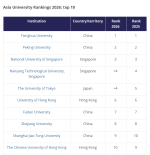
Tsinghua University retains first place, while mainland China continues to account for five of the top 10 institutions and 20 of the top 50, unchanged from last year. The results underline the continued strength of China’s system, which has consolidated its position at the summit even as other parts of Asia improve at a faster rate.

The remainder of the top 10 has seen little movement this year, with Singapore’s top two universities, National University of Singapore and Nanyang Technological University, Singapore, holding firm in third and joint fourth place respectively.

Meanwhile, The University of Tokyo in Japan has risen slightly to joint fourth position, up from fifth. And The Chinese University of Hong Kong slipped down one spot into 10th position, swapping places with China’s Shanghai Jiao Tong University, now in ninth.

搜狗截图20260424111039.png

Simon Marginson, professor of higher education at the universities of Bristol and Oxford, said China’s continued rise across global rankings reflects sustained government investment in research and universities.

“China continues to rise in all rankings tables at global and regional levels, however they are constructed, and especially – and spectacularly – in the Leiden Ranking of science output and citations, which is the best measure of pure science power, because its government prioritises national investment in science, technology and research universities.”

He added that “research performance, especially, is closely correlated to government funding, and always has been”.

“So next year the gap between China and the other two giants, USA and Europe, will widen significantly.”

The rankings also point to a more competitive regional landscape, particularly in East Asia. Although many universities in Japan and South Korea have fallen in rank, the data suggests that this is mainly a story of relative decline rather than weakening performance.

THE data scientist Catherine Tushabe said many universities in both countries had recorded small improvements in their overall scores but still experienced drops in their ranking position.

She added that although average institutional scores in Japan and South Korea had increased, their improvements were below the global median score change, meaning their gains did not keep pace with the global trend.

The data also highlights common areas of pressure. Across both countries, declines in research environment, research quality and industry scores were the most consistent negative movements, Tushabe said.

Gerard A. Postiglione, chair professor of education at the University of Hong Kong, said Japan and South Korea were declining “for the same reason the US lost ground [in the THE World University Rankings], that being the scaling up of China’s massive system of universities that benefit from returnee talent, increased budgets for both basic research, and the government’s aspiration to become world-leading in higher education”.

In Japan, the results are mixed. The University of Tokyo reached its highest position since 2015, and the newly merged Institute of Science Tokyo is the highest new entrant at 34th place – made up of two previously ranked institutions, Tokyo Medical and Dental University and Tokyo Institute of Technology. However, this is offset by a broader pattern of stability or decline, with 10 Japanese universities in the top 200 either holding position or falling.

South Korea shows a similar trend. Several institutions, including Daegu Gyeongbuk Institute of Science and Technology (DGIST), Kyungpook National University (KNU) and the University of Ulsan, have dropped six places or more, while relatively few have recorded significant gains.

By contrast, Hong Kong’s universities have strengthened their position. All six institutions ranked last year remain in the top 50, with Hong Kong Baptist University rising from 50th to 40th. In addition, two newly ranked institutions enter the top 100.

Malaysia is also emerging as a system to watch. Its top-ranked university has improved its position, while several others have climbed into the top 100. The leading Malaysian institution, Universiti Teknologi Petronas, has jumped forward to joint 35th place, up from joint 43rd.

Postiglione said Malaysia’s progress reflects a more strategic approach to regional positioning.

“Malaysia has become more strategic in learning from its tiny neighbour, Singapore, and using its larger population to become China’s largest ASEAN partner in cross-border university ventures.”

James Chin, professor of Asian studies at the University of Tasmania, said Malaysia’s recent gains reflect long-term efforts to position itself as a regional education hub, with strong performance driven in part by private universities that are particularly focused on improving their standing in global rankings.

“The key strength of the system is that the private universities are doing very well, in the sense that they take the rankings game seriously,” he said. “So this is a long process and what you’re seeing now is Malaysia in a mature place for higher education.”

Tushabe added that Malaysia’s average institutional score increase is “well above the global median”, indicating that Malaysian universities improved more than the global system overall. Although not all institutions have risen in rank, this upward momentum is beginning to translate into greater representation at the top end of the table.

Taken together, the results highlight a shifting competitive landscape in Asian higher education. China’s continued dominance reflects its ability to sustain performance at scale, while Hong Kong’s steady gains and Malaysia’s rising performance point to growing strength elsewhere in the region.

At the same time, the relative slippage of Japan and South Korea underlines the increasing intensity of competition, where even modest improvements may no longer be enough to hold position. As more systems advance at pace, maintaining rank is becoming as challenging as reaching it.


Asia University Rankings 2026: results announced

China’s ongoing strength means small gains for countries like Japan and South Korea are not enough for them to remain competitive. Meanwhile, Malaysia proves it’s one to watch. Tash Mosheim reports

Published on
April 23, 2026

Chinese universities dominate the Times Higher Education Asia University Rankings 2026 once again, maintaining their grip on the top of the table as competition intensifies across the region.

Tsinghua University retains first place, while mainland China continues to account for five of the top 10 institutions and 20 of the top 50, unchanged from last year. The results underline the continued strength of China’s system, which has consolidated its position at the summit even as other parts of Asia improve at a faster rate.

The remainder of the top 10 has seen little movement this year, with Singapore’s top two universities, National University of Singapore and Nanyang Technological University, Singapore, holding firm in third and joint fourth place respectively.

Meanwhile, The University of Tokyo in Japan has risen slightly to joint fourth position, up from fifth. And The Chinese University of Hong Kong slipped down one spot into 10th position, swapping places with China’s Shanghai Jiao Tong University, now in ninth.

View attachment 193839

Simon Marginson, professor of higher education at the universities of Bristol and Oxford, said China’s continued rise across global rankings reflects sustained government investment in research and universities.

“China continues to rise in all rankings tables at global and regional levels, however they are constructed, and especially – and spectacularly – in the Leiden Ranking of science output and citations, which is the best measure of pure science power, because its government prioritises national investment in science, technology and research universities.”

He added that “research performance, especially, is closely correlated to government funding, and always has been”.

“So next year the gap between China and the other two giants, USA and Europe, will widen significantly.”

The rankings also point to a more competitive regional landscape, particularly in East Asia. Although many universities in Japan and South Korea have fallen in rank, the data suggests that this is mainly a story of relative decline rather than weakening performance.

THE data scientist Catherine Tushabe said many universities in both countries had recorded small improvements in their overall scores but still experienced drops in their ranking position.

She added that although average institutional scores in Japan and South Korea had increased, their improvements were below the global median score change, meaning their gains did not keep pace with the global trend.

The data also highlights common areas of pressure. Across both countries, declines in research environment, research quality and industry scores were the most consistent negative movements, Tushabe said.

Gerard A. Postiglione, chair professor of education at the University of Hong Kong, said Japan and South Korea were declining “for the same reason the US lost ground [in the THE World University Rankings], that being the scaling up of China’s massive system of universities that benefit from returnee talent, increased budgets for both basic research, and the government’s aspiration to become world-leading in higher education”.

In Japan, the results are mixed. The University of Tokyo reached its highest position since 2015, and the newly merged Institute of Science Tokyo is the highest new entrant at 34th place – made up of two previously ranked institutions, Tokyo Medical and Dental University and Tokyo Institute of Technology. However, this is offset by a broader pattern of stability or decline, with 10 Japanese universities in the top 200 either holding position or falling.

South Korea shows a similar trend. Several institutions, including Daegu Gyeongbuk Institute of Science and Technology (DGIST), Kyungpook National University (KNU) and the University of Ulsan, have dropped six places or more, while relatively few have recorded significant gains.

By contrast, Hong Kong’s universities have strengthened their position. All six institutions ranked last year remain in the top 50, with Hong Kong Baptist University rising from 50th to 40th. In addition, two newly ranked institutions enter the top 100.

Malaysia is also emerging as a system to watch. Its top-ranked university has improved its position, while several others have climbed into the top 100. The leading Malaysian institution, Universiti Teknologi Petronas, has jumped forward to joint 35th place, up from joint 43rd.

Postiglione said Malaysia’s progress reflects a more strategic approach to regional positioning.

“Malaysia has become more strategic in learning from its tiny neighbour, Singapore, and using its larger population to become China’s largest ASEAN partner in cross-border university ventures.”

James Chin, professor of Asian studies at the University of Tasmania, said Malaysia’s recent gains reflect long-term efforts to position itself as a regional education hub, with strong performance driven in part by private universities that are particularly focused on improving their standing in global rankings.

“The key strength of the system is that the private universities are doing very well, in the sense that they take the rankings game seriously,” he said. “So this is a long process and what you’re seeing now is Malaysia in a mature place for higher education.”

Tushabe added that Malaysia’s average institutional score increase is “well above the global median”, indicating that Malaysian universities improved more than the global system overall. Although not all institutions have risen in rank, this upward momentum is beginning to translate into greater representation at the top end of the table.

Taken together, the results highlight a shifting competitive landscape in Asian higher education. China’s continued dominance reflects its ability to sustain performance at scale, while Hong Kong’s steady gains and Malaysia’s rising performance point to growing strength elsewhere in the region.

At the same time, the relative slippage of Japan and South Korea underlines the increasing intensity of competition, where even modest improvements may no longer be enough to hold position. As more systems advance at pace, maintaining rank is becoming as challenging as reaching it.


@Fatman17 why Asian University rankings thread is in Chinese technology? Is Asia Chinese?
 

Unmanned farming highlighted at Shandong's int'l vegetable sci-tech expo​

Source: Xinhua
2026-04-24 10:56:24
202604241b9ae4744db447f5b1aecbcb7ffa3ebd_20260424264bb98b0e9444b0ae14b7b0d29a7ce2.jpg


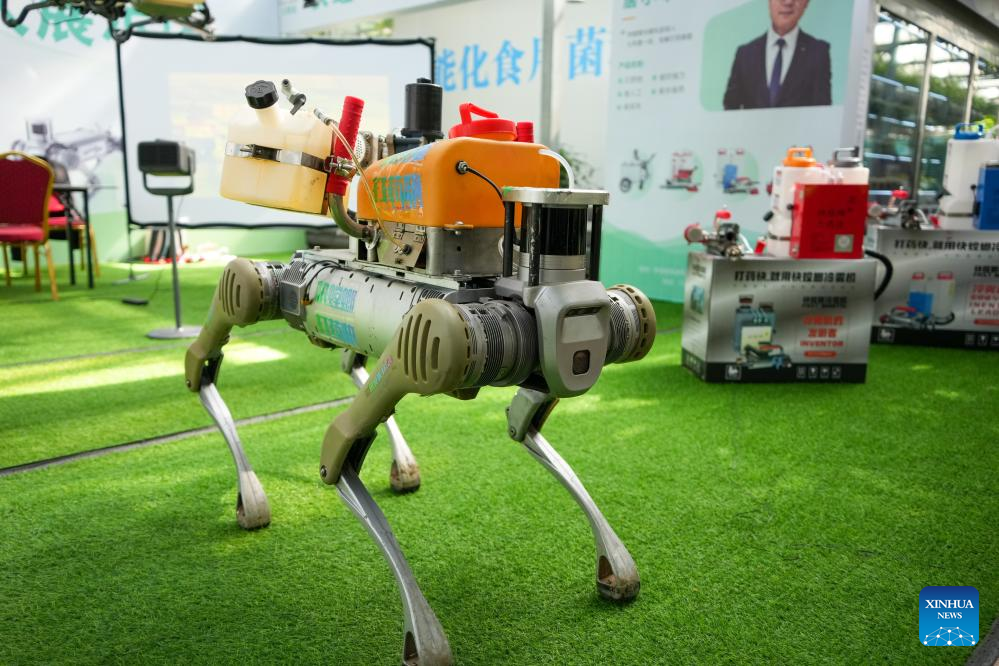
A robotic dog carrying agricultural gadgets is seen at the 27th China (Shouguang) International Vegetable Science and Technology Expo in Shouguang, east China's Shandong Province, April 20, 2026. Featuring more than 50 types of agricultural robots in its booth for digital agriculture, this year's expo allow visitors to peep into the future of unmanned farming. (Xinhua/Xu Suhui)

202604241b9ae4744db447f5b1aecbcb7ffa3ebd_20260424d6adb3947dea4c1e95ff2f4de5d09657.jpg


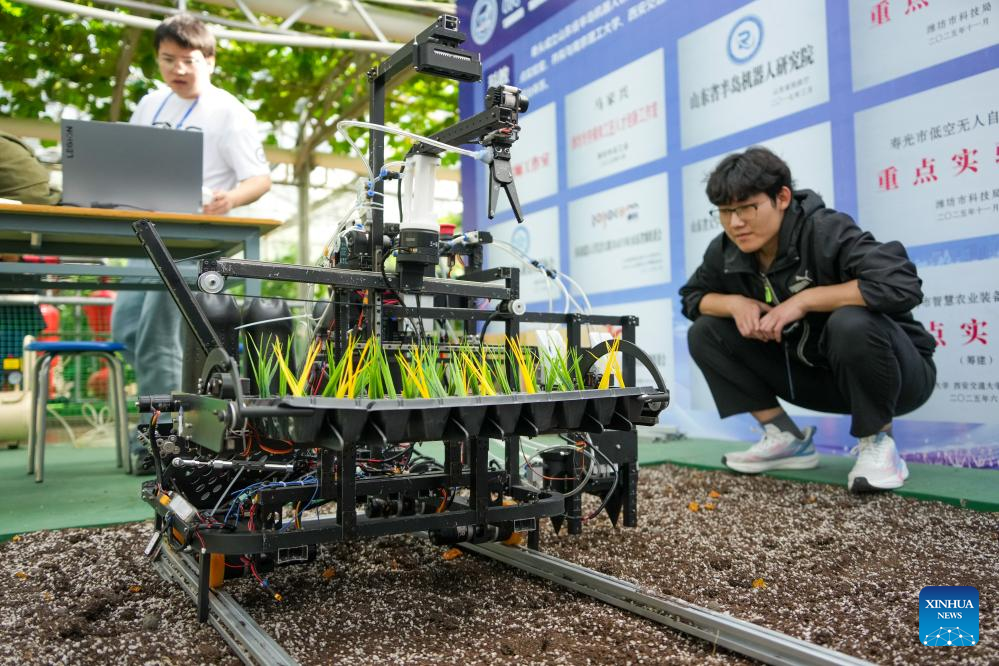
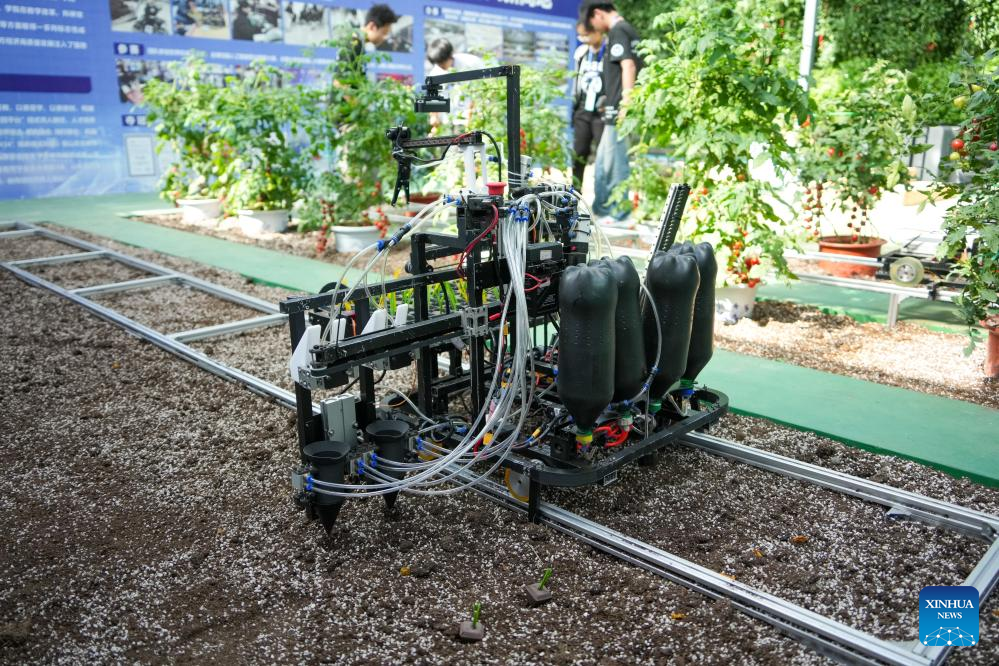
A seedling planting robot is seen at the 27th China (Shouguang) International Vegetable Science and Technology Expo in Shouguang, east China's Shandong Province, April 20, 2026. Featuring more than 50 types of agricultural robots in its booth for digital agriculture, this year's expo allow visitors to peep into the future of unmanned farming. (Xinhua/Xu Suhui)

202604241b9ae4744db447f5b1aecbcb7ffa3ebd_20260424aba30f127c8d46e3ac9d5235c1440b39.jpg


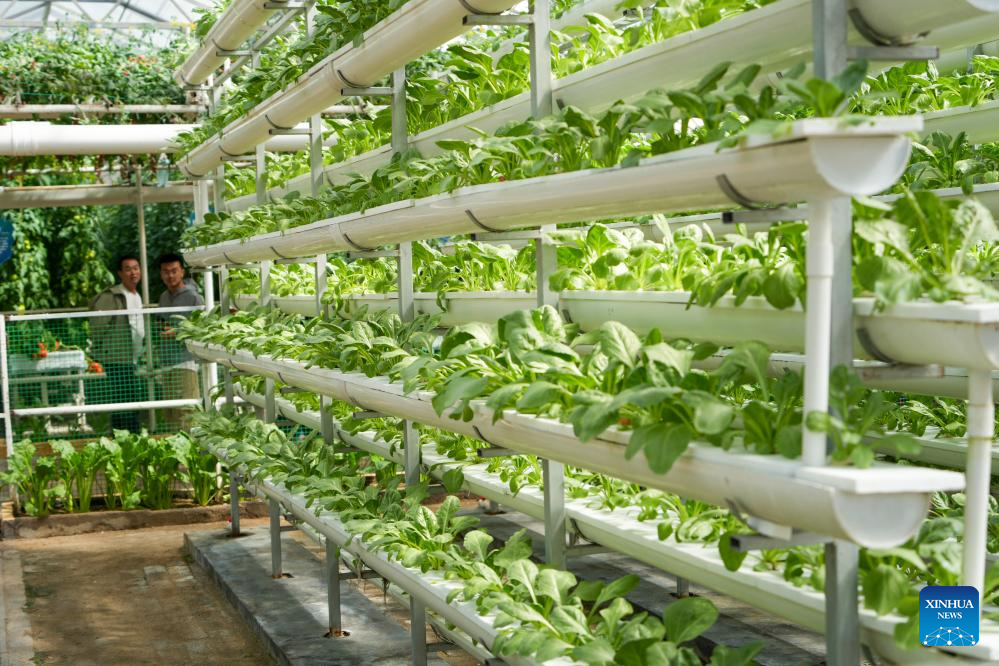
A vertical plantation scenario for unmanned farming is displayed at the 27th China (Shouguang) International Vegetable Science and Technology Expo in Shouguang, east China's Shandong Province, April 20, 2026. Featuring more than 50 types of agricultural robots in its booth for digital agriculture, this year's expo allow visitors to peep into the future of unmanned farming. (Xinhua/Xu Suhui)

202604241b9ae4744db447f5b1aecbcb7ffa3ebd_20260424c7dc8fb27806443d8be9b3ef46a7c93e.jpg


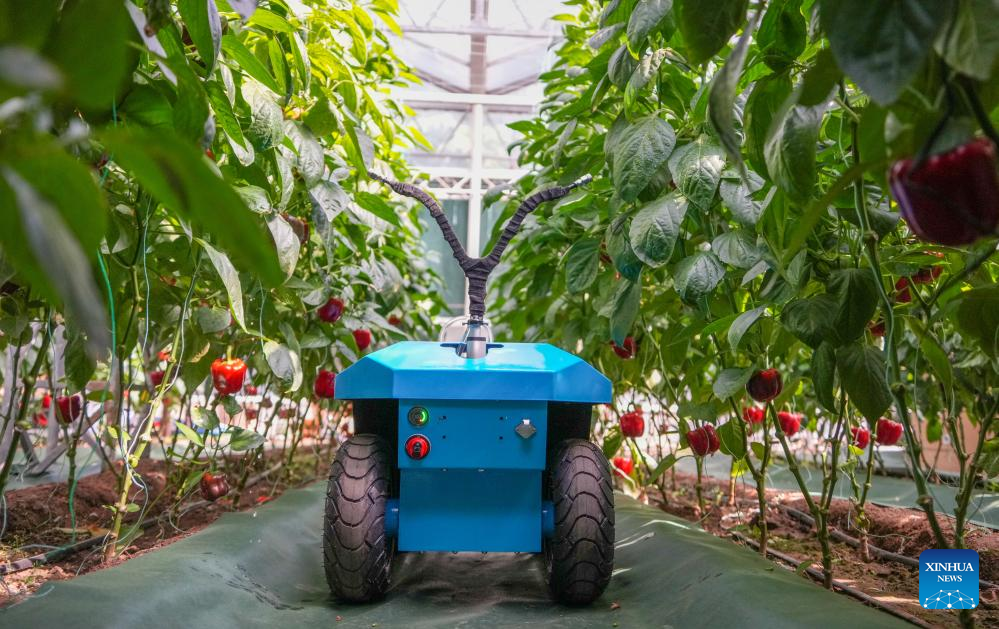
A spraying robot is seen at the 27th China (Shouguang) International Vegetable Science and Technology Expo in Shouguang, east China's Shandong Province, April 20, 2026. Featuring more than 50 types of agricultural robots in its booth for digital agriculture, this year's expo allow visitors to peep into the future of unmanned farming. (Xinhua/Xu Suhui)

202604241b9ae4744db447f5b1aecbcb7ffa3ebd_20260424660539763ce14314a86cddc956208bd5.jpg


A seedling planting robot is seen at the 27th China (Shouguang) International Vegetable Science and Technology Expo in Shouguang, east China's Shandong Province, April 20, 2026. Featuring more than 50 types of agricultural robots in its booth for digital agriculture, this year's expo allow visitors to peep into the future of unmanned farming. (Xinhua/Xu Suhui)

202604241b9ae4744db447f5b1aecbcb7ffa3ebd_2026042497c14ea02e064997a4893c9a2163f3c7.jpg


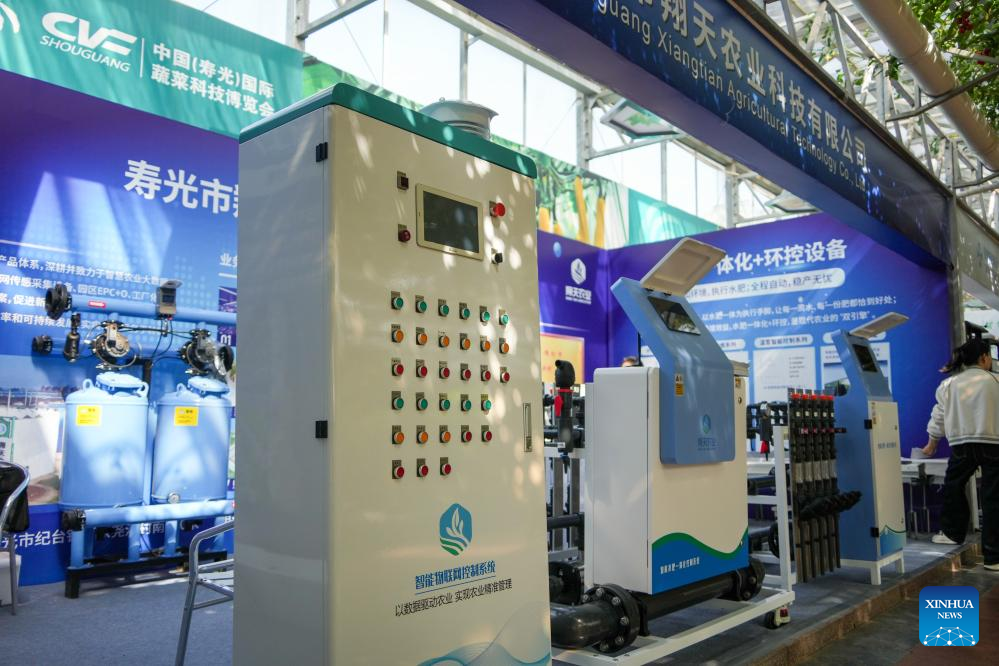
All-weather field environment monitoring devices are displayed at the 27th China (Shouguang) International Vegetable Science and Technology Expo in Shouguang, east China's Shandong Province, April 20, 2026. Featuring more than 50 types of agricultural robots in its booth for digital agriculture, this year's expo allow visitors to peep into the future of unmanned farming. (Xinhua/Xu Suhui)


Users who are viewing this thread

Pakistan Defence Latest

Back
Top