Asia University Rankings 2026: results announced
China’s ongoing strength means small gains for countries like Japan and South Korea are not enough for them to remain competitive. Meanwhile, Malaysia proves it’s one to watch. Tash Mosheim reports
Published on
April 23, 2026
Chinese universities dominate the
Times Higher Education Asia University Rankings 2026 once again, maintaining their grip on the top of the table as competition intensifies across the region.
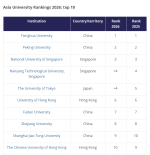
Tsinghua University retains first place, while mainland China continues to account for five of the top 10 institutions and 20 of the top 50, unchanged from last year. The results underline the continued strength of China’s system, which has consolidated its position at the summit even as other parts of Asia improve at a faster rate.
The remainder of the top 10 has seen little movement this year, with Singapore’s top two universities,
National University of Singapore and
Nanyang Technological University, Singapore, holding firm in third and joint fourth place respectively.
Meanwhile,
The University of Tokyo in Japan has risen slightly to joint fourth position, up from fifth. And
The Chinese University of Hong Kong slipped down one spot into 10th position, swapping places with China’s
Shanghai Jiao Tong University, now in ninth.
View attachment 193839
Simon Marginson, professor of higher education at the universities of Bristol and Oxford, said China’s continued rise across global rankings reflects sustained government investment in research and universities.
“China continues to rise in all rankings tables at global and regional levels, however they are constructed, and especially – and spectacularly – in the Leiden Ranking of science output and citations, which is the best measure of pure science power, because its government prioritises national investment in science, technology and research universities.”
He added that “research performance, especially, is closely correlated to government funding, and always has been”.
“So next year the gap between China and the other two giants, USA and Europe, will widen significantly.”
The rankings also point to a more competitive regional landscape, particularly in East Asia. Although many universities in Japan and South Korea have fallen in rank, the data suggests that this is mainly a story of relative decline rather than weakening performance.
THE data scientist Catherine Tushabe said many universities in both countries had recorded small improvements in their overall scores but still experienced drops in their ranking position.
She added that although average institutional scores in Japan and South Korea had increased, their improvements were below the global median score change, meaning their gains did not keep pace with the global trend.
The data also highlights common areas of pressure. Across both countries, declines in research environment, research quality and industry scores were the most consistent negative movements, Tushabe said.
Gerard A. Postiglione, chair professor of education at the
University of Hong Kong, said Japan and South Korea were declining “for the same reason the US lost ground [in the
THE World University Rankings], that being the scaling up of China’s massive system of universities that benefit from returnee talent, increased budgets for both basic research, and the government’s aspiration to become world-leading in higher education”.
In Japan, the results are mixed. The University of Tokyo reached its highest position since 2015, and the newly merged
Institute of Science Tokyo is the highest new entrant at 34th place – made up of two previously ranked institutions, Tokyo Medical and Dental University and Tokyo Institute of Technology. However, this is offset by a broader pattern of stability or decline, with 10 Japanese universities in the top 200 either holding position or falling.
South Korea shows a similar trend. Several institutions, including
Daegu Gyeongbuk Institute of Science and Technology (DGIST),
Kyungpook National University (KNU) and the
University of Ulsan, have dropped six places or more, while relatively few have recorded significant gains.
By contrast, Hong Kong’s universities have strengthened their position. All six institutions ranked last year remain in the top 50, with
Hong Kong Baptist University rising from 50th to 40th. In addition, two newly ranked institutions enter the top 100.
Malaysia is also emerging as a system to watch. Its top-ranked university has improved its position, while several others have climbed into the top 100. The leading Malaysian institution,
Universiti Teknologi Petronas, has jumped forward to joint 35th place, up from joint 43rd.
Postiglione said Malaysia’s progress reflects a more strategic approach to regional positioning.
“Malaysia has become more strategic in learning from its tiny neighbour, Singapore, and using its larger population to become China’s largest ASEAN partner in cross-border university ventures.”
James Chin, professor of Asian studies at the
University of Tasmania, said Malaysia’s recent gains reflect long-term efforts to position itself as a regional education hub, with strong performance driven in part by private universities that are particularly focused on improving their standing in global rankings.
“The key strength of the system is that the private universities are doing very well, in the sense that they take the rankings game seriously,” he said. “So this is a long process and what you’re seeing now is Malaysia in a mature place for higher education.”
Tushabe added that Malaysia’s average institutional score increase is “well above the global median”, indicating that Malaysian universities improved more than the global system overall. Although not all institutions have risen in rank, this upward momentum is beginning to translate into greater representation at the top end of the table.
Taken together, the results highlight a shifting competitive landscape in Asian higher education. China’s continued dominance reflects its ability to sustain performance at scale, while Hong Kong’s steady gains and Malaysia’s rising performance point to growing strength elsewhere in the region.
At the same time, the relative slippage of Japan and South Korea underlines the increasing intensity of competition, where even modest improvements may no longer be enough to hold position. As more systems advance at pace, maintaining rank is becoming as challenging as reaching it.
China’s ongoing strength means small gains for countries like Japan and South Korea are not enough for them to remain competitive. Meanwhile, Malaysia proves it’s one to watch. Tash Mosheim reports

www.timeshighereducation.com