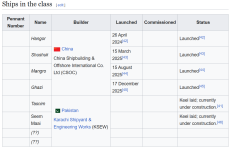
The submarine class, named after the PNS Hangor, is a diesel-electric attack submarine with air-independent propulsion (AIP) technology, which allows it to travel over greater distances before resurfacing.
Meanwhile, Admiral Ashraf highlighted that disruptions at critical maritime choke points increasingly threaten global trade and energy security.
He noted that maintaining a “stable, rule-based maritime order demands technologically advanced naval forces”.
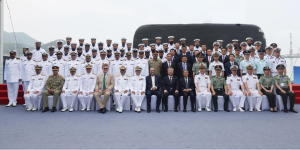
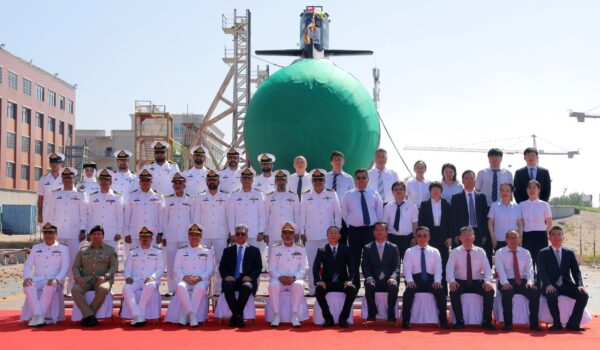
The naval chief observed that Hangor-class submarines — armed with state-of-the-art weapons, advanced sensors and AIP technology — “will be key in preserving maritime order and stability in the region”.
“These submarines will play a pivotal role in deterring aggression and ensuring security of vital Sea Lines of Communication (SLOCs) across the Arabian Sea and the wider Indian Ocean region,” he was quoted as saying.
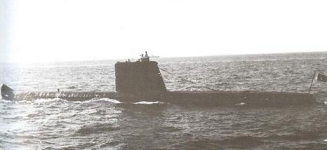
Admiral Ashraf said the name Hangor holds a significant place in Pakistan’s history, referring to the 1971 Pakistan-India war, when then-PNS Hangor became the first submarine to sink a warship after World War II, sinking the Indian frigate INS Khukri.
After being decommissioned, the Hangor is now on display at the Pakistan Maritime Museum in Karachi.
“PNS/M HANGOR will carry this illustrious legacy forward, as this is an important milestone for Pakistan Navy that will bolster our maritime defence and modernise our fleet with cutting-edge technology,” the naval chief stated.







 Pak Ship Collides With Indian Navy Unit, Delhi Summons Islamabad's Envoy (27 Viewers)
 India sends 500 tonnes of hilsa to Bangladesh in reverse trade flow amid supply crunch (5 Viewers)


