Indian Missiles and Guided Munitions

How "low" does the warhead section fly while hypersonic?
Low doesn’t mean 10 mts above water at Mach 10. It means staying inside the atmosphere on a depressed trajectory instead of going high ballistic. This thing goes horizontal within secs and stays there using aerodynamic lift and control surfaces to maneuver. The missile is generating lift throughout flight
not just stabilizing but actively flying like an aircraft.
That’s low enough to cut radar horizon and reaction time especially when it’s maneuvering at hypersonic speed.
 
Low doesn’t mean 10 mts above water at Mach 10. It means staying inside the atmosphere on a depressed trajectory instead of going high ballistic. This thing goes horizontal within secs and stays there using aerodynamic lift and control surfaces to maneuver. The missile is generating lift throughout flight
not just stabilizing but actively flying like an aircraft.
That’s low enough to cut radar horizon and reaction time especially when it’s maneuvering at hypersonic speed.
So not very low then.

And no, it's not a HGV, but a quasi ballistic missile, or rather aero ballistic missile, the warhead section reaches around mach 5 in the quasi phase. The warhead design is not that of a HGV, rather the strakes provide maneuvering control and some lift while in the atmosphere.

https://www.twz.com/land/indias-new-hypersonic-anti-ship-missile-shown-off-during-military-parade
 
So not very low then.

And no, it's not a HGV, but a quasi ballistic missile, or rather aero ballistic missile, the warhead section reaches around mach 5 in the quasi phase. The warhead design is not that of a HGV, rather the strakes provide maneuvering control and some lift while in the atmosphere.

https://www.twz.com/land/indias-new-hypersonic-anti-ship-missile-shown-off-during-military-parade
A quasi ballistic or aeroballistic missile still follows a largely ballistic path for most of its flight even if it uses a depressed trajectory and does some maneuvering later. Here, the vehicle pitches from vertical to near horizontal within a few secs of launch which actually proves it's sustained atmospheric flight rather than a lofted trajectory with a terminal correction phase. That’s a different regime altogether. It’s practically designed around to maintain hypersonic velocity and control within the atmosphere. It’s fair to say it’s not a classical boost glide HGV like DF-17 but that doesn’t automatically make it quasi-ballistic. There’s a growing category of atmospheric hypersonic vehicles that fly flatter trajectories, stay within denser layers of the atmosphere and use aerodynamic surfaces for continuous control. The presence of strakes and fins at hypersonic speeds even small surfaces generate enough lift and lateral force for meaningful maneuvering throughout the flight not just at the end.

Instead of: Ballistic arc + terminal maneuver​

It does: Continuous atmospheric flight, Constant maneuver capability​

 
A quasi ballistic or aeroballistic missile still follows a largely ballistic path for most of its flight even if it uses a depressed trajectory and does some maneuvering later. Here, the vehicle pitches from vertical to near horizontal within a few secs of launch which actually proves it's sustained atmospheric flight rather than a lofted trajectory with a terminal correction phase. That’s a different regime altogether. It’s practically designed around to maintain hypersonic velocity and control within the atmosphere. It’s fair to say it’s not a classical boost glide HGV like DF-17 but that doesn’t automatically make it quasi-ballistic. There’s a growing category of atmospheric hypersonic vehicles that fly flatter trajectories, stay within denser layers of the atmosphere and use aerodynamic surfaces for continuous control. The presence of strakes and fins at hypersonic speeds even small surfaces generate enough lift and lateral force for meaningful maneuvering throughout the flight not just at the end. A maneuvering hypersonic vehicle flying a low, continuously adjusted trajectory compresses detection time and makes tracking solutions far less stable.
You seem fixated on the fact that it goes horizontal a few seconds after launch. In that case, it's nothing more than a ground launched anti ship missile, augmented with fins and strokes for manoeuvres and some lift.
 
You seem fixated on the fact that it goes horizontal a few seconds after launch. In that case, it's nothing more than a ground launched anti ship missile, augmented with fins and strokes for manoeuvres and some lift.
A normal ground launched anti-ship missile doesn’t come out of a sealed canister, use small attitude control thrusters to orient itself in mid air and only then fire its main motor. That is used when you want very tight control over the initial trajectory not just fire and go straight.

It’s a two stage solid system. The 1st stage is a booster to push it quickly into hypersonic speeds. The 2nd stage is a sustainer which means the missile keeps flying at high speed with control inside the atmosphere. That’s very different from a regular anti-ship missile which flies much slower and more predictably.

Those mid-body cruciform surfaces you’re calling just fins are actually doing heavy work at those speeds. At hypersonic velocity, even small surfaces generate enough lift to control the flight path and allow sideways maneuvers during the entire flight. It can keep adjusting its path the whole way.

The early horizontal turn just tells you one thing: it’s staying inside the atmosphere instead of going into a ballistic arc. Once you combine that with high speed + low altitude + continuous maneuvering, it behaves very differently from a typical anti-ship missile. It’s not following a clean, stable path.
 
A normal ground launched anti-ship missile doesn’t come out of a sealed canister, use small attitude control thrusters to orient itself in mid air and only then fire its main motor. That is used when you want very tight control over the initial trajectory not just fire and go straight.
Are you sure about that? I'm surprised an indian like you hasn't seen a launch of your brhamos?

To view this content we will need your consent to set third party cookies.
For more detailed information, see our cookies page.


It’s a two stage solid system. The 1st stage is a booster to push it quickly into hypersonic speeds. The 2nd stage is a sustainer which means the missile keeps flying at high speed with control inside the atmosphere. That’s very different from a regular anti-ship missile which flies much slower and more predictably.
Yes, rather like the brahmos or the Russian P-800 Oniks (export version named Yakhont).

Those mid-body cruciform surfaces you’re calling just fins are actually doing heavy work at those speeds. At hypersonic velocity, even small surfaces generate enough lift to control the flight path and allow sideways maneuvers during the entire flight. It can keep adjusting its path the whole way.

The early horizontal turn just tells you one thing: it’s staying inside the atmosphere instead of going into a ballistic arc. Once you combine that with high speed + low altitude + continuous maneuvering, it behaves very differently from a typical anti-ship missile. It’s not following a clean, stable path.
Yes, like I said, it's an anti ship missile augmented with fins and strakes to provide lift and maneuvering control.
 
Are you sure about that? I'm surprised an indian like you hasn't seen a launch of your brhamos?

To view this content we will need your consent to set third party cookies.
For more detailed information, see our cookies page.


Yes, rather like the brahmos or the Russian P-800 Oniks (export version named Yakhont).


Yes, like I said, it's an anti ship missile augmented with fins and strakes to provide lift and maneuvering control.

What you described for BrahMos: vertical ejection, small control jets for pitch and roll, orienting the missile before main acceleration does have a parallel. The LR-HM also seems to use attitude control thrusters before main ignition and performs an early pitch over. You need to safely eject, orient and stabilize before committing to full thrust. So yes, at the 1st few secs, both systems solve a similar engineering challenge in a somewhat similar way.

But that’s where the similarity mostly ends.

What’s being discussed here is a 2 stage solid rocket motor system. There’s no ramjet cruise phase. The 1st stage boosts it rapidly into the hypersonic regime and the 2nd stage continues the flight at those hypersonic speeds inside the atmosphere. That alone puts it in a completely different speed and energy bracket. That sequence is used when you want precise alignment and controlled entry into a very specific flight envelope. In this case, hypersonic atmospheric flight.

The launch sequence is also different. BrahMos uses a hot vertical launch where the main booster ignites almost immediately. BrahMos has one job after boost: sustain via ramjet at supersonic speeds. Here, you have cold launch from a sealed canister followed by attitude control thrusters correcting orientation before the main motor fires. Here, you have a booster + hypersonic sustainer stage. The missile is staying in a high energy, high drag environment at hypersonic speeds. It stays inside the atmosphere. Once it’s in that regime, those mid-body cruciform surfaces with short span and long chord comes into play. At hypersonic speeds, even small surfaces generate serious lift. That means the missile isn’t just stabilizing itself, it can hold altitude, adjust its path and make lateral movements during the entire flight. The rear fins mainly keep it stable so those mid-body surfaces can actually do useful work.

This kind of system is doing continuous maneuvering at hypersonic speed within the atmosphere. Those cruciform surfaces actually allows the vehicle to keep adjusting its path throughout the flight.
 
Last edited:
What you described for BrahMos: vertical ejection, small control jets for pitch and roll, orienting the missile before main acceleration does have a parallel. The LR-HM also seems to use attitude control thrusters before main ignition and performs an early pitch over. You need to safely eject, orient and stabilize before committing to full thrust. So yes, at the 1st few secs, both systems solve a similar engineering challenge in a somewhat similar way.

But that’s where the similarity mostly ends.

What’s being discussed here is a 2 stage solid rocket motor system. There’s no ramjet cruise phase. The 1st stage boosts it rapidly into the hypersonic regime and the 2nd stage continues the flight at those hypersonic speeds inside the atmosphere. That alone puts it in a completely different speed and energy bracket. That sequence is used when you want precise alignment and controlled entry into a very specific flight envelope. In this case, hypersonic atmospheric flight.

The launch sequence is also different. BrahMos uses a hot vertical launch where the main booster ignites almost immediately. BrahMos has one job after boost: sustain via ramjet at supersonic speeds. Here, you have cold launch from a sealed canister followed by attitude control thrusters correcting orientation before the main motor fires. Here, you have a booster + hypersonic sustainer stage. The missile is staying in a high energy, high drag environment at hypersonic speeds. It stays inside the atmosphere. Once it’s in that regime, those mid-body cruciform surfaces with short span and long chord comes into play. At hypersonic speeds, even small surfaces generate serious lift. That means the missile isn’t just stabilizing itself, it can hold altitude, adjust its path and make lateral movements during the entire flight. The rear fins mainly keep it stable so those mid-body surfaces can actually do useful work.

This kind of system is doing continuous maneuvering at hypersonic speed within the atmosphere. Those cruciform surfaces actually allows the vehicle to keep adjusting its path throughout the flight.
You indians really are all talk. It takes you to write a diatribe to basically describe what I've already said; it's a ground launched anti ship missile augmented with fins for lift.
 
You indians really are all talk. It takes you to write a diatribe to basically describe what I've already said; it's a ground launched anti ship missile augmented with fins for lift.
A pure HGV mostly coasts and loses energy over time. Here, the powered 2nd stage keeps feeding energy which helps counter drag and allows midcourse maneuvering instead of just terminal maneuvers. India didn’t start this from scratch. Work from HSTDV fed into this. Things like hypersonic airflow control, thermal protection and high speed stability. That’s why this isn’t behaving like a normal cruise missile. It’s not fins added for lift. It’s a design where lift + propulsion are both used to keep the missile maneuvering at hypersonic speed the entire way.
To view this content we will need your consent to set third party cookies.
For more detailed information, see our cookies page.
 
You indians really are all talk. It takes you to write a diatribe to basically describe what I've already said; it's a ground launched anti ship missile augmented with fins for lift.
In short, our one is a boost sustain hypersonic system that combines glide like lift with continuous propulsion. It’s an energy sustained hypersonic maneuver system. Instead of gliding and bleeding speed like DF-ZF, our system keeps injecting energy mid flight. It’s a continuous capability.
 
I
In short, our one is a boost sustain hypersonic system that combines glide like lift with continuous propulsion. It’s an energy sustained hypersonic maneuver system. Instead of gliding and bleeding speed like DF-ZF, our system keeps injecting energy mid flight. It’s a continuous capability.
It's a quasi ballistic AShM with augmented lift with fins, no amount of dressing it up will change that fact.
 
I

It's a quasi ballistic AShM with augmented lift with fins, no amount of dressing it up will change that fact.
Typical quasi-ballistic missiles still go upward first, then follow a depressed arc, dip in and out of atmosphere, actively maneuvers during descent. But this particular Indian system never even commits to that arc. Never creates a clean ballistic arc: it turns early, stays low, keeps adding energy and keeps maneuvering the whole way. Uses aerodynamic lift (cruciform surfaces) instead of pure gravity driven descent.
Those mid-body aerodynamic surfaces generate those lifts at hypersonic speeds, allow skip like or sustained glide behavior, helps it to perform lateral + vertical maneuvers. Anyway, it’s up to you what you choose to believe.
 
1777923438242.png
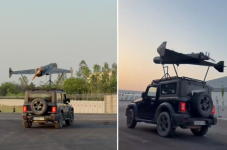
Indian drone manufacturer Hoverit has completed vehicle-mounted launch trials of its Divyastra Mk-2, a long-range one-way attack drone in the same class as Iran’s Shahed series.

The ground trial milestone follows an earlier high-speed taxi trial, with the company confirming in its announcement that vehicle-based launch has now been completed. “After successful High Speed Taxi Trial. Now: Vehicle based launch completed. Next: Rocket assisted takeoff,” Hoverit stated.

The Divyastra Mk-2 is positioned as a next-generation tactical UAV built for deep strategic operations, carrying a payload of 50 to 100 kilograms across an operational range of 1,500 to 2,000 kilometers at a cruising speed of approximately 180 kilometers per hour, according to Hoverit’s specifications. Flight endurance runs from 8 to 12 hours. When it reaches its target, the drone accelerates to a terminal attack speed of 300 to 400 kilometers per hour — a significant increase over cruising speed that reduces the window available for defensive systems to engage it. Those numbers place the Mk-2 firmly in the same performance envelope as the Shahed-136 and similar loitering munitions that have reshaped how militaries think about long-range strike, except that the Divyastra is designed for considerably heavier payloads and substantially greater range than most of the Iranian systems that have been documented in combat.

The command and control architecture Hoverit has built around the Mk-2 reflects the lessons the drone warfare community has drawn from watching Shahed operations and Ukrainian counter-drone efforts over the past three years. The system incorporates AI swarm intelligence — the ability to coordinate multiple drones toward a common objective — along with encrypted sovereign control links and resilient data connections designed to function in GPS-denied environments. That last capability is particularly significant. GPS jamming and spoofing have become standard tools in the electronic warfare kits of any military expecting to face long-range drone attacks, and a drone that loses navigation accuracy the moment an adversary turns on a jammer is a drone with a fundamental vulnerability. Building GPS-denied navigation resilience into the system from the ground up rather than retrofitting it later is a design choice that reflects operational maturity.

The vehicle-mounted launch capability that Hoverit just demonstrated addresses one of the persistent operational limitations of fixed-wing long-range attack drones. A system that requires a prepared runway or a catapult installation tied to a fixed location is a system that can be targeted, denied, or destroyed before it ever gets airborne. Vehicle-based launch means the Divyastra Mk-2 can be deployed from essentially any location accessible to a truck — a dirt road, a field, a forward operating position — without advance preparation of the launch site. Rocket-assisted takeoff, the next milestone on Hoverit’s development timeline, will eliminate even the need for a runway run, allowing the drone to lift off vertically or at a steep angle from a standing vehicle, which further reduces the operational footprint and the warning time an adversary has before a strike is already inbound.

India’s indigenous drone development has accelerated significantly over the past several years, driven by a combination of national policy priorities around defense self-reliance, operational experience with drone threats along its borders, and the global demonstration effect of Ukraine showing what long-range drone strikes can achieve against conventional military infrastructure. The Divyastra Mk-2’s specifications — particularly the 1,500 to 2,000 kilometer range and the 50 to 100 kilogram payload — suggest a system designed with strategic depth in mind rather than purely tactical applications. A drone that can fly 2,000 kilometers with a 100-kilogram warhead and navigate without GPS covers a very large portion of the subcontinent from any given launch point, and the swarm intelligence capability suggests the intent to employ multiple systems simultaneously rather than in isolated single strikes.

Hoverit describes the Mk-2’s primary mission profiles as strategic deep strike operations, deep surveillance and reconnaissance, and long-range tactical missions. The dual strike-and-surveillance framing is consistent with how most modern one-way attack drone programs are structured — the same platform that can deliver a payload can also carry sensors and return intelligence from areas too dangerous or distant for manned reconnaissance. The difference in terminal approach speed between cruising and attack modes — from 180 to 300-400 kilometers per hour — is specifically designed to complicate point defense, giving a defending system less reaction time than it would have against a drone maintaining constant speed throughout its flight profile.
 

Exclusive: New Drone Built By IIT Jammu Can't Be 'Jammed Or Detected'​

1777923533809.png
Jammu:
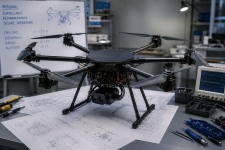
In a significant leap for the surveillance and combat capability of the Indian Army, researchers at the Indian Institute of Technology (IIT) Jammu have developed a next-generation drone that is virtually undetectable by enemy forces and immune to jamming.

The new drone has been designed for stealth operations across multiple areas, keeping in view the requirements of the Army.

How The New Drone Works

Unlike others, the drone developed by IIT Jammu students evades detection by ditching traditional radio frequencies. It uses advanced carbon composites and optical fibre-based communication, making it virtually invisible to radar.

"This means no tell-tale radio frequency signature, no detection - just silent, effective surveillance," Taran Sharas, who led the team of young researchers behind the drone, told NDTV.

It uses low-noise propellers for acoustic stealth, a carbon and plastic body to reduce radar cross-section, and vision-based Artificial Intelligence for GPS-independent, pre-programmed navigation.

"Even an interceptor drone can be mounted on this one to intercept enemy drones," another researcher said.

At high altitudes, the new drone remains beyond the range of human sight and most ground-based sensors.

Why This Matters

The development of the new drone comes a year after India launched Operation Sindoor against Pakistani terror camps in May 2025 in response to the Pahalgam terror attack in April that year.
 
Last edited:
View attachment 195608
In a major leap for India’s maritime strike capability amid the continuing West Asia crisis that has left global shipping under growing strategic stress, India has test-fired an indigenous long-range anti-ship hypersonic missile from a defence facility off the Odisha coast, defence officials said on Sunday.

Developed by the Defence Research and Development Organisation (DRDO), the 1,500+ km range anti-ship hypersonic missile (LR-AShM) commenced its Phase-II flight trial during a test conducted from Launch Complex-IV of the Integrated Test Range (ITR) at the APJ Abdul Kalam Island.

"After the missile successfully lifted off from a hermetically sealed container, leaving behind a thick layer of smoke, the stage separation was perfect. The missile was tracked by various range systems deployed in multiple domains. The flight data collected during the trial on Friday are being analysed. A couple of more tests will be conducted before the weapon is inducted into the armed forces," a defence official told Business Standard.
Beyond sheer speed, the missile incorporates unpredictable flight paths, including low-altitude, radar-evading trajectories and skipping manoeuvres.
 

Users who are viewing this thread

Pakistan Defence Latest

Back
Top